Introduction
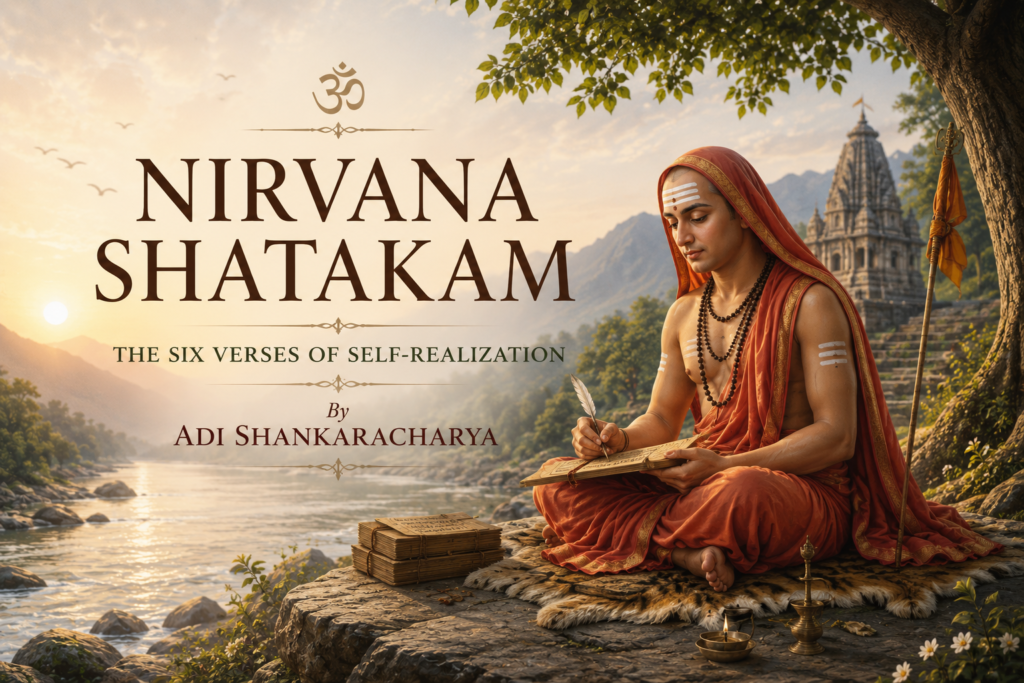
Nirvana Shatakam, also known as Atma Shatakam, is one of the most revered compositions of Adi Shankaracharya and a profound summary of the teachings of Advaita Vedanta. Consisting of six verses, this timeless text explores the nature of the Self and guides the seeker toward the realization of their true identity beyond the body, mind, and ego.
The central teaching of Nirvana Shatakam is that thoughts, emotions, possessions, relationships, or social roles do not limit our essential nature. Through a process of negation, Shankaracharya systematically removes every false identification until only pure awareness remains. This method reflects the Vedantic practice of Neti Neti, meaning “not this, not this,” which encourages seekers to look beyond the temporary and discover the eternal.
Each verse concludes with the powerful declaration, “Chidānanda-rūpaḥ Śivo’ham Śivo’ham,” which means, “I am of the nature of consciousness and bliss; I am Shiva, I am Shiva.” Far from being a statement of personal identity, this refrain points to the realization of the universal consciousness that exists within all beings. In the following verses, we will explore the Sanskrit text, transliteration, translation, and deeper meaning of this remarkable work, uncovering the wisdom that has inspired spiritual seekers for centuries.
If you wish to learn more about mantra meditation and sound, you can enroll in our Nada Yoga Teacher Training Program for deeper learning of Yoga of Sound.
Verse 1
Sanskrit
मनोबुद्ध्यहङ्कारचित्तानि नाहं
न च श्रोत्रजिह्वे न च घ्राणनेत्रे ।
न च व्योमभूमिर्न तेजो न वायुश्
चिदानन्दरूपः शिवोऽहं शिवोऽहम् ॥ १॥
Transliteration
Mano-buddhy-ahaṅkāra-cittāni nāhaṁ
Na ca śrotra-jihve na ca ghrāṇa-netre
Na ca vyoma-bhūmir na tejo na vāyuḥ
Cidānanda-rūpaḥ śivo’ham śivo’ham
Translation
I am not the mind, intellect, ego, or memory.
I am not the ears, the tongue, the nose, or the eyes.
I am not space, earth, fire, or air.
I am pure consciousness and bliss. I am Shiva; I am Shiva.
Commentary
The opening verse introduces the central method of Advaita Vedanta known as “Neti Neti,” meaning “not this, not this.” Adi Shankaracharya begins by removing the most common identities with which people associate themselves: the mind, intellect, ego, memory, and senses.
Most people define themselves by their thoughts, emotions, opinions, and experiences. However, all of these are constantly changing. Thoughts come and go, emotions rise and fall, and memories fade over time. Since these aspects are temporary, they cannot be the true Self.
The verse then extends this inquiry to the physical world, rejecting identification with the senses and the elements that make up the body and universe. Shankaracharya reminds us that while we experience the body and the world, we are not limited to them.
After negating everything that is observed, the verse reveals what remains: Chidānanda, or pure consciousness and bliss. This unchanging awareness is the witness of all thoughts, sensations, and experiences. It is this eternal reality that Shankaracharya identifies with the declaration, “Shivoham,” meaning “I am Shiva,” the infinite consciousness that underlies all existence.
Verse 2
Sanskrit
न च प्राणसंज्ञो न वै पञ्चवायुर्न वा सप्तधातुर्न वा पञ्चकोशः ।
न वाक्पाणिपादौ न चोपस्थ पायू
चिदानन्दरूपः शिवोऽहं शिवोऽहम् ॥ २॥
Transliteration
Na ca prāṇa-saṁjño na vai pañca-vāyur
Na vā sapta-dhātur na vā pañca-kośaḥ
Na vāk-pāṇi-pādau na copastha-pāyū
Cidānanda-rūpaḥ śivo’ham śivo’ham
Translation
I am not the vital breath, nor the five vital airs.
I am not the seven bodily constituents, nor the five sheaths.
I am not speech, hands, feet, nor the organs of procreation and elimination.
I am pure consciousness and bliss. I am Shiva; I am Shiva.
Commentary
Having denied identification with the mind and senses, Shankaracharya now turns toward subtler aspects of human existence.
In yogic philosophy, the body is sustained by five vital energies known as the Pancha Vayus. These govern breathing, circulation, digestion, elimination, and movement. Yet even these life forces are observed by awareness and therefore cannot be the Self.
The verse also refers to the Pancha Koshas, or five sheaths: the physical body, energy body, mental body, wisdom body, and bliss body. Vedanta teaches that these are layers covering the true Self, much like clothing covers the body.
By declaring “I am not these,” the seeker transcends every layer of identity and recognizes the witnessing consciousness that remains unchanged behind all bodily functions and experiences.
Verse 3
Sanskrit
न मे द्वेषरागौ न मे लोभमोहौ
मदो नैव मे नैव मात्सर्यभावः ।
न धर्मो न चार्थो न कामो न मोक्षः
चिदानन्दरूपः शिवोऽहं शिवोऽहम् ॥ ३॥
Transliteration
Na me dveṣa-rāgau na me lobha-mohau
Mado naiva me naiva mātsarya-bhāvaḥ
Na dharmo na cārtho na kāmo na mokṣaḥ
Cidānanda-rūpaḥ śivo’ham śivo’ham
Translation
I have no hatred or attachment.
I have no greed or delusion.
I have no pride or jealousy.
I am not bound by duty, wealth, desire, or even liberation.
I am pure consciousness and bliss. I am Shiva; I am Shiva.
Commentary
This verse addresses the emotional and psychological tendencies that bind human beings to suffering.
Attachment and aversion form the basis of much of our mental turmoil. We constantly chase what we like and avoid what we dislike. Alongside these arise greed, confusion, pride, and jealousy.
Shankaracharya points out that these qualities belong to the mind, not to the Self. The witness of these emotions remains untouched by them.
The verse culminates in an even deeper teaching. The four traditional aims of life, Dharma (righteousness), Artha (prosperity), Kama (desire), and Moksha (liberation), are all relevant only from the standpoint of the individual person. From the highest perspective of Advaita, the Self is already complete and free. It neither seeks liberation nor requires fulfillment.
Verse 4
Sanskrit
न पुण्यं न पापं न सौख्यं न दुःखं
न मन्त्रो न तीर्थं न वेदा न यज्ञाः ।
अहं भोजनं नैव भोज्यं न भोक्ता
चिदानन्दरूपः शिवोऽहं शिवोऽहम् ॥ ४॥
Transliteration
Na puṇyaṁ na pāpaṁ na saukhyaṁ na duḥkhaṁ
Na mantro na tīrthaṁ na vedā na yajñāḥ
Ahaṁ bhojanaṁ naiva bhojyaṁ na bhoktā
Cidānanda-rūpaḥ śivo’ham śivo’ham
Translation
I am neither virtue nor sin.
I am neither pleasure nor pain.
I am not a mantra, a pilgrimage, scriptures, or rituals.
I am neither the act of eating, the food, nor the eater.
I am pure consciousness and bliss. I am Shiva; I am Shiva.
Commentary
Here, Shankaracharya transcends the dualities that dominate human life.
Concepts such as “good” and “bad,” “pleasure” and “pain,” exist within the realm of experience. They constantly change according to circumstances. The Self, however, remains the unchanging witness of all experiences.
The verse also challenges attachment to spiritual practices themselves. Mantras, sacred places, scriptures, and rituals are valuable tools for purification and understanding, but they are not the final truth. They point toward realization; they are not realization itself.
The final line dissolves the distinction between subject, object, and action. The Self is beyond every division created by the mind and exists as pure, indivisible awareness.
Verse 5
Sanskrit
न मृत्युर्न शङ्का न मे जातिभेदः
पिता नैव मे नैव माता न जन्म ।
न बन्धुर्न मित्रं गुरुर्नैव शिष्यः
चिदानन्दरूपः शिवोऽहं शिवोऽहम् ॥ ५॥
Transliteration
Na mṛtyur na śaṅkā na me jāti-bhedaḥ
Pitā naiva me naiva mātā na janma
Na bandhur na mitraṁ gurur naiva śiṣyaḥ
Cidānanda-rūpaḥ śivo’ham śivo’ham
Translation
I have no death and no fear.
I have no distinction of caste or birth.
I have neither father nor mother, nor was I ever born.
I have neither a relative nor a friend, neither a teacher nor a student.
I am pure consciousness and bliss. I am Shiva; I am Shiva.
Commentary
This verse addresses some of humanity’s deepest fears and strongest identities.
Fear of death arises from identification with the body. If we believe we are merely physical beings, death appears inevitable. But according to Vedanta, consciousness itself is never born and never dies.
Shankaracharya further dissolves social identities such as family, caste, status, and relationships. These identities have practical value in daily life, but they do not define the true Self.
The Self exists before all labels, roles, and relationships. It is the timeless awareness in which all experiences arise and disappear.
Verse 6
Sanskrit
अहं निर्विकल्पो निराकाररूपो
विभुर्व्याप्य सर्वत्र सर्वेन्द्रियाणाम् ।
सदा मे समत्वं न मुक्तिर्न बन्धः
चिदानन्दरूपः शिवोऽहं शिवोऽहम् ॥ ६॥
Transliteration
Ahaṁ nirvikalpo nirākāra-rūpo
Vibhur vyāpya sarvatra sarvendriyāṇām
Sadā me samatvaṁ na muktir na bandhaḥ
Cidānanda-rūpaḥ śivo’ham śivo’ham
Translation
I am beyond all thoughts and distinctions.
I am formless and present everywhere.
I pervade all beings and all senses.
I am always in perfect equilibrium.
I am neither bound nor liberated.
I am pure consciousness and bliss. I am Shiva; I am Shiva.
Commentary
The final verse reveals the ultimate realization of Advaita Vedanta.
The Self is nirvikalpa, free from all concepts, divisions, and mental constructions. It is Nirakara, without form, shape, or limitation.
Because consciousness is present in every experience, it pervades everything. It is not confined to a body, a place, or a moment in time.
The declaration that there is neither bondage nor liberation may seem paradoxical. Yet from the highest perspective, the Self has never been bound. Liberation is simply the recognition of what has always been true.
The seeker who realizes this truth discovers an unshakable peace beyond fear, desire, and limitation. This is the state celebrated in the repeated proclamation:
“Chidānanda-rūpaḥ Śivo’ham Śivo’ham”: “I am of the nature of consciousness and bliss; I am Shiva, I am Shiva.”
Conclusion
Nirvana Shatakam stands as one of the clearest and most powerful expressions of Advaita Vedanta. In just six verses, Adi Shankaracharya guides the seeker through a process of self-inquiry, gradually removing every layer of false identification. The body, senses, mind, emotions, social roles, and even spiritual concepts are revealed as temporary aspects of experience rather than the true Self.
The central message of the text is that our essential nature is not limited by the changing circumstances of life. Beneath all thoughts, desires, fears, and identities exists an unchanging awareness that is pure consciousness and bliss. This realization is expressed through the repeated affirmation, “Shivoham,” meaning “I am Shiva,” the infinite consciousness that pervades all existence.
For spiritual seekers, Nirvana Shatakam offers both profound wisdom and practical guidance. Its verses encourage us to look beyond what we habitually call “I” and discover the deeper reality that remains constant through every experience. Whether studied philosophically, recited as a meditation, or contemplated as a spiritual practice, this timeless composition continues to inspire the journey toward self-knowledge, inner freedom, and lasting peace.