There are many ways to explore the question of who we are. We usually begin with what we can recognize easily: the body, the senses, thoughts, emotions, memories, relationships and personal identity. The Nirvana Shatkam, also known as the Atma Shatkam, takes a different route. Its six verses gradually move attention through these layers and point toward the Self as pure consciousness and bliss.
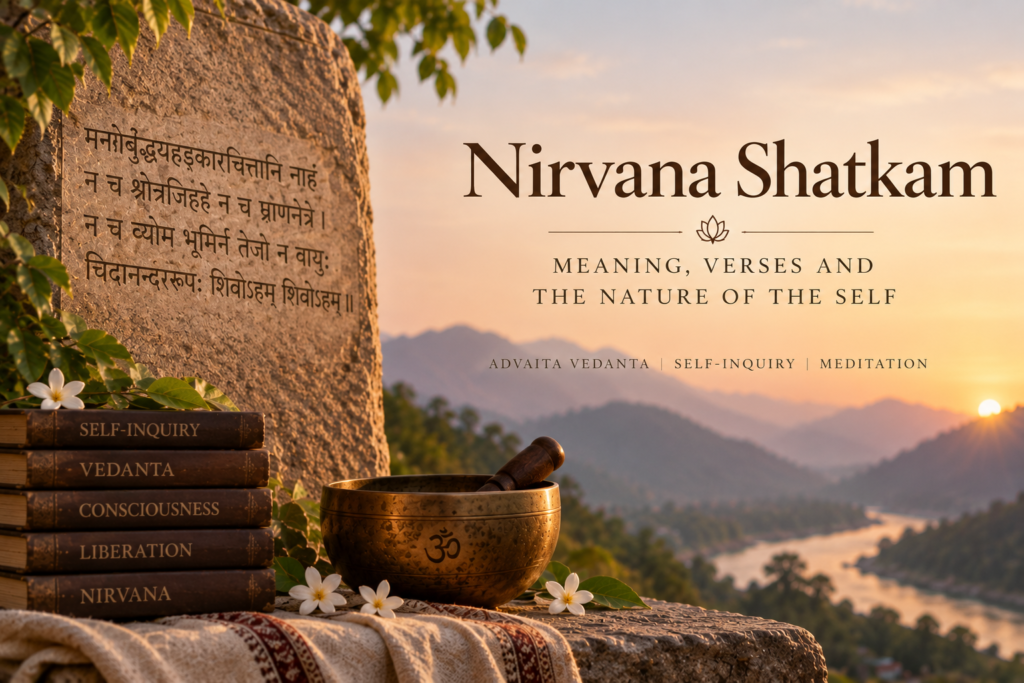
Traditionally attributed to Adi Shankaracharya, the Nirvana Shatkam is a concise expression of the Advaita Vedanta vision of the Self. Each verse examines another aspect of individual experience and concludes with the same powerful declaration: Cidānanda-rūpaḥ Śivo’haṃ Śivo’ham, meaning, “I am of the nature of consciousness and bliss; I am Śiva, I am Śiva.”
The teaching unfolds through a process of recognition. As attention moves through the mind, senses, body, emotions, social identity and concepts of bondage and liberation, the verses point toward the consciousness in whose presence all these experiences are known.
What is the Nirvana Shatkam?
The Nirvana Shatkam, also written as Nirvana Shatakam, is a six-verse Sanskrit hymn traditionally attributed to Adi Shankaracharya. It is also called Atma Shatkam, with Atma referring to the Self. The hymn presents a contemplative inquiry into the nature of the Self from the perspective of Advaita Vedanta.
The six verses examine different layers of human experience. The first explores the mind, intellect, ego, memory, senses and elements. The second moves through prāṇa, the five vital airs, the seven dhātus, the five koshas and the organs of action. The later verses examine emotions, desires, the four aims of life, religious practices, relationships, birth, death, form, bondage and liberation.
Each verse returns to the same refrain:
चिदानन्दरूपः शिवोऽहं शिवोऽहम् ।
Cidānanda-rūpaḥ Śivo’haṃ Śivo’ham
“I am of the nature of consciousness and bliss; I am Śiva, I am Śiva.”
Here, Śiva is understood in the Advaita context as auspicious, pure and undivided reality. The declaration therefore points toward the essential Self rather than personal pride or individual status.
Nirvana Shatkam and the Advaita Vedanta view of the Self
The central movement of the Nirvana Shatakam meaning can be understood through a simple question: what remains when changing aspects of experience are carefully examined?
Thoughts change. Feelings change. Memories appear and disappear. The body changes, the senses receive different experiences, and personal circumstances continue to develop. The hymn directs attention toward the awareness in whose presence these changes are known.
This approach reflects the Advaita Vedanta inquiry into the Self. The verses examine one layer after another and gradually turn attention away from identification with changing experience toward cidānanda, consciousness and bliss.
The process gives the hymn its contemplative depth. Each verse becomes an invitation to observe what we normally call “I” and to look more closely at the nature of that identity.
Nirvana Shatkam lyrics and the first verse
The first verse begins with the mind and the different functions through which individual experience takes place.
मनोबुद्ध्यहङ्कारचित्तानि नाहं
न च श्रोत्रजिह्वे न च घ्राणनेत्रे ।
न च व्योम भूमिर्न तेजो न वायुः
चिदानन्दरूपः शिवोऽहं शिवोऽहम् ॥
Mano-buddhy-ahaṅkāra-cittāni nāham
Na ca śrotra-jihve na ca ghrāṇa-netre
Na ca vyoma bhūmir na tejo na vāyuḥ
Cidānanda-rūpaḥ Śivo’haṃ Śivo’ham
The verse examines manas, buddhi, ahaṅkāra and citta. Manas relates to thinking and feeling, buddhi to understanding and decision, ahaṅkāra to the sense of individual identity, and citta to memory and mental impressions.
The verse then considers the senses. Ears hear, the tongue tastes, the nose smells and the eyes see. These are instruments through which experience takes place, while the teaching directs attention toward the consciousness that knows their experiences.
The verse also refers to vyoma, space, bhūmi, earth, tejas, fire, and vāyu, air. These belong to the field of physical manifestation, while the refrain points toward the Self as cidānanda, consciousness and bliss.
The second verse: prāṇa, koshas and embodied life
The second verse takes the inquiry further into the structure of embodied existence.
न च प्राणसंज्ञो न वै पञ्चवायुः
न वा सप्तधातुर्न वा पञ्चकोशः ।
न वाक्पाणिपादौ न चोपस्थपायू
चिदानन्दरूपः शिवोऽहं शिवोऽहम् ॥
Na ca prāṇa-saṃjño na vai pañca-vāyuḥ
Na vā sapta-dhātur na vā pañca-kośaḥ
Na vāk-pāṇi-pādau na copastha-pāyū
Cidānanda-rūpaḥ Śivo’haṃ Śivo’ham
The verse introduces prāṇa, the vital force that sustains and animates the body, along with its five principal movements: prāṇa, apāna, samāna, udāna and vyāna. It then refers to the seven traditional bodily constituents described in Āyurvedic thought: rasa, rakta, māṃsa, medas, asthi, majjā and śukra.
The verse also introduces the pañca koshas, or five sheaths:
- Annamaya: the physical sheath
- Prāṇamaya: the vital sheath
- Manomaya: the mental sheath
- Vijñānamaya: the intellectual sheath
- Ānandamaya: the bliss sheath
These five sheaths describe different layers through which embodied existence is experienced. The teaching directs attention beyond identification with any single layer toward the deeper Self.
The final part of the verse considers the organs of action, including speech, hands, feet, the organ of generation and the organ of elimination. These function as instruments through which the body engages with the world.
Once again, the verse returns to its central declaration:
Cidānanda-rūpaḥ Śivo’haṃ Śivo’ham.
The third verse: emotions, desires and the four aims of life
The third verse turns toward the emotional and psychological dimensions of human experience.
न मे द्वेषरागौ न मे लोभमोहौ
मदो नैव मे नैव मात्सर्यभावः ।
न धर्मो न चार्थो न कामो न मोक्षः
चिदानन्दरूपः शिवोऽहं शिवोऽहम् ॥
Na me dveṣa-rāgau na me lobha-mohau
Mado naiva me naiva mātsarya-bhāvaḥ
Na dharmo na cārtho na kāmo na mokṣaḥ
Cidānanda-rūpaḥ Śivo’haṃ Śivo’ham
The verse names several familiar movements of the mind: rāga, attraction or attachment; dveṣa, aversion; lobha, greed; moha, delusion; mada, pride; and mātsarya, jealousy. These qualities arise within changing circumstances and can be observed within one’s own experience.
The verse then introduces the traditional four aims of human life, known as the puruṣārthas:
Dharma refers to righteous living and responsibility.
Artha refers to prosperity and the material means of life.
Kāma refers to desire and enjoyment.
Mokṣa refers to liberation.
These four aims have an important place within traditional Indian thought. The verse places them within the field of individual life while directing attention toward the Self that remains deeper than these roles, aims and experiences.
The fourth verse: mantra, pilgrimage and spiritual practice
The fourth verse moves into religious practice, action and experience.
न पुण्यं न पापं न सौख्यं न दुःखं
न मन्त्रो न तीर्थं न वेदा न यज्ञाः ।
अहं भोजनं नैव भोज्यं न भोक्ता
चिदानन्दरूपः शिवोऽहं शिवोऽहम् ॥
Na puṇyaṃ na pāpaṃ na saukhyaṃ na duḥkhaṃ
Na mantro na tīrthaṃ na vedā na yajñāḥ
Ahaṃ bhojanaṃ naiva bhojyaṃ na bhoktā
Cidānanda-rūpaḥ Śivo’haṃ Śivo’ham
The verse considers puṇya and pāpa, merit and demerit arising from action, along with pleasure and pain. These belong to the changing field of individual experience.
It then mentions mantra, tīrtha, Veda and yajña, representing sacred recitation, pilgrimage, sacred knowledge and ritual offering. These have an important place within spiritual practice, while the Self is presented as the consciousness in whose presence such practices and experiences are known.
The verse uses the experience of eating to illustrate this distinction. Bhojana refers to the act of eating, bhojya to that which is eaten, and bhoktā to the experiencer. The entire relationship is known in consciousness, and the Self is described beyond any single part of this experience.
The fifth verse: birth, relationships and identity
The fifth verse moves into one of the most intimate areas of human identity: birth and relationships.
न मृत्युर्न शङ्का न मे जातिभेदः
पिता नैव मे नैव माता न जन्म ।
न बन्धुर्न मित्रं गुरुर्नैव शिष्यः
चिदानन्दरूपः शिवोऽहं शिवोऽहम् ॥
Na mṛtyur na śaṅkā na me jāti-bhedaḥ
Pitā naiva me naiva mātā na janma
Na bandhūr na mitraṃ gurur naiva śiṣyaḥ
Cidānanda-rūpaḥ Śivo’haṃ Śivo’ham
Human life naturally develops through relationships. A person may understand identity through family, friendship, social position and roles such as parent, child, teacher or student. These relationships have meaning within ordinary life, while the verse directs the inquiry toward the essential Self beyond these changing identities.
The statement concerning birth points specifically toward the distinction between the physical body and consciousness. The body enters the world through birth and remains subject to change and death, while the teaching describes the Self as consciousness rather than as a physical object.
The verse also speaks of jāti-bheda, distinctions based on birth or social identity. The essential consciousness is presented as undivided by these categories.
Even the relationship between guru and śiṣya, teacher and disciple, is ultimately transcended in the non-dual Self. Within the spiritual path, the distinction has an important practical role, while the Self itself remains undivided.
The sixth verse: the nature of the Self
The final verse brings the inquiry to its culmination.
अहं निर्विकल्पो निराकाररूपो
विभुर्व्याप्य सर्वत्र सर्वेन्द्रियाणाम् ।
सदा मे समत्वं न मुक्तिर्न बन्धः
चिदानन्दरूपः शिवोऽहं शिवोऽहम् ॥
Ahaṃ nirvikalpo nirākāra-rūpo
Vibhur vyāpya sarvatra sarvendriyāṇām
Sadā me samatvaṃ na muktir na bandhaḥ
Cidānanda-rūpaḥ Śivo’haṃ Śivo’ham
The word nirvikalpa points toward that which is free from conceptual division and distinction. Nirākāra means formless, directing attention toward the Self beyond limitation by physical form. Vibhu means all-pervading or unlimited.
The verse then presents samatva, sameness or non-difference. The Self remains undivided by the changing conditions of body and mind.
The final declaration is particularly significant:
Na muktir na bandhaḥ
“For me there is neither liberation nor bondage.”
At the level of individual experience, a person may experience limitation and seek liberation. From the standpoint presented in the hymn, the true Self as consciousness was never bound in the first place. Liberation therefore becomes a recognition of what is already true.
The verse closes once again with:
Cidānanda-rūpaḥ Śivo’haṃ Śivo’ham.
The meaning of Cidānanda-rūpaḥ Śivo’haṃ Śivo’ham
The repeated refrain forms the heart of the Nirvana Shatkam meaning.
Cidānanda combines the ideas of consciousness and bliss. Rūpaḥ means nature or form, giving the expression the sense of being of the nature of consciousness and bliss.
Śivo’haṃ Śivo’ham means “I am Śiva, I am Śiva.” Within the Advaita context described in the text, Śiva points toward the auspicious, pure and undivided reality. The declaration therefore moves beyond individual personality and points toward the essential Self.
Because the same line appears after every verse, it becomes the thread connecting the entire hymn. Each verse examines another layer of experience, and each one returns to the same recognition.
Nirvana Shatkam and the practice of self-inquiry
The six verses can be understood as a gradual movement through layers of identification.
The first verse examines the mind, intellect, ego, memory, senses and elements. The second moves through prāṇa, the bodily constituents, the five koshas and the organs of action. The third considers emotions, desires and the four aims of life. The fourth examines religious practice and experience, while the fifth explores birth and relationships. The sixth brings the inquiry toward the formless, all-pervading and undivided Self.
This movement gives the Atma Shatkam its contemplative structure. The practitioner observes the things usually included within the idea of “I” and gradually turns attention toward the consciousness through which those things are experienced.
The process can be approached as a form of discrimination. The hymn examines what changes and directs attention toward that which remains as the knowing presence.
Nirvana Shatkam and meditation
The Nirvana Shatkam can become a meaningful text for meditation because each verse offers a specific field of contemplation.
A practitioner can begin by settling the body and observing the breath. Attention can then move toward thoughts, emotions, sensations and memories, allowing each experience to arise and pass while remaining aware of the process.
The verses provide a philosophical framework for this observation. The mind, senses, body, emotions and identities can each become subjects of awareness, while the teaching directs attention toward the consciousness in whose presence they are known.
The repeated Shivo’ham can then become a contemplative refrain. Rather than treating it as a statement about the personality, the practitioner can contemplate its meaning within the Advaita vision of the Self.
Nirvana Shatkam and Nada Yoga
The connection between Nirvana Shatkam and Nada Yoga can be explored through the practice of attentive listening.
Nada Yoga places importance on sound, listening and awareness. A practitioner may work with mantra, voice, music or other forms of sound while developing greater sensitivity to the experience of hearing and listening.
The Nirvana Shatkam provides a philosophical direction for this attention. The ear and other senses appear in the first verse, while the deeper inquiry points toward the consciousness that knows sensory experience.
This gives sound a place within a broader contemplative process. Listening can become an opportunity to observe the senses, the mind and attention, while the philosophical inquiry turns toward the consciousness behind experience.
For students studying Nada Yoga teacher training, this connection can provide an interesting way to approach traditional teachings on sound and awareness. The hymn itself remains rooted in the Advaita Vedanta inquiry into the Self.
The five koshas and the Nirvana Shatkam
The second verse of the Nirvana Shatakam refers directly to the pañca koshas, or five sheaths. These are described as different layers through which embodied existence is experienced.
They are:
| Kosha | Meaning |
|---|---|
| Annamaya | Physical sheath |
| Prāṇamaya | Vital sheath |
| Manomaya | Mental sheath |
| Vijñānamaya | Intellectual sheath |
| Ānandamaya | Bliss sheath |
The hymn places these sheaths within its wider inquiry into the Self. Each represents a layer of embodied experience, while the Self is approached as the deeper consciousness associated with knowing these experiences.
This makes the Nirvana Shatkam particularly relevant to students who study traditional yoga philosophy alongside practices such as meditation, pranayama and Nada Yoga.
The deeper message of the Nirvana Shatkam
The six verses form a gradual movement from identification toward recognition. The body, senses, mind, intellect, ego, prāṇa, koshas, emotions, desires, social identity and relationships all belong to the field of human experience.
The hymn keeps returning to the same question through different layers. What remains when each changing identification is examined?
Its answer appears through the repeated refrain:
Cidānanda-rūpaḥ Śivo’haṃ Śivo’ham.
The Self is described as consciousness and bliss, pure and undivided. The final verse extends this understanding toward the ideas of formlessness, all-pervasiveness, sameness and freedom from bondage and liberation.
The teaching therefore becomes a movement toward recognition. The practitioner examines experience carefully and allows attention to rest increasingly on the consciousness through which experience becomes known.
Nirvana Shatkam and the meaning of Śivo’ham
The phrase Śivo’ham, often written as Shivoham, appears twice in the refrain of every verse.
In the context of the Nirvana Shatkam, it expresses the recognition of the Self as pure, undivided consciousness. The phrase therefore belongs to the Advaita Vedanta vision presented throughout the hymn.
Its meaning becomes clearer when considered alongside the six verses. The declaration follows an examination of the mind, senses, body, prāṇa, koshas, emotions, actions, relationships and concepts of bondage. Each layer leads back to the same recognition of cidānanda, consciousness and bliss.
Frequently asked questions
What is the Nirvana Shatkam?
The Nirvana Shatkam is a six-verse Sanskrit hymn traditionally attributed to Adi Shankaracharya. It is also known as the Atma Shatkam and presents an Advaita Vedanta inquiry into the nature of the Self.
What does Nirvana Shatkam mean?
The hymn presents a process of examining identification with the body, senses, mind, emotions, relationships and other changing aspects of experience. It then points toward the Self as consciousness and bliss through the repeated declaration Cidānanda-rūpaḥ Śivo’haṃ Śivo’ham.
Who wrote the Nirvana Shatkam?
The Nirvana Shatkam is traditionally attributed to Ādi Śaṅkarācārya.
What is the meaning of Shivoham?
Śivo’ham, or Shivoham, means “I am Śiva.” In the Advaita context of the hymn, Śiva represents auspicious, pure and undivided reality. The expression points toward the Self as consciousness and bliss.
What are the five koshas mentioned in Nirvana Shatkam?
The five koshas are Annamaya, Prāṇamaya, Manomaya, Vijñānamaya and Ānandamaya. They describe different layers through which embodied existence is experienced.
How many verses are there in Nirvana Shatkam?
The Nirvana Shatkam contains six verses, which is reflected in the name Shatkam, referring to a group of six. Each verse ends with the same refrain, Cidānanda-rūpaḥ Śivo’haṃ Śivo’ham.
Can Nirvana Shatkam be used for meditation?
The verses can be approached as a contemplative text. Reading or chanting them slowly can bring attention to the different layers of identity discussed in the hymn, followed by contemplation of consciousness and bliss as the nature of the Self.
How is Nirvana Shatkam related to Nada Yoga?
The first verse discusses the senses, including the ears, and the hymn as a whole directs attention toward consciousness. Within a Nada Yoga setting, attentive listening can become one way of exploring sensory experience and the awareness through which sound is known.
From identification to recognition
The Nirvana Shatkam begins by examining the familiar dimensions of human experience. The mind thinks, the senses perceive, the body acts, emotions arise, relationships shape daily life and personal identity develops through countless experiences.
The six verses gradually turn attention toward what lies deeper within this changing field. The body, mind, senses, prāṇa, emotions and identities become subjects of contemplation, while the Self is described as cidānanda, consciousness and bliss.
The final recognition is expressed through the refrain that has accompanied the entire hymn:
चिदानन्दरूपः शिवोऽहं शिवोऽहम्
Cidānanda-rūpaḥ Śivo’haṃ Śivo’ham
“I am of the nature of consciousness and bliss; I am Śiva, I am Śiva.”
For a student of yoga, the Nirvana Shatkam offers a rich meeting point between Sanskrit, meditation, self-inquiry and Advaita Vedanta. Its six verses invite careful observation of every layer through which the sense of “I” is experienced, gradually directing attention toward the consciousness that knows them all.