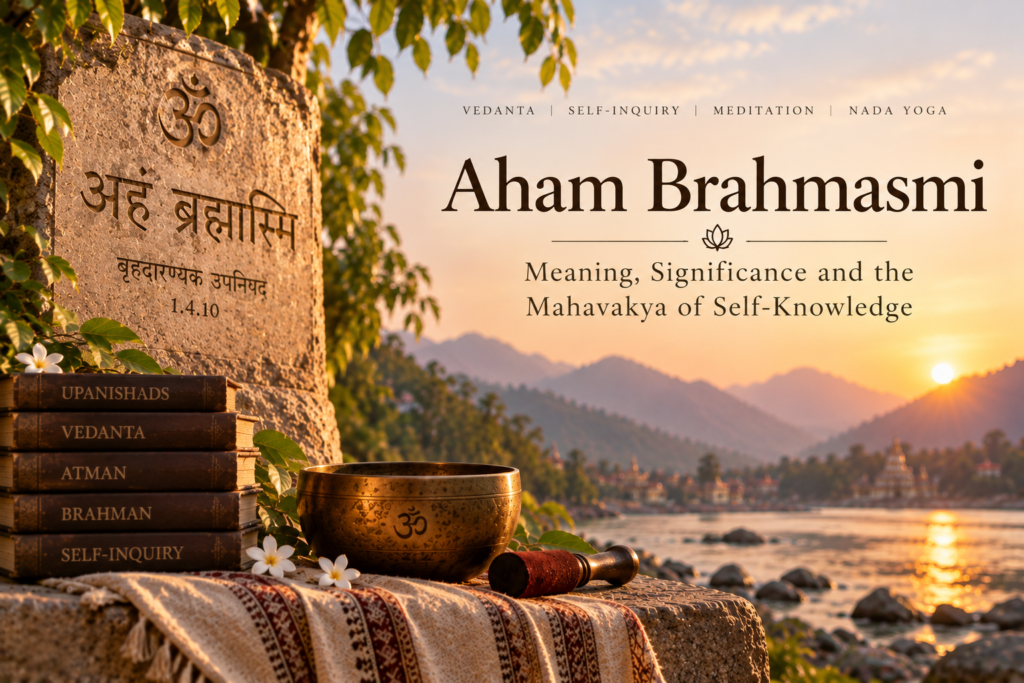
Some Sanskrit phrases describe a practice, while others turn attention toward the person who is practicing. Aham Brahmasmi belongs to the second kind. Written as अहं ब्रह्मास्मि, the phrase is commonly translated as “I am Brahman” and is traditionally recognized as one of the four Mahavakyas, or “great statements,” of the Upanishads. It appears in the Brihadaranyaka Upanishad 1.4.10 and is associated with the Yajurveda.
Within Vedanta, the statement points toward the relationship between the individual Self, known as Atman, and Brahman, the ultimate reality described in the Upanishadic tradition. This makes Aham Brahmasmi a meaningful subject for contemplation, meditation and self-inquiry. For practitioners exploring mantra meditation, Nada Yoga and sound-based yoga practices, the phrase also offers a sonic dimension through chanting, listening and silence.
What does Aham Brahmasmi mean?
The Sanskrit phrase Aham Brahmasmi contains three words:
- Aham means “I”
- Brahman refers to ultimate reality or the absolute
- Asmi means “am”
Together, the phrase means “I am Brahman.” Within the Upanishadic tradition, the word “I” points toward the deeper Self, known as Atman, and the statement connects that Self with Brahman.
This distinction forms an important part of Vedantic inquiry. The body changes throughout life, thoughts continue to change, emotions move through different states and circumstances develop over time. Aham Brahmasmi directs attention toward the underlying Self that Vedanta identifies with Brahman.
As a contemplative statement, the phrase can be repeated through japa or meditation. Understanding its philosophical context gives the repetition a deeper direction and helps the practitioner engage with the meaning behind the Sanskrit words.
Aham Brahmasmi in the Brihadaranyaka Upanishad
The source of Aham Brahmasmi is the Brihadaranyaka Upanishad, one of the principal Upanishadic texts of the Vedic tradition. The statement appears in section 1.4.10, where the surrounding passage connects Brahman with the recognition of the Self.
The Sanskrit statement is:
अहं ब्रह्मास्मि
Aham Brahmasmi
Within the surrounding teaching, Brahman recognizes itself through the statement “I am Brahman.” This context gives the phrase its philosophical depth and places it within an inquiry into the nature of the Self and reality.
Aham Brahmasmi therefore carries a different kind of meaning from an ordinary personal affirmation. The teaching asks the practitioner to examine what the word “I” actually means and to investigate the deeper identity referred to through the Upanishadic understanding of Atman.
What is a Mahavakya?
The Sanskrit word Mahavakya means “great statement” or “great saying.” In later Vedanta traditions, four statements from four Upanishads are commonly presented as the principal Mahavakyas, with each associated with one of the four Vedas.
| Mahavakya | Upanishad | Common translation |
|---|---|---|
| Prajnanam Brahma | Aitareya Upanishad | Consciousness is Brahman |
| Aham Brahmasmi | Brihadaranyaka Upanishad | I am Brahman |
| Tat Tvam Asi | Chandogya Upanishad | You are That |
| Ayam Atma Brahma | Mandukya Upanishad | This Self is Brahman |
Each statement approaches the relationship between the Self and ultimate reality from a particular direction. Aham Brahmasmi uses the first-person expression “I am,” which makes the phrase especially suitable for contemplation because the practitioner is encouraged to examine the meaning of “I” itself.
Aham Brahmasmi and the meaning of the Self
In everyday conversation, “I” usually refers to a person with a particular name, history, body, profession and personality. Vedantic inquiry takes this familiar idea of identity and examines it more deeply.
The body changes throughout life, while thoughts and emotions also move through constant change. Personal circumstances develop, memories shift and experiences come and go. Aham Brahmasmi directs this inquiry toward Atman, the Self described within the Upanishadic tradition.
Within Advaita Vedanta, the deepest Self is understood as Brahman. Other Vedantic schools interpret the relationship between the individual self and Brahman through their own philosophical frameworks, so the phrase is best understood within its specific Vedantic context.
For this reason, Aham Brahmasmi works especially well as a subject for sustained study. The phrase becomes clearer through the study of the Upanishads, Vedanta and guidance from a qualified teacher.
Aham Brahmasmi and Tat Tvam Asi
The meaning of Aham Brahmasmi becomes especially interesting when placed alongside another well-known Mahavakya, Tat Tvam Asi. The phrase appears in the Chandogya Upanishad 6.8.7 during the teaching between Uddalaka and his son Shvetaketu. The passage presents the subtle essence as the Self of all this and concludes with “Tat Tvam Asi, Shvetaketu,” commonly translated as “That thou art” or “You are That.”
Both statements approach related teachings from different perspectives. Tat Tvam Asi addresses the student through the expression “You are That,” while Aham Brahmasmi speaks from the perspective of realization through “I am Brahman.”
Studying these Mahavakyas together can therefore deepen the exploration of Self, identity and ultimate reality within Vedantic philosophy.
Is Aham Brahmasmi a mantra?
Aham Brahmasmi can be used for contemplation and meditation, while its traditional philosophical identity is as a Mahavakya. This distinction helps clarify the way the phrase functions within practice.
A bija mantra such as Om has a different structure and function from a philosophical statement such as Aham Brahmasmi. The Mahavakya presents a complete proposition and invites the practitioner to contemplate its meaning.
Through japa, meditation, self-inquiry and contemplative repetition, the phrase can become a focus for sustained attention. When spoken aloud, each Sanskrit syllable also becomes part of a sound experience, creating a natural connection between philosophical contemplation and Nada Yoga.
The sound of Aham Brahmasmi
The philosophical meaning of a mantra deserves careful attention, while the sound itself also forms an important part of chanting practice. Aham Brahmasmi can be pronounced slowly as:
A-ham Brah-ma-as-mi
The phrase moves through several distinct sounds. Aham begins openly and ends with a softer nasal resonance, while Brahmasmi introduces the consonant cluster brahm followed by the open vowel sounds of asmi.
Sanskrit pronunciation requires attention to vowel length, consonants and the natural movement between syllables. Learning pronunciation from a knowledgeable teacher can help preserve the character of the original language.
This is where mantra practice connects naturally with Nada Yoga. The practitioner can study the meaning of a phrase while also becoming attentive to the way sound carries attention through voice, rhythm, resonance and listening.
Aham Brahmasmi and Nada Yoga
Nada Yoga traditionally explores sound as a support for concentration, meditation and awareness. Practice can begin with an audible sound, allowing the practitioner to listen to the voice, observe resonance and follow the sound as it arises and fades. With continued practice, attention can become increasingly subtle.
Aham Brahmasmi offers a natural application of this approach. The practitioner can first learn the Sanskrit phrase, then chant it with clear pronunciation and listen carefully to the sound being created. Gradually, the volume can become softer until the phrase is whispered or repeated mentally.
This movement takes attention from speaking toward listening and from listening toward silence. Such a progression gives the practitioner an opportunity to explore how sound, attention and awareness interact within a Nada Yoga practice.
At Nada Yoga School, teacher training includes Sanskrit pronunciation, mantra chanting, mantra meditation, Vedic chanting, Indian ragas, voice practices and sound-based meditation.
Chanting Aham Brahmasmi as meditation
Aham Brahmasmi can become the focus of a simple contemplative meditation. Begin by sitting comfortably and allow the breath to settle for several moments before introducing the phrase.
Chant Aham Brahmasmi slowly and clearly, giving each syllable enough space to be heard. After each repetition, listen as the sound gradually fades and allow a short period of silence before beginning again.
As the practice continues, gradually reduce the volume. The phrase can move from a clear spoken chant into a soft whisper and eventually into mental repetition.
At this stage, bring the meaning into awareness. Allow Aham Brahmasmi to remain present as a subject of contemplation, giving the statement enough time and space for its meaning to unfold through practice.
This approach brings together mantra meditation, Sanskrit sound and Vedantic contemplation within one practice.
The importance of silence after the mantra
One of the subtle aspects of mantra practice appears after the final syllable. The phrase reaches its end, and a small space of silence follows.
Instead of immediately beginning another repetition, remain with that silence for a moment and listen carefully. Within Nada Yoga, silence can become another object of attention because the practice begins with an audible phrase and gradually reveals what remains when the phrase has faded.
This relationship between sound and silence can make the structure of the mantra easier to perceive. It also creates a natural movement from external chanting toward subtler meditation.
For practitioners who work with sacred sound, the silence after a mantra can therefore become part of the practice itself. Listening continues even after the audible phrase has disappeared.
Aham Brahmasmi and self-inquiry
Aham Brahmasmi becomes especially deep when approached as a question concerning identity. What does “I” actually refer to within the Vedantic inquiry?
The investigation can move through the body, personality, stream of thoughts and the awareness that observes those thoughts. Vedantic self-inquiry examines these different layers carefully, using the Mahavakya as a pointer toward the nature of the Self.
This process requires patience because the phrase carries philosophical meaning that develops through study and contemplation. A practitioner can spend years exploring the relationship between Atman, Brahman, consciousness and identity.
Aham Brahmasmi therefore works particularly well within a serious yoga and Vedanta study environment. Its meaning continues to open through reflection, meditation and sustained inquiry.
Aham Brahmasmi and Om
Aham Brahmasmi is often practiced alongside Om, especially in meditation settings. Om has an extensive place within the Upanishadic tradition and yoga, where it can serve as an opening sound before the Mahavakya or as a separate object of meditation.
A simple practice can begin with three repetitions of Om. Allow each sound to settle into silence before repeating Aham Brahmasmi several times.
This combination creates a movement between sacred sound, philosophical contemplation and silence. For practitioners studying Nada Yoga, the practice also offers an experiential way to observe how sound influences attention.
Aham Brahmasmi and sound healing
Aham Brahmasmi also appears in conversations about sound healing, although its traditional context belongs to the Upanishadic and Vedantic traditions. Its central purpose relates to self-knowledge and contemplation.
Contemporary sound healing can include singing bowls, gongs, tuning forks, voice, music and guided listening. These practices may support relaxation, meditation and wellbeing within appropriate contexts.
The human voice provides a natural connection between these areas. A practitioner can chant Aham Brahmasmi while paying attention to breath, resonance and listening, allowing mantra to become a sound-based contemplative practice while preserving its philosophical roots.
At Nada Yoga School, sound healing teacher training includes voice and toning practices, mantra chanting, Indian ragas, kirtan and practical work with singing bowls, gongs, tuning forks, tanpura and harmonium.
A simple Aham Brahmasmi practice
A ten-minute practice can provide a simple way to explore the relationship between sound, meaning and silence. Sit comfortably and allow the breathing to settle through several natural breaths.
Begin with three slow repetitions of Om. Allow each sound to fade naturally before introducing the Mahavakya.
Then chant:
Aham Brahmasmi
Repeat the phrase at a comfortable pace and keep the Sanskrit pronunciation clear. After every few repetitions, pause and listen to the silence.
Gradually reduce the volume to a whisper and continue for several repetitions. As the external sound becomes quieter, observe how the experience of the phrase changes.
Finally, repeat Aham Brahmasmi mentally. Bring the meaning into awareness and allow the phrase to remain as an object of contemplation while the breath continues naturally.
Finish the practice by sitting quietly for a few moments. Giving equal attention to sound, meaning and silence creates a balanced way to approach the practice.
Aham Brahmasmi in a Nada Yoga course
Studying a Mahavakya through Nada Yoga can bring together several dimensions of yogic learning. Students can learn Sanskrit pronunciation, explore mantra chanting, study philosophical background and develop listening skills through voice and music.
Nada Yoga School’s teacher training curriculum includes mantras, Vedic chanting, Sanskrit sounds, accurate pronunciation, mantra meditation, Indian ragas, kirtan and sound healing. Practical work with instruments and voice also forms part of the learning environment, giving students opportunities to explore sound as both a musical and contemplative practice.
Students interested in the therapeutic side of sound can also explore the school’s Sound Healing Teacher Training in Rishikesh, which includes theory, guided listening, instrument practice, voice work and meditation-based sound practices. These approaches serve different purposes while sharing an interest in sound, attention and awareness.
Aham Brahmasmi and the deeper purpose of mantra
Mantra practice can begin with repetition and gradually become a way of examining attention itself. Aham Brahmasmi offers a particularly deep example because the phrase carries a philosophical statement about identity.
Each repetition can therefore return attention to the question of who the “I” refers to. Sound gives the mind a steady point of attention, while meaning gives contemplation a clear direction.
Silence then creates space for observation after each repetition. Together, sound, meaning and silence make Aham Brahmasmi a rich subject for meditation within the Vedantic tradition.
Frequently asked questions about Aham Brahmasmi
What does Aham Brahmasmi mean?
Aham Brahmasmi means “I am Brahman.” Within Vedanta, the phrase refers to the identity of the deepest Self with Brahman, the ultimate reality described in the Upanishadic tradition.
Where does Aham Brahmasmi come from?
The phrase appears in the Brihadaranyaka Upanishad 1.4.10, one of the principal Upanishadic texts.
Is Aham Brahmasmi one of the Mahavakyas?
Yes. Aham Brahmasmi is traditionally counted among the four principal Mahavakyas associated with the four Vedas.
Is Aham Brahmasmi a mantra?
Aham Brahmasmi is primarily recognized as a Mahavakya, or great Upanishadic statement. Practitioners can use the phrase for mantra meditation, japa and contemplative practice.
What is the difference between Aham Brahmasmi and Tat Tvam Asi?
Both statements express teachings concerning the relationship between the Self and ultimate reality. Aham Brahmasmi means “I am Brahman,” while Tat Tvam Asi is commonly translated as “You are That.” Tat Tvam Asi appears in the Chandogya Upanishad 6.8.7.
Can Aham Brahmasmi be chanted?
Yes. The phrase can be chanted aloud, whispered or repeated mentally. Careful attention to pronunciation and resonance can add a Nada Yoga dimension to the practice.
Can Aham Brahmasmi be used for meditation?
Yes. The phrase can serve as an object of meditation and self-inquiry. Practitioners can combine repetition with reflection on the meaning of “I” and the traditional Vedantic understanding of Brahman.
What is the connection between Aham Brahmasmi and Nada Yoga?
Aham Brahmasmi can be explored through the sound of the Sanskrit phrase, attentive chanting, resonance, listening and silence. Nada Yoga provides a traditional framework for investigating sound and its relationship with meditation and awareness.
Final thoughts
Aham Brahmasmi is a short Sanskrit statement carrying an expansive philosophical teaching. Its four words invite the practitioner to examine the meaning of “I,” explore the nature of the Self and contemplate the Upanishadic understanding of Brahman.
Through chanting, the statement also becomes an experience of voice, rhythm, resonance and silence. This makes Aham Brahmasmi especially relevant for practitioners exploring the meeting point of Vedanta, mantra meditation and Nada Yoga.
The phrase can begin as something read in a Sanskrit text and gradually become something experienced through chanting. Careful listening then brings attention toward the sound itself, while the silence after the final syllable creates another space for contemplation.
This movement from meaning to sound, from sound to listening and from listening toward stillness gives Aham Brahmasmi a natural place within a deeper study of yoga and the philosophy of sound.