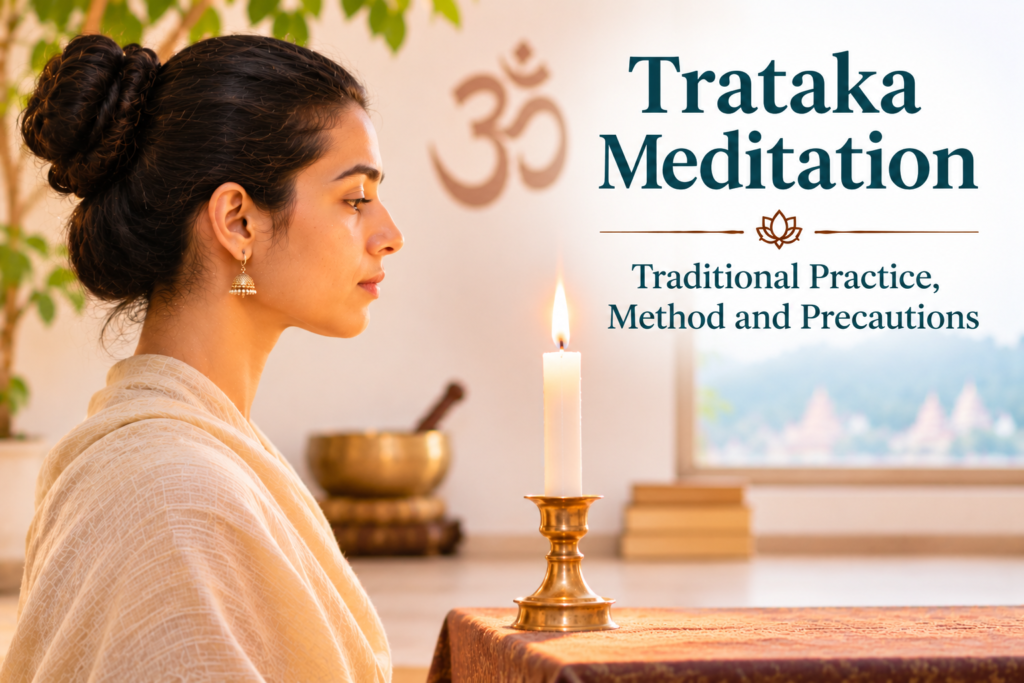
Trataka is a traditional yogic practice that develops concentration through steady gazing. The word Trataka comes from Sanskrit and means to gaze steadily at a fixed point. In this practice, a person focuses the eyes on a chosen object, often the flame of a candle or oil lamp.
Trataka has an important place in Hatha Yoga. Traditional texts describe it as one of the six cleansing practices known as Shatkarma. The practice also helps students explore concentration and mental stillness.
During Trataka, the practitioner keeps the gaze on one object for a comfortable period. After that, they close their eyes and observe the image that remains in the mind. This simple process encourages steady attention and awareness.
In this guide, we explore the meaning of Trataka, its traditional forms, how to practise candle gazing and the precautions beginners should follow.
What is Trataka meditation?
Trataka is a yogic technique that involves looking steadily at a fixed object. Practitioners usually sit in a comfortable position and direct their attention towards a small point or flame.
The Hatha Yoga Pradipika, a classical text on Hatha Yoga, includes Trataka among the six Shatkarma practices. It describes the technique as gazing steadily at a small object until tears appear.
The practice has two main forms:
- Bahya Trataka: The practitioner gazes at an external object, such as a candle flame or a small black dot.
- Antar Trataka: The practitioner closes the eyes and focuses on the mental image of the object.
Both forms involve steady attention. First, the eyes focus on an external object. Then, the practitioner turns their attention inward.
Trataka in traditional Hatha Yoga
Hatha Yoga describes six cleansing practices that prepare the body for further yogic training. These practices are collectively known as Shatkarma.
They include:
- Dhauti
- Basti
- Neti
- Trataka
- Nauli
- Kapalabhati
Each practice has its own method and purpose. Trataka focuses on the eyes and the ability to maintain attention.
The Hatha Yoga Pradipika describes Trataka in Chapter 2. According to the text, the practitioner gazes steadily at a small object until tears appear. Traditional teachings associate this practice with cleansing the eyes and developing concentration.
Trataka also has a connection with Dharana, the sixth limb of Patanjali’s eightfold path of yoga. Dharana means fixing the mind on a chosen object or place. Through steady gazing, practitioners can explore this principle in a practical way.
You can read more about these stages in our article on Dharana, Dhyana and Samadhi.
Different types of Trataka meditation
Traditional and contemporary yoga practices use several forms of gazing. Each form has a different object of focus. However, the main purpose remains the same: developing steady attention.
1. Bindu Trataka
Bindu means a point or dot. In this practice, the practitioner gazes at a small black dot placed on a white sheet of paper.
The dot should remain at eye level and at a comfortable distance. Its simple shape gives the eyes a clear point of focus. Therefore, beginners often find this method easy to understand.
2. Jyoti Trataka
Jyoti means light or flame. This is the familiar candle-gazing practice.
The practitioner places a candle at eye level and looks gently at the flame. A steady flame provides a clear object for concentration. For this reason, many yoga teachers introduce Jyoti Trataka to students who are learning the practice.
3. Antar Trataka
Antar means internal. In this method, the practitioner closes the eyes after external gazing and observes the remaining image of the object.
For example, after looking at a candle flame, the practitioner may notice its image behind the closed eyelids. The image may change in colour, shape or brightness. The practitioner simply observes these changes without forcing the image to remain.
4. Nasagra Drishti
Nasagra Drishti involves directing the gaze towards the tip of the nose. Certain yogic practices use this technique to develop visual focus and awareness.
However, the practice requires care. Holding the eyes in a forced position can cause discomfort. Beginners should learn this technique from an experienced yoga teacher.
5. Shambhavi Mudra
Shambhavi Mudra involves directing the gaze towards the space between the eyebrows. Traditional yoga practices use it as part of meditation and concentration.
Although people sometimes discuss Shambhavi Mudra alongside Trataka, the two practices have different instructions. Students should learn each technique separately under proper guidance.
How to practise candle Trataka meditation
Candle gazing is one of the most familiar forms of Trataka. Beginners can follow a simple routine to understand the practice.
Step 1: Prepare your space
Choose a quiet room with little air movement. Place a candle on a stable surface, away from curtains and other flammable objects.
Position the candle at eye level. A distance of around an arm’s length can be a useful starting point. Adjust it according to your comfort.
The flame should remain steady throughout the practice. Also, keep the room comfortably lit. Complete darkness is unnecessary.
Step 2: Sit comfortably
Sit in Sukhasana, Vajrasana or on a chair. Choose a position that allows you to keep your spine upright without strain.
Rest your hands on your knees or thighs. Relax your shoulders and face.
Before opening your eyes, take a few natural breaths. Allow the body to settle and bring your attention to the present moment.
Step 3: Gaze gently at the flame
Open your eyes and look towards the candle flame. Keep your gaze steady and your face relaxed.
Allow yourself to blink naturally. Avoid forcing the eyes to remain open for a long time.
Continue gazing for a short period. Keep your attention on the flame and gently return to it whenever your mind wanders.
Step 4: Close your eyes
After the external gazing phase, close your eyes gently. Notice whether an image of the flame remains visible.
The image may appear bright at first. Gradually, it may change shape, move or fade away.
Observe the image without trying to control it. When it disappears, remain quietly aware for a few moments.
Step 5: Complete the practice
Allow your eyes to rest before opening them. Then, look around slowly and return to your normal activities.
Beginners should start with short sessions. Gradually increase the duration only when the practice feels comfortable. A qualified teacher can help you understand the correct method and timing.
Benefits of Trataka meditation
Traditional yoga texts associate Trataka with eye cleansing and concentration. Today, many practitioners also use it as a meditation exercise.
Here are some ways the practice can support a regular yoga routine.
Develops concentration
Trataka gives the mind one clear object to focus on. When thoughts or outside sounds distract the practitioner, they gently return their attention to the chosen point.
Over time, this process can help practitioners become more aware of their attention. They also learn to recognise distractions and return to the present moment.
Encourages mental stillness
During Trataka, the practitioner sits quietly and observes one object. This creates a simple structure for meditation.
As the practice continues, the practitioner may become more aware of unnecessary thoughts and movements. This awareness can support a calmer meditation routine.
Develops visual attention
The practice asks the eyes to remain directed towards one object. As a result, practitioners become more aware of visual focus and the movements of their eyes.
However, Trataka should always remain comfortable. Practitioners should stop if they experience eye strain or irritation.
Supports meditation practice
Some beginners find it difficult to sit quietly with their eyes closed. A visible object can give them a starting point.
Trataka follows a clear sequence. First, the practitioner gazes at an object. Next, they close the eyes. Finally, they observe the remaining image.
This structure can help beginners understand how external focus gradually becomes internal attention.
Precautions to follow during Trataka
Trataka involves sustained visual attention. Therefore, practitioners should follow a few important precautions, especially when they are new to the technique.
Avoid forcing your eyes open
Do not try to stare at the flame without blinking. This can cause dryness, irritation and discomfort.
Allow natural blinking throughout the practice. Also, stop if your eyes begin to burn, hurt or feel excessively tired.
Start with short sessions
Long sessions can place unnecessary strain on the eyes. Beginners should start with brief periods of gazing.
As the practice becomes familiar, they can gradually increase the duration under proper guidance. There is no need to rush.
Keep the candle at a comfortable distance
A candle placed too close may cause discomfort. Keep it at eye level and choose a distance that allows you to see the flame clearly.
Also, make sure your neck remains relaxed. You should be able to look at the flame without bending your head.
Avoid practising when your eyes are irritated
People with red, painful or inflamed eyes should avoid Trataka until the problem has been addressed.
Similarly, anyone with an existing eye condition or recent eye surgery should consult an eye-care professional before attempting the practice.
Use a stable candle
Place the candle on a firm, heat-resistant surface. Keep it away from curtains, paper and clothing.
A steady flame also makes the practice easier. Therefore, avoid placing the candle near fans or open windows.
Never leave a burning candle unattended. Extinguish it safely after the session.
Do not use Trataka as a medical treatment
Traditional texts describe Trataka as a cleansing and concentration practice. However, it should not replace medical care or an eye examination.
If you experience headaches, blurred vision, dizziness or persistent discomfort, stop practising and seek medical advice.
Trataka and the practice of Dharana
Trataka has a close connection with Dharana, which means concentration in classical yoga.
Patanjali describes Dharana as fixing the mind’s attention on a particular place or object. The practitioner learns to maintain attention and gently return to the chosen focus whenever the mind wanders.
Trataka offers a practical way to explore this idea. The candle flame provides an external object for attention. After closing the eyes, the practitioner observes its mental image.
This process also introduces the relationship between Dharana and Dhyana. Dharana involves directing attention towards an object. Dhyana refers to a continuous flow of attention towards that object.
With regular practice, students can develop a clearer understanding of these concepts. However, meditation develops gradually through consistent effort and guidance.
What is the difference between Trataka and candle gazing?
Candle gazing is a common form of Trataka. However, traditional Trataka follows a more structured method.
During the practice, the student prepares the body, focuses on the flame and then closes the eyes to observe its remaining image. The practitioner gives attention to both the external object and the internal experience.
Trataka also has a place within the six cleansing practices of Hatha Yoga. Therefore, its traditional context includes both visual focus and the wider discipline of yogic training.
The quality of attention is central throughout the practice. The practitioner observes the flame calmly and avoids forcing the eyes or mind.
Frequently asked questions about Trataka meditation
How long should beginners practise Trataka?
Beginners should start with a short period of comfortable gazing. They can gradually increase the duration under the guidance of a qualified teacher. Avoid forcing the eyes to remain open.
Should the eyes remain open throughout Trataka?
During external gazing, the eyes remain directed towards the chosen object. However, practitioners should blink naturally. After this stage, they close their eyes and observe the remaining image.
Can I practise Trataka without a candle?
Yes. You can use a small black dot or another suitable fixed object. Bindu Trataka, for example, uses a small point on a plain surface.
Is Trataka suitable for everyone?
People with certain eye conditions, active irritation or recent eye surgery should seek medical advice before practising. Beginners should also learn the technique from a qualified yoga teacher.
Is Trataka part of Hatha Yoga?
Yes. The Hatha Yoga Pradipika describes Trataka as one of the six traditional Shatkarma practices. The text explains its method through steady gazing at a small object.
What is the difference between Bahya Trataka and Antar Trataka?
Bahya Trataka involves gazing at an external object, such as a candle flame or dot. Antar Trataka involves closing the eyes and observing the mental image of that object.
Can Trataka improve concentration?
Trataka provides a structured exercise in sustained attention. Regular practice may help practitioners become more aware of distractions and learn to return their attention to a chosen object.
Final thoughts
Trataka is a traditional Hatha Yoga practice that connects visual attention with meditation. It begins with steady external gazing and continues with the observation of an internal image.
Through this process, practitioners explore concentration, awareness and mental stillness. The practice also provides a practical introduction to Dharana, one of the eight limbs of Patanjali’s yoga.
Beginners should approach Trataka with patience. Start with short sessions, keep the eyes relaxed and follow suitable guidance. With regular practice, this simple technique can become a valuable part of a wider meditation routine.