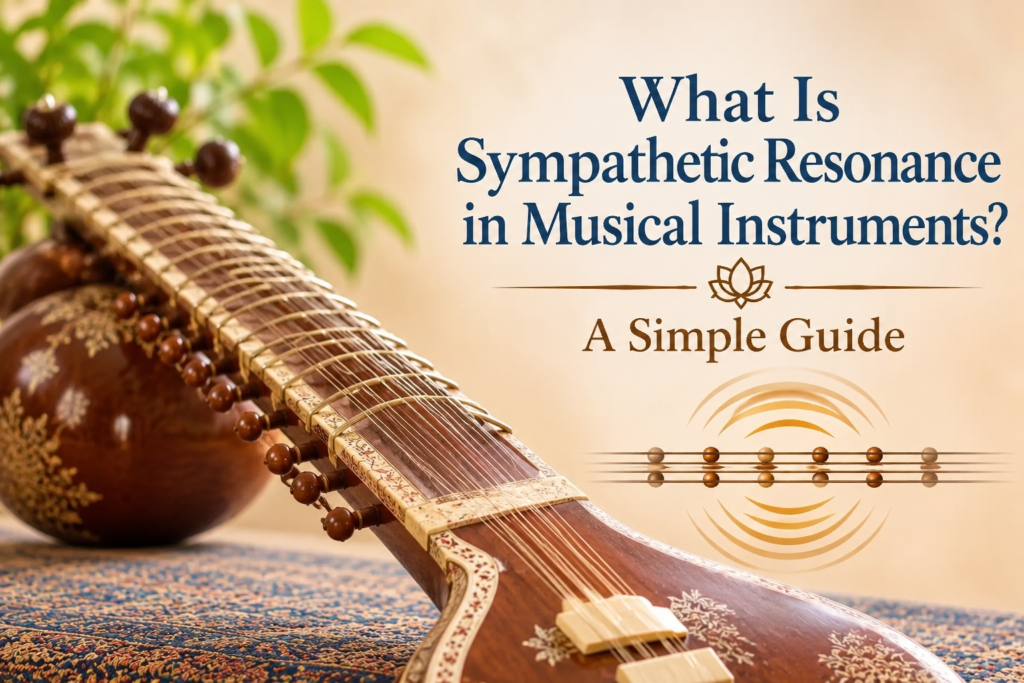
When a musician plays a note on a string instrument, another string nearby may begin to vibrate even though nobody has touched it. A tanpura can produce a continuous drone that causes other instruments to respond with subtle resonances. Similarly, the strings of a sitar may vibrate in response to notes played on its main strings.
This phenomenon is known as sympathetic resonance. It occurs when an object begins to vibrate in response to sound or vibration from another source. The effect plays an important role in the acoustic character of several musical instruments, particularly those with sympathetic strings.
Understanding sympathetic resonance helps explain why certain instruments produce rich, layered sounds and how their construction influences their tonal quality. It also offers an interesting connection between acoustics, Indian classical music and the study of sound in Nada Yoga.
What is sympathetic resonance?
Sympathetic resonance occurs when an object vibrates in response to an external sound or mechanical vibration that contains energy close to one of its natural resonant frequencies.
Every physical object has natural frequencies at which it tends to vibrate. These frequencies depend on properties such as its material, shape, size, tension and construction.
When sound waves reach an object, they transfer energy through the surrounding air. If the incoming sound contains a frequency close to one of the object’s natural frequencies, the object may begin to vibrate more strongly. This response is called sympathetic resonance.
For example, imagine two tuning forks designed to produce the same pitch. When one fork is struck, it creates sound waves that travel through the air. If the second fork is placed nearby, it may begin vibrating even though it has received no direct impact.
The second tuning fork responds because the incoming sound contains energy at a frequency that matches its natural frequency.
The same principle operates in musical instruments. Strings, soundboards, resonating chambers and other components can respond to vibrations generated elsewhere in the instrument or by nearby sound sources.
How does sympathetic resonance work?
Sympathetic resonance involves the transfer of energy between vibrating systems. The process becomes easier to understand by looking at the relationship between natural frequency, sound waves and vibration.
1. Every object has natural frequencies
A string, metal plate, wooden soundboard or hollow resonating chamber can vibrate in different patterns. Each pattern has an associated natural frequency.
A stretched string, for instance, has a fundamental frequency determined largely by its length, tension and mass per unit length. It can also vibrate in higher modes, producing additional frequencies.
These natural frequencies determine how an object responds when exposed to external vibrations.
2. Sound transfers energy through the air
When an instrument produces a sound, its vibrating components disturb the surrounding air. These disturbances travel as sound waves and reach nearby objects.
When sound waves strike another instrument or one of its components, they exert small forces on it. The receiving object may begin to vibrate as a result.
3. Matching frequencies create a stronger response
The receiving object responds most strongly when the incoming sound contains a frequency close to one of its natural frequencies.
This is resonance. The closer the frequency match, the greater the potential response, provided the sound supplies sufficient energy and damping does not suppress the vibration.
The object may produce a quiet secondary sound that contributes to the overall acoustic character of the instrument.
Sympathetic resonance in Indian musical instruments
Indian classical instruments offer some of the clearest examples of sympathetic resonance. Several traditional instruments include additional strings that respond to the notes played by the musician.
These strings create a sustained, shimmering quality that contributes to the distinctive sound of the instrument.
Sitar
The sitar contains sympathetic strings known as taraf. These strings run beneath the main playing strings and are usually tuned to notes associated with the raga being performed.
When the musician plays a note on the main strings, the resulting sound can excite corresponding sympathetic strings. They begin vibrating and produce additional resonances.
The taraf strings contribute to the sitar’s characteristic ringing quality. Their response also changes according to the notes played, the tuning of the strings and the acoustic environment.
<em>Each sympathetic string responds most strongly when the played sound contains energy near its own resonant frequency.</em>
Sarod
The sarod also uses sympathetic strings to enrich its sound. These strings are positioned beneath the main playing strings and are tuned according to the musical requirements of the performance.
When the musician plays a note, the sympathetic strings respond to matching frequency components. Their vibrations create a resonant background that supports the main melody.
The interaction between the main and sympathetic strings contributes to the instrument’s sustained tonal character.
Tanpura
The tanpura produces a continuous drone that provides a tonal reference for Indian classical music. Its strings are plucked repeatedly in a carefully arranged sequence, creating overlapping vibrations and a rich harmonic texture.
The instrument’s sound is influenced by the relationship between string tension, tuning and the contact between each string and its bridge. This contact produces a distinctive buzzing quality known as jivari.
The tanpura also creates a sound environment in which other instruments and voices can resonate. When a singer or instrumentalist produces notes related to the drone, certain frequency components may interact with the tanpura’s sound and create audible resonance.
The tanpura therefore offers a useful setting for observing how sustained sound, harmonic relationships and resonance contribute to musical listening.
Veena
Some forms of the veena incorporate sympathetic strings that respond to the notes played on the main strings. Their vibrations add depth and sustain to the instrument’s sound.
The exact arrangement varies between veena types. In instruments equipped with sympathetic strings, their tuning and placement influence which notes produce the strongest response.
Sympathetic resonance and ordinary resonance: Understanding the difference
The terms resonance and sympathetic resonance are closely related. Sympathetic resonance describes a particular situation in which one vibrating object responds to another source without direct physical contact.
Resonance is the broader phenomenon in which a system responds strongly to energy supplied near one of its natural frequencies.
Consider two examples:
- When a musician plucks a guitar string, the string vibrates according to its natural modes. This is the direct vibration of the string.
- When another string begins vibrating because it receives sound energy from the first string, sympathetic resonance occurs.
In both situations, natural frequencies determine the response. The distinction lies in how the vibration begins.
What is the role of sympathetic resonance in sound quality?
Sympathetic resonance influences several aspects of an instrument’s sound. It can add tonal complexity, create a longer audible decay and produce a sense of depth.
Richness and harmonic complexity
Sympathetic strings introduce additional frequency components into the sound. These components interact with the notes produced by the main strings, creating a layered tonal character.
The resulting sound can feel fuller because several vibrating elements contribute to the overall acoustic output.
Sustain and lingering resonance
When sympathetic strings begin vibrating, they continue producing sound after the initial note has been played. The duration depends on factors such as string material, tension, energy transfer and damping.
This response contributes to the lingering quality often heard in instruments such as the sitar and sarod.
Musical connection between notes
The tuning of sympathetic strings influences which notes create stronger resonant responses. Instrument makers and musicians use this relationship to shape the instrument’s response to a particular raga or musical setting.
When the sympathetic strings are tuned appropriately, notes played by the musician can activate a network of related resonances.
Can sympathetic resonance occur in singing bowls?
Yes. Sympathetic resonance can occur between singing bowls and other resonating objects when their natural frequencies respond to the sound produced nearby.
For example, if two singing bowls have overlapping resonant frequencies, playing one bowl may cause the other to vibrate slightly. The effect depends on the bowls’ acoustic properties, distance, orientation and the intensity of the sound.
A bowl may also respond to sound produced by another instrument, such as a gong or a sustained musical tone, when the incoming sound contains energy close to one of its resonant frequencies.
However, the response may be subtle. A bowl can receive acoustic energy without producing an easily audible secondary sound.
This provides an interesting way to explore the relationship between sound frequency, resonance and the physical properties of musical instruments.
How can you demonstrate sympathetic resonance?
A simple tuning fork experiment provides a practical demonstration.
Materials required:
- Two tuning forks with the same frequency
- A rubber mallet
- A quiet room
- A stable surface
Procedure:
- Place both tuning forks on a stable surface or hold them securely.
- Strike the first tuning fork gently using the rubber mallet.
- Allow it to vibrate while keeping the second tuning fork nearby.
- Stop the first fork by gently touching its prongs.
- Listen carefully to the second fork.
If the second fork has received enough energy, it may continue producing a faint sound after the first fork has been stopped. This indicates that it has begun vibrating through sympathetic resonance.
The experiment works best when both tuning forks have matching natural frequencies and are positioned close enough for effective sound transmission.
A similar demonstration can be attempted with two strings tuned to the same pitch. Pluck one string and observe whether the other begins to vibrate. A small piece of paper placed lightly on the second string can help reveal movement.
What factors influence sympathetic resonance?
The strength of sympathetic resonance depends on several acoustic and physical conditions.
Frequency matching: The receiving object responds most strongly when the incoming sound contains frequencies close to its natural resonant frequencies.
Distance: Sound energy generally decreases as it travels away from its source. Objects placed closer to the vibrating instrument may receive stronger acoustic energy.
Material and construction: The density, stiffness, dimensions and damping characteristics of an object influence its natural frequencies and response.
Tension: In string instruments, tension affects the natural frequencies of the strings. Small changes in tuning can alter which notes excite sympathetic strings.
Acoustic environment: Room reflections and resonances can influence the sound energy reaching an object. A room with strong reflections may produce a different response from a heavily treated room.
These factors explain why the same instrument can behave differently in different settings.
Sympathetic resonance and the experience of listening
Sympathetic resonance reveals how sound travels between objects and influences the surrounding acoustic environment. A musician may play a single note, while several other components of the instrument respond and contribute to the resulting sound.
For listeners, this creates an opportunity to hear music as an interaction between vibrating systems. The sound of a sitar, for example, includes the main melody alongside the subtle resonance of its taraf strings.
This principle also connects with the practice of attentive listening in Nada Yoga. The tradition explores sound as an object of concentration and contemplation. Listening closely to a tanpura drone or the sustained resonance of a musical instrument can help practitioners develop awareness of tonal detail, vibration and silence.
Those studying sound-based practices can explore these acoustic principles alongside practical instrument work through a structured Sound Healing Teacher Training Course in Rishikesh.
Frequently asked questions
Is sympathetic resonance the same as vibration?
Vibration refers to repeated movement around an equilibrium position. Sympathetic resonance occurs when one object begins vibrating in response to energy from another source, especially when the incoming frequency is close to one of its natural frequencies.
Why do sitar strings vibrate without being touched?
The sitar’s sympathetic strings receive sound energy from the main playing strings. When the sound contains frequencies close to their natural frequencies, they begin vibrating and contribute additional resonance.
Do all musical instruments produce sympathetic resonance?
Sympathetic resonance can occur in many instruments, although its role varies. Instruments with dedicated sympathetic strings are specifically designed to use this effect as part of their sound.
Can sympathetic resonance happen between two singing bowls?
Yes. A singing bowl can respond to sound from another bowl when the incoming sound contains energy close to one of its natural frequencies. The strength of the response depends on the bowls’ properties and their arrangement.
Does sympathetic resonance make sound louder?
It can increase the sound produced by a resonating component, although the overall effect depends on how much energy reaches that component and how efficiently it radiates sound. Sympathetic resonance often contributes to tonal richness and sustain rather than simply increasing loudness.
Conclusion
Sympathetic resonance is an important acoustic phenomenon that explains how musical instruments respond to sound produced by other vibrating objects. In instruments such as the sitar, sarod and veena, sympathetic strings contribute to their distinctive tonal character and sustained resonance.
Studying this phenomenon gives musicians and sound practitioners a clearer understanding of how frequency, vibration and instrument construction interact. It also encourages a closer style of listening, where even the quieter resonances within a musical sound become easier to recognise.