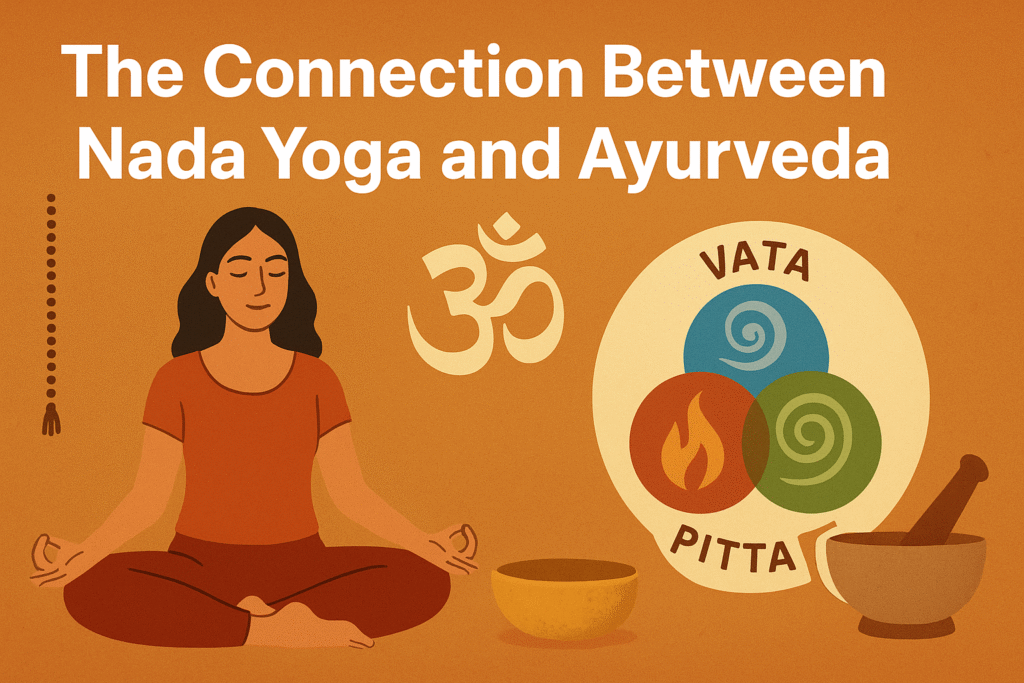
Introduction: When Ancient Sound Meets Timeless Healing
Have you ever noticed how a certain song can instantly lift your mood, calm your nerves, or even bring back memories you thought you’d forgotten? That’s not just emotion—it’s vibration at work. In ancient India, this wisdom took the form of Nada Yoga, the yoga of sound, and Ayurveda, the science of life.
Individually, both are powerful. But when combined, Nada Yoga and Ayurveda create a profound system of vibrational medicine that can balance your doshas, restore inner harmony, and improve overall health. From mantra chanting for dosha balance to sound baths for Vata imbalance, sound becomes a tool to heal the body and calm the mind.
Let’s explore how these two sister sciences meet, and how you can use them in your daily life.
If you wish to explore professional sound healing training and are searching for a place to learn authentic sound-based practices, you can check Nada Yoga School.
Yoga and Ayurveda: The Shared Roots of Healing
Ayurveda and Yoga are often described as two sides of the same coin. Ayurveda provides a complete system of healing based on diet, herbs, daily routine, and energy balance. Yoga, on the other hand, focuses on physical postures, breathwork, meditation, and higher states of consciousness.
Nada Yoga, one of yoga’s more subtle practices, goes beyond the body and breath. It focuses on listening—both to external sounds and to the inner sound, or anahata nada, the “unstruck sound.”
When we bring this into the Ayurvedic framework, we find a natural synergy:
- Ayurveda diagnoses imbalance in Vata, Pitta, and Kapha doshas.
- Nada Yoga provides sound-based practices to restore balance and harmony.
This is why many practitioners today turn to Ayurveda sound therapy as a holistic way to address stress, anxiety, and energy imbalance.
Vibrational Medicine in Ayurveda
Ayurveda recognizes that the universe is made of five elements: earth, water, fire, air, and ether. Out of these, ether (akash) is the space through which sound travels. Sound, therefore, is one of the most direct and subtle forms of healing.
This is often referred to as Vibrational Medicine Ayurveda—healing not by physical substances, but by resonance. Every cell in your body vibrates, and disharmony in vibration shows up as disease. Restoring resonance through sound realigns the subtle and physical bodies.
Examples include:
- Mantra chanting to calm the nervous system.
- Singing bowls to bring clarity and focus.
- Sound baths to restore deep relaxation and balance.
Sound Healing for Doshas: A Practical Guide
Nada Yoga for Vata Dosha
- When imbalanced: Vata causes anxiety, insomnia, restlessness, and overthinking.
- Healing sound: Deep, grounding sounds such as Om or slow, steady chants.
- Practice: A sound bath for Vata imbalance using Tibetan bowls or low-pitched mantras.
Nada Yoga for Pitta Dosha
- When imbalanced: Pitta creates anger, frustration, inflammation, or digestive issues.
- Healing sound: Cooling, soothing sounds like Shanti or flowing ragas with water-like melodies.
- Practice: Gentle mantra chanting for dosha balance with elongated vowels and calming rhythms.
Nada Yoga for Kapha Dosha
- When imbalanced: Kapha leads to lethargy, depression, and emotional heaviness.
- Healing sound: Stimulating, uplifting sounds—drums, fast kirtan, or energizing mantras.
- Practice: Group chanting sessions or lively devotional songs to awaken energy.
This way, Nada Yoga and Ayurveda together offer personalized sound healing based on your constitution.
Nada Yoga and Chakra Healing
Another way to understand the connection is through the chakras. Each chakra has its own vibrational frequency and a bija (seed) mantra:
- Lam for root chakra (stability, grounding).
- Vam for sacral chakra (creativity, flow).
- Ram for solar plexus chakra (fire, digestion).
- Yam for heart chakra (love, compassion).
- Ham for throat chakra (communication, truth).
- Om for third eye and crown chakra (intuition, spiritual awareness).
By chanting or meditating on these sounds, you align not only your chakras but also your Ayurvedic doshas, since each chakra relates to elemental energies that overlap with Vata, Pitta, and Kapha.
Nada Yoga Benefits for Health
Bringing sound into your wellness practice has numerous benefits:
- Reduces anxiety and stress – vibrations calm the nervous system.
- Balances sleep cycles – especially beneficial for Vata imbalance.
- Cools excess heat – soothing sounds help Pitta-related issues like irritability or heartburn.
- Boosts energy – stimulating sounds awaken Kapha’s sluggishness.
- Supports meditation – inner sound (nada) helps deepen focus and spiritual connection.
This is why practices like Ayurvedic sound healing for anxiety are gaining popularity worldwide.
How to Use Sound to Balance Energy: Simple Practices
You don’t need advanced training to start. Here are approachable practices:
- Morning mantra: Begin your day with 5–10 minutes of chanting Om Shanti.
- Sound bath meditation: Attend a guided session or listen to recorded bowls and gongs.
- Self-humming: Simply hum with awareness; it stimulates the vagus nerve and relaxes the body.
- Personal mantra for dosha balance: Choose chants based on whether you need grounding, cooling, or energizing.
Even 10 minutes a day can shift your energy and balance your doshas.
Conclusion: Harmony Through Sound and Ayurveda
The connection between Nada Yoga and Ayurveda is both ancient and remarkably relevant today. In a world filled with noise, we can consciously use sound not just for entertainment, but for healing. Whether through sound healing for doshas, mantra chanting, or chakra balancing, sound becomes medicine.
If you’re curious to experience this firsthand, consider joining a program where these two sciences are integrated. At Nada Yoga School in Rishikesh, we combine yoga teacher training with deep explorations of sound, mantra, and Ayurveda. It’s more than a practice—it’s a journey into harmony.