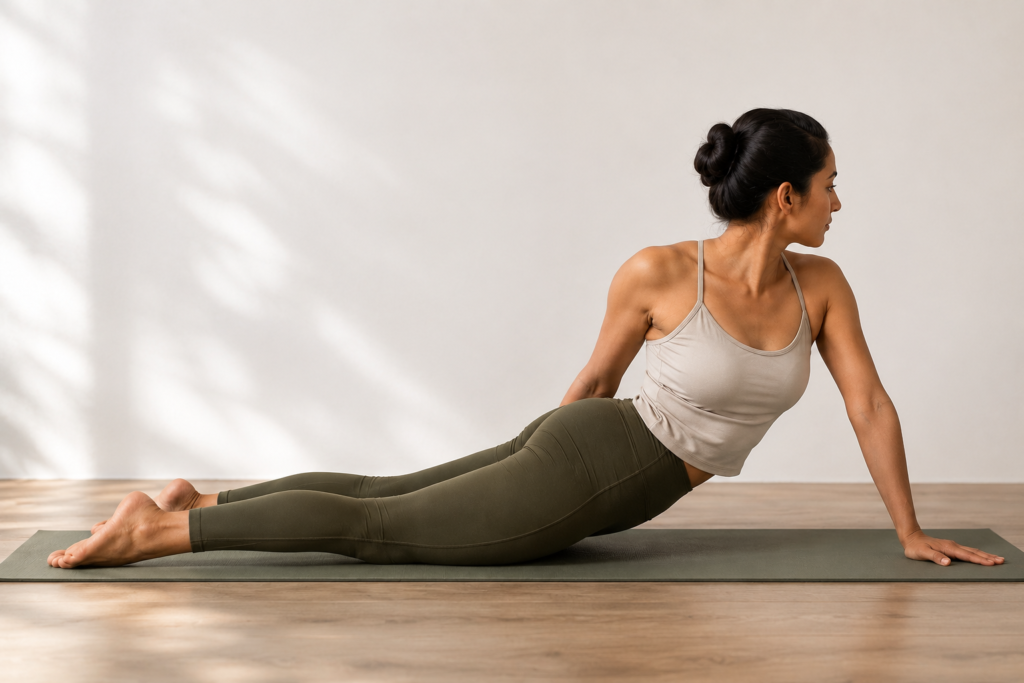
Tiryaka Bhujangasana (often translated as Twisting or Swaying Cobra) is a gentler variation of Cobra Pose that combines a low backbend with a controlled spinal twist—you lift the chest and then rotate to look back toward one heel, return to center, and repeat to the other side. Beyond general practice, this pose appears in traditional Śaṅkhaprakṣhālana (intestinal cleansing) sequences alongside a small set of dynamic postures, where it’s used to mobilize the abdomen and spine. Treat any digestion-related claims as traditional rather than clinical.
How to Do Tiryaka Bhujangasana (Step by Step)
- Set up your base
Lie prone with legs long and slightly apart (hip-width or a little wider), tops of feet on the mat. Place hands beside the lower ribs or under the shoulders, elbows hugging in. Keep shoulders away from the ears. - Inhale—lift to a low Cobra
Press the tops of the feet and thighs down to anchor the pelvis. On an inhale, lift the chest forward and up into a comfortable Baby Cobra (keep a slight bend in the elbows; hips remain grounded). - Exhale—twist to one side
Keeping both hips grounded, gently rotate the torso to the right and look back toward the right heel. Many schools cue one arm straighter and the other a bit more bent to facilitate the twist—move only as far as the breath stays easy. - Inhale—return to center
Come back to neutral Baby Cobra. - Exhale—twist to the other side
Rotate to the left, gaze toward the left heel. - Repeat & finish
Move side-to-side for 4–8 rounds each side, then lower to the belly and rest in Makarasana (Crocodile). If you’re using it within a cleansing or warm-up sequence, keep the tempo smooth and steady.
Notes: Keep the twist mostly in the thoracic spine; avoid letting the twist dump into the low back or the hips roll off the floor. If you feel lumbar compression, lower a bit and reduce the twist.
Benefits (what practitioners commonly experience)
- Gentle spinal mobility: pairs extension + rotation to keep the spine supple without aggressive backbending.
- Front-body opening: lengthens abdominals and hip flexors while broadening the chest and shoulders.
- Upper-back and shoulder control: low-load pressing teaches shoulder-blade organization that supports safer backbends.
- Traditional digestive effects: in the Śaṅkhaprakṣhālana context, the side-to-side movement is used to assist abdominal motility (traditional rationale, not medical advice).
Anatomy: What’s Working (and Why)
- Backbend engine: The lift is driven by spinal extensors (erector spinae, multifidi), assisted by light arm work. Balanced abdominal tone helps distribute the curve evenly along the spine.
- Twist mechanics: External + internal obliques, intercostals, and paraspinals (including multifidus) contribute to axial rotation; these tissues often limit (or enable) easy, pain-free twisting.
- Scapular support: A subtle “press the floor and broaden” action recruits serratus anterior and lower trapezius to stabilize the shoulder blades and decompress the neck/upper back—useful in every backbend.
Preparatory (and Follow-Up) Poses
Before:
- Sphinx (Salamba/Saral Bhujangasana) or Baby Cobra to groove a gentle backbend.
- Cat–Cow and Thread-the-Needle to mobilize thoracic rotation without load.
- Locust (Salabhasana) variations to wake up posterior-chain support.
After:
- Neutralize with Child’s Pose or a mild forward fold; progress to Cobra or Up Dog only if the low back feels clear and supported.
Contraindications & When to Modify
Avoid or seek individualized guidance if you have:
- Active back or spinal injury, shoulder/wrist injuries—weight-bearing and rotation can aggravate symptoms.
- Peptic ulcer, hernia, hyperthyroidism, or intestinal disorders (commonly cited cautions for Twisting Cobra in traditional sources).
- Pregnancy or recent abdominal surgery/hernia—prone backbends and abdominal pressure are typically not advised.
Red flags while practicing: sharp lumbar pain, pinching in the neck/shoulders, wrist tingling, or nausea—stop, rest, and scale down (or skip).
Safer substitutes: Sphinx with a small head/upper-thoracic turn, or very low Baby Cobra with minimal rotation.
Common Mistakes (and Quick Fixes)
- Hips lifting or twisting with the chest → keep both ASIS heavy; twist primarily through the ribs/upper back.
- Neck cranked back → keep the back of the neck long; let the eyes lead the gaze toward the heel only as far as is comfortable.
- Over-reliance on arms → think “chest forward” and use back strength first; hands refine the lift rather than force it.
Practice Tips & Variations
- Range dial: Keep the twist tiny at first; as tissues warm, explore a little more rotation—but keep breathing unhurried.
- Elbow options: For some bodies, one elbow straighter, the other more bent helps orient the twist; others prefer both elbows softly bent—experiment to avoid lumbar compression.
- Rep schemes: In dynamic warm-ups or cleansing sequences, work 6–8 cycles per side; for a slower practice, hold 1–3 breaths at each side before returning to center.
Conclusion
In a world where so much of our day is spent sitting, rushing, and carrying tension through the spine, practices like Tiryaka Bhujangasana offer a simple way to reconnect movement with breath. This twisting cobra variation is not about achieving a dramatic backbend, but about cultivating gentle mobility, awareness, and balance throughout the body. Whether practiced as part of a traditional cleansing sequence or within a modern yoga flow, it can help awaken the chest, mobilize the spine, and bring renewed energy to the body when approached with patience and proper alignment.
If you wish to deepen your understanding of traditional yogic practices, spinal alignment, pranayama, and authentic asana methodology, explore our 200 hour yoga teacher training in Rishikesh, where these ancient techniques are taught through both classical wisdom and practical experience.