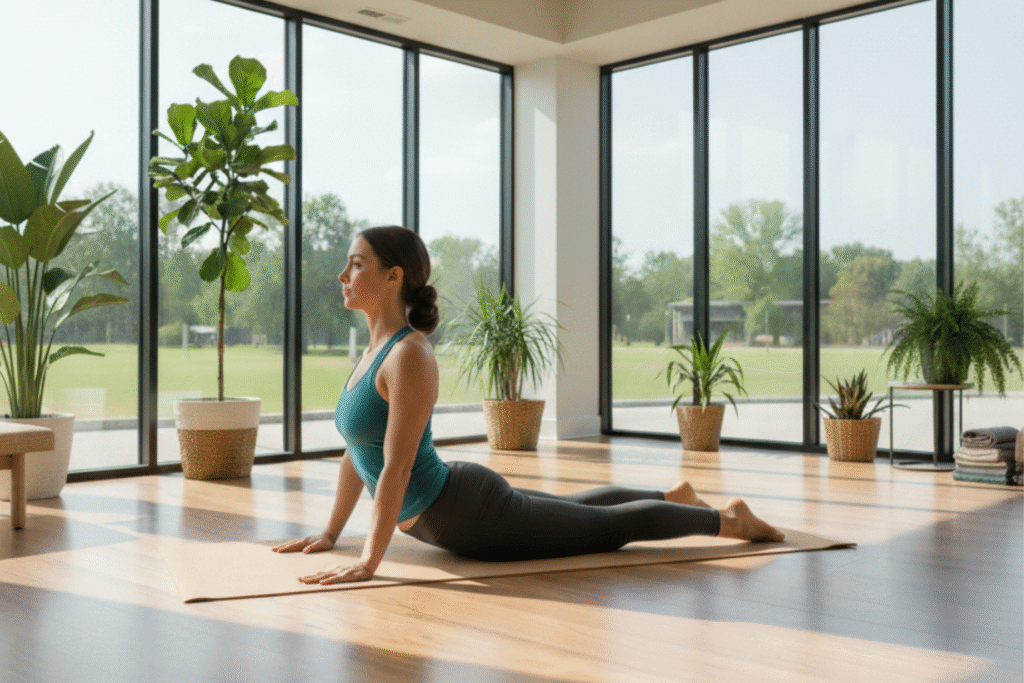
Saral Bhujangasana literally means “easy cobra.” In most modern lineages, it’s the same shape as Salamba Bhujangasana (Sphinx Pose)—a gentle, supported backbend done on the forearms. It’s widely used as a beginner-friendly way to explore spinal extension and chest opening, and as a preparatory pose for deeper backbends like Bhujangasana (Cobra) and Upward-Facing Dog.
How to Do Saral Bhujangasana (Step by Step)
Root & lengthen
Press the tops of the feet and pubic bone gently into the mat to anchor the pelvis. Reach long through the toes and crown.
Lift the chest
On an inhale, press the elbows and forearms down to lift the head, shoulders, and chest into a comfortable backbend. Draw the shoulders away from the ears and broaden across the collarbones. Keep the neck long, gaze slightly forward.
Subtle core support
Lightly tone the lower belly—think of a gentle dome lifting away from the floor—to distribute the curve evenly along the spine (not just the low back). Breathe smoothly. Hold 5–10 breaths.
Exit
On an exhale, lower the chest and head. Rest a moment in Makarasana (Crocodile) or Advasana (prone rest). Traditional sequencing suggests following with a forward bend to neutralize.
Breath pattern (classic cue): Inhale to lift, exhale to lower; breathe normally in the final position.
Benefits (what practitioners commonly experience)
- Gentle back-strengthening & spinal mobility. Sphinx is considered the gentlest of backbends, letting beginners explore extension with support. It can help counter a slumped posture from sitting.
- Opens the front body. Lengthens abdominals and hip flexors; broadens chest/shoulders for easier breathing.
- Soothing yet energizing. Often used therapeutically and in physical-therapy contexts as a “prone prop” for certain low-back presentations; many students report reduced back tension and improved postural awareness. (Always follow professional guidance for pain conditions.)
- Preparation for deeper backbends. Builds patterning for Cobra, Locust, and Upward-Facing Dog.
Anatomy: What’s Working
- Primary action—spinal extension. The erector spinae (iliocostalis, longissimus, spinalis) and deep multifidi extend the spine to lift the sternum away from the floor. Gentle abdominal tone helps distribute the curve and avoids hinging at the lumbar spine.
- Shoulder girdle. Pressing the elbows/forearms into the mat engages serratus anterior for shoulder stability; the scapulae draw slightly down/back as the chest opens. Keep elbows from splaying to maintain good mechanics.
- Hips & legs. With the pelvis anchored, the front-body tissues (rectus abdominis, psoas, rectus femoris) lengthen. Light, well-timed glute engagement can help support the sacrum for many bodies, though schools differ on how much—aim for balanced tone, not gripping.
Preparatory (and Follow-Up) Poses
- Before: Cat–Cow; Makarasana (Crocodile); Advasana (prone rest); Setu Bandha Sarvangasana (gentle bridge); Ardha Shalabhasana/Salabhasana (Locust variations). These warm the spine and teach posterior-chain engagement.
- After: A forward bend or Child’s Pose to neutralize. Move on to Bhujangasana (Cobra) once the Sphinx feels easy and symmetrical.
Contraindications & Modifications
- Ulcer, hernia, intestinal tuberculosis, hyperthyroidism: commonly listed cautions in traditional texts/blogs—practice only under qualified supervision or avoid.
- Pregnancy, recent abdominal surgery, fractured ribs/wrists: avoid or use professional guidance and props. (Although Sphinx is light on the wrists, late-pregnancy and post-surgical backbends generally require individualized care.)
- Acute back pain or diagnosed spinal conditions: Sphinx is sometimes used therapeutically, but don’t self-treat—work with a clinician/experienced teacher.
Red flags: pain (sharp/nervey) in the low back, tingling, or headache—come out and rest in Crocodile, then reassess with less depth or more support.
Variations & Props
- Intensity dial: Slide elbows slightly forward (milder) or toward the shoulders (stronger). Place a folded blanket under the hips or elbows for comfort.
- Restorative Sphinx: Support the ribs/sternum with a bolster or keep a very small lift; great for fatigued days.
- Seal Pose (Yin variation): Hands further forward, elbows straight, deeper backbend—advanced and not for sensitive backs.
Teaching & Self-Practice Cues (Quick Checklist)
- Press forearms down, heart forward; shoulders away from ears.
- Keep a soft belly lift to share the backbend across the spine.
- Anchor the pelvis—pubic bone heavy, legs active—to protect the low back.
- Finish with a brief counterpose (Child’s or a gentle forward fold).