The Gajananam Bhutaganadi Sevitam Mantra is one of the most revered Sanskrit prayers dedicated to Lord Ganesha, the remover of obstacles and the deity of wisdom, prosperity, and new beginnings. Across India, this mantra is traditionally chanted before commencing any auspicious work, spiritual practice, yoga session, or sacred ceremony.
Beyond its devotional significance, this ancient Sanskrit mantra carries profound vibrational qualities that help calm the mind, cultivate focus, and prepare the practitioner for deeper meditation.
Whether you are new to mantra chanting or an experienced yogi, understanding the meaning behind every verse allows the mantra to become a living spiritual practice rather than mere repetition.
The Gajananam Bhutaganadi Sevitam Mantra (Sanskrit)
गजाननं भूतगणादिसेवितं
कपित्थजंबूफलसारभक्षितम् ।
उमासुतं शोकविनाशकारणं
नमामि विघ्नेश्वरपादपङ्कजम् ॥
Transliteration
Gajānanaṁ Bhūtagaṇādi Sevitaṁ
Kapittha-Jambū-Phala-Sāra-Bhakṣitam
Umāsutaṁ Śoka-Vināśa-Kāraṇam
Namāmi Vighneśvara-Pāda-Paṅkajam
English Translation
“I bow to Lord Ganesha, the elephant-faced One, who is served by the hosts of divine beings, who delights in the essence of kapittha and rose-apple fruits, who is the beloved son of Goddess Uma (Parvati), the destroyer of sorrow, and whose lotus feet remove all obstacles.”
Meaning of the Mantra Line by Line
Gajānanaṁ Bhūtagaṇādi Sevitam
- Gajānanam means “the elephant-faced Lord.”
- Bhūtagaṇādi Sevitam means “served by celestial beings and Shiva’s attendants.”
This opening verse acknowledges Ganesha as the supreme leader of the divine attendants and symbolizes immense wisdom, intelligence, and compassionate strength.
Kapittha-Jambū-Phala-Sāra-Bhakṣitam
This line describes Lord Ganesha enjoying the essence of kapittha (wood apple) and jambu (rose apple) fruits.
In yogic symbolism, fruits represent the sweet rewards of spiritual discipline. Ganesha teaches that true fulfillment comes through patience, devotion, and inner maturity.
Umāsutaṁ Śoka-Vināśa-Kāraṇam
This verse means:
“The beloved son of Goddess Uma (Parvati), who destroys sorrow.”
Ganesha is revered not merely as a remover of external obstacles but also as the one who removes inner suffering arising from fear, confusion, ego, and ignorance.
Namāmi Vighneśvara-Pāda-Paṅkajam
This concluding verse means:
“I bow to the lotus feet of Lord Vighneshwara, the remover of obstacles.”
In yogic philosophy, surrendering at the lotus feet symbolizes humility, devotion, and the willingness to allow divine intelligence to guide one’s life.
Who is Lord Ganesha?
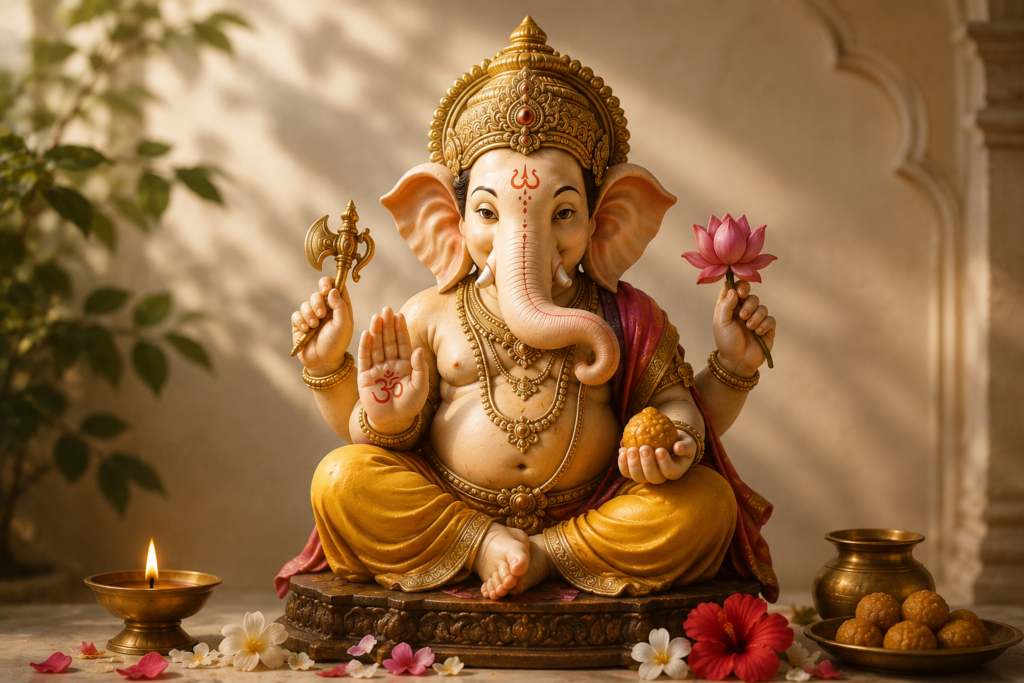
Lord Ganesha is one of the most universally worshipped deities in Hinduism. He is recognized by:
- Elephant head symbolizing wisdom
- Large ears representing deep listening
- Curved trunk signifying adaptability
- Broken tusk symbolizing sacrifice
- Mouse as His vehicle representing mastery over desires
In yogic traditions, Ganesha governs the Muladhara (Root Chakra), the energetic center associated with stability, grounding, security, and new beginnings.
Spiritual Benefits of Chanting the Gajananam Mantra
Regular chanting of this mantra is believed to offer numerous spiritual and psychological benefits.
Removes Obstacles
The mantra invokes Ganesha as Vighneshwara, the remover of obstacles that hinder spiritual and worldly progress.
Improves Concentration
The rhythmic pronunciation of Sanskrit syllables naturally steadies the breath and quiets mental fluctuations, enhancing focus during meditation and study.
Creates Mental Calmness
Chanting helps reduce anxiety, mental restlessness, and emotional turbulence by synchronizing breath, sound, and awareness.
Cultivates Humility
The final verse encourages surrender, reminding practitioners that wisdom begins with humility.
Supports Spiritual Practice
Many yoga teachers recite this mantra before:
It creates an atmosphere of reverence and prepares the mind for deeper inner exploration.
How to Chant the Gajananam Bhutaganadi Sevitam Mantra
For beginners, the following practice can be beneficial:
- Sit comfortably with the spine erect.
- Close your eyes and take several slow breaths.
- Chant the mantra slowly with clear pronunciation.
- Focus on the vibration rather than speed.
- Repeat 11, 21, or 108 times.
- After chanting, sit quietly for a few minutes and observe the silence.
Consistency is more important than duration.
Why Sanskrit Pronunciation Matters
Sanskrit mantras are regarded in the yogic tradition as vibrational formulas. Every syllable has a specific phonetic structure designed to produce subtle resonance within the body and mind.
Accurate pronunciation preserves the integrity of these vibrations and deepens the meditative experience.
This principle lies at the heart of Nada Yoga, the Yoga of Sound, where sound is experienced as a pathway toward inner stillness and expanded awareness.
Ganesha Mantra in Nada Yoga
In the tradition of Nada Yoga, mantra is more than devotional prayer—it is a refined practice of listening, resonance, and inner transformation.
When chanting the Gajananam Mantra, practitioners are encouraged to observe:
- The vibration in the chest and throat.
- The natural rhythm of the breath.
- The subtle silence between repetitions.
- The gradual quieting of mental activity.
Over time, the practice shifts attention from the external sound to the inner sound (Nāda), revealing deeper layers of awareness.
If you wish to study mantra chanting, Sanskrit pronunciation, Indian classical music, kirtan, and the philosophy of sacred sound in depth, explore our Nada Yoga Teacher Training in Rishikesh. You can also deepen your understanding through our Sound Healing Teacher Training Course, where mantra, vibration, and therapeutic applications of sound are taught as part of a comprehensive curriculum.
Frequently Asked Questions
What is the Gajananam Bhutaganadi Sevitam Mantra used for?
It is primarily chanted to invoke Lord Ganesha’s blessings before beginning new ventures, spiritual practices, ceremonies, or important life events. It is believed to remove obstacles and bring clarity and auspiciousness.
Can beginners chant this mantra?
Yes. Beginners can chant it daily with sincerity. Learning the correct Sanskrit pronunciation enhances the experience, but devotion and regular practice are equally important.
How many times should I chant it?
Many practitioners chant it 11, 21, or 108 times, although even a single mindful repetition can be meaningful.
What is the best time to chant?
Early morning during Brahma Muhurta or before meditation and yoga practice is traditionally considered ideal. However, the mantra may be chanted whenever you seek clarity, protection, or a focused state of mind.
Is this mantra connected to meditation?
Yes. The mantra helps quiet the mind, regulate the breath, and prepare practitioners for meditation. In Nada Yoga, it also serves as a gateway to experiencing the subtle vibrations of sound and silence.
Final Thoughts
The Gajananam Bhutaganadi Sevitam Mantra has been cherished for centuries as an invocation of wisdom, protection, and auspicious beginnings. Its poetic Sanskrit verses remind practitioners that the greatest obstacles often arise within the mind, and that humility, devotion, and attentive listening can transform them into opportunities for growth.
Whether chanted before meditation, yoga practice, or the start of a new endeavor, this timeless prayer offers a moment to pause, align with higher intention, and cultivate inner steadiness. Through regular repetition and mindful awareness, the mantra becomes not only a devotional hymn but also a profound practice of self-discovery through sound.