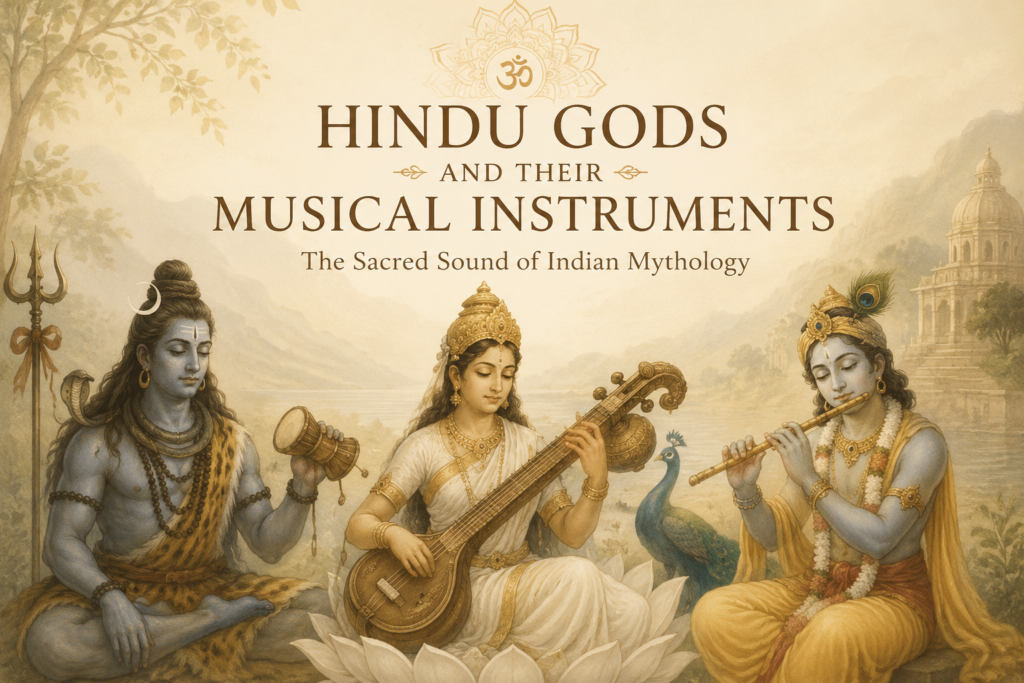
Long before sound was studied as physics, it was worshipped as divinity. In Indian thought, music is not mere entertainment. It is Nada, the primordial vibration believed to underlie creation itself. The concept of Nada Brahma (“sound is God”) runs through the Vedas, the Puranas, and centuries of classical music theory, and it finds its clearest expression in the instruments carried by the gods, goddesses, and devotees of Hindu mythology.
At Nada Yoga School in Rishikesh, we teach that every instrument in Indian tradition has a mythological lineage: a deity who plays it, blesses it, or embodies it. Understanding these stories isn’t just folklore; it deepens how a practitioner relates to sound, rhythm, and inner stillness. This blog explores nine major figures of Indian mythology and the instruments associated with each, along with the historical and scriptural context behind them.
If you want to learn about sound, music, mantra, and healing, you can check out our Nada Yoga Teacher Training & Sound Healing Course in Rishikesh.
Why Music Holds a Sacred Place in Hinduism
In Hindu philosophy, the universe itself is believed to have emerged from vibration. The concept of Nada, meaning sound or vibration, appears throughout yogic and spiritual traditions. Ancient texts describe creation not as a physical event alone but as the unfolding of primordial sound.
The syllable “Om” is considered the original cosmic vibration from which all existence arises. This sacred sound is revered as the essence of creation and is widely used in meditation, mantra chanting, and yogic practice.
Because of this understanding, music has never been viewed solely as entertainment. It has served as a form of worship, meditation, healing, and self-realization.
Indian classical music evolved alongside spiritual traditions. Temples became centers of devotional singing, mantra recitation, and instrumental performance. Many musical traditions still begin by invoking Lord Ganesha and Goddess Saraswati, acknowledging music as a sacred offering rather than merely an artistic skill.
The Philosophy of Nada Yoga
Nada Yoga literally means “the Yoga of Sound.” It teaches that sound can become a meditation pathway and ultimately to higher states of consciousness.
According to yogic philosophy, there are two forms of sound.
Ahata Nada
Ahata Nada refers to an audible sound that is created through vibration. Singing, chanting, musical instruments, and spoken words all belong to this category.
Anahata Nada
Anahata Nada is the inner sound that arises without physical vibration. Yogic texts describe it as a subtle spiritual experience perceived during deep meditation.
The musical instruments associated with Hindu deities symbolize both forms of sound. They remind practitioners that every vibration has the potential to become a spiritual practice when approached with awareness.
Lord Shiva and the Damaru
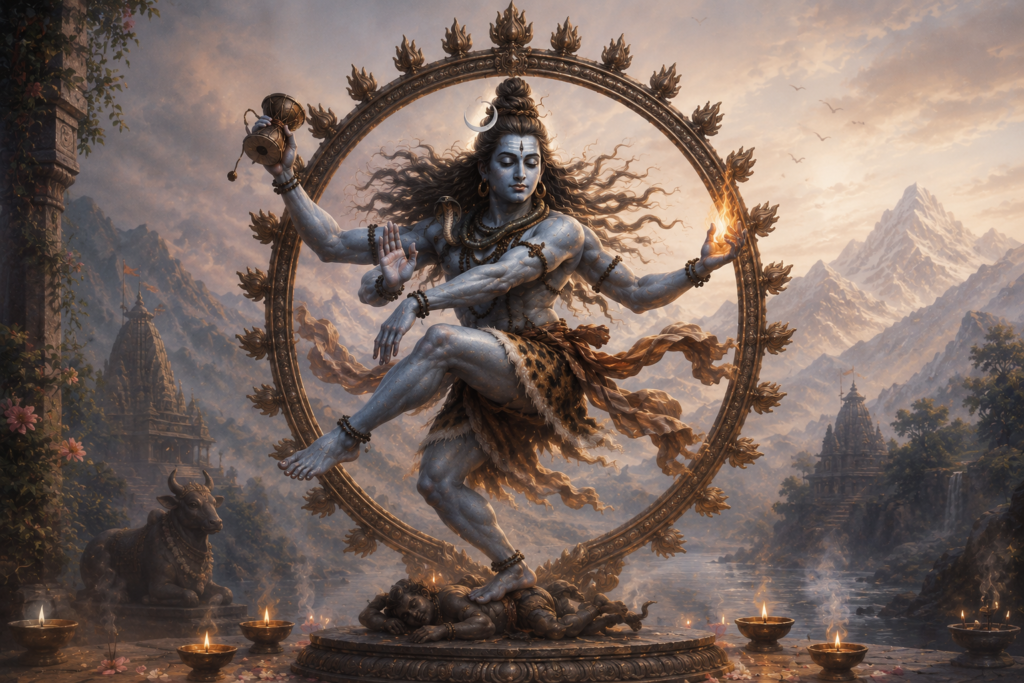
The Mythology Behind Shiva’s Damaru
Among all divine instruments in Hindu mythology, the damaru is perhaps the most symbolic.
Lord Shiva, especially in his form as Nataraja, the Cosmic Dancer, is almost always depicted holding a small hourglass-shaped drum known as the damaru.
According to Shaiva tradition, the rhythmic beats of Shiva’s damaru accompanied the cosmic dance known as the Tandava. This dance represents the eternal cycle of creation, preservation, and dissolution.
A well-known tradition states that after Shiva completed his cosmic dance, fourteen sacred sounds emerged from the damaru. These sounds are known as the Maheshvara Sutras, which later became central to the grammatical system described by the ancient scholar Panini.
Although this tradition belongs to later Sanskrit scholarship rather than the earliest Vedic texts, it beautifully expresses the belief that language itself has divine origins.
Symbolism of the Damaru
The damaru represents the following:
- Creation through vibration
- The rhythm of the universe
- Balance between masculine and feminine energies
- The origin of language and sound
- Transformation through spiritual awakening
- Origin of the Bija Mantras
The hourglass shape also symbolizes the union of Shiva and Shakti, reminding us that creation depends upon the harmonious interaction of consciousness and energy.
Connection to Nada Yoga
For practitioners of Nada Yoga, Shiva’s damaru represents the eternal rhythm present within all existence. Every heartbeat, every breath, and every vibration reflect this universal rhythm.
Listening deeply becomes a spiritual practice.
Goddess Saraswati and the Veena
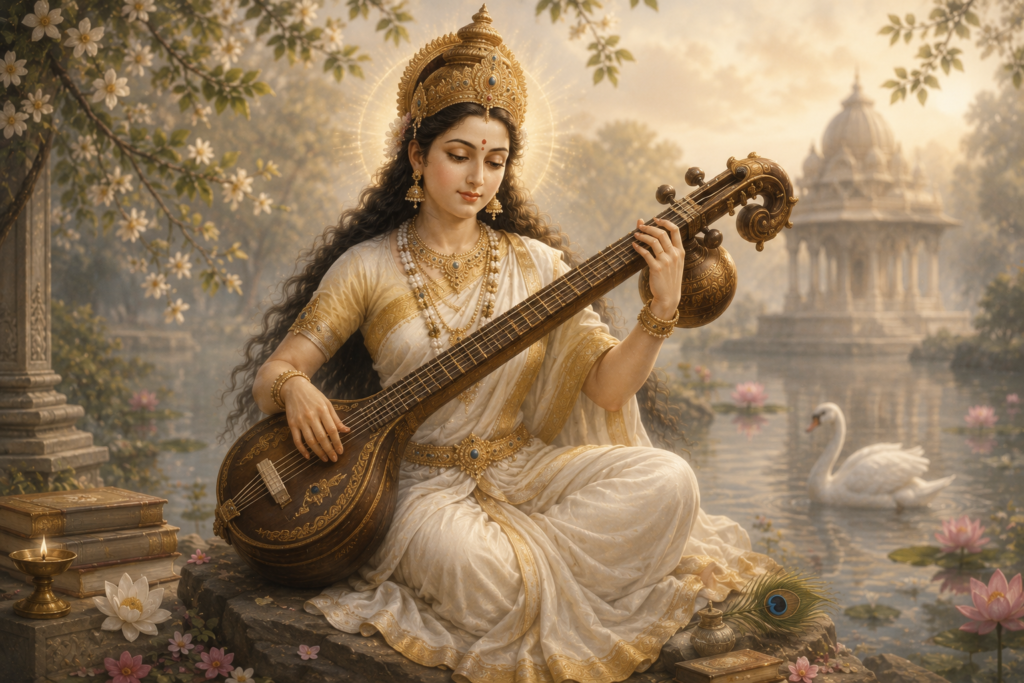
The Goddess of Knowledge and Music
Goddess Saraswati is revered as the deity of wisdom, learning, speech, literature, and music.
She is almost always portrayed seated on a white lotus while gracefully holding the veena, one of India’s oldest string instruments.
The veena symbolizes disciplined learning rather than spontaneous expression. Mastering the instrument requires patience, concentration, and continuous practice, qualities that also define the spiritual path.
Symbolism of the Veena
Each element of the veena carries symbolic meaning.
The strings represent harmony.
The tuning symbolizes balance.
The act of playing represents the alignment of knowledge with intuition.
In Hindu iconography, Saraswati’s veena reminds seekers that true wisdom arises when intellect and inner awareness work together.
Importance in Indian Classical Music
The veena occupies a respected place in Indian classical music. Although many instruments evolved, the veena continues to symbolize the highest ideals of musical discipline and devotion.
Students of music often seek the blessings of Saraswati before beginning their training, particularly during festivals such as Vasant Panchami.
Lord Krishna and the Flute
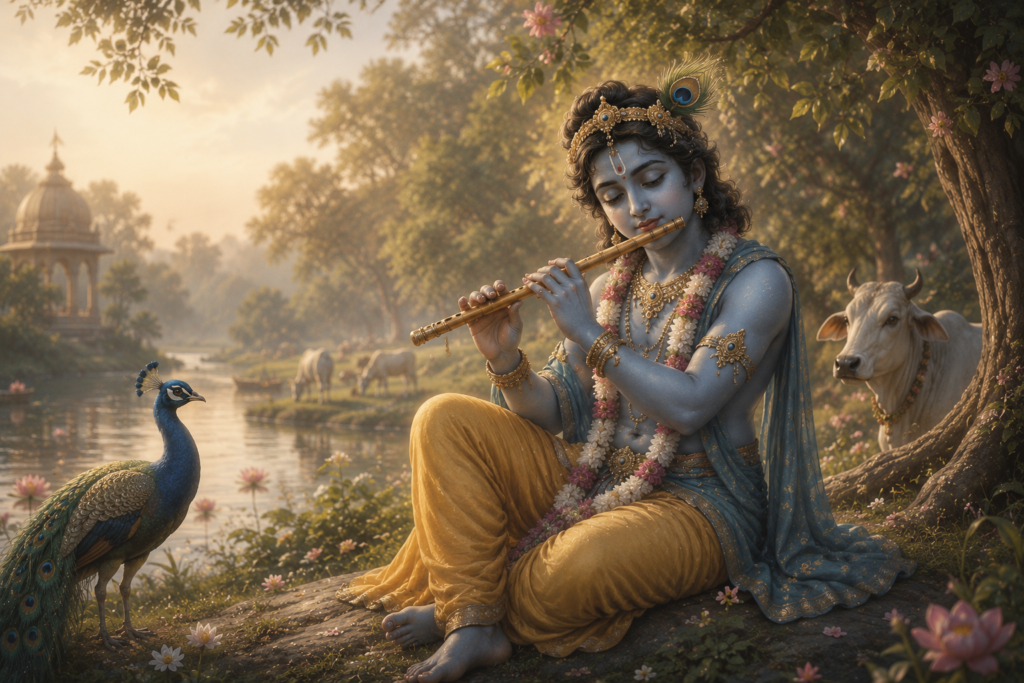
The Divine Call of the Flute
No instrument is more closely associated with devotion than Lord Krishna’s flute, also known as the venu or murali.
The Bhagavata Purana describes how Krishna’s flute enchanted not only the gopis of Vrindavan but also animals, birds, rivers, and even the forests.
His music represented divine love rather than ordinary attraction.
The flute became a symbol of the soul’s longing to reunite with the Divine.
Why the Flute is Symbolic
Unlike many instruments, the flute is hollow.
This emptiness carries deep spiritual symbolism.
Just as the flute produces beautiful music only when it is empty, the human heart becomes a channel for divine grace when it is free from ego and attachment.
The simplicity of the flute teaches humility, surrender, and openness.
Krishna and Bhakti
Krishna’s music lies at the heart of Bhakti Yoga.
Devotional singing, kirtan, and bhajans all reflect the spirit of Krishna’s flute.
Even today, musicians and spiritual practitioners continue to experience the flute as an instrument that awakens love, compassion, and devotion.
Lord Vishnu and the Panchajanya Conch
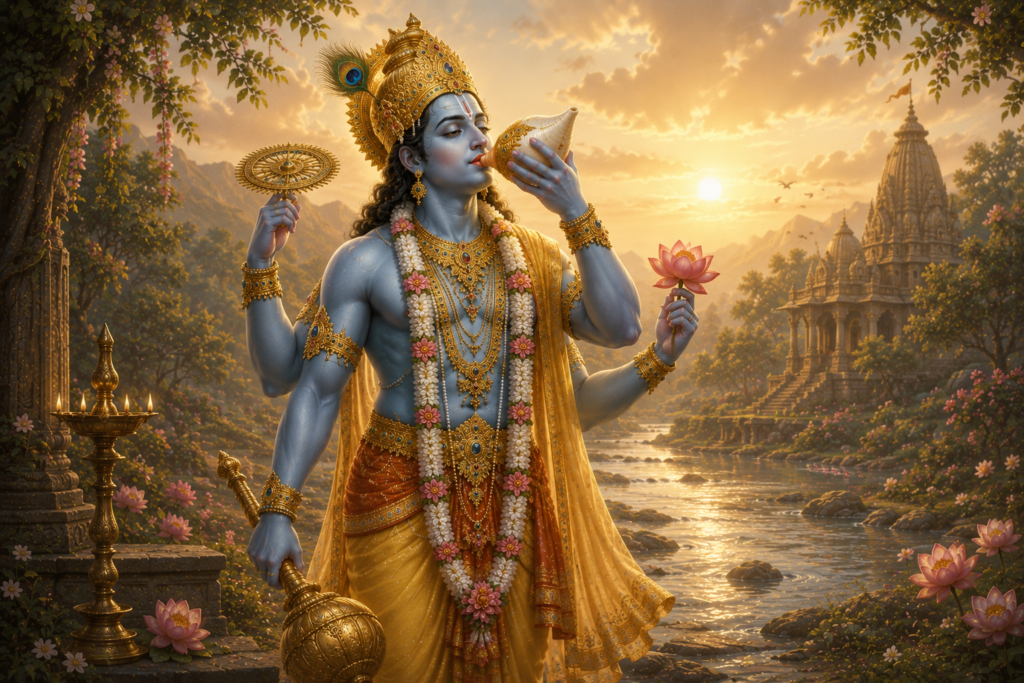
The Sacred Sound of the Conch
Lord Vishnu, the preserver of the universe in the Hindu Trimurti, is traditionally depicted holding four sacred objects: the Sudarshana Chakra, Kaumodaki Gada, Padma (lotus), and the Panchajanya, his divine conch shell. While the conch is not a musical instrument in the classical sense like the veena or flute, it is one of the oldest sacred sound instruments in Hindu tradition.
According to the Mahabharata and the Puranas, the Panchajanya was acquired by Lord Vishnu in his incarnation as Krishna after defeating the asura Panchajana. Before the start of the Kurukshetra War, Krishna blew the Panchajanya, its powerful sound inspiring the Pandavas while announcing the beginning of the battle for righteousness.
Symbolism of the Conch
The Panchajanya represents purity, protection, and the victory of dharma over adharma. Its deep, resonant sound is believed to symbolize the cosmic vibration of Om, awakening spiritual awareness and dispelling negativity.
Even today, conch shells are blown in Hindu temples and homes before prayers, yajnas, and festivals to purify the environment and prepare the mind for worship.
Vishnu and Sacred Sound
The sound of Vishnu’s conch reflects the principles of harmony, protection, and spiritual awakening.
For practitioners of Nada Yoga, the Panchajanya demonstrates that even a single sustained vibration can influence the mind and elevate consciousness. Like the chanting of mantras or the continuous drone used in Indian classical music, the sacred sound of the conch invites stillness, devotion, and a deeper connection with the Divine.
Narada Muni and the Mahati Veena
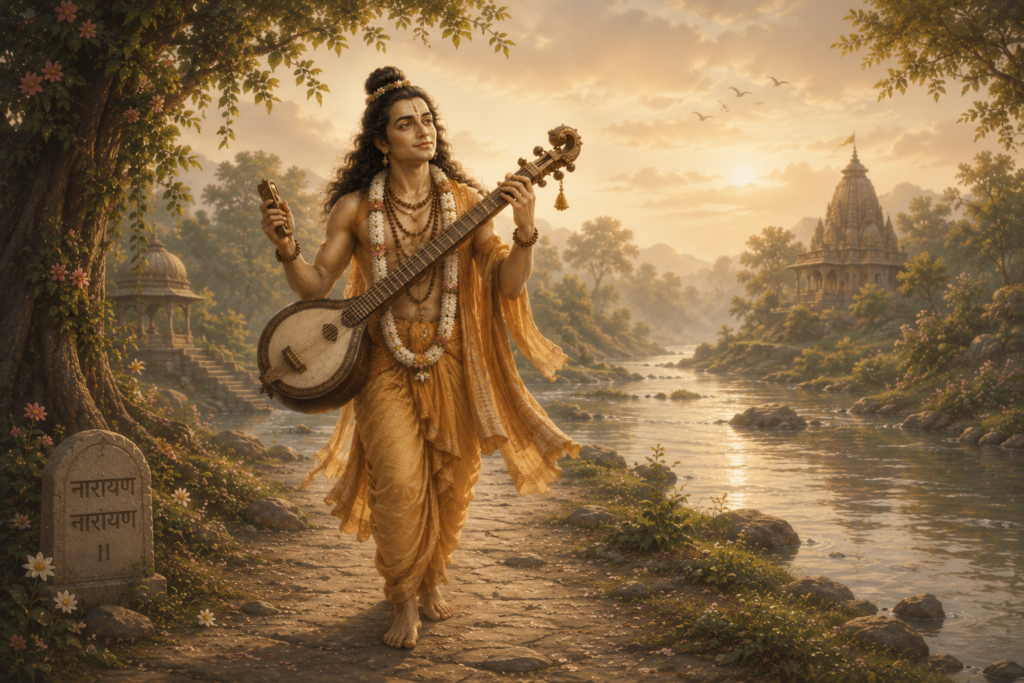
The Divine Sage
Narada Muni is one of the most fascinating figures in Hindu mythology.
He appears throughout the Mahabharata, Ramayana, Bhagavata Purana, and many other texts as a wandering sage, messenger, and devoted musician.
Narada is traditionally depicted carrying the Mahati Veena while constantly chanting the names of Lord Vishnu.
Music as Devotion
Narada teaches that music reaches its highest purpose when offered as devotion.
Unlike performance for recognition or praise, sacred music becomes an offering of love.
The teachings attributed to Narada emphasize bhakti as one of the simplest and most direct paths toward spiritual realization.
His veena, therefore, symbolizes music guided by devotion rather than ego.
Lord Ganesha and Rhythm
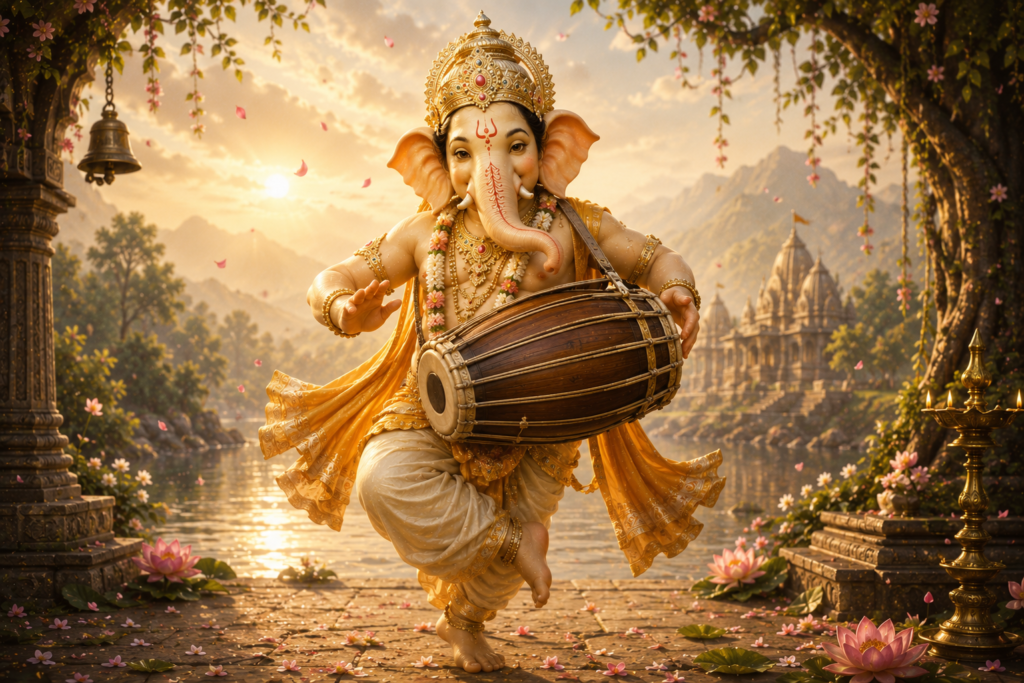
Is Ganesha Associated with a Musical Instrument?
Unlike Shiva or Saraswati, Lord Ganesha is not consistently linked with one particular musical instrument in classical iconography.
However, he holds a special place in Indian music.
Musicians traditionally invoke Ganesha before performances because he is regarded as the remover of obstacles and the patron of new beginnings.
In many regional artistic traditions, Ganesha is depicted playing instruments such as the mridangam, tabla, veena, flute, or pakhawaj. These depictions celebrate his joyful nature but are artistic expressions rather than standardized iconography.
Why Musicians Worship Ganesha
Beginning with Ganesha represents the following:
- Removing obstacles in learning
- Developing discipline
- Cultivating humility
- Inviting success through sincere effort
For this reason, music schools throughout India often begin ceremonies by offering prayers to Lord Ganesha.
Other Hindu Deities Connected with Music
Nataraja
The form of Shiva known as Nataraja embodies the cosmic dance of creation.
Although the dance itself is central, the accompanying damaru reminds us that rhythm and movement together sustain the universe.
Hanuman
Hanuman is deeply associated with devotional singing.
Many traditions describe him joyfully singing the glories of Lord Rama. Bhajan and kirtan traditions often invoke Hanuman as the embodiment of unwavering devotion expressed through sacred sound.
The Gandharvas
Hindu scriptures also describe the Gandharvas as celestial musicians who perform in the heavenly realms.
They symbolize the highest refinement of music and are frequently mentioned in the Mahabharata and the Puranas.
What These Sacred Instruments Teach Us
Each divine instrument represents a spiritual lesson.
| Deity | Instrument | Spiritual Meaning |
|---|---|---|
| Lord Shiva | Damaru | Creation, rhythm, transformation |
| Goddess Saraswati | Veena | Wisdom, harmony, learning |
| Lord Krishna | Flute | Divine love, surrender, devotion |
| Narada Muni | Mahati Veena | Bhakti, sacred music, remembrance |
| Lord Ganesha | Various musical depictions | Auspicious beginnings and disciplined practice |
| Lord Vishnu | Conch | Purity and protection |
Together, these instruments reveal that music in Hinduism is much more than artistic expression.
It is a language of the soul.
The Connection Between Indian Mythology and Nada Yoga
Nada Yoga teaches that every sound influences the mind.
Ancient mythology expresses this truth through symbolic stories.
Shiva reminds us that creation begins with vibration.
Saraswati teaches that wisdom requires harmony.
Krishna shows that music can awaken unconditional love.
Narada demonstrates that devotion transforms music into prayer.
These teachings continue to inspire practitioners of mantra chanting, kirtan, Indian classical music, and sound meditation.
For students of Nada Yoga, mythology offers more than fascinating stories. It provides a symbolic map for understanding the deeper purpose of sacred sound.
Conclusion
The musical instruments of Hindu gods are timeless symbols of spiritual wisdom. They remind us that sound is capable of shaping consciousness, expressing devotion, and connecting us with something greater than ourselves.
Whether it is the rhythmic pulse of Shiva’s damaru, the graceful melody of Saraswati’s veena, the enchanting call of Krishna’s flute, or the devotional music of Narada’s veena, each instrument reflects a different aspect of the spiritual journey.
These symbols continue to influence Indian classical music, temple traditions, yoga, and the philosophy of Nada Yoga. They invite us to listen more deeply, practice more sincerely, and recognize that every vibration has the potential to become a path toward inner peace.
Frequently Asked Questions
Which Hindu god is associated with the damaru?
Lord Shiva is traditionally associated with the damaru. It symbolizes cosmic rhythm, creation, transformation, and the power of sacred sound.
Which goddess is associated with the veena?
Goddess Saraswati is depicted holding the veena, representing wisdom, learning, music, harmony, and refined knowledge.
Why does Lord Krishna play the flute?
Krishna’s flute symbolizes divine love, compassion, and the soul’s longing for union with the Divine. Its hollow form also represents freedom from ego.
Who is Narada Muni?
Narada Muni is a revered sage in Hindu tradition who carries the Mahati Veena and spreads devotion through music and the chanting of Lord Vishnu’s names.
How is Nada Yoga connected to Hindu mythology?
Nada Yoga teaches that sound is a pathway to spiritual awakening. The sacred instruments of Hindu gods illustrate different dimensions of this philosophy by showing how rhythm, melody, devotion, and vibration can lead to higher consciousness.
Why is music considered sacred in Hinduism?
Music is considered sacred because Hindu philosophy views sound as the foundation of creation. Chanting, mantra recitation, devotional singing, and classical music are all regarded as spiritual practices that can purify the mind and deepen awareness.