The Brahma Murari Tripurantakari Mantra is one of the most beloved morning prayers in the Hindu tradition. Often recited at sunrise, this short yet profound verse invokes the blessings of the Navagrahas (Nine Celestial Influences) while honoring the divine forces of creation, preservation, and transformation.
Unlike longer Vedic hymns, this mantra can be chanted in less than a minute, making it an ideal addition to your daily spiritual practice. Whether you seek mental clarity, peace, or simply wish to begin the day with positive energy, this sacred verse serves as a beautiful morning invocation. It is traditionally associated with praying for an auspicious beginning and harmonizing oneself with cosmic order.
If you’d like to deepen your understanding of mantra, Sanskrit chanting, and the yogic science of sound, explore our Nada Yoga Teacher Training in Rishikesh. You can also discover the therapeutic application of vibration through our Sound Healing Teacher Training Course, where ancient wisdom meets practical healing techniques.
Brahma Murari Tripurantakari Mantra (Sanskrit)
ब्रह्मामुरारिस्त्रिपुरांतकारी
भानुशशी भूमिसुतो बुधश्च ।
गुरुश्च शुक्रश्च शनि राहु केतवः
कुर्वंतु सर्वे मम सुप्रभातम् ॥
Brahma Murari Tripurantakari Mantra (Transliteration)
Brahmā Murāris Tripurāntakārī
Bhānuḥ Śaśī Bhūmisuto Budhaśca ।
Guruśca Śukraśca Śani Rāhu Ketavaḥ
Kurvantu Sarve Mama Suprabhātam ॥
English Meaning
“May Lord Brahma, Lord Murari (Vishnu), Lord Tripurantaka (Shiva), the Sun, the Moon, Mars, Mercury, Jupiter, Venus, Saturn, Rahu, and Ketu all bless me and make this morning auspicious.”
Word-by-Word Meaning
Brahmā
The creator of the universe and the source of knowledge and wisdom.
Murāri
A name of Lord Vishnu, meaning “the destroyer of the demon Mura,” representing preservation and protection.
Tripurāntakārī
Lord Shiva, who destroyed the three demon cities (Tripura), symbolizing the destruction of ignorance and ego.
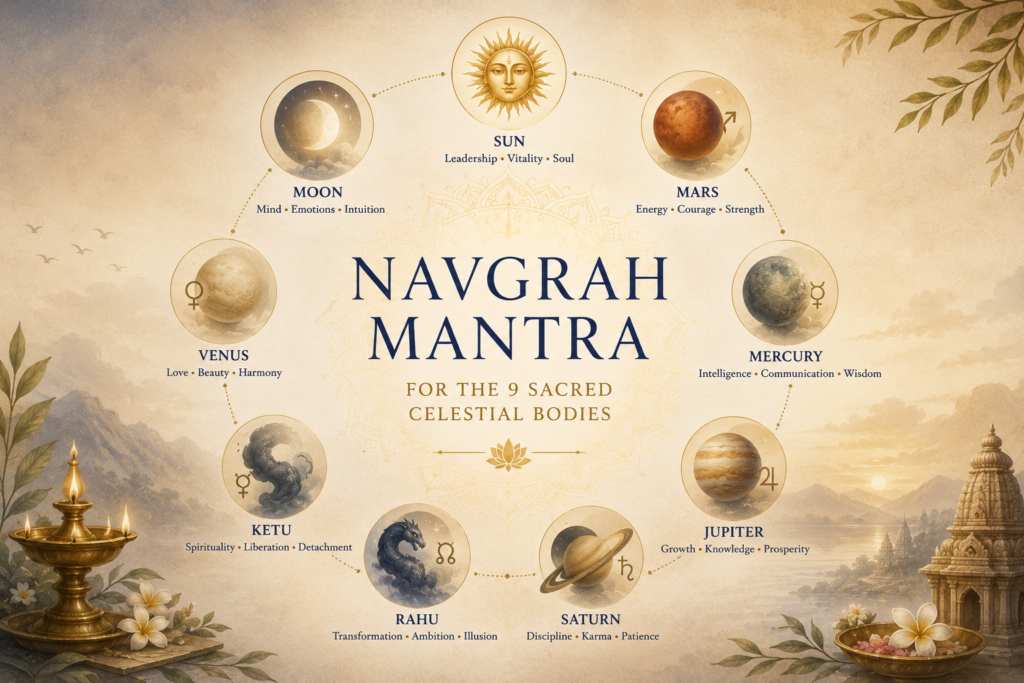
Bhānuḥ
The Sun, representing vitality, confidence, illumination, and life force.
Śaśī
The Moon, associated with emotional balance, peace, and intuition.
Bhūmisuta
Mars, literally “the son of Earth,” symbolizing strength, courage, and determination.
Budha
Mercury, representing intelligence, communication, and discernment.
Guru
Jupiter, the teacher among the planets, symbolizing wisdom, expansion, and spiritual knowledge.
Śukra
Venus, associated with beauty, harmony, relationships, and prosperity.
Śani
Saturn, the planet of discipline, patience, responsibility, and karmic lessons.
Rāhu
The north lunar node, representing transformation, ambition, and life’s unexpected turns.
Ketu
The south lunar node, symbolizing detachment, spiritual awakening, and liberation.
Kurvantu Sarve Mama Suprabhātam
“May all of them make my morning auspicious.”
Why Is This Called the Navagraha Morning Mantra?
The mantra invokes the Navagrahas, the nine celestial influences recognized in Hindu philosophy and Jyotisha (Vedic astrology). Rather than asking for material rewards, the prayer seeks harmony with the cosmic forces believed to influence different aspects of human life.
Beginning the day with gratitude toward these universal energies symbolizes living in alignment with nature, karma, and divine intelligence.
Benefits of Chanting Brahma Murari Tripurantakari
1. Creates an Auspicious Start to the Day
Many devotees recite this mantra immediately after waking to cultivate positivity and mental clarity.
2. Encourages Inner Balance
By remembering the principal deities along with the nine planetary forces, the practitioner develops a sense of harmony and acceptance.
3. Supports Daily Meditation
The mantra serves as an excellent opening prayer before meditation, yoga, pranayama, or mantra chanting.
4. Deepens Awareness of Cosmic Rhythm
The verse reminds us that our lives are connected with larger cycles of nature, time, and consciousness.
5. Cultivates Gratitude
Starting the morning with remembrance of divine forces encourages humility, mindfulness, and devotion.
How to Chant the Mantra
You don’t need elaborate rituals to benefit from this prayer.
For a simple daily practice:
- Wake before or around sunrise.
- Sit comfortably with a straight spine.
- Take a few slow, deep breaths.
- Chant the mantra 3, 9, 11, or 21 times with calm awareness.
- Focus on the meaning rather than speed.
- Sit silently for a minute afterward, allowing the vibrations to settle.
Many practitioners naturally combine this morning prayer with pranayama, gentle Hatha Yoga, or a few minutes of meditation for a more complete spiritual routine.
Spiritual Significance
This mantra beautifully reflects a central idea in the yogic tradition: the universe functions through balance.
Brahma represents creation.
Vishnu represents preservation.
Shiva represents transformation.
The Navagrahas represent the cosmic influences through which life unfolds.
By remembering all these forces together, the practitioner acknowledges that every day is an opportunity to live in harmony with both the outer universe and the inner self.
This understanding resonates deeply with the teachings of Nada Yoga, where practitioners explore the interconnectedness of vibration, sound, and consciousness through sacred chanting and meditative listening.
Frequently Asked Questions
Is Brahma Murari Tripurantakari a Navagraha Mantra?
Yes. It is widely regarded as a morning prayer invoking the blessings of the Navagrahas while also remembering Brahma, Vishnu, and Shiva.
When should this mantra be chanted?
The ideal time is early morning, preferably around sunrise, although it may be chanted at any peaceful time during the day.
How many times should I chant it?
Many people chant it 3, 9, 11, or 21 times. Consistency is generally considered more valuable than a fixed count.
Can beginners chant this mantra?
Absolutely. Its short length and simple pronunciation make it suitable for beginners as well as experienced practitioners.
Do I need to know Vedic astrology?
No. The mantra is fundamentally a prayer for harmony, auspiciousness, and divine blessings. Anyone can chant it with sincerity.
Final Thoughts
The Brahma Murari Tripurantakari Mantra is a timeless reminder that every morning is an opportunity to begin again. In just one verse, it honors the divine powers of creation, preservation, transformation, and the celestial forces that symbolize the rhythms of existence.
Whether you approach it as a devotional prayer, a meditative chant, or a mindful morning ritual, this sacred mantra offers a simple way to welcome each day with clarity, gratitude, and inner balance.
If you’re interested in experiencing the deeper dimensions of sacred sound, mantra chanting, and meditative listening, exploring Nada Yoga can naturally extend this practice. Learning how sound influences consciousness through traditional teachings offers a profound complement to daily mantra recitation. Likewise, incorporating a regular Hatha Yoga practice can help prepare both body and mind for deeper meditation and spiritual awareness.