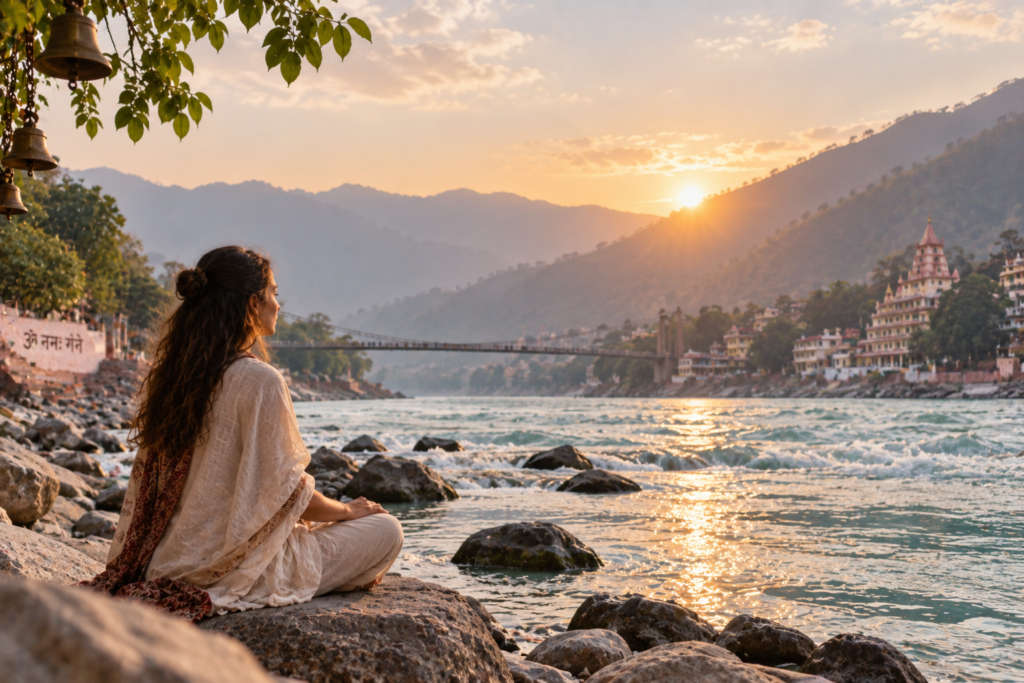
There is a particular quality to the sound of the Ganga in Rishikesh. The river moves continuously through the city, passing temples, ghats, bridges, ashrams, and quiet stretches where people sit for meditation. Its sound changes with the current, the rocks, the season, and the surrounding landscape, creating a natural rhythm that can become part of the experience of being in Rishikesh.
For someone who spends time beside the river, the Ganga gradually becomes more than something to look at. Water moves over stones, gathers speed around bends, and settles into softer currents, while temple bells, birds, distant conversations, chanting, and music occasionally enter the soundscape. With a little attention, these sounds can become an invitation to listen rather than simply background noise.
This is particularly interesting in a city known for yoga and meditation. Rishikesh is often described as the yoga capital of the world, yet much of the experience of practising yoga here happens outside the classroom. The sound of the river, the atmosphere around the ghats, and the devotional music heard throughout the city all become part of the environment.
For anyone interested in Nada Yoga, meditation, or sound healing, the Ganga offers an especially natural way to explore the relationship between sound and attention.
The Ganga as a natural soundscape
The first impression of the Ganga is often visual, especially in the Himalayan surroundings of Rishikesh. The river, hills, temples, suspension bridges, and ghats create an unmistakable landscape that has attracted pilgrims and spiritual seekers for generations.
Staying beside the river for a few minutes brings attention to another part of the experience. The sound of flowing water contains many small variations, with some sections producing a deeper continuous tone while others create lighter, sharper sounds as the current moves across rocks.
The sound also changes according to distance. Sitting close to the water makes individual movements easier to hear, while listening from farther away blends the river into the larger atmosphere of the city. Wind, birds, temple bells, voices, and music become part of the same acoustic environment.
This makes the Ganga an interesting natural soundscape for meditation. There is enough continuity for attention to settle, while the subtle changes in the water keep the listening experience dynamic.
Why flowing water can feel calming
Flowing water is often used as a background sound for meditation, relaxation, sleep, and other quiet activities. Its continuous character can provide a relatively stable auditory environment, while gradual changes in volume and texture keep the sound from becoming completely static.
Individual responses naturally vary. A crowded riverbank can feel busy, while a quieter stretch of the Ganga can create a much more peaceful atmosphere. Personal memories and associations with water also influence how someone experiences the sound.
The important quality is continuity. When attention has a steady sound to follow, it can become easier to notice when the mind wanders and gently return to the experience of the present moment.
This does not require the listener to interpret the sound or search for a particular effect. The river can simply be heard as it is.
That simplicity is part of what makes natural sound interesting in contemplative practices.
The connection between the Ganga and Nada Yoga
Sound has held an important place in Indian contemplative traditions, and Nada Yoga offers one approach to exploring sound through attentive listening. Rather than treating sound simply as something heard in the background, Nada Yoga encourages a deeper awareness of the qualities of sound and the experience of listening itself.
The word nada is commonly associated with sound, and Nada Yoga explores sound as a means of cultivating concentration and awareness. Different practices can involve the human voice, mantra, music, external sounds, and increasingly subtle experiences of listening.
This does not require a musical instrument.
A person can listen to breathing, a temple bell, a bird, wind moving through trees, or flowing water. The practice begins with paying attention to what is already present.
For someone studying Nada Yoga in Rishikesh, the Ganga provides a natural environment in which this principle can be experienced directly. The river offers a continuous sound that can be followed without needing to create or control it, allowing listening itself to become part of the practice.
The experience can be especially interesting when the listener stops trying to separate sounds into categories. The river, voices, bells, birds, and wind begin to form one changing field of sound.
From natural sound to sound healing
This attentive approach to listening also creates an interesting connection with sound healing. Sound healing practices commonly involve singing bowls, gongs, tuning forks, chimes, drums, vocal sounds, and other instruments, with different sounds offering different qualities of resonance, rhythm, duration, and texture.
The Ganga creates its own version of a continuously changing soundscape.
A singing bowl produces a tone that gradually changes as its resonance fades. A gong creates layers of sound that emerge and disappear at different moments. Chimes produce individual tones that appear briefly before giving way to silence. The river creates a similarly changing experience through the movement of water across rocks and through different sections of the current.
The comparison is about the experience of listening rather than suggesting that the river functions as a therapeutic instrument.
Spending time with natural sound can simply develop greater sensitivity to qualities that also become important when working with sound healing instruments. Someone who begins paying attention to resonance may start noticing how long a sound remains present. A person listening carefully to rhythm may become more aware of subtle changes in repetition.
This kind of listening is valuable because sound healing involves more than producing sounds. The practitioner also needs to listen to the sound itself and remain aware of the environment in which it is being experienced.
The sound of the Ganga and the experience of vibration
Sound can be experienced through hearing, although the experience of sound can also involve physical sensation.
This becomes particularly clear with the human voice. When someone hums, the sound can be heard through the ears while vibration is also felt around the face, nose, throat, and chest. A sustained vocal sound creates an immediate relationship between the person producing the sound and the sound being produced.
Instruments create their own physical presence. A gong can produce a strong resonance that can be felt in the surrounding space. A singing bowl creates a tone that gradually fills the room and changes as it fades.
The Ganga offers a different kind of physical sound experience. The movement of water produces vibration and sound across the riverbed, rocks, banks, and surrounding environment.
Standing close to the river can make the sound feel almost tangible, especially when the current is strong. The experience reminds the listener that sound exists within a physical environment and changes according to space, distance, surfaces, and movement.
For someone exploring sound healing in Rishikesh, this can be a useful observation. Learning about sound begins with learning to notice it.
The human voice beside the river
The soundscape of Rishikesh also includes another important element: the human voice.
Mantra chanting, kirtan, prayers, devotional singing, and informal musical gatherings can often be heard around the river, adding another layer to the natural sound of the Ganga.
The voice is especially interesting because it can be experienced both externally and physically. When a person hums or sustains a vowel, the sound can be heard through the ears while vibration is also felt around the face, throat, and chest.
This relationship between voice, vibration, and listening has long been explored through Indian musical and yogic traditions.
Sitting beside the Ganga while quietly humming can create an interesting interaction between the intimate vibration of the voice and the much larger, continuous sound of the river. The voice is close to the body, while the river occupies a much larger space.
Attention can move between them naturally, allowing the experience to remain grounded in listening.
This is one of the simplest ways to understand why the human voice has such an important place in sound-based practices. A person does not need to hold an instrument to create sound. The body itself can become part of the listening experience.
Ganga aarti and the sound of devotion
The evening Ganga aarti brings another dimension to the relationship between sound and the river.
As people gather along the ghats, bells, prayers, chanting, and devotional music fill the surrounding space while the Ganga continues flowing beside the ceremony. The soundscape becomes much denser than it is during a quiet morning.
The experience demonstrates how strongly sound can be connected with place.
Human voices and instruments rise and fall according to the structure of the ceremony, while the river maintains a continuous presence underneath them. Bells appear suddenly and then fade. Chanting creates repetition. Music creates rhythm and melody.
For anyone interested in the cultural role of sound in India, the aarti offers an opportunity to observe how sound, place, ritual, and collective attention can come together.
The same river can provide a quiet setting for individual meditation during the morning and become the center of a communal devotional experience in the evening.
Repetition, rhythm, and the flowing river
One reason repetitive sound can become absorbing is that the brain is naturally sensitive to patterns.
A repeated rhythm provides information about what may happen next. Once a pattern becomes familiar, attention can settle into it rather than constantly searching for something new.
The Ganga does not produce a perfectly repetitive sound, yet it has a continuous rhythmic quality. The current moves, changes, accelerates, slows down, and interacts with the riverbed. This creates repetition within variation.
Music often works in a similar way.
A mantra may repeat the same phrase while the voice changes slightly. A kirtan may return to the same melodic line. A sound healing session may use a recurring rhythm or sustained tone while introducing different instruments.
The listener receives enough familiarity to establish a sense of continuity while still encountering small changes.
The flowing Ganga offers this experience naturally, without a musician or practitioner directing it.
A simple meditation beside the Ganga
A person does not need a complicated technique to explore the sound of the river.
Sitting somewhere relatively quiet beside the Ganga and spending several minutes listening can be enough to notice how attention responds to continuous natural sound. The deeper movement of the water can become the background while smaller sounds gradually become noticeable.
A bird may call from the trees. A temple bell may ring somewhere across the river. Someone may begin chanting nearby. A conversation may enter the soundscape and disappear again.
When thoughts appear, attention can return to the river without trying to force those thoughts away. The practice becomes an exercise in noticing, listening, and returning.
This is a simple principle found across many sound-based meditation practices. Attention does not have to remain perfectly still for meditation to take place. The practitioner can notice movement and repeatedly return to the chosen object of awareness.
The Ganga makes this process particularly accessible because the sound is already there.
The relationship between silence and sound
Listening to the Ganga can also change the way silence is understood.
Silence beside the river is rarely complete silence. Even during quiet periods, there is the sound of water, wind, distant voices, birds, or movement in the surrounding landscape.
This kind of environment shows that silence can exist as a quality of attention rather than simply the complete absence of sound.
A person may sit beside the Ganga and become deeply absorbed in listening even while many sounds continue around them. The mind can become quieter without the environment becoming silent.
This idea has an important place in Nada Yoga. Sound and silence are closely connected because the experience of one makes the other more noticeable.
A sustained sound eventually fades into silence. Silence makes the next sound easier to notice. The river continues moving through this cycle constantly, with individual sounds appearing and disappearing within its larger flow.
Why the Ganga is part of the Rishikesh experience
The relationship between the Ganga and yoga in Rishikesh extends beyond the river’s religious and cultural significance. The river also shapes the sensory environment in which people practise, study, walk, meditate, and spend their days.
Someone attending a yoga teacher training in Rishikesh may encounter the sound of the Ganga before an early morning class and again while walking back to their accommodation. A person attending a kirtan may hear the river beneath the music, while someone exploring sound healing may begin noticing the qualities of natural resonance in a completely different way.
These experiences can gradually change how a person listens to the environment.
The river also gives Rishikesh a distinctive acoustic character. The sound of water remains present even as the sounds of the city change around it. In the early morning, the river may seem especially prominent. During the day, traffic, conversations, and activity become more noticeable. In the evening, devotional music and temple bells add another layer.
The Ganga remains part of all of these moments.
Experiencing sound in everyday life
Sound healing and Nada Yoga can sometimes seem like practices that require a particular setting, instrument, or formal session. The Ganga offers a different perspective because it demonstrates that attentive listening can begin with ordinary surroundings.
A person walking along the river can notice how the sound changes when moving closer to the water. Someone sitting on a ghat can observe how voices travel across the river. A visitor crossing a bridge can hear the water from a completely different position.
These small observations develop an awareness of sound as something shaped by space.
This awareness can become useful when working with instruments. A singing bowl played in a small room creates a different experience from the same bowl played outdoors. A gong behaves differently depending on the size and acoustic qualities of the space. The human voice also changes according to the surroundings.
The Ganga provides an everyday reminder that sound is never completely separate from its environment.
The Ganga as a teacher of listening
Perhaps the most interesting quality of the river is that it never produces exactly the same sound twice.
The overall character remains recognizable, yet every moment contains small differences. The water encounters a different stone, the current changes direction, wind moves across the surface, or another sound enters from the riverbank.
Listening closely means becoming sensitive to these small changes.
This quality has a natural connection with the practice of sound healing. Anyone working with sound eventually develops an appreciation for subtle differences in tone, resonance, volume, rhythm, and duration. These qualities may seem small at first, yet they strongly influence how a sound is experienced.
The Ganga offers an opportunity to observe such changes without any formal lesson.
The river simply continues flowing, while the listener gradually becomes more attentive.
A different way to experience the Ganga
The Ganga is photographed, crossed, worshipped, bathed in, and visited every day. It can also simply be heard.
Spending ten or fifteen quiet minutes beside the river without music, conversation, or a phone can reveal a different side of Rishikesh. The water becomes less like background noise and more like a constantly changing field of sound, with layers appearing and disappearing as attention becomes more refined.
For those interested in Nada Yoga, the experience offers a natural lesson in attentive listening. For people exploring sound healing, it provides an opportunity to notice how resonance, rhythm, continuity, physical space, and environmental sound influence perception.
The experience does not require a special interpretation. The Ganga can simply be allowed to remain what it is: a living river whose movement creates an ever-changing soundscape.
In a city where people come from around the world to study yoga, meditation, music, and sound healing, the river offers one of the simplest lessons available. Before learning to create a sound, it is worth learning how to listen to one.