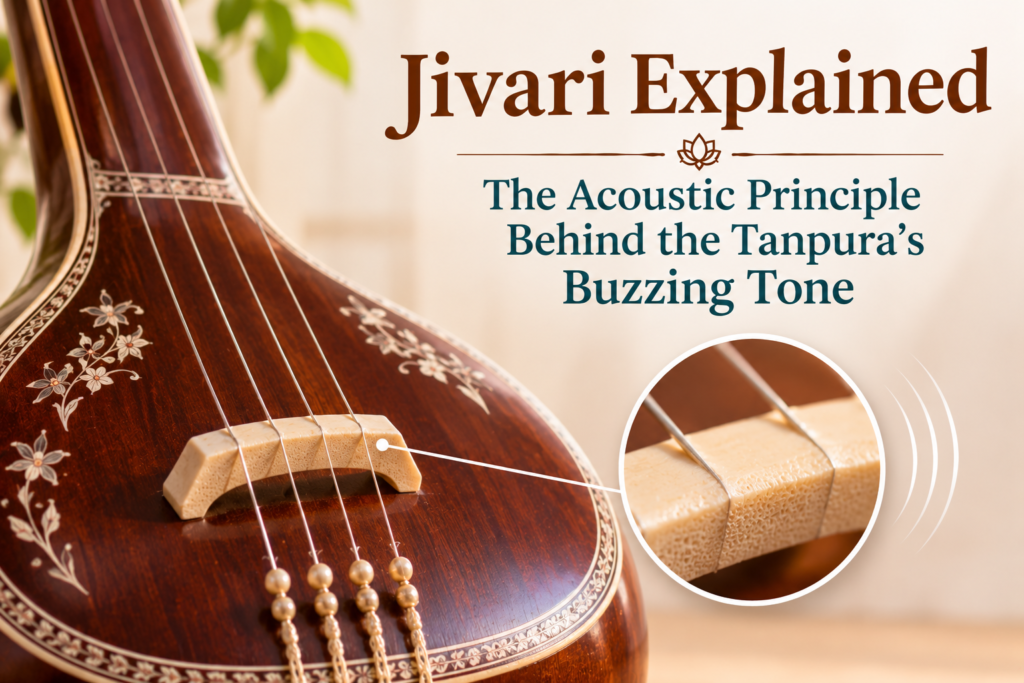
The tanpura produces one of the most recognisable sounds in Indian classical music. Its continuous drone supports singers and instrumentalists, establishes the tonal reference for a raga, and creates a rich acoustic background for musical exploration. When a tanpura is tuned and played carefully, each plucked string produces a sustained tone with a distinctive shimmer and gentle buzzing quality.
This characteristic sound comes largely from jivari, also written as jawari or javari. The term describes the acoustic effect created by the interaction between a vibrating string and the specially shaped bridge of the instrument. A fine adjustment to the bridge and the string’s contact point can change the tone significantly, affecting its brightness, resonance and overtone structure.
Understanding the jivari of the tanpura reveals how traditional instrument-making knowledge and the physics of vibrating strings work together to create a distinctive musical sound.
What is jivari in a tanpura?
Jivari refers to the characteristic buzzing, resonant quality produced when a tanpura string interacts with its specially shaped bridge. The effect depends on the bridge’s curvature, the string’s movement and the precise point where the string makes contact with the bridge.
A conventional string instrument often uses a bridge that allows the string to vibrate with relatively stable contact at its endpoint. The tanpura uses a broad, carefully shaped bridge that permits a different kind of interaction. As the string vibrates, its contact with the bridge changes slightly throughout the vibration cycle. This interaction helps produce a complex sound containing a rich series of overtones.
A small thread, traditionally called jiva, may be placed between the string and the bridge. Its position can be adjusted to refine the contact and influence the resulting tone. The musician or instrument maker carefully positions this thread to achieve the desired sound.
The terms jivari and jawari appear in different transliterations and musical contexts. In discussions of the tanpura, they generally refer to the characteristic acoustic effect and the adjustment process associated with producing it.
How does the tanpura’s jivari bridge work?
To understand jivari, it helps to look at the relationship between a string, its bridge and the sound produced by vibration.
1. The string begins to vibrate
When a musician gently strokes a tanpura string, the string moves away from its resting position and begins vibrating. The tension, length and mass of the string determine its fundamental frequency, which gives the note its basic pitch.
A tanpura commonly has four strings, although some instruments have five or six. The strings are tuned to notes that establish the tonal foundation for the music being performed. Their precise tuning depends on the instrument, musical tradition and performer.
2. The string interacts with the curved bridge
The vibrating string passes over a wide bridge with a carefully shaped surface. As the string moves, the effective contact point between the string and bridge changes slightly.
This interaction influences the string’s motion and the way its vibration develops. Rather than producing a tone dominated by the fundamental frequency alone, the string generates a complex mixture of harmonic components.
These components, called overtones, contribute to the tone’s colour. Their relative strength affects whether a sound seems bright, soft, thin, full or richly resonant.
3. The jiva thread refines the contact
On many traditional tanpuras, a fine cotton thread is placed between the string and the bridge. This thread raises the string slightly and helps create a finely adjustable contact region.
The placement of the thread is important because even a small shift can alter the interaction between the vibrating string and the bridge. Instrument makers adjust the thread and bridge surface to produce the desired balance of resonance and buzzing.
This adjustment requires careful listening and experience. If the string contacts the bridge incorrectly, the tone may sound uneven, excessively harsh or insufficiently resonant.
4. The soundboard and body reinforce the tone
The bridge transfers vibrational energy into the instrument’s soundboard and resonating body. The soundboard and body then contribute to the sound that reaches the listener.
The final tone therefore depends on several interacting factors: string tension, plucking technique, bridge geometry, thread placement and the instrument’s construction. Jivari plays a central role in shaping the sound, while the other components influence its overall character.
The science of jivari: Why does it create a buzzing tone?
The buzzing sound of the tanpura is closely connected to the production of higher harmonics and the changing interaction between the string and bridge.
When a string vibrates freely, its motion produces a fundamental frequency and a series of partials. In an idealised string, these partials occur at integer multiples of the fundamental frequency. For example, a string with a fundamental frequency of 100 Hz has harmonics near 200 Hz, 300 Hz and 400 Hz.
The tanpura’s bridge modifies the vibration and can strengthen particular higher-frequency components. As the string moves close to the bridge, the changing contact conditions affect its motion and transfer energy into a richer pattern of overtones.
The resulting sound has a distinctive texture. The listener hears the fundamental pitch alongside a complex spectrum of higher components, creating the familiar shimmering drone.
Research into tanpura acoustics has examined this process through vibration measurements, high-speed video and frequency analysis. Experiments show that the bridge and the string’s interaction contribute significantly to the instrument’s unusual overtone structure. Researchers have also investigated how the energy of different overtones changes over time after a string is played.
Physicist C. V. Raman studied the acoustic properties of Indian string instruments, including the tanpura, and explored how their bridge designs contribute to their characteristic tones. His work helped establish a scientific foundation for understanding the instrument’s distinctive sound.
Jivari demonstrates how a carefully designed physical interaction can transform the acoustic character of a vibrating string.
What are overtones, and why do they matter?
Overtones are frequency components above the fundamental frequency of a sound. They help determine timbre, which allows listeners to distinguish between instruments playing the same note.
Imagine a vocalist singing a note while a tanpura sounds in the background. Both may share the same fundamental pitch, yet they have different tonal qualities. The voice has its own pattern of harmonics, shaped by the vocal folds and vocal tract. The tanpura produces a different pattern through its strings, bridge and resonating body.
The interaction of these frequency components gives each sound its individual character.
In the tanpura, a strong series of overtones contributes to the impression of fullness and continuity. The sound can seem to contain a subtle inner movement even when the musician is sustaining a single pitch through repeated plucking.
These overtones also help the drone support Indian classical music. The continuous tonal reference gives a vocalist or instrumentalist a stable pitch centre against which to develop a raga. The performer can listen to the relationship between notes and the tonal foundation throughout the musical phrase.
For a broader introduction to the instrument’s role in classical music and meditation, read The tanpura: The timeless drone that shapes Indian classical music and meditation.
How do musicians recognise a well-adjusted jivari?
A well-adjusted tanpura generally produces a clear, sustained and balanced drone. The buzzing quality should complement the fundamental pitch and its overtones, creating a sound that remains rich and even across the strings.
Musicians and instrument makers listen for several characteristics during tuning and adjustment.
Clarity of the fundamental: The main note should remain perceptible throughout the sound. A rich overtone structure supports the pitch and gives the drone depth.
Smooth resonance: The sound should develop and decay naturally after each stroke. Sudden rattling or irregular buzzing can indicate a problem with the string, thread or bridge contact.
Balance between strings: Each string should contribute appropriately to the overall drone. A single string that sounds excessively loud or harsh can disturb the balance of the instrument.
Consistency across repeated strokes: Repeatedly playing the same string should produce a stable tonal quality. Inconsistent sound may indicate a change in finger technique, string position or bridge contact.
The ideal jivari varies according to the instrument and the musician’s preference. Some performers prefer a more pronounced buzzing quality, while others favour a softer, smoother tone. The goal is to achieve a sound that supports the music and remains comfortable to hear over an extended performance.
Why is jivari adjustment a specialised skill?
Adjusting jivari requires a trained ear and a practical understanding of the instrument’s construction. The bridge surface must have an appropriate shape, and the string must meet it at the correct point. On instruments that use a thread, its placement also needs careful attention.
Traditional instrument makers develop this skill through repeated observation, listening and adjustment. They assess how small changes affect the tone and learn to recognise the sound associated with different bridge conditions.
A bridge that is too flat, too steep or unevenly shaped can alter the contact pattern. A poorly positioned thread can produce an excessive buzz or weaken the desired resonance. String condition and tuning also influence the result.
For these reasons, substantial bridge work is best handled by an experienced tanpura maker or technician. Musicians should avoid aggressive filing or reshaping without appropriate knowledge, as the process can permanently change the instrument’s sound.
Routine tuning and careful playing remain important. Gentle, consistent strokes help reveal the quality of the jivari and make it easier to assess the balance between strings.
Jivari and the listening practice of Nada Yoga
The tanpura also has a place in the study of Nada Yoga, a tradition that explores sound through listening, musical practice, mantra and meditation.
Its drone offers a sustained field of sound that can support attentive listening. As the strings are played repeatedly, the listener may begin to notice the relationship between the fundamental pitch, its overtones and the subtle changes in the sound’s intensity.
This type of listening requires patience. Instead of following a melody or focusing on a sequence of changing notes, the practitioner can rest attention on the continuity of the drone and observe its tonal details.
Jivari makes the tanpura particularly interesting in this context because the sound contains several layers of acoustic information. The ear can follow the stable pitch while also perceiving the shimmer created by the overtones.
Within Nada Yoga, sound may serve as an object of concentration and a support for meditation. The tanpura provides one practical way to explore this relationship between musical sound and attentive awareness.
Those interested in studying sound through Indian classical music, mantra and meditative listening can explore the principles covered in Nada Yoga teacher training in Rishikesh. Readers interested in the broader use of instruments and sound practices can also learn about the curriculum of a sound healing teacher training course in Rishikesh.
How to listen to jivari in a tanpura
You do not need specialist equipment to begin noticing the effect of jivari. A carefully tuned acoustic tanpura and a quiet listening environment are enough for a simple exercise.
- Listen to one string at a time. Ask an experienced musician to play a single string gently, allowing its sound to continue before the next stroke.
- Focus on the main pitch. Notice the fundamental note that remains recognisable throughout the sound.
- Listen for the overtone texture. Pay attention to the bright, shimmering quality surrounding the fundamental. The sound may seem to contain a range of higher tones.
- Observe the decay. Notice how the sound changes after the initial stroke and how its tonal colour develops over time.
- Listen to the full drone. Once you have heard the strings individually, listen to the combined sound and observe how their tones form a continuous tonal background.
A musician or teacher can help you identify the effect more clearly by demonstrating differences between string positions and bridge adjustments. Avoid changing the bridge or thread yourself simply to experiment, since these adjustments can affect the instrument’s setup.
Frequently asked questions about jivari
Is jivari the same as the tanpura’s buzzing sound?
Jivari is the term associated with the characteristic buzzing and resonant quality created by the interaction between the string and the specially shaped bridge. The buzzing sound is the audible result of this acoustic behaviour.
What is the jiva thread used for?
The jiva thread is placed between the string and bridge on many tanpuras. Its position helps refine the contact between these components and influences the instrument’s overtone structure and tonal quality.
Does jivari affect the pitch of the tanpura?
The fundamental pitch is primarily determined by the string’s length, tension and mass. Jivari mainly influences the timbre and overtone structure, although the interaction with the bridge can affect the perceived pitch and the acoustic behaviour of the string.
Why does a tanpura sound different from a guitar?
The instruments use different bridge designs and playing techniques. A tanpura’s curved bridge and carefully adjusted string contact create a distinctive overtone-rich drone. A conventional guitar bridge is designed to support a different type of string vibration and tone production.
Can jivari be adjusted at home?
Minor thread adjustments may be part of routine tanpura maintenance for experienced players. However, bridge reshaping and detailed jivari work require specialised knowledge. An instrument maker or trained technician is the safest choice when the bridge needs substantial adjustment.
Conclusion
Jivari is a defining acoustic principle behind the tanpura’s characteristic buzzing tone. The interaction between the vibrating string, curved bridge and, where used, the fine jiva thread shapes the instrument’s complex overtone structure and sustained resonance.
The effect brings together traditional craftsmanship and the physics of sound. It also helps explain why the tanpura holds such an important place in Indian classical music: its carefully shaped tone provides a stable pitch reference while creating a rich acoustic environment for melody and attentive listening.
By understanding jivari, musicians and listeners can appreciate the detailed craftsmanship behind a sound that often appears simple at first hearing. Each stroke reveals a complex interaction between vibration, instrument design and the ear.