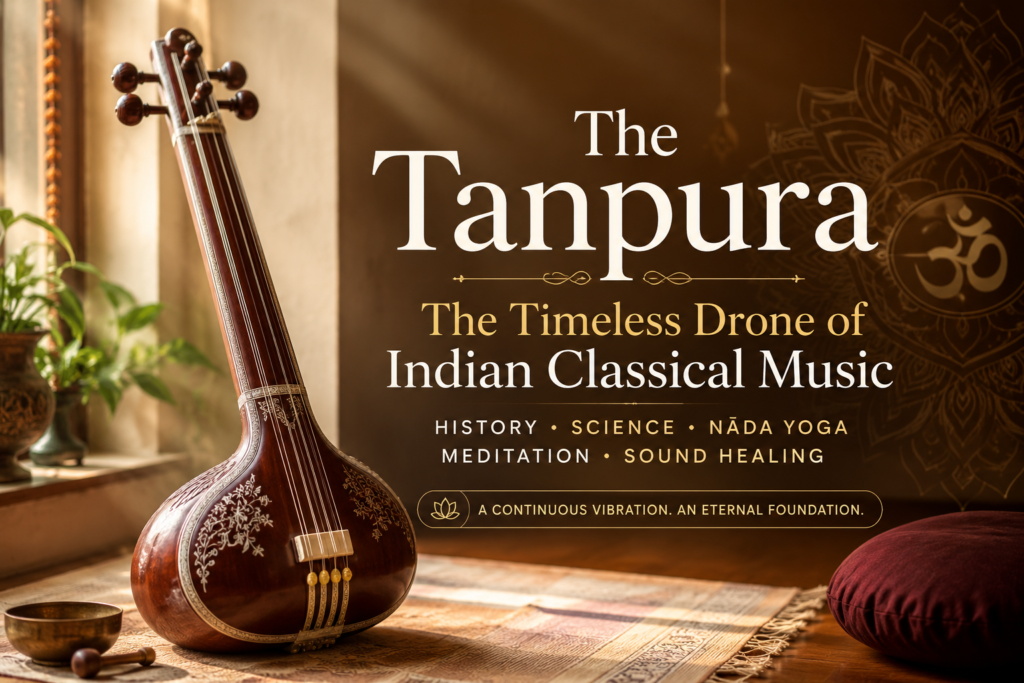
Before a vocalist sings the first note of a raga, before a sitar begins its melody, and before a mantra fills a meditation hall, another sound quietly establishes itself.
It is the gentle, continuous drone of the Tanpura.
To someone hearing Indian classical music for the first time, the instrument may seem almost invisible. It never performs dazzling solos or intricate rhythmic patterns, nor does it seek the spotlight like a sitar or sarod. Instead, it remains in the background, producing an uninterrupted stream of resonance that supports every note sung or played. Yet without the Tanpura, Indian classical music would lose the very foundation upon which its melodies are built.
For centuries, musicians have relied on the Tanpura as their guide for pitch and intonation. Yogis and meditators have listened to its rich drone as a way of quieting the mind, while practitioners of Nada Yoga have regarded it as a living expression of Nāda Brahma, the ancient philosophy that the universe itself is vibration.
Today, the Tanpura continues to inspire not only classical musicians but also those exploring meditation, mindfulness, and sound healing traditions. Its timeless resonance has found a place in yoga studios, meditation retreats, and sound healing meditations, where it creates an atmosphere of stability, deep listening, and inner stillness. More than an instrument, it reminds us that beneath every melody, every thought, and every passing moment lies a constant vibration waiting to be heard.
What Is a Tanpura?
The Tanpura, also known as the Tambura or Tamboora, is a long-necked, fretless string instrument used to create a continuous drone throughout a performance of Indian classical music.
Unlike melodic instruments such as the sitar, sarod, or veena, the Tanpura does not perform compositions or improvisations. Its purpose is entirely different. It repeatedly sounds the tonic note (Sa) together with supporting notes such as Pa or Ma, creating a rich and harmonious field of resonance that remains present from the beginning to the end of a performance.
Rather than drawing attention to itself, the Tanpura allows every other musical element to flourish. Singers rely on it to maintain accurate intonation, instrumentalists use it as a constant tonal reference, and listeners often find that its gentle drone creates a sense of calm long before the melody begins.
Its simplicity is precisely what makes it extraordinary.
The History of the Tanpura
The Tanpura did not appear overnight. Like many elements of Indian classical music, it evolved gradually over centuries as musical traditions became more refined.
Although no surviving ancient scripture describes the modern Tanpura in detail, its origins can be traced through the development of early Indian string instruments and the growing importance of sustained tonal support in Vedic chanting.
Early Foundations in Vedic India
The Sāma Veda, one of India’s oldest sacred texts, places great emphasis on precise chanting and accurate intonation. While the Tanpura itself is not mentioned, the idea of maintaining a stable tonal center was already considered essential.
The practice of singing sacred hymns with consistent pitch eventually influenced the development of many later musical traditions.
The Influence of the Nāṭyaśāstra
Around the beginning of the Common Era, Bharata Muni’s Nāṭyaśāstra established many of the foundational principles of Indian music.
The text discusses several string instruments, particularly the Vīṇā, while also exploring ideas such as resonance, harmony, and tonal relationships. These concepts later became central to the role the Tanpura would play in Indian classical music.
The Rise of the Raga Tradition
As Indian music gradually shifted towards the sophisticated raga system during the medieval period, musicians required a reliable source of continuous pitch.
This need encouraged the development of the Tanpura into an instrument specifically designed to produce an uninterrupted drone rather than melodies.
By the Mughal era, the Tanpura had become indispensable in traditions such as:
- Dhrupad
- Khayal
- Bhajan
- Devotional music
- Instrumental classical performances
Today, despite electronic alternatives, the acoustic Tanpura remains the preferred choice for many of India’s finest musicians because of its unmatched warmth and resonance.
The Design Behind the Tanpura’s Unique Sound
At first glance, the Tanpura appears remarkably simple. However, every part of its construction has been carefully refined over generations to produce one of the richest acoustic sounds found in any musical instrument.
A traditional Tanpura consists of:
- A large resonating body made from a dried gourd or carved wood.
- A long hollow neck.
- Four or five metal strings.
- Wooden tuning beads.
- A flat bridge known as the Jawari.
- Fine cotton thread placed beneath the strings.
Each of these components contributes to the instrument’s remarkable voice.
Unlike many string instruments, the Tanpura is not designed to create sharp, isolated notes. Instead, its construction encourages each plucked string to resonate for an extended period while interacting with the vibrations of the other strings.
The result is a continuous sound that feels almost alive.
The Secret of the Jawari
Perhaps the most fascinating feature of the Tanpura is its bridge.
Known as the Jawari, this carefully shaped surface allows the vibrating string to touch the bridge in a unique way as it oscillates.
Rather than producing a clean, quickly fading note, the Jawari creates a sustained cascade of harmonics that gives the Tanpura its characteristic shimmering quality.
This subtle interaction between string and bridge is so important that skilled craftsmen spend years mastering the art of shaping a perfect Jawari.
How Does the Tanpura Work?
Unlike melodic instruments that constantly change notes, the Tanpura follows a simple repeating pattern.
A common tuning is:
- Pa
- Sa
- Sa
- Sa
Some ragas instead use:
- Ma
- Sa
- Sa
- Sa
The player gently plucks one string after another in a slow, continuous cycle.
As one note begins to fade, the next is already emerging. This overlap creates an uninterrupted field of sound that surrounds both performer and listener.
Although only four strings are being played, the interaction of their harmonics creates a remarkably complex acoustic landscape.
Rather than hearing separate notes, the listener experiences a continuous sonic atmosphere that feels stable, spacious, and deeply immersive.
The Science Behind the Tanpura
For musicians, the Tanpura is a trusted companion.
For physicists, it is an elegant demonstration of acoustic science.
Every time one of its strings is plucked, several physical processes occur simultaneously.
Harmonics and Resonance
Each string produces much more than a single frequency.
The listener hears:
- The fundamental frequency.
- Natural harmonic overtones.
- Sympathetic resonance between the strings.
- Long-lasting sustain.
- Subtle variations created by the Jawari bridge.
These harmonics blend continuously, creating the rich texture that makes the Tanpura instantly recognisable.
Instead of sounding repetitive, the drone constantly evolves through tiny fluctuations in resonance.
Why the Drone Sounds So Rich
Several factors contribute to the Tanpura’s extraordinary sound quality:
- The large resonating chamber amplifies vibration naturally.
- The curved Jawari bridge enriches harmonic content.
- The strings interact sympathetically with one another.
- The repeated plucking pattern prevents the sound from fading completely.
Together, these elements create an acoustic environment unlike almost any other musical instrument.
The Tanpura as a Teacher of Listening
One reason musicians practise with the Tanpura every day is that it trains the ear rather than simply providing accompaniment.
Its drone helps performers develop:
- Precise pitch recognition.
- Stable intonation.
- Sensitivity to microtones (Śruti).
- Improved vocal control.
- Deeper listening skills.
Rather than forcing the musician into the correct note, the Tanpura encourages careful listening until the voice naturally aligns with its resonance.
This is why generations of Indian classical musicians have affectionately called the Tanpura the guru of pitch.
The Tanpura in Indian Classical Music
Ask any Indian classical musician to name the most important instrument on stage, and many will not say the sitar, sarod, or tabla.
They will say the Tanpura.
That answer often surprises people because the Tanpura never performs the melody. Yet every note sung or played depends upon it. The drone provides a constant tonal centre that allows musicians to explore a raga with confidence while maintaining perfect intonation.
In Indian classical music, a performer is never simply singing individual notes. Every note exists in relationship to Sa, the tonic. The Tanpura keeps this relationship alive throughout the performance, gently reminding the musician where home is.
Unlike Western music, which often changes key or harmony, Indian classical music develops around a single tonal centre. The Tanpura preserves that centre from beginning to end, allowing the emotional character of the raga to unfold naturally.
Why Every Musician Practices with the Tanpura
Students begin learning alongside the Tanpura from the earliest stages of their musical education.
Instead of depending on electronic tuners or visual cues, they develop their ears by listening carefully to the drone and matching every note to its resonance.
Practising with the Tanpura helps musicians develop:
- Accurate pitch.
- Stable intonation.
- Breath control.
- Vocal endurance.
- Awareness of subtle microtones (Śruti).
- Deep listening skills.
This emphasis on listening is one reason Indian classical music produces such remarkable vocal precision. Rather than relying solely on technique, musicians cultivate an intimate relationship with sound itself.
The Tanpura and Nada Yoga
The importance of the Tanpura extends far beyond music.
Within Nada Yoga, the ancient yogic science of sound, it represents one of the clearest expressions of the philosophy that the universe is sustained by vibration.
The Sanskrit word Nāda means sound or vibration, while Yoga means union. Together, they describe a practice in which sound becomes a pathway towards meditation and self-realisation.
The uninterrupted drone of the Tanpura beautifully reflects this philosophy.
Melodies constantly change.
Thoughts come and go.
Breath rises and falls.
Yet beneath all of these changing experiences, the drone remains steady.
For practitioners of Nada Yoga, this becomes more than a musical experience. It becomes a reminder of the unchanging awareness that exists beneath the constantly changing activity of the mind.
Listening as Meditation
One of the simplest yet most profound practices in Nada Yoga is attentive listening.
Rather than analysing the music or waiting for the next note, practitioners simply allow their attention to rest within the continuous resonance of the Tanpura.
As listening deepens, many people notice a gradual shift.
External sounds become less distracting.
Breathing slows naturally.
Mental activity softens.
Moments of silence between thoughts become easier to recognise.
The Tanpura therefore becomes more than an instrument. It becomes an object of meditation that gently guides attention inward.
Why the Tanpura Is Used in Meditation and Sound Healing
Although the Tanpura has always belonged to Indian classical music, its role has expanded into meditation and modern sound healing traditions.
Many meditation teachers choose the Tanpura because its steady drone creates an acoustic environment that encourages sustained attention without overwhelming the senses.
Unlike music with changing melodies and rhythms, the Tanpura remains remarkably stable. This allows practitioners to settle into a relaxed state while maintaining awareness of the present moment.
Today, the Tanpura is frequently used during:
- Meditation sessions.
- Yoga Nidra.
- Prāṇāyāma practice.
- Mantra chanting.
- Guided relaxation.
- Vocal resonance exercises.
- Mindfulness sessions.
Its sound supports these practices not because it contains a magical frequency, but because it encourages deep listening and uninterrupted concentration.
The Tanpura in Sound Healing
As interest in sound healing meditation continues to grow, more practitioners are discovering the unique qualities of the Tanpura.
Its gentle resonance blends naturally with instruments such as:
- Singing bowls.
- Tuning forks.
- Gongs.
- Shruti boxes.
- Temple bells.
- The Shankha (sacred conch).
Together, these instruments create immersive sound environments that support relaxation and mindful awareness.
What Does Science Say About the Tanpura?
The calming quality of the Tanpura is familiar to musicians and meditation practitioners alike, but what does modern science tell us?
Although research specifically examining the Tanpura remains limited, several related fields help explain why many people find its sound deeply relaxing.
Studies have shown that:
- Music influences emotional processing.
- Focused listening supports mindfulness.
- Slow breathing encourages relaxation.
- Harmonic sound environments affect auditory perception.
- Sustained attention can reduce mental distraction.
The Tanpura naturally combines many of these elements.
Its continuous drone encourages listeners to remain present without constantly anticipating musical changes. As attention settles into the sound, breathing often becomes slower and more regular, creating conditions that many people associate with relaxation and meditation.
Appreciating Tradition and Science Together
It is important to distinguish traditional understanding from scientific evidence.
Modern science clearly recognises that sound influences attention, emotion, and perception.
However, there is currently no scientific evidence showing that the Tanpura itself possesses unique healing frequencies capable of treating disease.
Its value is better understood as part of a wider contemplative practice that combines attentive listening, breath awareness, and meditation.
This balanced perspective allows us to appreciate both the ancient wisdom surrounding the Tanpura and the growing body of research exploring the effects of sound on human experience.
Learning the Tanpura Through Traditional Practice
To truly understand the Tanpura, it is not enough to simply hear its sound.
Its deeper significance emerges through practice.
Students exploring a Sound Healing Course in Rishikesh often encounter the Tanpura alongside mantra chanting, Yoga Nidra, meditation, and the philosophy of Nada Yoga. Rather than being introduced merely as a background instrument, it is presented as a tool for cultivating listening, breath awareness, and inner stillness.
Those who continue into a Sound Healing Teacher Training in Rishikesh discover how the Tanpura complements singing bowls, tuning forks, and other traditional instruments while remaining firmly rooted in India’s classical musical heritage. This holistic approach reflects the enduring influence of sound healing in Rishikesh, where ancient yogic practices continue to inspire contemporary approaches to meditation and mindful listening.
Final Thoughts
The Tanpura has remained at the heart of India’s musical and spiritual traditions for centuries, not because it demands attention, but because it quietly supports everything around it. Its uninterrupted drone provides the foundation upon which ragas are performed, voices are trained, and meditation unfolds. Through its rich harmonics and timeless resonance, it teaches one of the most profound lessons of Indian classical music and Nada Yoga: beneath every changing melody lies a constant vibration.
Whether heard in a concert hall, a temple, or during sound healing meditation, the Tanpura continues to invite us into a deeper way of listening. It reminds us that true listening is not simply the act of hearing sound but the practice of becoming fully present with it. In that continuous drone, generations of musicians, yogis, and seekers have discovered a space where music, meditation, and silence naturally meet.
Frequently Asked Questions
What is a Tanpura?
A Tanpura is a traditional Indian string instrument that produces a continuous drone rather than melodies. It provides the tonal foundation for Indian classical music and is widely used in Nada Yoga and meditation.
Why is the Tanpura important?
The Tanpura helps singers and musicians maintain accurate pitch while creating a stable harmonic environment. It also supports deep listening and concentration during meditation.
Is the Tanpura used in sound healing?
Yes. Many practitioners use the Tanpura during sound healing meditations, Yoga Nidra, mantra chanting, and breathwork because its continuous drone encourages relaxation and mindful awareness.
Can beginners benefit from listening to the Tanpura?
Absolutely. Even without musical training, many people find the steady resonance calming and supportive for meditation, breath awareness, and relaxation.