Kandharasana, commonly known as Shoulder Pose, is a foundational backbend in Hatha Yoga that strengthens the posterior body while opening the chest, shoulders, and hips. Often compared to Setu Bandhasana (Bridge Pose), Kandharasana differs by requiring practitioners to hold the ankles, creating a deeper chest opening and greater engagement of the shoulders.
Although the pose appears simple, it teaches many of the essential principles required for more advanced backbends. Proper alignment, steady breathing, and mindful activation of the legs and core help practitioners develop spinal mobility while improving posture and body awareness.
For students enrolled in a Hatha Yoga Teacher Training in Rishikesh, Kandharasana serves as an important preparatory posture before progressing to deeper backbends such as Chakrasana (Wheel Pose). It is commonly included in traditional Hatha Yoga classes because it balances strength with flexibility while cultivating stability throughout the body.
In this guide, you’ll learn how to practice Kandharasana safely, understand its anatomical benefits, explore common mistakes, and discover why it remains an essential posture in every authentic Hatha Yoga course.
What Is Kandharasana?
The Sanskrit word Kandha means shoulder, while Asana means posture.
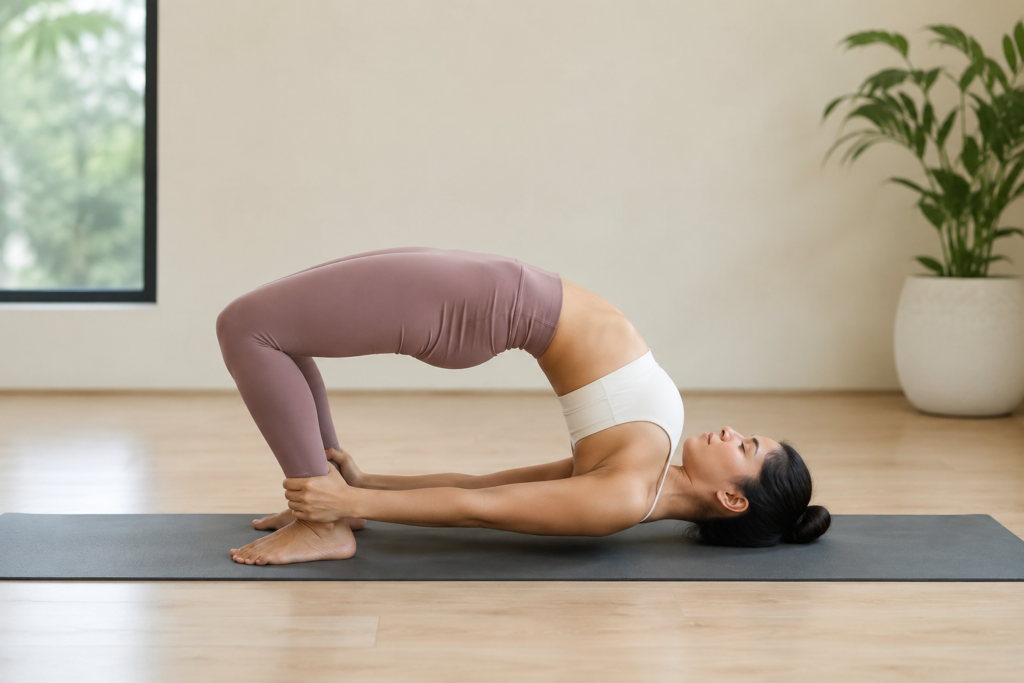
In Kandharasana, the practitioner lies on the back, bends the knees, holds the ankles, and lifts the hips toward the ceiling while grounding through the feet and shoulders. Unlike Bridge Pose, where the arms often remain beside the body, Kandharasana traditionally involves holding the ankles, encouraging greater chest expansion and shoulder stability.
This posture belongs to the category of gentle backbends and is widely practiced in traditional Hatha Yoga for improving posture, strengthening the back body, and preparing students for more advanced spinal extension.
How to Practice Kandharasana Step by Step
Step 1: Starting Position
- Lie comfortably on your back.
- Bend both knees.
- Place your feet flat on the mat about hip-width apart.
- Bring your heels as close to your sitting bones as comfortably possible.
- Reach back and hold your ankles with your hands.
If reaching the ankles isn’t comfortable, place your arms alongside the body or use a yoga strap around the ankles.
Step 2: Prepare the Upper Body
Before lifting:
- Relax the neck.
- Keep the gaze toward the ceiling.
- Draw the shoulder blades gently toward one another.
- Maintain the natural curve of the cervical spine.
Avoid flattening or overstretching the neck.
Step 3: Lift into the Pose
As you inhale:
- Press firmly through both feet.
- Lift the hips upward.
- Continue lifting the spine one vertebra at a time.
- Expand the chest toward the chin without forcing the neck.
Keep the weight evenly distributed between:
- Feet
- Shoulders
- Upper arms
Avoid placing excessive pressure on the neck.
Step 4: Hold the Position
Remain in the posture for 5–10 slow breaths.
Focus on:
- Even breathing
- Stable knees
- Relaxed facial muscles
- Broad collarbones
- Active legs
Advanced practitioners may remain longer depending on their experience.
Step 5: Release Slowly
Exhale gently.
Lower the spine one segment at a time until the hips return to the floor.
Rest for several breaths before repeating.
Traditionally, the posture may be repeated 2–3 times.
Benefits of Kandharasana
Regular practice of Kandharasana offers numerous physical and mental benefits.
Strengthens the Posterior Chain
The posture strengthens:
- Gluteus maximus
- Hamstrings
- Spinal extensors
- Calf muscles
These muscles help support healthy posture and spinal stability.
Opens the Chest and Shoulders
As the chest lifts upward, the pose stretches:
- Pectoral muscles
- Front shoulders
- Hip flexors
- Abdomen
This counteracts the rounded posture associated with prolonged sitting.
Improves Spinal Mobility
Kandharasana encourages healthy spinal extension while improving flexibility throughout the thoracic and lumbar spine.
Practicing with proper alignment can help reduce stiffness caused by sedentary lifestyles.
Supports Better Posture
The pose strengthens muscles responsible for maintaining an upright posture while opening tight areas that contribute to slouching.
For students spending long hours at desks, Kandharasana can become an excellent posture for restoring balance.
Encourages Deep Breathing
Chest expansion creates additional space for the lungs.
Many practitioners notice:
- Easier breathing
- Improved awareness of the diaphragm
- Greater relaxation
Prepares the Body for Advanced Backbends
In traditional Hatha Yoga classes, Kandharasana serves as a progression toward deeper postures including:
- Chakrasana (Wheel Pose)
- Ustrasana (Camel Pose)
- Dhanurasana (Bow Pose)
Learning proper alignment here builds confidence for more demanding backbends.
Anatomy of Kandharasana
Understanding anatomy helps practitioners perform the posture more safely and effectively.
Primary Muscles Activated
- Gluteus maximus
- Hamstrings
- Erector spinae
- Adductors
- Quadriceps
These muscles generate the lifting action of the hips.
Muscles Being Stretched
- Hip flexors
- Abdominal muscles
- Chest
- Front shoulders
- Neck (gently)
Maintaining balanced muscular engagement prevents excessive compression in the lower back.
Common Mistakes to Avoid
Allowing the Knees to Splay Outward
Keep the knees aligned with the feet.
This improves hip stability and protects the lower back.
Turning the Head
Never rotate the head while holding the posture.
The neck should remain completely still.
Lifting Too High with the Lower Back
Instead of forcing the lumbar spine, think about lengthening the spine while lifting the sternum.
The extension should be distributed throughout the entire back.
Holding the Breath
Maintain smooth, controlled breathing throughout the posture.
Breath restriction often creates unnecessary tension.
Placing the Feet Too Far Away
If the feet are positioned too far from the hips, lifting becomes more difficult and places unnecessary stress on the knees.
Modifications for Beginners
If you’re new to the pose, several modifications can make Kandharasana more accessible.
Use a Yoga Strap
Loop a strap around both ankles if your hands cannot comfortably reach.
Keep the Arms Beside the Body
Instead of holding the ankles, place the palms flat beside the hips.
This variation closely resembles Bridge Pose and is often used in beginner Hatha Yoga classes.
Supported Kandharasana
Place a yoga block beneath the sacrum.
This restorative variation allows practitioners to experience the chest opening without muscular effort.
Advanced Variations
Once the foundational posture feels comfortable, practitioners may explore:
- Longer holds
- Dynamic hip lifts
- One-leg Bridge variations
- Progression toward Chakrasana
Advanced variations should be practiced under qualified guidance.
Contraindications and Precautions
Avoid or modify Kandharasana if you have:
- Recent neck injuries
- Shoulder injuries
- Severe lower back pain
- Abdominal hernia
- Recent abdominal surgery
Pregnant practitioners should consult an experienced yoga teacher before practicing deep backbends.
If you experience:
- Sharp pain
- Numbness
- Tingling
- Difficulty breathing
Exit the posture immediately.
Preparatory Poses
Preparing the body improves both safety and alignment.
Recommended poses include:
- Pelvic Tilts
- Sphinx Pose
- Bhujangasana (Cobra Pose)
- Salabhasana (Locust Pose)
- Cat-Cow Stretch
These movements gently activate the posterior chain before entering Kandharasana.
Counterposes
After practicing Kandharasana, balance the spine with gentle neutralizing postures such as:
- Makarasana (Crocodile Pose)
- Balasana (Child’s Pose)
- Apanasana (Knees-to-Chest Pose)
- Supine Spinal Twist
These poses help release any residual tension in the back.
Kandharasana in a 200 Hour Yoga Teacher Training in Rishikesh
Kandharasana is a valuable teaching posture within a traditional 200 Hour Yoga Teacher Training in Rishikesh. Students learn how to perform the pose and also how to teach it with confidence, understanding proper alignment, anatomy, breath coordination, contraindications, and safe modifications for practitioners of different abilities.
A comprehensive Hatha Yoga Teacher Training in Rishikesh emphasizes the principles behind each asana rather than simply memorizing sequences. Through daily Hatha Yoga classes, students develop the observational skills needed to correct alignment, prevent injuries, and adapt postures to individual needs.
Whether you aspire to become a yoga teacher or deepen your personal practice, studying Kandharasana provides a strong foundation for mastering backbends and understanding the biomechanics of Hatha Yoga.
Conclusion
Kandharasana is a simple yet highly effective backbend that strengthens the posterior chain, improves spinal mobility, opens the chest, and prepares practitioners for more advanced yoga postures. While its physical benefits are significant, its true value lies in teaching balance, stability, mindful breathing, and proper alignment—principles that form the foundation of Hatha Yoga.
Frequently Asked Questions
Is Kandharasana the same as Bridge Pose?
They are closely related but not identical. In Kandharasana, practitioners traditionally hold their ankles, whereas Bridge Pose usually keeps the arms alongside the body or interlaces the fingers beneath the back.
Is Kandharasana suitable for beginners?
Yes. With proper guidance and modifications, Kandharasana is appropriate for beginners and is commonly taught in introductory Hatha Yoga classes.
How long should I hold Kandharasana?
Beginners can hold the posture for 5–10 slow breaths. As strength and flexibility improve, the duration can gradually increase.
Can Kandharasana help improve posture?
Yes. The posture strengthens the back muscles while opening the chest and shoulders, making it beneficial for counteracting rounded shoulders and prolonged sitting.