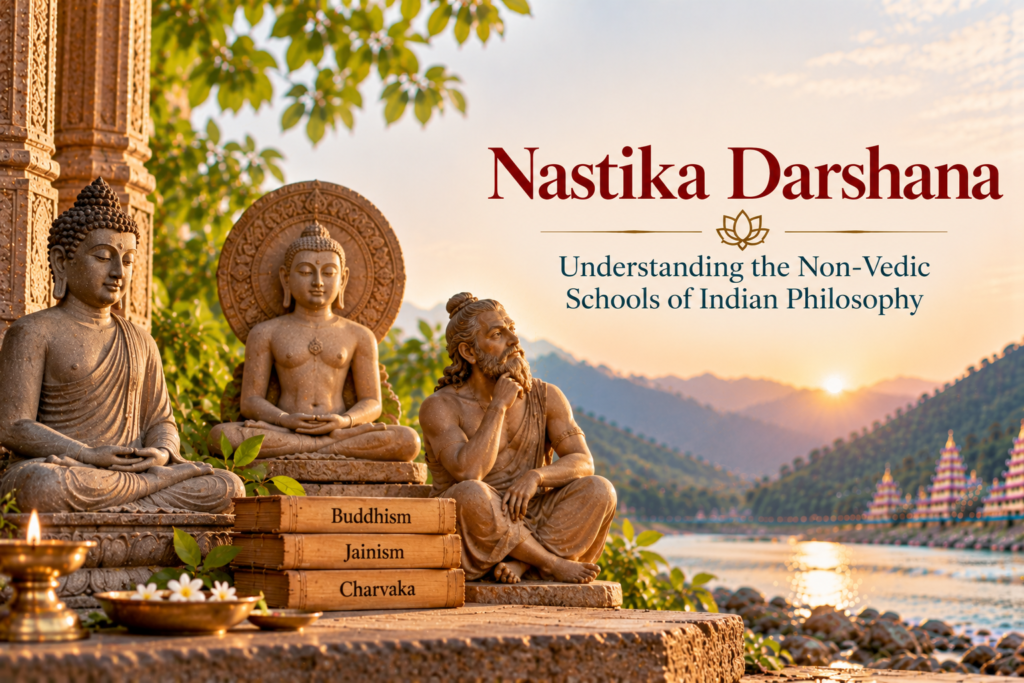
Indian philosophy contains a remarkable range of viewpoints. Alongside the six classical Astika Darshanas, which recognize the authority of the Vedas, Indian thinkers developed philosophical traditions that questioned or rejected Vedic authority.
These traditions are broadly described as Nastika Darshanas.
The word nastika is often translated as “heterodox,” “non-orthodox,” or “one who does not accept.” In the context of Indian philosophy, the most important distinction concerns acceptance of Vedic authority. Nastika therefore does not simply mean “atheist.” Buddhism and Jainism, for example, are traditionally classified as Nastika traditions, while their philosophical systems contain extensive teachings on ethics, meditation, consciousness, karma and liberation.
The most commonly discussed Nastika traditions are Buddhism, Jainism and Charvaka or Lokayata. Each developed a distinctive understanding of knowledge, reality, human experience and the possibility of liberation.
What does Nastika mean?
The Sanskrit term Nāstika is related to na asti, meaning “it is not” or “there is not.”
In philosophical classification, the term came to describe traditions that did not accept the authority of the Vedas as the final source of knowledge. This classification places Buddhism, Jainism and Charvaka outside the Astika group of six Vedic philosophical systems.
The distinction becomes important when studying Indian philosophy because Astika and Nastika are technical philosophical classifications.
For example, classical Samkhya is generally classified as Astika even though its classical metaphysics does not require a creator God. Charvaka is classified as Nastika because it rejects Vedic authority and develops a materialist account of reality.
Therefore, translating Astika as simply “believer in God” and Nastika as simply “atheist” can create confusion.
The three major Nastika traditions
The three traditions most commonly included in discussions of Nastika philosophy are:
| Tradition | Central concern | Distinctive feature |
| Buddhism | Suffering, impermanence, consciousness and liberation | No permanent self |
| Jainism | Soul, karma, non-violence and liberation | Individual souls and strict ethical discipline |
| Charvaka / Lokayata | Perception, material reality and human experience | Materialism and rejection of supernatural claims |
These traditions are very different from one another.
Buddhism developed teachings around the Four Noble Truths, dependent origination, impermanence and non-self. Jain philosophy developed an elaborate account of individual souls, karma, non-violence and liberation. Charvaka developed a materialist philosophy emphasizing perception and rejecting claims about realities beyond experience.
1. Buddhism
Buddhism emerged in ancient India through the teachings associated with Siddhartha Gautama, the Buddha.
Rather than accepting the Vedas as an authoritative revelation, Buddhist philosophy developed its own account of knowledge, ethics, meditation and liberation. This placed Buddhism within the Nastika classification.
Buddhist philosophy is extensive, with many different schools developing over centuries. Still, several foundational ideas provide a useful starting point.
The problem of suffering
The Buddha’s teachings begin with an examination of dukkha, commonly translated as suffering, dissatisfaction or unsatisfactoriness.
The tradition presents the Four Noble Truths:
- The truth of dukkha
- The origin of dukkha
- The cessation of dukkha
- The path leading toward its cessation
This framework gives Buddhist philosophy a strongly practical character. The question concerns the causes of suffering and the possibility of freedom from it.
Impermanence
Anicca, or impermanence, is another central Buddhist teaching.
Everything conditioned is subject to change. Bodies change, sensations change, emotions change, relationships change and mental states change.
Observation of impermanence becomes an important part of Buddhist meditation and philosophical analysis.
Anatta: the question of the Self
One of the most significant differences between Buddhist philosophy and several Indian traditions concerns the concept of anatta, or non-self.
Buddhist teachings examine the body, sensations, perceptions, mental formations and consciousness as changing processes. The teaching challenges the idea of an eternal, unchanging personal self behind these processes.
This creates an important philosophical contrast with traditions such as Vedanta, which develop teachings concerning Atman.
The comparison is particularly valuable for students of Indian philosophy because both traditions ask profound questions about identity and consciousness while reaching different conclusions.
Buddhism and meditation
Meditation occupies a central position in Buddhist traditions.
Practices such as mindfulness and concentration developed into sophisticated systems of contemplative training. The practitioner observes experience carefully and develops insight into impermanence, suffering and non-self.
This creates an interesting connection with yoga philosophy.
Both Buddhist and Yogic traditions developed detailed meditation systems in India, although their philosophical interpretations of consciousness and the Self differ.
For a student of Yoga, studying Buddhist philosophy can therefore clarify the different ways Indian traditions approached meditation and liberation.
Buddhism and sound
Sound also has an important place in several Buddhist traditions.
Mantras, chanting and recitation became particularly significant in Mahayana and Vajrayana Buddhism. Buddhist communities have developed rich traditions of scriptural chanting, ritual sound and mantra practice.
These practices can be studied alongside Nada Yoga while keeping their different philosophical contexts clear.
Nada Yoga traditionally approaches sound through a yogic framework involving listening, concentration and consciousness. Buddhist traditions approach chanting and mantra through their own teachings on practice, compassion, visualization, ritual, and awakening. A lot of buddhist techniques of meditation are taught during a yoga course especially in sound healing teacher training courses.
2. Jainism
Jainism is another major Nastika tradition.
Jain philosophy developed independently of Vedic authority and presents a sophisticated account of reality, knowledge, ethics and liberation. Its tradition traces its teachings through a succession of Tirthankaras, with Mahavira regarded as the 24th Tirthankara of the current age.
Jain philosophy places enormous importance on ethical discipline and the purification of the individual soul.
The Jiva
A central Jain concept is jiva, the living or conscious soul.
Jain philosophy recognizes individual souls as real entities. This creates an important contrast with Buddhism’s doctrine of anatta.
According to Jain thought, the soul possesses the potential for unobstructed knowledge and other perfected qualities. Karma becomes a major part of the explanation for why this potential remains obscured.
Karma in Jain philosophy
Jainism presents karma in a distinctive way.
Karmic matter is understood as binding to the soul as a consequence of actions and passions. Spiritual discipline gradually removes these karmic obstructions and allows the soul’s inherent qualities to become fully expressed.
This differs considerably from the way karma is understood in Buddhist and Vedantic traditions.
The shared Sanskrit word karma therefore does not guarantee an identical philosophical meaning across Indian traditions.
Ahimsa and Jain philosophy
Perhaps the most widely recognized Jain principle is ahimsa, or non-violence.
Jain ethical practice gives exceptional importance to avoiding harm to living beings. This principle shapes food choices, occupation, daily conduct, monastic discipline and spiritual practice.
For Jain renunciants, ethical discipline can become extremely rigorous.
The goal is purification of the soul and release from karmic bondage. Jain philosophical thought therefore connects metaphysics, ethics and spiritual practice very closely.
Anekantavada: many-sided reality
Jain philosophy is also known for anekantavada, commonly described as the doctrine of many-sidedness.
The principle emphasizes the complexity of reality and the limitations of viewing something from only one standpoint.
Jain philosophers developed sophisticated methods for qualifying philosophical statements according to the standpoint from which they are made.
This has made Jain philosophy particularly important in discussions of pluralism, perspective and philosophical reasoning.
Jainism and liberation
The goal of Jain spiritual practice is liberation of the soul.
A liberated soul is free from karmic obstruction and manifests its inherent qualities fully. Jain philosophy therefore presents liberation as a transformation in the condition of the individual soul.
The path includes ethical discipline, non-violence, ascetic practice, knowledge and spiritual purification.
3. Charvaka or Lokayata
The third major Nastika tradition is Charvaka, also known as Lokayata.
Charvaka is particularly distinctive because it developed a strongly materialist and naturalistic philosophy. It rejected supernatural entities such as an immaterial soul, God and an afterlife.
The historical reconstruction of Charvaka is difficult because its original philosophical texts have largely been lost. Much of what is known comes through quotations, criticisms and descriptions preserved in works belonging to other philosophical traditions.
This makes it important to treat detailed claims about Charvaka with some caution.
Perception as knowledge
Charvaka philosophy gives special importance to pratyaksha, direct perception.
The tradition is commonly described as accepting perception as the most reliable means of knowledge and rejecting claims that depend upon unverifiable inference or scriptural testimony.
This emphasis makes Charvaka particularly interesting from the perspective of Indian epistemology.
The school asks a simple but powerful question: What evidence do we actually have for a claim?
If something cannot be directly experienced or adequately established, Charvaka philosophy approaches the claim with skepticism.
Charvaka and inference
The traditional picture of Charvaka requires some nuance.
It is often described as rejecting inference entirely. However, scholarly discussions indicate that the position was more sophisticated. Practical inferences based on observed relationships could have value, while metaphysical inferences concerning entities such as God or an afterlife were treated with skepticism.
This distinction matters because everyday life clearly involves inference.
A person sees smoke and reasonably expects fire. Charvaka criticism becomes particularly relevant when inference is extended into claims about entities that cannot be observed.
Charvaka and the material world
Charvaka philosophy gives priority to the physical world.
The tradition is commonly associated with the four elements of earth, water, fire and air, from which material phenomena are understood to arise. Consciousness is treated as connected with the material organization of the body rather than as an independent immaterial substance.
This creates a sharp philosophical contrast with traditions that affirm an eternal soul or transcendent consciousness.
Charvaka and God
Charvaka does not accept the existence of a creator God.
Its philosophical method questions claims that cannot be established through experience or reliable evidence. The school therefore rejects the supernatural cosmologies accepted by many other Indian philosophical traditions.
The difference between Buddhism, Jainism and Charvaka
Calling all three traditions “Nastika” can make them appear more similar than they actually are.
Their fundamental philosophical positions differ substantially.
| Question | Buddhism | Jainism | Charvaka |
| Vedic authority | Rejected | Rejected | Rejected |
| Permanent individual Self | No permanent self in Buddhist teaching | Individual jivas exist | No immaterial eternal soul |
| Karma | Central | Central | Rejected |
| Rebirth | Central to traditional Buddhist teachings | Central | Rejected |
| Liberation | Nirvana | Liberation of the soul | No traditional moksha |
| God | Various Buddhist traditions differ, with creator God unnecessary to the core path | Creator God is not central | Creator God rejected |
| Main emphasis | Suffering, impermanence, non-self, awakening | Soul, karma, ahimsa, purification | Perception, materialism, naturalism |
This table provides a broad orientation. Each tradition contains multiple schools and historical developments, so individual doctrines can be more nuanced than a short comparison suggests.
Astika and Nastika: the important distinction
The relationship between Astika and Nastika Darshanas is one of the most misunderstood subjects in introductory discussions of Indian philosophy.
The six Astika schools are:
- Nyaya
- Vaisheshika
- Samkhya
- Yoga
- Purva Mimamsa
- Vedanta
The major Nastika traditions include:
- Buddhism
- Jainism
- Charvaka / Lokayata
The distinction concerns their relationship to Vedic authority.
This classification creates some fascinating philosophical situations.
Samkhya can be classified as Astika while developing a metaphysics that does not depend upon a creator God.
Buddhism can be classified as Nastika while developing highly sophisticated philosophical systems concerning consciousness, ethics and liberation.
Jainism can be classified as Nastika while maintaining an elaborate metaphysical account of souls, karma and liberation.
Charvaka can be classified as Nastika because it rejects Vedic authority as well as supernatural metaphysics.
Nastika does not mean atheism
This distinction deserves its own section because it is so frequently misunderstood.
Nastika and atheism are not identical categories.
The term Nastika primarily concerns the status of the Vedas within a philosophical system.
Atheism concerns belief in God or gods.
These questions overlap in some traditions, especially Charvaka, yet they remain philosophically distinct.
Buddhist philosophy does not require belief in a creator God, while its primary philosophical concerns center on suffering, impermanence, non-self and liberation.
Jain philosophy also does not depend upon a creator God, while maintaining a detailed metaphysics of individual souls and karma.
Therefore, describing every Nastika tradition simply as “atheistic philosophy” loses important distinctions.
Nastika philosophy and the concept of the Self
The question of the Self creates one of the most interesting contrasts among Indian philosophical traditions.
Vedanta explores Atman and its relationship with Brahman.
Samkhya distinguishes Purusha from Prakriti.
Jainism affirms individual jivas.
Buddhism develops the teaching of anatta, questioning the existence of a permanent self.
Charvaka rejects the idea of an immaterial eternal soul and explains consciousness through the material body.
These different positions demonstrate how intensely Indian philosophers examined the question of personal identity.
Nastika philosophy and meditation
Buddhism provides the strongest connection between Nastika philosophy and systematic meditation.
Meditative practices became central to Buddhist traditions, particularly practices involving mindfulness, concentration and insight.
Jainism also developed extensive contemplative and ascetic practices directed toward purification and liberation.
Charvaka presents a fundamentally different picture because it does not accept an immortal soul or traditional liberation through spiritual practice.
Studying these differences helps clarify that meditation itself does not automatically imply one particular metaphysical worldview.
Nastika philosophy and Yoga
The relationship between Nastika traditions and Yoga is historically fascinating.
Buddhist and Jain traditions developed their own systems of meditation, ethics, renunciation and liberation alongside Brahmanical Yoga traditions.
This means that meditation was part of a much wider Indian philosophical environment.
For a yoga student, studying Buddhism and Jainism can therefore broaden the understanding of how concepts such as concentration, renunciation, discipline, non-violence and liberation developed across different traditions.
Nastika philosophy and Nada Yoga
For students of Nada Yoga, the comparison becomes especially interesting through the question of sound and consciousness.
Traditional Nada Yoga approaches sound through a yogic framework. Listening can become a method for concentration, meditation and inward awareness.
Buddhist traditions also developed extensive practices involving chanting, recitation and mantra, especially within Mahayana and Vajrayana contexts.
Jain traditions have their own traditions of sacred recitation and devotional practice.
Charvaka provides a radically different philosophical perspective because it treats sensory experience as central to knowledge and does not accept supernatural explanations for consciousness.
These perspectives can be studied side by side while preserving their individual philosophical contexts.
Why study Nastika Darshanas?
Studying Nastika philosophy is valuable because Indian philosophical history contains genuine disagreement.
Philosophers questioned one another about the authority of scripture, the nature of consciousness, the existence of the soul, the reality of karma, the possibility of liberation and the reliability of different forms of knowledge.
Buddhist thinkers challenged the concept of a permanent self. Jain thinkers developed a detailed theory of individual souls and many-sided reality. Charvaka thinkers questioned supernatural claims and emphasized perception.
These debates contributed to the development of Indian logic, epistemology, metaphysics and ethics.
Shad Darshana and Nastika Darshana together
The six Astika schools and major Nastika traditions together provide a much broader picture of Indian philosophy.
The Astika Darshanas explore reality from perspectives grounded in Vedic authority.
The Nastika traditions developed outside that authority and offered alternative approaches to knowledge, ethics, consciousness and liberation.
Studying both groups gives a student a more complete picture of the philosophical debates that shaped India.
It also shows that Indian philosophy was never a single uniform system. It was a long conversation involving agreement, disagreement, debate, interpretation and philosophical refinement.
Final thoughts
Nastika Darshana refers broadly to Indian philosophical traditions that reject the authority of the Vedas. The three traditions most commonly discussed under this classification are Buddhism, Jainism and Charvaka.
Their philosophies differ deeply.
Buddhism investigates suffering, impermanence and non-self while developing extensive traditions of meditation and ethical practice. Jainism emphasizes individual souls, karma, non-violence and purification. Charvaka takes a materialist approach, giving primary importance to perception and rejecting supernatural explanations.
For students of Indian philosophy and Yoga, these traditions offer an important lesson: the philosophical landscape of India contains many different answers to the same fundamental questions.
What is consciousness? What is the Self? What can human beings know? What causes suffering? What makes a life meaningful? Is liberation possible?
The Astika and Nastika traditions developed different answers, and studying those differences makes the history of Indian philosophy far richer.
FAQs
What are Nastika Darshanas?
Nastika Darshanas are Indian philosophical traditions that reject or do not accept the authority of the Vedas. Buddhism, Jainism and Charvaka are the three major traditions commonly placed in this category.
What are the three main Nastika schools?
The three major Nastika traditions are Buddhism, Jainism and Charvaka or Lokayata.
Does Nastika mean atheist?
Nastika primarily refers to rejection of Vedic authority. The term should not be treated as a simple synonym for atheism. Buddhist and Jain philosophies, for example, have philosophical positions that cannot be reduced to the question of belief in a creator God.
Is Buddhism a Nastika philosophy?
Yes. Buddhism is traditionally classified as Nastika because it does not recognize the Vedas as an authoritative foundation for its philosophical and spiritual teachings.
Is Jainism Nastika?
Yes. Jainism is traditionally classified as Nastika because Jain philosophy developed independently of Vedic authority. Jain thinkers developed their own account of knowledge, reality, karma, ethics and liberation.
What is Charvaka philosophy?
Charvaka, also known as Lokayata, is an ancient Indian materialist philosophy associated with skepticism toward supernatural claims. It places particular importance on perception as a source of knowledge and rejects concepts such as an immaterial soul and afterlife.
What is the difference between Astika and Nastika?
The primary distinction concerns acceptance of Vedic authority. The six Astika Darshanas are Nyaya, Vaisheshika, Samkhya, Yoga, Purva Mimamsa and Vedanta. Buddhism, Jainism and Charvaka are major Nastika traditions.
Is Samkhya Nastika because it does not require God?
No. Classical Samkhya is classified as Astika because of its relationship with Vedic authority. The Astika-Nastika distinction is not simply a classification based on belief in a creator God.
How is Buddhism different from Vedanta?
One major philosophical difference concerns the Self. Buddhist teachings develop the doctrine of anatta, while Vedanta traditions develop teachings concerning Atman. The two traditions therefore approach personal identity and consciousness through significantly different philosophical frameworks.
How is Jainism different from Buddhism?
Jainism affirms individual souls and teaches a path of purification from karmic bondage. Buddhist philosophy develops the doctrine of non-self and approaches liberation through teachings concerning suffering, impermanence and dependent origination.