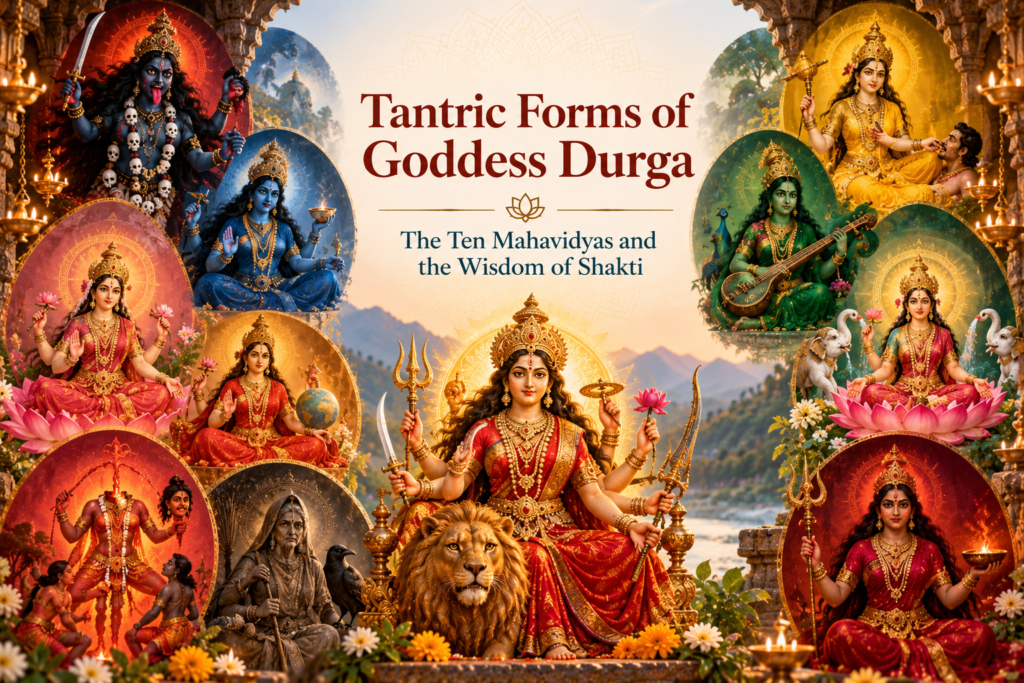
Goddess Durga appears in Hindu tradition as a powerful protector who confronts forces that threaten cosmic order. Her image, with multiple arms, divine weapons and a lion or tiger, represents courage, discernment and the strength required to restore balance. Across the wider Shakta tradition, the Divine Mother also appears through forms that invite deeper reflection on time, knowledge, beauty, death, transformation and the nature of reality.
Tantric traditions explore these dimensions of the Goddess through distinct forms of worship, sacred texts, mantras, yantras and contemplative practices. One of the most significant groups is the Dasha Mahavidya, or the Ten Great Wisdom Goddesses. These ten forms express different dimensions of Mahadevi, the Great Goddess, and occupy an important place in Shakta Tantra. Their imagery ranges from fierce and unsettling to graceful and auspicious, inviting practitioners to contemplate the many ways divine power manifests.
Understanding these traditions requires a distinction between the familiar nine forms of Durga worshipped during Navratri and the ten Mahavidyas of Tantric Shaktism. Both belong to the wider world of Goddess worship, yet each group has its own theological background, symbolism and ritual traditions.
What does Tantra mean in Goddess worship?
Tantra refers to a diverse collection of Hindu and Buddhist traditions that developed their own scriptures, ritual systems, contemplative methods and understandings of spiritual power. Within Hindu Shaktism, Tantric traditions place the Goddess, or Shakti, at the centre of spiritual life. Many Shakta schools understand her as the supreme reality that creates, sustains and transforms the universe. <sup>[1]</sup>
The Sanskrit word Shakti means power, capacity or energy. In Shakta philosophy, it expresses the dynamic power through which existence unfolds. Devotees may worship this power through a particular form of the Goddess, using images, mantras, ritual offerings, meditation and other practices according to their tradition.
Tantric Goddess worship includes many approaches. Some traditions emphasise devotion and formal worship, while others place greater emphasis on initiation, mantra practice, visualisation and subtle philosophical teachings. Specific methods vary between lineages, regions and texts, so a single description cannot represent every Tantric school.
The fierce appearance of certain goddesses also carries symbolic meaning. Skulls, weapons, fire and intense expressions can evoke mortality, the destruction of ignorance, the limits of ordinary identity and the transformative dimensions of existence. Practitioners interpret these symbols within their own theological and ritual frameworks.
The Dasha Mahavidya: Ten forms of the Divine Mother
The Dasha Mahavidya tradition presents ten goddesses, each with distinctive imagery, mythology and spiritual associations. The name combines dasha, meaning ten, with mahavidya, commonly translated as great wisdom or great knowledge.
The ten goddesses are Kali, Tara, Tripura Sundari, Bhuvaneshwari, Bhairavi, Chhinnamasta, Dhumavati, Bagalamukhi, Matangi and Kamala. Lists sometimes use alternative names, including Shodashi for Tripura Sundari and Tripura Bhairavi for Bhairavi. The Mahavidyas form an important group within Shakta Tantra, although their histories and individual worship traditions developed in different ways. <sup>[2]</sup>
A well-known origin narrative appears in later Shakta texts. In one version, Sati reveals ten powerful forms when Shiva attempts to prevent her from attending her father Daksha’s sacrifice. The goddesses appear in different directions, demonstrating the immense power of the Divine Mother. Traditions vary in their accounts, and devotees interpret this story in different ways.
The Mahavidyas can be understood as ten approaches to contemplating the Goddess. Each reveals a distinctive aspect of Shakti, from time and transformation to beauty, speech, silence and abundance.
1. Goddess Kali: Time, transformation and liberation
Kali occupies a central place in several Tantric traditions. Her dark complexion, garland of severed heads, skirt of arms and association with cremation grounds create an intense image of the Goddess. Traditional interpretations connect these features with time, mortality, the destruction of ego and the impermanence of worldly existence.
The name Kali relates to kala, a Sanskrit term associated with time. Her imagery brings attention to the forces that consume every created form. At the same time, devotees approach Kali as a compassionate Mother who protects her followers and guides them through fear and transformation.
Kali’s presence in Tantric traditions is especially prominent in Bengal and other parts of eastern India. Her worship includes devotional hymns, mantra, ritual offerings and contemplative practices that vary between lineages.
For spiritual reflection, Kali invites practitioners to examine their relationship with change, fear and attachment. Her symbolism asks how a person might meet life’s difficult experiences with courage and deeper awareness.
2. Goddess Tara: Guidance and liberating wisdom
Tara appears in Hindu Shakta Tantra as a goddess associated with protection, guidance and liberating knowledge. Her name is commonly connected with the idea of crossing over or helping someone reach the other shore. Devotional interpretations therefore present her as a guide through difficulty and uncertainty.
Artists often depict Tara with blue or dark colouring, a sword, a lotus or other symbolic objects, depending on the tradition. Her fierce appearance communicates the power required to confront obstacles, while her role as a guide expresses compassion and wisdom.
Hindu Tantric Tara worship has its own history and practices. Buddhist traditions also venerate Tara, particularly as a compassionate saviour, and these traditions developed distinct teachings and ritual systems. Although the names and some visual features overlap, the Hindu and Buddhist forms belong to different religious contexts.
Within Shakta practice, Tara encourages contemplation of speech, knowledge and the capacity to move through difficult circumstances with clarity.
3. Goddess Tripura Sundari: Beauty and the harmony of the cosmos
Tripura Sundari, also known as Shodashi and Lalita in closely related traditions, represents beauty, grace and the harmony of existence. Her name is often translated as the beautiful one of the three worlds. Her iconography frequently presents a youthful goddess seated on a throne, holding symbolic implements such as a noose, goad, bow and arrows.
Her worship holds a particularly important position in the Sri Vidya tradition. Practitioners use the Sri Yantra, a sacred geometric diagram formed by interlocking triangles, as a focus for worship and contemplation. The diagram expresses relationships between the Goddess, the cosmos and the spiritual journey according to Sri Vidya teachings.
Tripura Sundari presents beauty as a dimension of sacred reality. Her symbolism encourages practitioners to explore the relationship between harmony, perception, desire and spiritual understanding. The Sri Vidya tradition develops these themes through a specialised body of texts, mantras, ritual practices and philosophical interpretations.
4. Goddess Bhuvaneshwari: Space and the universal Mother
Bhuvaneshwari represents the Goddess as the sovereign of the worlds. Her name combines bhuvana, meaning world or realm, with ishwari, meaning goddess or sovereign. She therefore expresses the power that holds the universe within its vast expanse.
Artists often portray Bhuvaneshwari with a peaceful expression and a radiant presence. Her imagery reflects spaciousness, receptivity and the sustaining power of the Divine Mother. While some Mahavidyas appear through intense or unsettling forms, Bhuvaneshwari invites contemplation through an image of expansive awareness.
Her symbolism offers a way to reflect on space itself. Every object, movement and sound appears within a surrounding field, and contemplative traditions may use this observation to explore the relationship between awareness and experience.
In a Nada Yoga context, this idea can provide a thoughtful point of connection. Sound unfolds through space, while listening requires attention to the sound and the environment in which it arises. This comparison serves as a contemplative connection, with each tradition retaining its own philosophical foundations.
5. Goddess Bhairavi: Discipline, intensity and spiritual effort
Bhairavi expresses the fierce and transformative power of the Goddess. Her name shares a linguistic and theological relationship with Bhairava, a fierce form of Shiva. In Tantric traditions, Bhairavi can represent intensity, spiritual discipline and the force that confronts deeply rooted patterns.
Her iconography may include red colouring, weapons, flames or other symbols of powerful energy. Such imagery conveys the seriousness of spiritual effort and the transformative potential of sustained practice.
Bhairavi’s symbolism can be understood through the discipline required to develop concentration and insight. A spiritual path often calls for patience, ethical commitment and the ability to face difficult aspects of one’s own character. Bhairavi embodies these themes within the specific devotional and philosophical frameworks of her traditions.
Her worship and associated practices differ between Tantric lineages. Formal ritual and specialised mantra practice belong to traditions with their own requirements and systems of instruction.
6. Goddess Chhinnamasta: Sacrifice, life force and transformation
Chhinnamasta is among the most striking figures in the Mahavidya group. Artists typically portray her holding her severed head, with streams of blood flowing toward herself and accompanying figures. This intense image has attracted a wide range of interpretations within Tantric scholarship and devotional literature.
Her symbolism may involve self-sacrifice, the relationship between life and death, the movement of vital energy and the transformation of ordinary identity. Some interpretations also explore the relationship between nourishment, desire and the cycle of existence.
The image challenges viewers to consider how life continually involves change, exchange and transformation. It places creation and destruction within the same symbolic field, reflecting the complex vision of divine power found in some Tantric traditions.
Chhinnamasta’s imagery also demonstrates why the Mahavidyas require careful interpretation. A brief description of the image can introduce the subject, while a fuller understanding depends on the particular texts, ritual traditions and theological explanations that inform her worship.
7. Goddess Dhumavati: Impermanence and the wisdom of difficult times
Dhumavati stands apart from many other forms of the Goddess. Artists often depict her as an elderly woman associated with smoke, desolation, poverty or widowhood. Her imagery brings attention to experiences that people may find uncomfortable, including loss, ageing, uncertainty and the decline of familiar circumstances.
The name Dhumavati relates to dhuma, meaning smoke. Smoke obscures clear vision and suggests a state in which familiar forms lose their definition. Her symbolism can therefore evoke uncertainty and the limits of ordinary perception.
Within Tantric traditions, Dhumavati carries associations with the knowledge that emerges through difficult experiences. Her form directs attention toward impermanence and the changing nature of worldly conditions. Devotees and interpreters approach her through different theological perspectives, and her symbolism carries meanings that extend beyond a single explanation.
Dhumavati reminds practitioners that spiritual reflection can include the full range of human experience. Her place among the Mahavidyas gives sacred significance to themes that many people encounter through ageing, grief and periods of uncertainty.
8. Goddess Bagalamukhi: Stillness, restraint and focused power
Bagalamukhi is widely associated with the power to immobilise, restrain or silence opposing forces. Her iconography often shows her holding the tongue of a figure while raising a weapon. Traditional interpretations connect this image with the control of harmful speech, the restraint of hostile actions and the power to bring disruptive forces to a halt.
Her worship has a prominent place in certain Tantric ritual traditions. Devotees may approach her for protection, victory in disputes or the restraint of adversarial forces, according to their beliefs and lineage practices.
The symbolism of Bagalamukhi also invites reflection on speech and attention. Words can influence relationships, shape decisions and intensify conflict. The ability to pause before speaking can help a person respond with greater discernment.
This everyday reflection offers a limited but useful way to appreciate her symbolism. Traditional worship carries its own religious meanings, while the broader theme of restraint provides a point of connection for anyone interested in the discipline of speech and focused awareness.
9. Goddess Matangi: Speech, music and knowledge
Matangi holds a particularly interesting place for readers exploring the relationship between Goddess worship, music and sacred sound. She is associated with speech, learning, artistic expression and forms of knowledge that challenge established boundaries. Some traditions connect her closely with music and the power of the spoken word.
Artists may depict Matangi with a veena, linking her imagery with musical learning and refined expression. Her presence among the Mahavidyas expands the understanding of divine wisdom to include language, creativity, performance and the transmission of knowledge.
Matangi’s traditions also engage with themes of social boundaries and purity. Certain accounts and forms of worship deliberately challenge conventional ideas about what society regards as acceptable or sacred. These themes require attention to their historical and ritual contexts, particularly because practices vary between lineages.
For students of Indian classical music, Matangi offers an opportunity to reflect on the spiritual significance that traditions can assign to voice, melody and artistic discipline. Music requires careful listening, a developed sense of pitch and a relationship between intention and expression. These qualities can support contemplative practice, while Matangi’s own worship remains rooted in her specific Shakta and Tantric traditions.
10. Goddess Kamala: Prosperity, nourishment and auspiciousness
Kamala represents an auspicious and benevolent dimension of the Divine Mother. Her name means lotus, and her imagery closely resembles familiar depictions of Lakshmi. She often appears seated or standing on a lotus, surrounded by symbols of prosperity, beauty and abundance.
Kamala expresses the sustaining qualities of divine power. Her traditional associations include material wellbeing, fertility, nourishment and the flourishing of life. The lotus adds another layer of symbolism because it rises above muddy water while producing a beautiful flower.
Within the Mahavidya tradition, Kamala completes the group through an image of abundance and auspiciousness. Her presence also illustrates the breadth of the ten goddesses, whose forms include fierce transformation alongside beauty, prosperity and grace.
Her worship encourages reflection on the relationship between spiritual life and worldly wellbeing. Different traditions interpret prosperity through their own teachings, including the responsibilities that accompany material resources and the value of generosity.
Are the Mahavidyas the same as the Navadurga?
The Navadurga and the Dasha Mahavidya both belong to Hindu Goddess traditions, yet they represent distinct groups with different theological and ritual contexts. The Navadurga are the nine forms of Durga associated especially with the nine days of Navratri. The Mahavidyas form a group of ten wisdom goddesses with a prominent place in Shakta Tantra.
The nine Navadurga are Shailaputri, Brahmacharini, Chandraghanta, Kushmanda, Skandamata, Katyayani, Kalaratri, Mahagauri and Siddhidatri. Their stories and symbolism often present a devotional journey through courage, discipline, protection, maternal care and spiritual fulfilment.
The Mahavidyas approach the Divine Mother through a different framework. Their forms include Kali, Chhinnamasta and Dhumavati, whose imagery explores mortality and transformation, as well as Tripura Sundari, Matangi and Kamala, whose traditions emphasise beauty, knowledge and auspiciousness.
Some devotees understand all these forms as expressions of the same supreme Goddess. This understanding allows different traditions to coexist within a broad vision of Shakti while preserving the distinctive identities of each group.
Mantra, yantra and meditation in Tantric Goddess traditions
Mantra and yantra play important roles in many forms of Tantric Goddess worship. A mantra consists of sacred syllables, words or verses used within a particular spiritual tradition. A yantra provides a visual focus for ritual worship or meditation, often through geometric arrangements that carry specific theological meanings.
The Mahavidyas have individual mantra traditions, iconographic descriptions and ritual associations. Their use depends on the relevant lineage and the instructions that practitioners receive. Some forms of worship involve formal initiation and specialised procedures, so detailed Tantric practices require guidance from a qualified teacher within the appropriate tradition.
Public devotional hymns and general prayers offer another way to learn about the Goddess. Readers can explore the stories, symbolism and philosophical ideas associated with each form, while approaching formal Tantric practice with respect for its traditional context.
Meditation also appears across many Hindu traditions, although its methods and goals vary. A practitioner may reflect on a goddess’s qualities, contemplate a sacred image or engage with a devotional text as part of a broader spiritual discipline.
What can the Mahavidyas teach about Shakti?
The Mahavidyas present a wide-ranging vision of the Divine Feminine. Their forms engage with time, mortality, beauty, space, speech, discipline and prosperity. Taken together, they invite reflection on the many dimensions of existence and the different ways spiritual traditions understand divine power.
Their imagery also challenges narrow ideas about what wisdom should look like. Some goddesses appear graceful and welcoming, while others confront the viewer with unsettling images of death, destruction or social exclusion. Within their traditions, these forms can express different aspects of the same expansive reality.
Shakti provides a central concept for understanding this vision. She represents the power through which the universe takes form and through which divine activity becomes possible. Shakta traditions explore this idea through mythology, ritual, philosophy and devotion, with the Mahavidyas offering one distinctive framework for its expression.
For a student of Indian spiritual traditions, learning about the Mahavidyas also opens a window into the diversity of Hindu Goddess worship. Each form deserves attention to its own history, symbolism and devotional context.
The relationship between Tantric Goddess worship and Nada Yoga
Nada Yoga explores attentive listening and the role of sound in contemplative practice. Its traditional teachings include reflection on audible sound, musical tones, mantra and the subtler dimensions of listening. Tantric Goddess traditions also use sacred sound in various forms of worship, including mantras and hymns, although each lineage understands these practices through its own philosophy.
Matangi offers a particularly relevant point of connection because her symbolism includes speech, music and artistic expression. Her place among the Mahavidyas provides an opportunity to consider how sound and knowledge intersect within certain forms of Shakta worship.
Devotional music also creates a bridge between philosophical reflection and lived practice. Chanting a hymn requires attention to pronunciation, rhythm and breath, while listening to a melody can cultivate patience and sensitivity. In a Nada Yoga setting, these qualities support the development of attentive listening and an appreciation of sound.
These connections can enrich the study of both traditions when their distinct teachings remain clear. The Mahavidyas belong to a specific Shakta and Tantric framework, while Nada Yoga has its own concepts, practices and philosophical sources.
Frequently asked questions
What are the ten Tantric forms of Goddess Shakti?
The Dasha Mahavidya are Kali, Tara, Tripura Sundari, Bhuvaneshwari, Bhairavi, Chhinnamasta, Dhumavati, Bagalamukhi, Matangi and Kamala. They form an important group within Shakta Tantric traditions, with each goddess carrying distinctive symbolism and devotional associations.
Is Durga one of the ten Mahavidyas?
Durga is a major form of the Great Goddess in Hindu tradition, while the Dasha Mahavidya form a distinct group of ten goddesses. Many Shakta traditions understand these forms as expressions of the same supreme Shakti, although their individual identities and worship practices remain distinct.
What is the difference between Navadurga and Dasha Mahavidya?
Navadurga refers to the nine forms of Durga associated especially with Navratri. Dasha Mahavidya refers to ten wisdom goddesses with a prominent place in Shakta Tantra. Both groups express aspects of the Divine Mother through different stories, symbols and devotional frameworks.
Which Mahavidya is associated with music?
Matangi holds a particularly strong association with speech, music, artistic expression and knowledge in many accounts of the Mahavidya tradition. Her iconography sometimes includes a veena, which reinforces this connection with music.
Do the Mahavidyas have individual mantras?
Yes. Each Mahavidya has associated mantras, hymns and ritual traditions. Specific practices vary between lineages, and some Tantric methods require initiation and instruction from a qualified teacher.
What is the spiritual significance of the Mahavidyas?
The Mahavidyas offer a framework for contemplating different dimensions of divine power, including time, transformation, beauty, knowledge, speech and abundance. Devotees understand their significance through the teachings, rituals and devotional traditions connected with each goddess.
Final thoughts
The Tantric forms of the Goddess reveal the depth and diversity of Shakta traditions. Through the Dasha Mahavidya, the Divine Mother appears as Kali’s transformative power, Tara’s guidance, Tripura Sundari’s beauty, Matangi’s connection with knowledge and music, and Kamala’s auspicious abundance. Each form carries its own stories and symbolism, contributing to a wider vision of Shakti.
Studying these goddesses offers a meaningful way to explore Hindu philosophy, sacred imagery and devotional practice. Their traditions also demonstrate how mythology, mantra, meditation and ritual can work together within a spiritual framework. With careful study and respect for their individual contexts, the Mahavidyas provide a rich introduction to one of the most distinctive areas of Tantric Goddess worship.