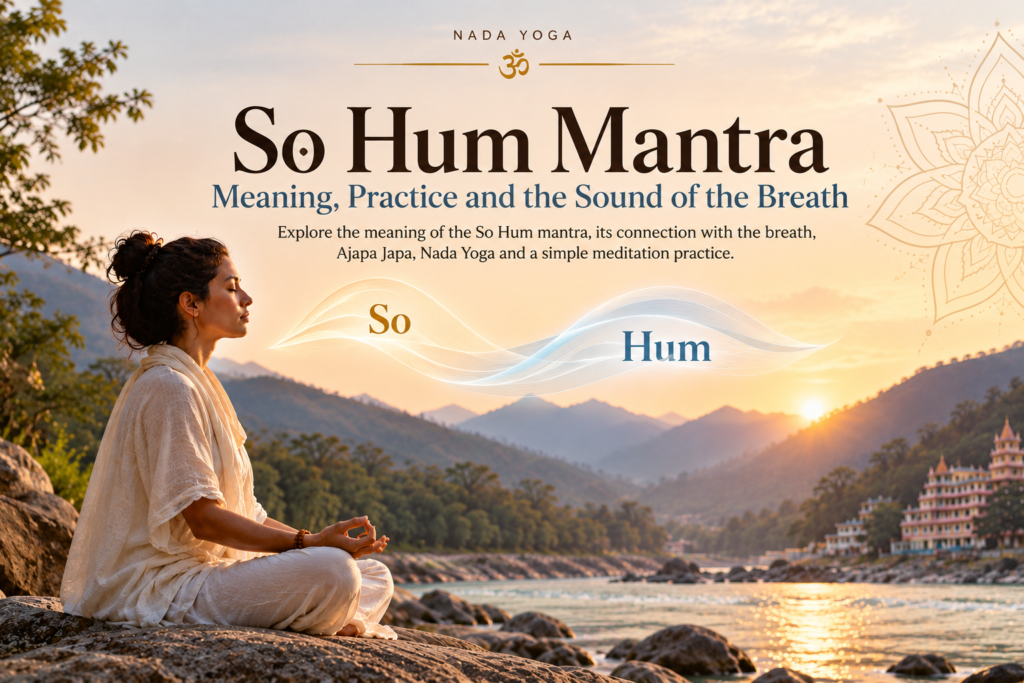
Before a mantra becomes a spoken phrase, it can begin with something much closer to us: the breath.
Every breath carries movement, rhythm and sound. Yogic traditions have long explored this natural rhythm as a foundation for meditation and mantra practice. So Hum, also written Soham or So’ham, is traditionally associated with this relationship between breath, awareness and the sense of identity expressed through the phrase “I am That.”
The practice has a particularly interesting place within Nada Yoga, where listening becomes an important part of meditation. Instead of creating a complex sound, the practitioner can begin by observing the natural breath and gradually becoming more attentive to its subtle rhythm.
This makes So Hum an accessible mantra for anyone interested in mantra meditation, breath awareness, Nada Yoga and sound-based practices.
What is the So Hum mantra?
So Hum is a traditional Sanskrit mantra commonly written as सोऽहम् (So’ham). It is generally understood as “I am That,” with saḥ referring to “That” and aham meaning “I.”
The phrase appears in yogic and Vedantic traditions as an expression of the relationship between individual consciousness and the larger reality described as “That.” Its use as a breath-linked mantra also developed within traditions of Ajapa Japa, a form of continuous or spontaneous mantra awareness associated with the natural movement of breathing.
The spelling varies across English-language sources. You may see So Hum, Soham, or So’ham, while the underlying Sanskrit expression remains the same.
For meditation, the phrase becomes especially meaningful because the practitioner connects each part of the mantra with the movement of breathing. This gives the mind a simple rhythm to follow while awareness remains close to the present moment.
What does So Hum mean?
The most common translation of So’ham is “I am That.”
The phrase can be approached at several levels. At the simplest level, it expresses a contemplative statement about identity. In Vedantic interpretation, “That” can refer to the ultimate reality or consciousness described in the teachings, while “I” points toward the individual self.
For meditation, the phrase can also function as a reminder to observe the relationship between the individual breath, the body and awareness.
The meaning becomes more experiential through repetition. As the mantra follows the breath, the practitioner has an opportunity to move between the conceptual meaning of the words and the direct experience of breathing, listening and observing.
This relationship between meaning and experience is one reason So Hum continues to appear in meditation traditions.
Why is So Hum called the mantra of the breath?
So Hum is often called the mantra of the breath because traditional practice connects its two syllables with inhalation and exhalation.
A common approach associates So with the incoming breath and Hum with the outgoing breath. The practitioner mentally follows the rhythm rather than forcing the breath into a particular pattern.
This creates a simple cycle:
Inhale: So
Exhale: Hum
The practice can continue naturally for several minutes. As attention becomes steadier, the practitioner begins to notice the breath as both movement and sound.
That detail is especially relevant to Nada Yoga. Sound can be approached through deliberate chanting, musical tones and instruments, while the breath offers a subtler starting point for listening.
So Hum and Ajapa Japa
Ajapa Japa refers to a form of mantra awareness associated with repetition that becomes spontaneous or continuous. In traditional yoga literature, the natural movement of the breath receives particular attention in connection with So’ham and Hamsa practices.
The idea is especially interesting because the practitioner gradually shifts from deliberately repeating a mantra toward recognizing a mantra within the rhythm of natural breathing.
A beginner may consciously think “So” during inhalation and “Hum” during exhalation. With practice, the repetition can become more effortless, allowing attention to rest on the breath itself.
This gives Ajapa Japa a different character from ordinary verbal repetition. The breath provides the rhythm, while awareness follows the rhythm.
The relationship between So Hum and Hamsa
So Hum and Hamsa appear together in several traditional discussions of breath-based mantra practice. The two expressions contain the same Sanskrit sounds in a different arrangement.
So’ham can be understood as “I am That,” while Hamsa means “swan” in Sanskrit and also carries symbolic meanings within yogic traditions. Traditional teachings sometimes describe the natural breath through the complementary forms Hamsa and So’ham.
These interpretations belong to traditional yogic frameworks and can vary across lineages. For a practitioner, the most useful starting point remains the direct relationship between breath, sound and attention.
Listening to the breath as sound
Modern life often places attention on external sound. We hear conversations, traffic, music, notifications, machinery and countless other sounds throughout the day.
So Hum meditation offers a different direction. The practitioner brings attention closer to the sound and movement of breathing.
Sit quietly and listen to the breath before introducing the mantra. Notice the gentle sound of inhalation and exhalation. Observe its rhythm, volume and changing texture.
Once the breath becomes familiar, mentally introduce So with the inhalation and Hum with the exhalation.
The practice then becomes a form of listening.
This distinction matters within Nada Yoga, where attentive listening plays a central role. The aim of the practice can include becoming increasingly sensitive to sound and its relationship with awareness. Nada Yoga School describes its approach through mantra, meditation, music, voice and listening practices, placing sound within a broader yogic framework.
So Hum and Nada Yoga
Nada Yoga is traditionally described as the yoga of sound. Its practices explore the relationship between sound, attention, meditation and inner awareness.
So Hum fits naturally into this field because the practitioner can approach the mantra through several forms of sound. You can chant it aloud, whisper it, repeat it mentally or follow its association with the natural breath.
Each method creates a different experience.
When you chant So Hum aloud, the voice becomes the primary sound. When you whisper it, the sound becomes softer and closer to the body. When you repeat it mentally, attention turns inward. When you follow the breath itself, the practice becomes increasingly subtle.
This progression gives students an opportunity to explore the movement from audible sound toward inner listening.
So Hum meditation and the importance of natural breathing
A simple So Hum meditation begins with natural breathing.
Find a comfortable seated position and allow the spine to remain upright without excessive effort. Close the eyes if that feels comfortable, then spend a few moments observing the breath.
Once the breathing feels familiar, mentally repeat So as you inhale and Hum as you exhale.
Keep the breathing comfortable. Let the mantra follow the breath instead of forcing the breath to follow a fixed rhythm.
If attention wanders, return gently to the next inhalation and begin again with So. Follow the sound mentally through the entire breath, then allow Hum to accompany the exhalation.
After several minutes, you may begin to notice small changes in the experience of breathing. The rhythm can feel more apparent, and the transition between inhalation and exhalation can become easier to observe.
The space between So and Hum
An interesting part of So Hum meditation lies between the two sounds.
The inhalation reaches its natural completion. Then the exhalation begins. Likewise, the exhalation ends before another inhalation starts.
These transitions contain moments of stillness.
Rather than deliberately extending these pauses, simply notice them. The attention can rest briefly in the changing relationship between movement and stillness.
This observation connects So Hum with a wider principle found throughout sound-based meditation. A sound becomes easier to appreciate when we hear its beginning, continuation, fading and the silence that surrounds it.
The same principle appears in music. A note has a beginning and an ending, while the space around the note contributes to the musical experience.
In mantra meditation, silence can become part of the practice in a similar way.
So Hum and the movement from sound to silence
Many mantra practices begin with an audible voice. The practitioner learns the pronunciation, establishes a rhythm and gradually becomes familiar with the sound.
So Hum can follow a similar progression.
You may begin by chanting the mantra aloud several times. After that, reduce the volume to a whisper. Eventually, allow the mantra to continue mentally while the physical voice becomes quiet.
The practice can then become primarily a listening experience.
This progression offers a practical way to understand one aspect of Nada Yoga. External sound provides a clear object for attention. As the sound becomes subtler, the practitioner develops greater sensitivity to the internal experience of listening.
Traditional Nada Yoga teachings explore this movement toward increasingly subtle forms of sound and awareness. The approach at Nada Yoga School also places mantra, voice, music and meditation within the study of Nada Yoga.
So Hum and meditation on identity
The phrase “I am That” gives So Hum a contemplative dimension beyond breath awareness.
During meditation, the practitioner can contemplate the meaning after becoming familiar with the rhythm of the mantra. Each inhalation accompanied by So can become a reminder of “That,” while each exhalation accompanied by Hum can bring attention back to “I.”
The practice can then move between breath and contemplation.
This approach belongs to a traditional philosophical framework. It should therefore be understood through the teachings and lineage in which it is practiced, especially when exploring deeper interpretations of the relationship between the individual self and ultimate reality.
For beginners, staying close to the breath can provide a simple and grounded entry point.
So Hum and the practice of listening
Listening is an active part of mantra meditation.
When you repeat So Hum, you can listen to the pronunciation, rhythm and resonance of each sound. When you practice mentally, you can observe the subtle presence of the mantra in the mind.
Over time, this attention can sharpen your awareness of small changes in sound.
This is particularly valuable for students studying Indian classical music and Nada Yoga. Indian classical music places considerable importance on attentive hearing, pitch, resonance and tonal relationships. Nada Yoga extends the practice of listening into a contemplative context.
Nada Yoga School integrates Indian classical music, kirtan, bhajans, mantra and sound practices into its wider yoga education.
Can So Hum be chanted aloud?
Yes. So Hum can be practiced through audible chanting as well as mental repetition.
Audible chanting can help beginners establish the pronunciation and rhythm. It also makes the relationship between voice and breath easier to observe.
Begin with a comfortable volume and allow the voice to remain relaxed. The purpose of the practice is attentive repetition, so excessive force in the voice can distract from the breath.
After several repetitions, gradually soften the sound. This creates an opportunity to experience how the same mantra changes as it moves from external voice toward quieter forms of practice.
A simple So Hum meditation practice
A short practice can take around ten minutes.
Begin by sitting comfortably. Allow the body to settle and observe several natural breaths before introducing the mantra.
During the next few breaths, mentally repeat So with the inhalation and Hum with the exhalation. Keep your attention on the complete movement of each breath.
After several minutes, bring more attention to the sound of breathing. Listen to the subtle movement of air and observe how the mantra accompanies it.
Then allow the mantra to become quieter. Continue repeating it mentally while keeping the breath natural.
For the final minute, release the deliberate repetition and simply sit with the breath.
When the practice ends, take a moment to notice the quality of your attention before opening the eyes.
This practice can become a daily meditation or a preparation for deeper mantra and Nada Yoga work.
What makes So Hum different from other mantras?
So Hum has a distinctive relationship with breathing.
Many mantras require deliberate repetition through speech or mental japa. So Hum can be linked directly to the natural cycle of inhalation and exhalation, which gives it a particularly accessible structure for meditation.
Its meaning also gives the practice a philosophical dimension. The phrase “I am That” invites contemplation of identity and consciousness within the traditions that teach it.
For someone beginning mantra meditation, these two qualities create a useful combination: the breath provides a physical anchor while the meaning provides a contemplative direction.
Learning So Hum through Nada Yoga in Rishikesh
A structured course can help students explore mantra beyond individual practice.
At Nada Yoga School in Rishikesh, Nada Yoga teacher training includes mantra pronunciation, mantra meditation, chanting, Indian classical music, voice work and sound-based practices. The school describes Nada Yoga as a discipline centred on sound, vibration, awareness and deep listening.
The school’s wider yoga programs also integrate Nada Yoga, Vedic chanting, kirtan, music lessons, meditation and pranayama.
Students who are specifically interested in sound-based therapeutic work can explore the school’s Sound Healing Teacher Training, which includes practical instrument work, guided sessions and the study of sound healing methods.
For practitioners interested in both traditions, studying the voice, breath and listening can create a strong foundation for understanding how different forms of sound practice work.
Frequently asked questions about So Hum
What does So Hum mean?
So Hum, or So’ham, is traditionally translated as “I am That.” The phrase carries philosophical significance within yogic and Vedantic traditions and can also serve as a breath-linked mantra for meditation.
Is So Hum a Sanskrit mantra?
Yes. So’ham is a Sanskrit expression written as सोऽहम्. English-language sources use several spellings, including So Hum, Soham and So’ham.
How do you practice So Hum meditation?
Sit comfortably and observe your natural breathing. Mentally repeat So during inhalation and Hum during exhalation while maintaining gentle awareness of the breath.
What is Ajapa Japa?
Ajapa Japa refers to traditional practices involving continuous or spontaneous mantra awareness. So’ham and the natural movement of the breath are closely associated with this approach in yogic traditions.
Can I chant So Hum aloud?
Yes. You can chant So Hum aloud, whisper it or repeat it mentally. Audible chanting can help develop pronunciation and awareness of the voice before moving toward quieter forms of practice.
Is So Hum part of Nada Yoga?
So Hum can be explored within Nada Yoga through its relationship with voice, breath, listening, mantra and meditation. Nada Yoga provides a broader traditional framework for studying sound and attentive listening.
Can So Hum be used in sound healing?
So Hum is a traditional mantra, while sound healing is a broader field of sound-based practice. Practitioners may include voice and mantra within sound-focused sessions, while maintaining awareness of the distinct traditions and purposes involved.
Final thoughts
So Hum begins with something simple: the breath.
As the practice develops, that breath becomes a rhythm for mantra. The mantra becomes a sound for meditation, and the sound creates an opportunity to listen more carefully.
This makes So Hum particularly interesting within Nada Yoga, where attentive listening forms an important part of the journey through sound. The practitioner can begin with the audible voice, move toward mental repetition and eventually spend more time observing the subtle relationship between breath, sound and silence.
For anyone exploring mantra meditation, Nada Yoga or sound healing, So Hum offers a gentle starting point. Its practice brings together breath, sound and awareness while preserving the deeper philosophical meaning carried by the Sanskrit phrase.
At its heart, So Hum invites the practitioner to listen closely to something that has been present with every breath.