Ayurveda describes health as a dynamic relationship between the body, mind, digestion and daily habits. Its traditional approach to wellbeing includes dietary practices, herbal preparations, lifestyle routines and specialised therapies designed according to an individual’s constitution and condition. Among these practices, Panchakarma holds an important place.
Panchakarma is a traditional Ayurvedic system of therapeutic procedures associated with the removal of accumulated waste and the restoration of balance within the body. The Sanskrit word combines Pancha, meaning five, and Karma, meaning actions or procedures. It refers to five principal therapeutic methods described in classical Ayurvedic literature.
Panchakarma is often discussed in connection with detoxification, digestion and rejuvenation. Understanding its traditional principles, individual procedures and appropriate applications helps explain its role within Ayurveda.
What is Panchakarma?
Panchakarma is a specialised branch of Ayurvedic treatment that uses five principal procedures to address specific health conditions. Classical Ayurvedic texts describe these procedures as part of a broader therapeutic approach that includes preparation, treatment and post-treatment care.
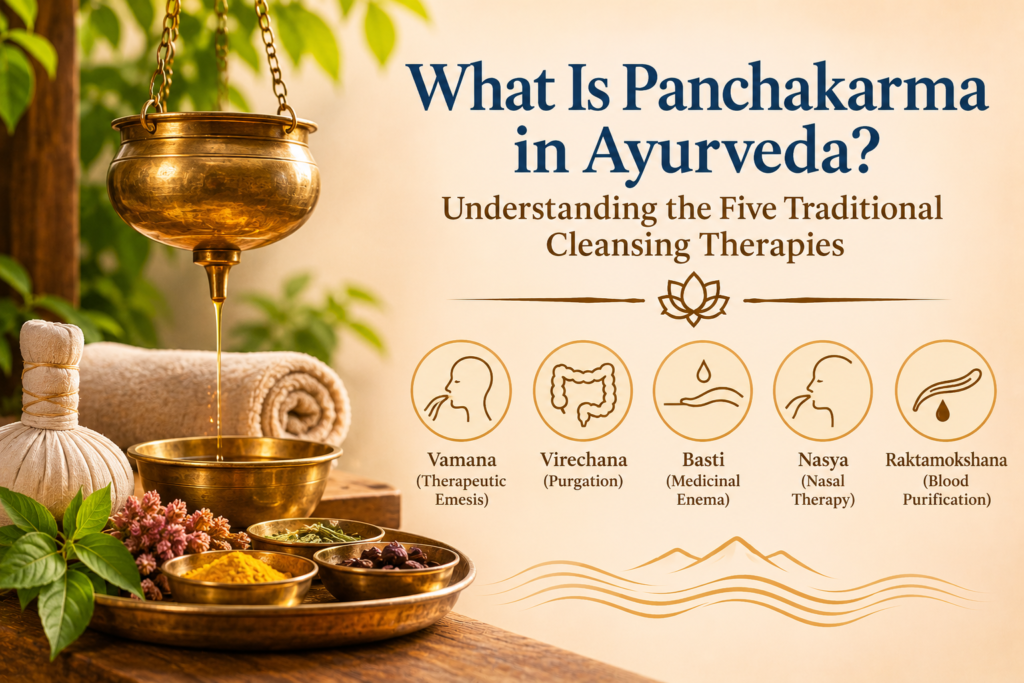
The five procedures are:
- Vamana, or therapeutic emesis.
- Virechana, or therapeutic purgation.
- Basti, or medicated enema.
- Nasya, or administration of medicines through the nasal passages.
- Raktamokshana, or therapeutic bloodletting.
The selection of procedures depends on the individual’s condition, constitution, digestive capacity, age and other clinical considerations. A qualified Ayurvedic physician assesses these factors before recommending a treatment plan.
Panchakarma is traditionally associated with the management of imbalances involving the three doshas: Vata, Pitta and Kapha. Each procedure has a specific role within Ayurvedic theory and is selected according to the therapeutic objective.
The five procedures of Panchakarma
Each of the five procedures follows a distinct method and has traditionally been associated with particular doshic imbalances.
1. Vamana: Therapeutic emesis
Vamana is a controlled therapeutic procedure involving induced vomiting under professional supervision. Classical Ayurveda primarily associates it with the management of aggravated Kapha dosha.
Before the procedure, the patient generally undergoes preparatory treatments intended to prepare the body. These may include internal and external oleation, followed by therapeutic sweating. The main procedure is then performed according to the physician’s assessment and the individual’s condition.
In traditional Ayurvedic practice, Vamana is associated with conditions involving excess Kapha, particularly those affecting the respiratory and digestive systems.
This procedure requires careful assessment and monitoring. Induced vomiting can cause dehydration, electrolyte disturbances and other complications when performed without appropriate medical supervision.
2. Virechana: Therapeutic purgation
Virechana is a therapeutic procedure that uses prescribed medicines to produce controlled bowel evacuation. Ayurveda primarily associates it with the elimination of aggravated Pitta dosha.
The preparation may involve oleation and sweating therapies, followed by the administration of a suitable purgative preparation. The choice of medicine and the intensity of treatment depend on the individual’s digestive capacity and clinical condition.
Traditional Ayurvedic texts describe Virechana in relation to Pitta-related disorders, including certain skin and digestive conditions.
After the procedure, dietary restrictions and a gradual return to regular meals form an important part of traditional post-treatment care.
3. Basti: Medicated enema
Basti involves the administration of prescribed medicinal preparations through the rectum. It holds particular importance in classical Ayurveda because of its association with Vata dosha.
Ayurvedic literature describes several forms of Basti. Two commonly discussed types are:
- Niruha Basti: A preparation generally based on herbal decoctions, combined with other prescribed ingredients.
- Anuvasana Basti: An oil-based preparation administered according to the individual’s treatment requirements.
The choice depends on the patient’s condition and the physician’s assessment.
Traditional Ayurveda considers Basti an important therapy for conditions associated with Vata imbalance, including certain musculoskeletal and digestive complaints.
The procedure requires appropriate clinical knowledge, preparation and hygiene. Its application should always be determined by a qualified practitioner.
4. Nasya: Nasal administration of medicines
Nasya involves the administration of prescribed medicinal substances through the nasal passages. These may include herbal oils, juices or other preparations selected according to the treatment objective.
In Ayurveda, the nasal passages are traditionally described as an important route for therapies associated with the head and neck region.
The procedure may be recommended within Ayurvedic practice for certain conditions involving the sinuses, nasal passages and head. The exact preparation, quantity and method depend on the individual’s assessment.
Nasya is also performed in different forms according to the substance used and the intended therapeutic effect.
5. Raktamokshana: Therapeutic bloodletting
Raktamokshana is a traditional Ayurvedic procedure involving the removal of a controlled quantity of blood. Classical texts associate it with the management of certain conditions involving Rakta, or blood, and aggravated Pitta.
Traditional methods include the use of specialised instruments and other techniques described in Ayurvedic literature.
Some classical approaches also discuss the use of leeches in specific circumstances. The method depends on the condition being treated and the practitioner’s training.
Bloodletting carries significant risks, including infection, excessive bleeding and anaemia. It requires appropriate medical facilities, sterile procedures and professional assessment. It is not suitable for general self-treatment.
The preparatory stages of Panchakarma
Panchakarma traditionally involves several stages. The five principal procedures are only one part of the complete treatment process. Preparation and recovery are also considered essential.
Purva Karma: Preparation
Purva Karma refers to the preparatory procedures performed before the main treatment. Two important practices are Snehana and Swedana.
Snehana, or oleation, involves the use of oils or ghee through internal or external application. In traditional Ayurveda, this practice prepares the body for subsequent therapeutic procedures.
Swedana, or sweating therapy, uses controlled heat to induce perspiration. Different methods may involve steam, warm compresses or other specialised techniques.
The selection and duration of these practices depend on the individual’s condition and the intended treatment.
Pradhana Karma: Main treatment
Pradhana Karma refers to the principal therapeutic procedure selected for the patient. Depending on the assessment, this may involve Vamana, Virechana, Basti, Nasya or Raktamokshana.
A person may receive one procedure or a combination of therapies as part of a treatment plan. Panchakarma does not require every individual to undergo all five procedures.
Paschat Karma: Post-treatment care
Paschat Karma refers to the recovery and dietary care that follows the main procedure.
An important traditional practice during this stage is Samsarjana Krama, a gradual dietary progression. Food is introduced in stages according to the individual’s digestive capacity and the intensity of the preceding treatment.
The diet may begin with easily digestible preparations before gradually returning to regular meals. Rest, appropriate activity and continued guidance from the practitioner are also part of the recovery process.
The role of the three doshas in Panchakarma
Ayurvedic theory describes three primary doshas: Vata, Pitta and Kapha. These principles are used to understand physiological functions and patterns of imbalance within the traditional system.
Vata is associated with movement, circulation, breathing and nervous system functions. Its qualities include dryness, lightness, mobility and coldness.
Pitta is associated with transformation, digestion, metabolism and body temperature. Its qualities include heat, intensity and sharpness.
Kapha is associated with structure, stability, lubrication and cohesion. Its qualities include heaviness, moisture, coolness and steadiness.
Panchakarma procedures are traditionally selected according to the dosha considered aggravated and the individual’s overall condition.
For example, Vamana is primarily associated with Kapha, Virechana with Pitta and Basti with Vata. These associations form part of Ayurvedic treatment theory and guide the selection of procedures within the traditional system.
Who may consider Panchakarma?
Within Ayurveda, Panchakarma is recommended according to individual health assessments. A physician considers the person’s constitution, age, digestive strength, current symptoms, medical history and suitability for particular procedures.
Traditional Ayurvedic practice discusses Panchakarma in relation to several chronic and recurring health complaints. However, the effectiveness of individual Panchakarma procedures for specific medical conditions varies, and strong clinical evidence remains limited for many claimed benefits.
People with pregnancy, significant weakness, dehydration, bleeding disorders, serious medical conditions or other health concerns may face additional risks. Some procedures can also interact with medicines or existing treatments.
Anyone considering Panchakarma should consult a qualified healthcare professional and disclose their complete medical history. These procedures should never be attempted independently.
Panchakarma and the Ayurvedic approach to daily living
Panchakarma forms one part of a wider Ayurvedic approach to health. Classical Ayurveda also gives considerable attention to daily routines, seasonal adjustments, food choices and digestive habits.
Practices such as Dinacharya, or daily routine, and Ritucharya, or seasonal routine, are traditionally used to organise everyday life according to changes in the environment and the body’s needs.
Diet also has a central role. Ayurveda considers the qualities of food, individual digestive capacity and the timing of meals when developing dietary recommendations.
Following Panchakarma, practitioners may suggest specific routines and dietary practices based on the treatment received. These recommendations are intended to support the transition back to ordinary activities.
Frequently asked questions about Panchakarma
What does Panchakarma mean?
Panchakarma is a Sanskrit term formed from Pancha, meaning five, and Karma, meaning actions or procedures. It refers to five principal therapeutic procedures described in classical Ayurveda.
What are the five types of Panchakarma?
The five principal procedures are Vamana, Virechana, Basti, Nasya and Raktamokshana. Each has a distinct method and traditional therapeutic application.
How long does Panchakarma take?
The duration varies according to the individual’s condition, the procedures selected and the preparation and recovery stages. A treatment plan may extend over several days or weeks, depending on the physician’s assessment.
Is Panchakarma suitable for everyone?
No. Suitability depends on age, health status, medical history and the specific procedure being considered. Some people may face significant risks from particular treatments.
Does Panchakarma remove toxins from the body?
Ayurvedic literature describes Panchakarma in terms of eliminating accumulated doshas and waste products. Modern medicine uses different definitions and methods to evaluate detoxification. The body already has organs, including the liver and kidneys, that process and eliminate waste. Claims that Panchakarma removes unspecified toxins or cleanses the body in a scientifically established way require careful qualification.
Is Panchakarma the same as an Ayurvedic massage?
No. Ayurvedic massage is generally an external therapy that may form part of the preparatory stage of Panchakarma. Panchakarma refers to a broader treatment system involving specific procedures, preparation and post-treatment care.
Conclusion
Panchakarma is an important part of classical Ayurvedic treatment. Its five principal procedures are traditionally used within a structured system that includes preparation, individual assessment and post-treatment care.
Understanding Panchakarma requires familiarity with Ayurvedic concepts such as the three doshas, digestive capacity and the relationship between treatment and daily routine. Each procedure has its own method, indications and precautions, making professional assessment essential.
For anyone exploring Ayurveda, Panchakarma offers insight into the traditional Indian understanding of therapeutic care and the importance given to individualised treatment. Its practices are best approached with informed guidance, realistic expectations and careful attention to safety.