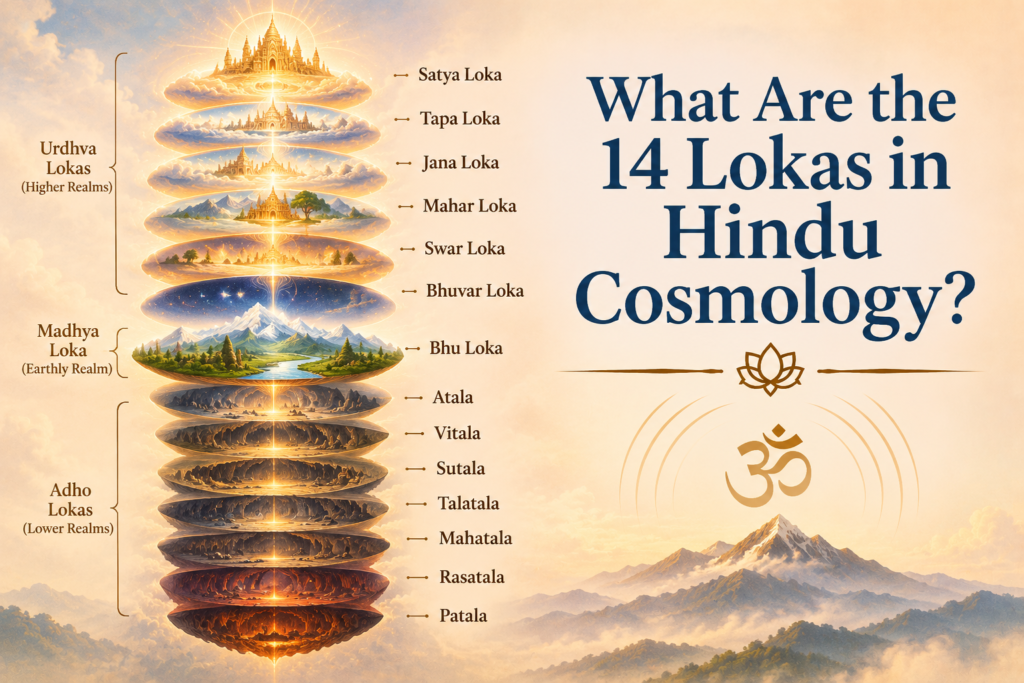
Hindu cosmology describes the universe through a complex system of worlds, planes of existence and cosmic regions known as Lokas. Several Hindu scriptures, particularly the Puranas, describe fourteen Lokas arranged into seven higher realms and seven lower realms. Together, these worlds form a traditional model of the universe that explains the different levels of existence inhabited by humans, celestial beings, sages, divine figures and other supernatural beings.
The Sanskrit word Loka generally means world, realm or plane of existence. In Hindu cosmological traditions, each Loka has its own characteristics, inhabitants and relationship with the larger cosmic order. Some are associated with spiritual knowledge and divine beings, while others are described through the experiences of earthly life and the subterranean worlds.
The fourteen Lokas provide an important perspective on how ancient Indian traditions understood the structure of the universe. Their descriptions also connect with ideas about karma, spiritual evolution, creation and the cycles of existence.
Understanding the 14 Lokas in Hindu cosmology
According to the traditional Puranic model, the fourteen Lokas are divided into two groups:
The seven higher Lokas (Urdhva Lokas):
- Bhuloka
- Bhuvarloka
- Svarloka
- Maharloka
- Janaloka
- Tapoloka
- Satyaloka
The seven lower Lokas (Adho Lokas):
- Atala
- Vitala
- Sutala
- Talatala
- Mahatala
- Rasatala
- Patala
The higher Lokas are traditionally associated with the celestial worlds, sages and elevated states of existence. The lower Lokas are described as subterranean realms inhabited by different groups of powerful beings, including Daityas, Danavas and Nagas.
These descriptions vary across Hindu scriptures and philosophical traditions. The Bhagavata Purana, Vishnu Purana and other texts provide detailed accounts of these worlds, their inhabitants and their place within the cosmic structure.
The seven higher Lokas
The seven higher Lokas are arranged above the earthly realm in traditional Hindu cosmology. Their descriptions connect physical existence with celestial life, spiritual knowledge and increasingly subtle forms of existence.
1. Bhuloka: The earthly realm
Bhuloka is the physical world inhabited by human beings and other earthly forms of life. It is the realm of mountains, rivers, oceans, forests and living creatures.
In Hindu cosmology, Bhuloka is the field of human experience, where individuals perform actions and experience the consequences of their karma. Human existence holds particular significance because it provides opportunities for spiritual practice, self-discipline, knowledge and liberation.
The Earth is also considered sacred in many Hindu traditions. Rivers such as the Ganga, mountains such as the Himalayas and pilgrimage locations throughout India hold religious significance because they are associated with divine stories and spiritual practices.
Human life within Bhuloka is therefore connected with the wider principles of Dharma, Karma and Moksha.
2. Bhuvarloka: The intermediate realm
Bhuvarloka is traditionally described as the region between the earthly world and the celestial realm of Svarga. It is associated with the intermediate space surrounding the Earth and is sometimes connected with the atmosphere and the region inhabited by certain celestial beings.
In Puranic descriptions, this realm is associated with beings such as Siddhas, Charanas and other supernatural entities. It also has connections with the subtle existence of departed beings in certain Hindu traditions.
Bhuvarloka appears in the Gayatri Mantra, which invokes the three worlds: Bhur, Bhuvah and Svah. These three terms represent the earthly, intermediate and celestial realms in this traditional cosmological framework.
3. Svarloka: The celestial heaven
Svarloka, also called Svargaloka, is the heavenly realm traditionally ruled by Indra, the king of the Devas. It is associated with celestial pleasures, divine beings and the rewards of meritorious actions.
According to Hindu scriptures, Svarga is inhabited by Devas, Gandharvas, Apsaras and other celestial beings. It is often described as a beautiful realm containing magnificent palaces, gardens and heavenly pleasures.
Indra’s celestial residence is known as Amaravati. The divine gardens of Nandana are also associated with this realm.
In the traditional understanding of karma, individuals who accumulate sufficient merit through righteous actions and religious observances may experience life in Svarga after death. However, Svarga is still part of Samsara, the cycle of birth and death. Its inhabitants eventually return to other forms of existence when the results of their accumulated merit are exhausted.
4. Maharloka: The realm of great sages
Maharloka is traditionally described as a higher realm inhabited by great sages and spiritually advanced beings. It is associated with elevated knowledge, meditation and long periods of spiritual existence.
The sages Bhrigu and other great Rishis are associated with this realm in Puranic accounts. Maharloka is described as a place where spiritual wisdom and contemplative practices occupy a central position.
Some Puranic descriptions explain that during the cosmic dissolution known as Pralaya, the inhabitants of Maharloka move to higher realms to remain beyond the destructive influence affecting the lower worlds.
This realm represents a stage in the traditional cosmic hierarchy associated with spiritual knowledge and the long duration of existence.
5. Janaloka: The realm of enlightened beings
Janaloka is traditionally described as the realm inhabited by highly advanced sages and the mind-born sons of Brahma.
Among the beings associated with this realm are the four Kumaras: Sanaka, Sanandana, Sanatana and Sanatkumara. They are traditionally described as eternally youthful sages who embody wisdom, renunciation and spiritual knowledge.
The Kumaras appear in several Hindu scriptures and are known for their teachings on self-realisation and the nature of the Supreme Reality.
Janaloka is associated with a high level of spiritual understanding. Its inhabitants are described as possessing deep knowledge of the cosmic order and remaining devoted to contemplation and spiritual inquiry.
6. Tapoloka: The realm of intense austerity
Tapoloka is associated with Tapas, a Sanskrit term referring to austerity, disciplined effort and spiritual heat generated through dedicated practice.
This realm is traditionally inhabited by highly advanced ascetics and spiritually powerful beings who have devoted themselves to intense meditation and self-discipline.
The inhabitants of Tapoloka are described as having developed extraordinary spiritual abilities through long periods of austerity. Their existence is associated with concentration, detachment and profound knowledge.
The concept of Tapoloka reflects the importance of Tapas in Indian spiritual traditions. Practices such as meditation, control of the senses, disciplined living and sustained spiritual study are regarded as ways of refining the mind and strengthening spiritual understanding.
7. Satyaloka: The highest realm
Satyaloka, also known as Brahmaloka, is traditionally regarded as the highest of the fourteen Lokas. It is described as the abode of Lord Brahma, the creator deity within the Hindu Trimurti.
The name Satyaloka is associated with Satya, meaning truth. It represents an elevated realm connected with cosmic knowledge, creation and the divine order.
According to Puranic descriptions, Brahma resides in this realm, where he performs his role in the cosmic process of creation. The inhabitants are associated with advanced spiritual knowledge and a long duration of existence.
Some Hindu philosophical traditions connect Brahmaloka with liberation, particularly through specific teachings about spiritual knowledge and the attainment of higher states of existence. The precise relationship between Brahmaloka and Moksha varies across Vedanta schools and scriptural interpretations.
The seven lower Lokas
The seven lower Lokas are traditionally described as regions beneath Bhuloka. They are also called Patala Lokas, although Patala is specifically the name of the lowest realm in the fourteen-world arrangement.
These worlds are described in the Puranas as vast subterranean regions containing magnificent buildings, precious stones, gardens and extraordinary beings. Their inhabitants include Nagas, Daityas and Danavas.
The lower Lokas are frequently associated with powerful supernatural beings and unusual forms of life. Their descriptions differ from the popular understanding of hell because they are presented as inhabited worlds with their own environments and communities.
8. Atala: The first lower realm
Atala is the uppermost of the seven lower Lokas. According to the Bhagavata Purana, it is associated with Bala, a powerful son of the Danava architect Maya.
The descriptions of Atala include extraordinary powers and unusual forms of pleasure. The realm is associated with beings who possess magical abilities and enjoy various forms of material experience.
Its accounts also describe substances and experiences that can produce powerful sensations and influence the behaviour of those who encounter them.
Atala represents one of the distinctive worlds within the Puranic descriptions of the subterranean universe.
9. Vitala: The second lower realm
Vitala is the second of the lower Lokas. It is associated with a form of Lord Shiva known as Hara-Bhava in certain Puranic descriptions.
The Bhagavata Purana describes a remarkable form of gold associated with the interaction between Shiva and his divine energy in this realm. Vitala is also presented as a place containing extraordinary natural and material riches.
Its descriptions connect the realm with supernatural forces and the presence of powerful beings.
10. Sutala: The kingdom of King Bali
Sutala is one of the most distinctive lower Lokas because of its association with King Mahabali, the generous and powerful Asura king.
According to Hindu mythology, Mahabali performed a great sacrifice and became known for his generosity and devotion. During the Vamana Avatar of Lord Vishnu, the deity approached him in the form of a dwarf Brahmin and requested three steps of land.
Vamana expanded to a cosmic form and covered the Earth and the heavens with his first two steps. Mahabali then offered his own head for the third step. Lord Vishnu placed his foot upon him and sent him to Sutala.
Rather than presenting Sutala as a place of punishment, several Puranic accounts describe it as a magnificent kingdom blessed by Lord Vishnu. The deity also promised to remain close to Mahabali as his protector.
The story of Sutala highlights themes of generosity, devotion, humility and divine grace.
11. Talatala: The realm of Maya Danava
Talatala is traditionally associated with Maya Danava, an extraordinary architect and master of magical arts.
Maya Danava is known in Hindu mythology for constructing magnificent palaces, cities and elaborate structures. His knowledge of architecture and supernatural abilities makes him an important figure in several epic and Puranic narratives.
Talatala is described as a realm where Maya exercises his extraordinary powers. According to Puranic accounts, Lord Shiva granted him protection following the destruction of Tripura, the three cities associated with the Asuras.
This realm is connected with the knowledge of illusion, architecture and supernatural arts.
12. Mahatala: The realm of the Nagas
Mahatala is traditionally described as a region inhabited by powerful Naga beings. Nagas are serpent-like supernatural beings who occupy an important place in Hindu mythology.
The Puranas describe several groups of Nagas living in Mahatala. They are associated with great strength, supernatural abilities and the possession of valuable treasures.
Some Naga figures are connected with divine protection, water, fertility and the hidden riches of the Earth. Their presence in Hindu mythology reflects the cultural importance of serpent symbolism across Indian religious traditions.
Mahatala is therefore associated with the powerful Naga communities and their distinctive forms of existence.
13. Rasatala: The realm of Daityas and Danavas
Rasatala is described as a lower world inhabited by powerful groups of Asuras, particularly Daityas and Danavas.
These beings are often portrayed in Hindu mythology as powerful opponents of the Devas. Their stories appear throughout the Puranas and epics, where conflicts between Devas and Asuras form part of the wider cosmic narrative.
The inhabitants of Rasatala are described as possessing great strength and supernatural abilities. Their realm is also associated with impressive structures and extraordinary material conditions.
These descriptions form part of the broader Puranic understanding of the different communities inhabiting the cosmic worlds.
14. Patala: The deepest lower realm
Patala is the lowest of the seven lower Lokas and the fourteenth realm in the traditional arrangement.
It is widely associated with the Nagas and is described in the Puranas as a magnificent subterranean world filled with precious stones, beautiful palaces and extraordinary natural features.
The great serpent Vasuki is among the important Naga figures associated with the wider Patala traditions. Other serpent kings and Naga communities also appear in descriptions of these regions.
Interestingly, Patala is frequently portrayed as a place of remarkable beauty and material splendour. Some Puranic accounts describe its inhabitants as enjoying extraordinary pleasures and living in magnificent surroundings.
These descriptions show that the lower Lokas have their own distinctive cosmological identities and cannot all be understood as places of punishment.
What is the difference between the higher and lower Lokas?
The fourteen Lokas represent different realms within the traditional Hindu cosmological structure. Their descriptions reflect different types of existence, inhabitants and experiences.
The higher Lokas are generally associated with celestial beings, spiritual knowledge, divine presence and advanced states of existence. The lower Lokas are associated with powerful supernatural communities, including Asuras and Nagas, as well as extraordinary material environments.
The distinction also reflects traditional ideas about karma and the results of actions. However, the relationship between an individual’s karma and a particular Loka is explained differently across Hindu scriptures and philosophical schools.
It is important to understand that the lower Lokas are not uniformly described as places of suffering. Sutala, for example, is presented as a blessed kingdom under the protection of Lord Vishnu. Similarly, Patala is described through images of beauty and abundance.
The fourteen Lokas therefore form a complex cosmological system with different forms of existence and experiences.
The connection between the 14 Lokas, Karma and Samsara
The fourteen Lokas are closely connected with the Hindu understanding of Karma and Samsara.
Karma refers to action and its consequences. According to several Hindu traditions, actions performed through thought, speech and behaviour influence future experiences. These consequences may extend beyond an individual’s present lifetime.
Samsara refers to the cycle of birth, death and rebirth. Within this framework, different Lokas represent possible realms of existence through which beings may pass according to their karma and spiritual condition.
For example, Svargaloka is traditionally associated with the enjoyment of the results of meritorious actions. Once the accumulated merit is exhausted, a being may return to another form of existence.
This understanding highlights the temporary nature of the different Lokas within the larger cycle of Samsara.
Moksha, or liberation, represents freedom from this cycle. In many Hindu philosophical traditions, the ultimate spiritual goal involves realising the nature of the Self and its relationship with ultimate reality.
The fourteen Lokas provide a cosmological framework for understanding different forms of existence, while the teachings on Moksha point towards a state beyond ordinary worldly experience.
The 14 Lokas and the Gayatri Mantra
The Gayatri Mantra is one of the most widely respected mantras in Hindu tradition. It appears in the Rigveda and is traditionally associated with Savitr, the divine source of illumination.
The opening words of the mantra are:
Om Bhur Bhuvah Svah
These three terms refer to three traditional cosmic realms:
- Bhur: The earthly world.
- Bhuvah: The intermediate realm.
- Svah: The celestial realm.
These three worlds form an important part of the traditional understanding of Hindu cosmology. They are also commonly referred to as the three Vyahritis, sacred utterances associated with the mantra.
The Gayatri Mantra invokes divine illumination and wisdom. Its traditional recitation is associated with spiritual reflection, clarity and the development of understanding.
Although the mantra refers explicitly to three realms in its opening, the broader Puranic cosmological model describes fourteen Lokas. The two frameworks are related through their use of cosmic levels, although they serve different purposes in their respective scriptural contexts.
Why are the 14 Lokas important in Hindu philosophy?
The fourteen Lokas offer insight into the way Hindu traditions describe the universe and the different forms of existence within it. Their significance extends beyond cosmological geography because they connect with philosophical ideas about consciousness, karma, spiritual practice and liberation.
They also demonstrate the diversity of Hindu mythology. The accounts of Indra, Brahma, Shiva, Vishnu, the Kumaras, Mahabali and the Nagas provide a rich collection of stories that explain the relationships between divine beings and different cosmic realms.
For students of Hindu philosophy, studying the Lokas helps develop a broader understanding of Puranic literature and its descriptions of the universe. It also provides useful context for exploring concepts such as Dharma, Samsara and Moksha.
Different Hindu schools interpret cosmological descriptions in different ways. Some understand the Lokas primarily as actual cosmic regions, while others also explore their symbolic or philosophical significance. These interpretations can coexist within the wider diversity of Hindu thought.
Frequently asked questions about the 14 Lokas
How many Lokas are there in Hindu cosmology?
The traditional Puranic model describes fourteen Lokas. These consist of seven higher realms and seven lower realms.
Which is the highest Loka?
Satyaloka, also known as Brahmaloka, is traditionally regarded as the highest of the fourteen Lokas. It is associated with Lord Brahma and the process of cosmic creation.
Which is the lowest Loka?
Patala is the lowest of the seven lower Lokas and the fourteenth realm in the traditional arrangement.
Is Svargaloka the same as Moksha?
No. Svargaloka is a celestial realm associated with the enjoyment of the results of meritorious actions. Moksha refers to liberation from Samsara, the cycle of birth and death. Svarga is generally considered a temporary state of existence within this cycle.
Are the lower Lokas considered hell?
The lower Lokas are not uniformly described as hell. They are presented as inhabited subterranean worlds containing different communities of supernatural beings. Some, such as Sutala and Patala, are described as magnificent realms.
Who lives in the higher Lokas?
The higher Lokas are associated with different celestial and spiritual beings. Their inhabitants include Devas, great sages, the Kumaras and other spiritually advanced beings. Satyaloka is traditionally associated with Lord Brahma.
What is the connection between the 14 Lokas and the Gayatri Mantra?
The opening words of the Gayatri Mantra, Om Bhur Bhuvah Svah, refer to three traditional cosmic realms: the earthly, intermediate and celestial worlds. The fourteen-Loka system provides a more detailed cosmological arrangement found in Puranic literature.
Conclusion
The fourteen Lokas form an important part of traditional Hindu cosmology. Through the seven higher and seven lower realms, Hindu scriptures describe a universe containing different forms of existence, from the earthly world of human beings to the celestial abode of Brahma and the subterranean kingdoms of Nagas and Asuras.
Their descriptions connect mythology with philosophical ideas about Karma, Samsara, spiritual knowledge and liberation. Stories such as the descent of Vamana before King Mahabali, the wisdom of the four Kumaras and the celestial kingdom of Indra give these realms their distinctive identities.
Studying the fourteen Lokas provides a deeper understanding of Hindu cosmological traditions and the religious literature that preserves them. It also introduces the broader philosophical question of existence and the different levels through which beings experience the universe.