Yoga philosophy invites us to examine a fundamental question: what distinguishes the one who experiences life from the experiences themselves? The body changes, thoughts arise and fade, emotions shift, and memories continually shape our understanding of the world. Meanwhile, the mind processes information and the senses connect us with our surroundings. Sankhya philosophy examines these changing aspects of experience and introduces Purusha, the conscious principle that witnesses them.
The distinction between Purusha and Prakriti forms the foundation of classical Sankhya. Through its analysis of the three gunas, the mind, intellect, senses and elements, the tradition offers a detailed account of nature and human experience. Ultimately, Sankhya aims to cultivate viveka, or discriminative knowledge, through which a person recognises the difference between consciousness and the changing processes of nature.
What is Sankhya Yoga?
The Sanskrit term Sankhya, commonly written as Sāṅkhya or Sāṃkhya, relates to enumeration and systematic analysis. This meaning reflects the philosophy’s method of identifying the principles that shape the universe and human experience. By examining these principles individually, Sankhya builds a structured explanation of existence.
The classical system draws particular attention to Īśvarakṛṣṇa’s Sāṅkhya Kārikā, a philosophical text generally dated to around the fourth century CE. Through this work, the tradition presents its metaphysical framework and explains how knowledge of reality can lead toward liberation.
Sankhya also shares important concepts with the Yoga tradition associated with Patañjali. Both systems discuss Purusha, Prakriti and the three gunas, while classical Sankhya focuses primarily on analysing reality and Patañjali’s Yoga places particular emphasis on disciplined practice and meditation. Their close relationship makes Sankhya valuable for understanding the philosophical background of classical yoga.
The Bhagavad Gita uses the expression Sankhya Yoga in a related context. In Chapter 2, Krishna explains the nature of the Self and the changing body before developing teachings on wisdom, equanimity and disciplined action. The text therefore connects philosophical understanding with the way a person approaches everyday responsibilities.
The central idea of Sankhya: Purusha and Prakriti
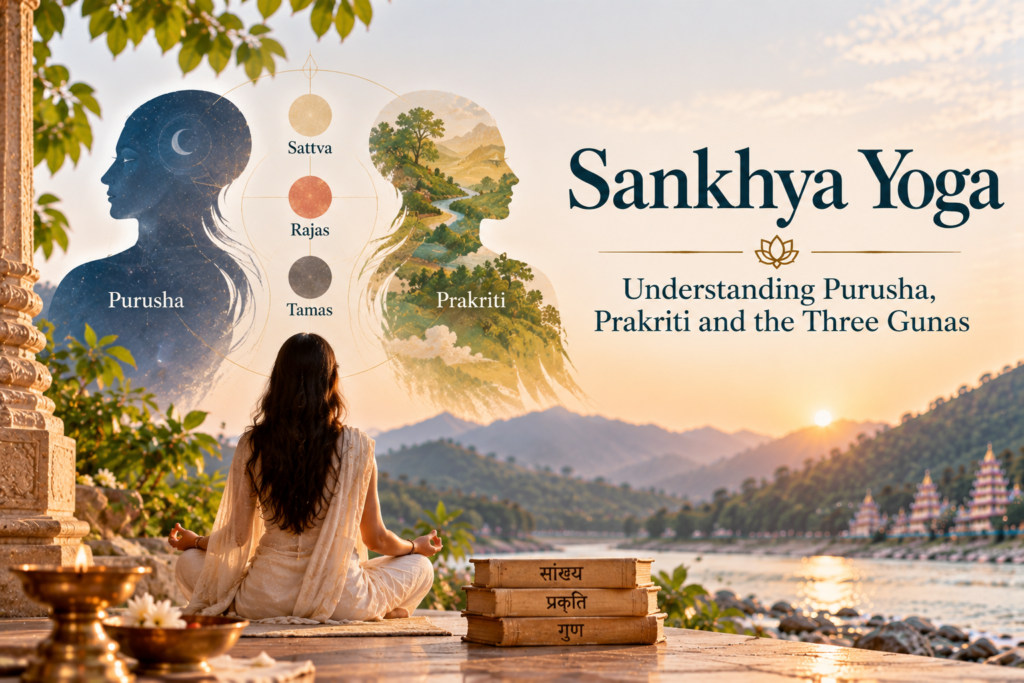
Sankhya explains existence through two fundamental principles: Purusha and Prakriti. Purusha represents consciousness, while Prakriti encompasses nature and the processes through which the world and human experience unfold. Their relationship provides the basis for understanding the philosophy’s account of the mind, senses and material universe.
Classical Sankhya describes Purusha as unchanging and conscious. Prakriti, by contrast, continually changes and produces the structures involved in experience. The body, senses, thoughts, emotions and intellect all belong to Prakriti, while Purusha represents the conscious principle that knows experience.
Consider how the mind responds to a sound. The ears receive auditory information, the mind interprets the sound, and memory may connect it with a particular person or place. Sankhya places these changing processes within Prakriti and distinguishes them from Purusha, the conscious principle associated with awareness of the experience.
What is Purusha?
Purusha occupies a central position in Sankhya philosophy. Depending on the context, the Sanskrit term can refer to a person, the Self or the conscious principle. Classical Sankhya uses it to describe pure consciousness, which remains distinct from the changing structures of nature.
The tradition characterises Purusha as an inactive witness. Thoughts may change, emotions may arise and bodily sensations may fluctuate, yet Purusha retains its essential nature. Sankhya uses this distinction to explain how consciousness relates to the constant movement of experience.
Another important feature of classical Sankhya is its teaching that many Purushas exist. Each conscious being has an individual Purusha within this philosophical framework. This position differs from Advaita Vedanta, which explains the ultimate Self through a non-dual understanding of Atman and Brahman.
What is Prakriti?
Prakriti means nature or the productive principle behind manifestation. In Sankhya, the term encompasses the physical universe and the psychological structures through which embodied beings experience it. The body, senses, mind, intellect and ego all belong to Prakriti because each participates in changing processes.
Sankhya describes Prakriti through three fundamental constituents called gunas. These are Sattva, Rajas and Tamas. Their continual interaction accounts for the different qualities and movements that appear throughout nature.
Each guna contributes a distinctive quality to experience. Sattva relates to clarity and harmony, Rajas to movement and activity, and Tamas to heaviness and inertia. Together, they provide a traditional framework for understanding the changing conditions of the mind and the wider world.
The three gunas
The three gunas are among the best-known concepts in Sankhya philosophy. Later Indian philosophical and yogic traditions also use these categories to explain the qualities of nature and human experience. Within the classical framework, the gunas function as constituents of Prakriti and continually interact with one another.
Sattva: Clarity and harmony
Sattva represents clarity, illumination, lightness and harmony. When Sattva becomes prominent, traditional descriptions associate it with a clear mind, steady attention and the ability to reflect carefully. These qualities support understanding and discernment within the Sankhya framework.
For example, a person may find it easier to concentrate during a quiet period of study or meditation. Sankhya can interpret this quality of experience through Sattva, which supports clarity within Prakriti. The concept therefore helps explain the conditions that traditional yoga practices aim to cultivate.
Rajas: Movement and activity
Rajas represents activity, movement, desire and passion. It drives the processes through which Prakriti expresses change, including effort, ambition and physical or mental activity. When Rajas becomes prominent, a person may experience strong motivation alongside restlessness or distraction.
Rajas plays an important role in everyday life because action requires movement and effort. Sankhya encourages practitioners to recognise these qualities as expressions of Prakriti. This understanding helps explain why activity and desire belong to the changing field of nature within the philosophy.
Tamas: Heaviness and inertia
Tamas represents heaviness, inertia, obscurity and inactivity. Traditional Sankhya descriptions associate it with states in which clarity decreases and movement becomes difficult. Tamas also forms an essential part of Prakriti’s structure, alongside Sattva and Rajas.
A person may experience heaviness after a tiring day or struggle to concentrate when feeling mentally dull. The three-guna framework offers a traditional way to describe such changing qualities of experience. Each guna interacts with the others, creating different combinations of clarity, activity and inertia.
The 25 tattvas of Sankhya
Classical Sankhya analyses reality through 25 tattvas, a Sanskrit term meaning principles or fundamental categories. The system begins with Purusha and Prakriti, then explains the structures that emerge from Prakriti. This enumeration provides a detailed map of the physical and psychological processes involved in embodied experience.
| Principle | Sanskrit term | Role in the Sankhya framework |
|---|---|---|
| 1 | Purusha | Conscious principle |
| 2 | Prakriti | Primordial nature |
| 3 | Buddhi or Mahat | Intellect or cosmic intelligence |
| 4 | Ahamkara | Ego-principle or sense of individuality |
| 5 | Manas | Mind |
| 6–10 | Jnanendriyas | Five organs of knowledge |
| 11–15 | Karmendriyas | Five organs of action |
| 16–20 | Tanmatras | Five subtle sensory potentials |
| 21–25 | Mahabhutas | Five gross elements |
The enumeration distinguishes Purusha from the 24 principles associated with Prakriti. Although different presentations may arrange the categories in slightly different ways, the central distinction remains consistent throughout classical Sankhya.
Buddhi, Ahamkara and Manas
Sankhya gives particular attention to three inner faculties: Buddhi, Ahamkara and Manas. Together, these concepts help explain how the mind processes experience, forms a sense of individuality and makes decisions. Each belongs to Prakriti, even though consciousness illuminates the experience of these faculties.
Buddhi: The faculty of discernment
Buddhi refers to intellect, discernment and the ability to make decisions. It evaluates information and helps organise experience into an understandable form. Within Sankhya, Buddhi belongs to Prakriti and therefore remains distinct from Purusha.
This distinction matters because Sankhya treats even the faculty of understanding as part of nature’s changing processes. A person may develop clearer judgement through study and reflection, yet the philosophy still distinguishes the intellect from the conscious principle that knows experience.
Ahamkara: The sense of individuality
Ahamkara refers to the ego-principle or the sense of “I.” It shapes the experience of individuality by connecting thoughts, sensations and actions with a personal identity. For example, a person may identify with the body, claim ownership of particular thoughts or interpret experiences as defining features of the self.
Sankhya examines this identification because liberation depends on discriminating between Purusha and Prakriti. As practitioners observe the changing structures of identity, they can begin to understand how the sense of individuality operates within the field of nature.
Manas: The coordinating mind
Manas refers to the mind as a coordinating faculty. It works with sensory information, organises impressions and participates in the processing of experience. Alongside the senses, Buddhi and Ahamkara, Manas forms part of the psychological structure that Sankhya places within Prakriti.
Together, these three faculties offer a traditional explanation of how experience becomes organised. The senses receive information, Manas coordinates impressions, Ahamkara relates them to individuality, and Buddhi supports discernment. Purusha remains distinct from these processes within the classical system.
The senses and the five elements
Sankhya extends its analysis from the inner faculties to sensory experience and the physical world. The philosophy identifies five organs of knowledge, associated with hearing, touch, sight, taste and smell. It also identifies five organs of action, connected with functions such as speech, grasping, movement, reproduction and elimination.
The system then introduces five tanmatras, which represent subtle sensory potentials associated with sound, touch, form, taste and smell. From these principles emerge the five mahabhutas, or gross elements:
- Akasha: Space or ether
- Vayu: Air
- Agni: Fire
- Apas: Water
- Prithvi: Earth
This sequence gives Sankhya a detailed account of the relationship between subtle sensory qualities and the material world. The five elements belong to the traditional philosophical framework, which organises experience through its own categories and terminology.
Why is sound important in Sankhya?
Sound has a distinctive place within the Sankhya framework. The tradition associates Shabda, or sound, with Akasha, the element commonly translated as space or ether. This relationship forms part of the classical account of sensory qualities and the elements.
The concept also provides an interesting connection to Indian traditions that explore mantra, sacred sound and Nada Yoga. These traditions developed their own teachings about listening, vibration and contemplative practice, drawing on a wider history of Indian thought about sound.
For students of Nada Yoga, Sankhya offers a philosophical way to examine the listening experience. A sound enters awareness, the mind interprets it, and memory may give it personal meaning. By observing these processes, practitioners can explore the distinction between the sound as an object of experience and the consciousness that knows it.
This connection brings philosophical inquiry into a practical setting. Attentive listening can help students notice the changing qualities of sound, while Sankhya invites them to consider the conscious principle associated with awareness of those changes.
The three gunas in everyday life
The gunas also provide a traditional vocabulary for describing changing qualities in everyday experience. A clear and peaceful morning may suggest Sattva, a period of intense activity may reflect Rajas, and a heavy or dull state may resemble Tamas. These examples illustrate the traditional framework rather than a scientific classification of mental states.
Sankhya treats the gunas as fundamental constituents of Prakriti. Their interactions account for the changing qualities that appear throughout nature, including the shifting conditions of the mind. This perspective gives practitioners a structured way to reflect on the qualities that shape their experience.
Within yoga philosophy, practices that encourage clarity and discernment can support the development of Sattva. As the mind becomes clearer, practitioners may find it easier to observe changing experiences and investigate their relationship with Purusha. The larger aim remains discriminative understanding, which Sankhya places at the centre of liberation.
Sankhya and the mind
One of Sankhya’s important contributions to yoga philosophy is its classification of the mind as part of Prakriti. Everyday language often connects thoughts, emotions and personal identity with the sense of self. Sankhya examines these experiences individually and asks how each relates to the conscious principle.
Thoughts arise and change, emotions shift in response to circumstances, and sensations vary with the body and environment. Even the sense of personal identity can become an object of observation during reflection. Sankhya places these changing experiences within Prakriti and distinguishes them from Purusha.
This distinction forms the basis of its philosophical inquiry. If a person can observe thoughts, sensations and emotions as changing experiences, Sankhya asks what distinguishes these experiences from the consciousness that knows them. The question leads directly to the tradition’s account of liberation.
What is liberation in Sankhya?
Classical Sankhya associates liberation with Kaivalya, a term often understood as isolation or complete independence. The central problem concerns mistaken identification between Purusha and Prakriti. Although Purusha remains distinct from nature within the philosophy, ordinary experience can obscure that distinction.
Sankhya teaches that discriminative knowledge resolves this confusion. Through Viveka, the practitioner recognises the difference between the conscious principle and the changing structures of nature. This understanding forms the basis of liberation within the classical system.
A traditional metaphor compares Prakriti to a dancer who performs for Purusha. Once the dancer has fulfilled her purpose, the performance comes to an end. The image illustrates Sankhya’s view that nature’s activity serves a purpose through which Purusha gains the knowledge necessary for liberation.
Sankhya and Yoga
Sankhya and Yoga share an important place in the history of Indian philosophy. Sankhya provides a systematic analysis of reality, while the Yoga tradition associated with Patañjali places particular emphasis on disciplined practice, concentration and meditative absorption. Both systems discuss Purusha, Prakriti, the gunas and liberation.
Knowledge of Sankhya can therefore help students understand concepts in the Yoga Sutras. The two traditions share much of their philosophical vocabulary, which makes their relationship especially relevant to the study of classical yoga. At the same time, each system develops its own account of spiritual practice and metaphysical questions.
Classical Sankhya generally presents a dualistic framework based on Purusha and Prakriti. Patañjali’s Yoga shares this foundation while also discussing Ishvara, a special Purusha who occupies a distinctive place in the Yoga Sutras. Studying both systems allows students to understand their connections while recognising their differences.
Sankhya Yoga in the Bhagavad Gita
The expression Sankhya Yoga has a particularly important place in the Bhagavad Gita. Chapter 2 carries this title and presents Krishna’s teaching to Arjuna about the Self, the body and the nature of wise action. As the chapter develops, Krishna explains equanimity, discernment and the disciplined performance of one’s duty.
This usage can cause confusion because the expression refers to a particular chapter of the Gita as well as a broader philosophical tradition. Classical Sankhya focuses on the distinction between Purusha and Prakriti and explains reality through its 25 tattvas. The Gita’s Sankhya Yoga develops teachings about knowledge of the Self and connects them with disciplined action.
The concepts overlap, while each context has its own emphasis. Reading the Gita alongside classical Sankhya can help students understand how Indian philosophical texts use shared terminology to explore related questions from different perspectives.
Sankhya and self-inquiry
Sankhya offers a structured approach to examining personal experience. A practitioner can begin by observing the body, which changes over time and responds to its environment. Attention can then move toward sensations, emotions and thoughts, each of which also changes.
The inquiry can continue toward the sense of individuality. A person may notice how memories, preferences and social roles shape the feeling of being a particular individual. Sankhya places these changing aspects of experience within Prakriti and asks the practitioner to distinguish them from Purusha.
This process reflects the tradition’s emphasis on Viveka. Through careful observation, practitioners investigate the difference between the contents of experience and the conscious principle that knows them. The inquiry supports Sankhya’s central aim of liberation through discriminative knowledge.
Sankhya and meditation
Meditation gives this philosophical distinction a practical dimension. As attention becomes steadier, practitioners can observe thoughts as events that arise and pass away. They can apply the same observation to sensations, emotions and sensory impressions, gradually developing a clearer understanding of their changing nature.
This practice relates to Viveka, or discriminative understanding. Within Sankhya, meditation serves a deeper purpose than creating a pleasant mental state: it supports the recognition of the distinction between Purusha and Prakriti. The philosophical framework therefore gives meditation a clear relationship with the tradition’s understanding of liberation.
Sankhya and Nada Yoga
For students of Nada Yoga, Sankhya provides an interesting philosophical map for understanding the experience of sound. A sound becomes an object of hearing, the mind processes it, and the listener may respond with memories, emotions or associations. Sankhya places these changing processes within Prakriti.
Nada Yoga uses sound and attentive listening as objects of concentration and contemplation. Students may focus on a musical tone, a mantra, the tanpura drone or the changing qualities of sound. Through sustained attention, listening can become a way to investigate the nature of experience.
Sankhya adds a philosophical question to this practice: what is aware of the sound? As practitioners observe the movement of sound and the mind’s responses, they can reflect on Purusha, the conscious principle described by classical Sankhya. This connection brings together philosophical inquiry and the practical discipline of listening while preserving the distinct teachings of each tradition.
Sankhya, Vedanta and Yoga
Sankhya also provides useful context for studying Vedanta because the traditions share terminology while reaching different philosophical conclusions. Classical Sankhya describes multiple Purushas and distinguishes them from Prakriti. Advaita Vedanta, by contrast, presents a non-dual understanding in which Atman and Brahman are ultimately identical.
The Yoga philosophy associated with Patañjali shares many elements of Sankhya’s metaphysical framework, while developing its own approach to practice and liberation. These relationships illustrate the diversity of Indian philosophical thought and the importance of studying each tradition within its own context.
Comparing Sankhya, Yoga and Vedanta helps students recognise both shared concepts and fundamental differences. Such comparisons can deepen their understanding of consciousness, nature, the Self and the aims of spiritual practice.
Why study Sankhya today?
Sankhya remains valuable for yoga students because it provides a detailed vocabulary for examining experience. Its distinction between Purusha and Prakriti encourages practitioners to consider the body, mind, emotions and consciousness as distinct aspects of philosophical inquiry. The three gunas offer an additional framework for reflecting on the changing qualities of nature.
The philosophy also helps students understand the ideas behind many classical yoga teachings. Concepts such as Viveka, Kaivalya and the relationship between consciousness and the mind become easier to explore when students understand Sankhya’s basic principles.
Most importantly, Sankhya invites sustained reflection on a fundamental question: what changes, and what is aware of that change? This inquiry connects the philosophical study of Sankhya with meditation, self-inquiry and contemplative listening.
Final thoughts
Sankhya is one of the foundational philosophical systems connected with classical yoga. Its distinction between Purusha and Prakriti provides the central framework, while the three gunas and 25 tattvas explain how the tradition understands nature, the mind, the senses and embodied experience.
For yoga students, Sankhya can deepen the understanding of meditation and self-inquiry. Meditation provides an opportunity to observe the changing movements of Prakriti, while philosophical reflection investigates the conscious principle described as Purusha. In Nada Yoga, attentive listening offers another way to examine experience by observing sound, the mind’s responses and the awareness that knows them.
Ultimately, Sankhya directs attention toward Viveka, or clear discrimination. Through this understanding, practitioners explore the distinction between changing experience and the conscious principle that classical Sankhya identifies as Purusha.
Frequently asked questions
What is Sankhya Yoga?
Sankhya Yoga can refer to Sankhya-based teachings within yoga philosophy or specifically to Chapter 2 of the Bhagavad Gita, titled Sankhya Yoga. Classical Sankhya focuses on Purusha, Prakriti, the three gunas and liberation through discriminative knowledge.
What are Purusha and Prakriti?
Purusha represents the conscious principle in classical Sankhya, while Prakriti represents nature and the changing physical and psychological processes of experience. Their distinction forms the foundation of Sankhya philosophy.
What are the three gunas?
The three gunas are Sattva, Rajas and Tamas. Classical Sankhya describes them as the fundamental constituents of Prakriti, associated respectively with clarity, activity and inertia.
What are the 25 tattvas of Sankhya?
The 25 tattvas are the principles through which classical Sankhya analyses reality. They include Purusha, Prakriti, intellect, ego, mind, the senses, subtle sensory potentials and the five gross elements.
Is Sankhya the same as Yoga?
Sankhya and Yoga are closely related philosophical traditions that share several concepts. Classical Sankhya focuses on the analysis of reality, while the Yoga tradition associated with Patañjali emphasises disciplined practice and meditation.
What is the goal of Sankhya philosophy?
Sankhya identifies Kaivalya, or liberation, as its goal. Discriminative knowledge allows the practitioner to recognise the fundamental distinction between Purusha and Prakriti.
How is Sankhya connected to Nada Yoga?
Sankhya classifies sound and sensory experience within Prakriti, while Nada Yoga uses sound and attentive listening as objects of concentration. Their connection offers a philosophical perspective on listening and awareness