Walk into almost any traditional Hindu temple during morning worship, and one of the first sounds you are likely to hear is not a bell, a drum, or a chant.
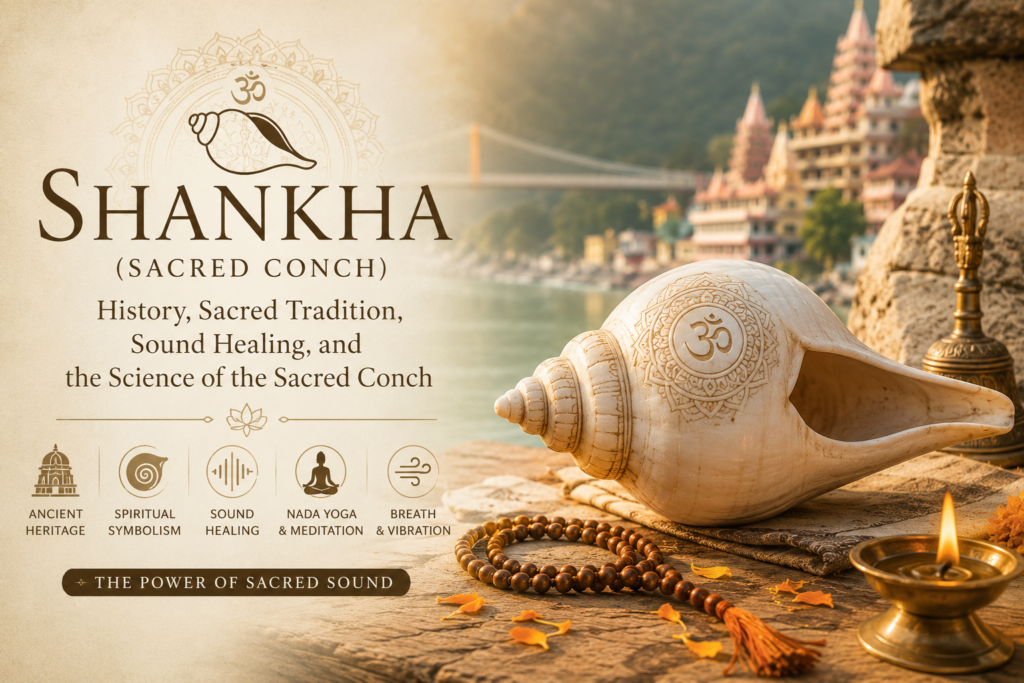
It is the powerful call of the Shankha, the sacred conch shell.
Its deep, resonant tone fills the temple long before prayers begin. For a few moments, conversations stop, attention shifts, and the atmosphere changes. The sound seems to invite everyone present into a different state of awareness, marking the transition from the ordinary rhythms of daily life to something sacred.
For thousands of years, the Shankha has held a special place in India’s spiritual traditions. It has announced temple ceremonies, accompanied Vedic rituals, inspired warriors on ancient battlefields, and prepared meditators for silence. More than a ritual object, it represents one of humanity’s oldest natural wind instruments and a profound reminder of the role that sound plays in Yoga and spiritual practice.
Today, the Shankha continues to find its place within sound healing traditions, meditation, and Nada Yoga, where practitioners explore the relationship between breath, vibration, and consciousness. Although its symbolism is deeply rooted in Indian philosophy, its sound also reflects universal principles of acoustics, resonance, and mindful breathing.
The Ancient Origins of the Shankha
The story of the Shankha begins thousands of years before the construction of India’s great temples.
Archaeological discoveries from the Indus Valley Civilization reveal that large conch shells were already being crafted into ornaments, ceremonial objects, and ritual instruments more than four thousand years ago. Excavations at Harappa, Mohenjo-daro, Lothal, and Dholavira have uncovered workshops dedicated to shell craftsmanship, demonstrating that these remarkable sea shells held cultural and spiritual significance long before the classical period of Indian history.
As Vedic culture evolved, the Shankha gradually became associated with sacred ceremonies. Priests sounded it before yajñas, kings used it during royal processions, and communities recognised its distinctive call as the signal that worship was about to begin.
Its practical purpose eventually merged with spiritual symbolism, transforming the Shankha into one of the most recognisable emblems of Hindu tradition.
The Shankha in Hindu Scriptures
The sacred conch appears throughout India’s spiritual literature, including the Vedas, the Purāṇas, and the Mahābhārata.
Perhaps its most famous appearance comes in the opening chapter of the Bhagavad Gītā, where the great warriors announce the beginning of the Battle of Kurukṣetra by sounding their individual conches.
पाञ्चजन्यं हृषीकेशो देवदत्तं धनञ्जयः ।
पौण्ड्रं दध्मौ महाशङ्खं भीमकर्मा वृकोदरः ॥
Pāñcajanyaṁ Hṛṣīkeśo Devadattaṁ Dhanañjayaḥ
Pauṇḍraṁ dadhmau mahāśaṅkhaṁ Bhīmakarmā Vṛkodaraḥ
“Lord Krishna blew His conch Pāñcajanya, Arjuna blew Devadatta, and Bhīma sounded the mighty Pauṇḍra.”
Bhagavad Gītā 1.15
Each warrior’s conch possessed its own name and identity, reflecting the reverence given to these instruments.
The Shankha also became one of the four principal symbols carried by Lord Viṣṇu, alongside the Sudarśana Chakra, Gadā, and Padma. Within this iconography, the conch represents the awakening power of divine sound and the call towards righteousness and spiritual awareness.
Why Is the Shankha Blown Before Worship?
Anyone who has visited an Indian temple has probably wondered why the conch is always sounded before rituals begin.
The answer is both practical and symbolic.
Historically, the Shankha served as a natural announcement system. Before clocks, microphones, or loudspeakers, its powerful resonance travelled across temple complexes and surrounding villages, gathering devotees for prayer.
More importantly, its sound creates a clear psychological transition.
The moment the Shankha is blown:
- Everyday conversation naturally comes to a pause.
- Attention shifts towards the present moment.
- Worship begins with collective awareness.
- The atmosphere becomes calm and intentional.
Traditional teachings also describe the sound of the Shankha as auspicious, symbolising purity and the removal of negative influences before sacred ceremonies. Whether understood spiritually or symbolically, its resonance has long been associated with creating a space of reverence and focus.
The Shankha and the Philosophy of Nada Yoga
Within Nada Yoga, sound is far more than something we hear.
It is understood as a pathway to awareness.
The Sanskrit word “Nāda” refers to vibration or sound, while “Yoga” means “union.” Together, they describe a practice in which listening becomes a form of meditation.
The Shankha fits naturally within this philosophy.
Unlike electronic instruments or digitally generated tones, the conch shell is shaped by nature itself. As air moves through its spiral chamber, it produces a rich spectrum of harmonics that extend far beyond a single note.
For many practitioners, the sound unfolds in three stages:
- Breath creates the vibration.
- The vibration becomes an audible sound.
- The sound gradually dissolves into silence.
This progression beautifully reflects one of the central teachings of Nada Yoga: moving from external sound towards inner stillness.
Blowing the Shankha Is a Practice of Breath
Producing a clear tone from a Shankha is more challenging than it first appears.
It requires much more than simply blowing air into the shell.
To create a steady sound, practitioners develop:
- Deep diaphragmatic breathing.
- Controlled exhalation.
- Relaxed facial muscles.
- Stable posture.
- Sustained breath support.
In many ways, blowing the Shankha resembles a natural breathing exercise.
The emphasis on slow, controlled exhalation makes it an excellent complement to Prāṇāyāma, mantra chanting, and meditation practices.
Many traditional teachers introduce the Shankha before chanting because it encourages practitioners to become fully aware of their breath before using the voice.
How the Shankha Supports Breath Awareness
Every sound produced by the Shankha begins with the breath.
As practitioners learn to sustain a clear tone, they naturally improve their awareness of how they inhale, exhale, and regulate airflow.
Regular practice may help practitioners develop:
- Better breath awareness.
- Greater control over prolonged exhalation.
- Improved diaphragmatic breathing.
- Coordination between breath and sound.
- Increased breath endurance for chanting and meditation.
These benefits arise primarily from the breathing technique itself rather than any mystical property of the shell.
Like many traditional yogic practices, the value lies in the quality of attention brought to the experience.
Feeling the Vibration
The Shankha is not only heard.
It is felt.
As the shell resonates, many practitioners notice subtle vibrations throughout the chest, throat, jaw, and face. These sensations arise because the conch produces complex harmonic overtones that interact with the surrounding air and with the body’s natural sensitivity to vibration.
Within traditional Indian philosophy, these vibrations are often understood as supporting the balanced flow of Prāṇa, the vital life force described in Yoga and Ayurveda.
From an acoustic perspective, they demonstrate how rich harmonic sounds can create immersive listening experiences that engage both hearing and bodily perception.
The Shankha in Modern Sound Healing
Although deeply rooted in ancient tradition, the Shankha continues to find a meaningful place within contemporary sound healing meditations.
Today, practitioners often use it:
- At the beginning of meditation sessions.
- Before Yoga Nidra.
- During mantra chanting.
- To open sound baths.
- As part of traditional yogic ceremonies.
Its role is not to produce healing through a specific frequency but to establish presence, encourage mindful breathing, and create a clear transition into meditation.
This reflects an important principle shared by many sound healing traditions. The instrument itself is only one part of the experience. Equally important are the quality of attention, the breath, and the intention with which sound is introduced.
What Does Science Say?
The Shankha occupies an interesting space where ancient tradition meets modern understanding.
Science clearly supports several aspects of the practice.
Researchers understand that:
- Controlled breathing influences the autonomic nervous system.
- Slow exhalation may encourage relaxation.
- Sound affects attention and emotional processing.
- Harmonic resonance shapes our perception of sound.
At the same time, scientific research specifically examining the Shankha remains limited.
While many practitioners describe feelings of calm, focus, or spiritual connection after blowing the conch, these experiences should be appreciated as personal and traditional rather than universal medical outcomes.
Recognizing this distinction allows us to honor both the wisdom of tradition and the importance of evidence-based understanding.
Learning the Role of the Shankha in Traditional Sound Practices
The Shankha is often introduced as a ceremonial instrument, but within traditional yogic education it represents something much deeper. It teaches the relationship between breath, sound, attention, and silence, principles that remain central to Nada Yoga and many classical Indian practices.
Students exploring a Sound Healing Course in Rishikesh frequently encounter the Shankha alongside singing bowls, mantra chanting, meditation, and breathwork. Rather than treating it as an isolated ritual object, authentic training situates it within the broader context of sound-healing traditions, where every instrument serves to cultivate awareness rather than simply produce sound.
Final Thoughts
For thousands of years, the voice of the Shankha has echoed through temples, sacred ceremonies, and places of meditation, reminding practitioners that sound begins not with an instrument but with the breath itself. Its spiral form symbolizes an inward journey, while its resonant tone invites the mind to become still and attentive.
Whether appreciated as a remarkable natural instrument, a sacred symbol of Hindu tradition, or a valuable part of sound healing traditions, the Shankha continues to inspire those seeking a deeper relationship with breath, vibration, and awareness. Within Nada Yoga and authentic sound-healing meditations, its timeless call reminds us that every conscious breath can serve as a bridge between the outer world of sound and the inner experience of silence.
Frequently Asked Questions
What is a Shankha?
A Shankha is a sacred conch shell traditionally used in Hindu rituals, temple worship, Yoga, and meditation. It is one of the oldest natural wind instruments known to humanity.
Why is the Shankha blown in temples?
The Shankha announces the beginning of worship, gathers devotees, creates a sacred atmosphere, and symbolically marks the transition from everyday activity to spiritual practice.
Is blowing a Shankha good for breathing?
Blowing the Shankha requires controlled diaphragmatic breathing and sustained exhalation. Many practitioners find that regular practice improves breath awareness and supports techniques used in Prāṇāyāma and chanting.
How is the Shankha used in sound healing?
In modern sound healing, the Shankha is often used to begin meditation sessions, support mindful breathing, and establish a calm atmosphere. Its value lies in combining breath, resonance, and focused attention rather than producing any scientifically established therapeutic frequency.