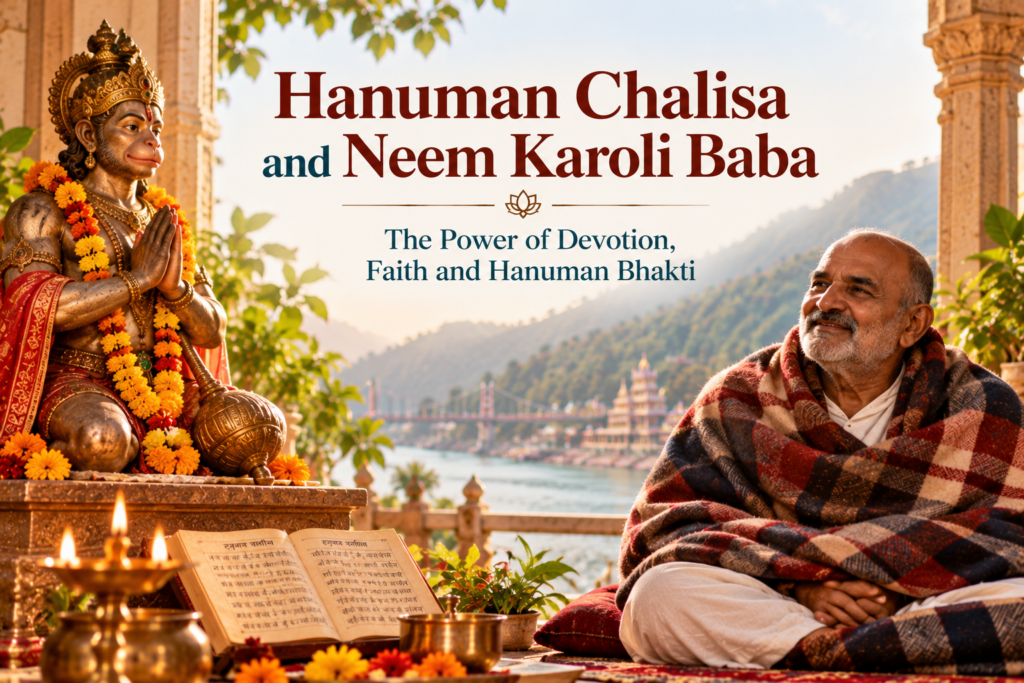
The Hanuman Chalisa holds a special place in the devotional life of millions of people. People recite it in homes, temples and ashrams as an expression of faith and remembrance. Its forty verses praise Lord Hanuman’s strength, wisdom, humility and complete dedication to Lord Rama. Through regular chanting, devotees reflect on these qualities and bring the spirit of devotion into their daily lives.
Neem Karoli Baba, also known as Maharaj-ji, became one of the most recognised spiritual figures associated with Hanuman Bhakti in modern India. His deep devotion to Hanuman influenced his teachings and the devotional practices followed by his disciples. He encouraged people to remember God through prayer, chanting and selfless service. As a result, the Hanuman Chalisa became an important part of the spiritual life of many communities connected with him.
The relationship between the Hanuman Chalisa and Neem Karoli Baba offers a meaningful way to understand Bhakti Yoga, sacred poetry and devotional sound. It also shows how an ancient hymn continues to inspire spiritual practice across generations.
What is the Hanuman Chalisa?
The Hanuman Chalisa is a devotional hymn dedicated to Lord Hanuman. The poet-saint Goswami Tulsidas traditionally receives credit for its composition. He wrote the hymn in Awadhi, a language associated with the region of present-day Uttar Pradesh.
The composition contains forty Chaupais, or four-line verses, along with opening and closing Dohas, which are couplets. The word Chalisa comes from Chalis, meaning forty. Each verse praises a quality, deed or aspect of Hanuman’s character.
The hymn begins with an invocation to the Guru:
श्रीगुरु चरन सरोज रज, निज मनु मुकुरु सुधारि।
बरनउँ रघुबर बिमल जसु, जो दायकु फल चारि॥
Tulsidas compares the mind to a mirror that needs cleansing before it can reflect the pure glory of Lord Rama. He begins by seeking the Guru’s grace, establishing humility and guidance as important foundations of devotional practice.
The second Doha expresses humility before Hanuman and asks for strength, wisdom and knowledge. The forty Chaupais then describe Hanuman’s qualities, his service to Rama and his role in the Ramayana.
Through these verses, the hymn presents Hanuman as an ideal devotee whose strength and knowledge serve a higher purpose.
Who was Neem Karoli Baba?
Neem Karoli Baba, affectionately known as Maharaj-ji, was a twentieth-century Indian saint whose life and teachings centred on devotion, love and selfless service. His followers remember his deep love for Lord Hanuman and his encouragement of devotional practices such as Ram Naam and Hanuman Chalisa recitation.
His birth name is commonly recorded as Lakshmi Narayan Sharma. He travelled and lived in different parts of northern India, where devotees came to know him by several names, including Neeb Karori Baba.
Maharaj-ji established and inspired several ashrams and temples dedicated to Hanuman. Kainchi Dham, situated in the Kumaon hills of Uttarakhand, became one of the principal centres associated with his life and teachings. Its Hanuman temple and annual gatherings continue to attract devotees from India and abroad.
His followers often express his central message through three ideas: love everyone, serve everyone and remember God. These teachings reflect the spirit of Bhakti Yoga, where devotion becomes part of everyday conduct.
Why was Neem Karoli Baba so devoted to Hanuman?
Hanuman occupied a central place in Maharaj-ji’s devotional life. His followers remember him as someone who frequently spoke about Hanuman, encouraged the recitation of the Hanuman Chalisa and inspired people to remember Lord Rama.
In the Ramayana, Hanuman represents complete dedication to Rama. His strength comes with humility, his knowledge guides his service, and his actions reflect concern for others. These qualities also appear throughout the stories and teachings associated with Neem Karoli Baba.
Maharaj-ji’s devotion influenced the spiritual atmosphere of his ashrams. Hanuman temples, devotional singing, Ram Naam and the recitation of the Chalisa became important parts of the practices followed by his devotees.
The Neem Karoli Baba Ashram and Hanuman Temple organisation also preserves devotional resources connected with the hymn, including commentary and recordings. These resources help devotees understand and continue the tradition of Hanuman Bhakti.
The connection between Neem Karoli Baba and the Hanuman Chalisa
For devotees of Neem Karoli Baba, the Hanuman Chalisa expresses the devotion he encouraged throughout his life. This connection appears through regular remembrance of Hanuman, repetition of sacred verses and the cultivation of devotion through daily practice.
Regular recitation as an act of remembrance
Maharaj-ji’s devotees remember his encouragement of regular Hanuman Chalisa recitation. The hymn gives practitioners a familiar structure for remembering Hanuman and reflecting on his qualities.
Regular recitation also brings continuity to spiritual practice. A devotee may chant in the morning, during a temple gathering or as part of evening prayer. Over time, the verses become familiar and their meaning can guide personal reflection.
Hanuman Chalisa and collective devotion
Devotional gatherings at ashrams associated with Maharaj-ji often include group recitation, Aarti and Kirtan. The Neem Karoli Baba Ashram in Taos, New Mexico, for example, publishes information about its Hanuman Chalisa gatherings and devotional programmes.
Group chanting brings participants together through a shared rhythm and common focus. As familiar verses fill the space, individual voices become part of a collective devotional experience.
Kirtan follows a similar spirit of shared participation. Through singing the names of the Divine, participants express devotion through melody, rhythm and repetition.
The hymn as a guide to devotion
The Hanuman Chalisa repeatedly praises Hanuman’s humility, courage, wisdom and service. These qualities give devotees meaningful subjects for contemplation.
As practitioners recite the verses, they can reflect on how these qualities apply to their own lives. Courage may help them face difficulties, while humility encourages thoughtful action. The hymn therefore provides a regular opportunity to bring faith and service into everyday conduct.
The deeper meaning of Hanuman in the Hanuman Chalisa
The Hanuman Chalisa presents several dimensions of Hanuman’s character. Understanding these qualities adds depth to the experience of chanting and explains why the hymn holds such an important place in Bhakti traditions.
Hanuman as a symbol of strength
The opening Chaupai describes Hanuman as an ocean of knowledge and virtues:
जय हनुमान ज्ञान गुन सागर।
जय कपीस तिहुँ लोक उजागर॥
Jai Hanuman gyan gun sagar, Jai Kapis tihun lok ujagar.
The verse praises Hanuman as a vast source of knowledge and noble qualities. His strength appears throughout the Ramayana, especially during his journey to Lanka, his search for Sita and his participation in the battle against Ravana.
In devotional interpretation, Hanuman’s strength remains closely connected with his dedication to Rama. His courage serves a higher purpose and guides his actions.
Hanuman as a symbol of humility
Hanuman possesses extraordinary abilities, yet he serves Rama with complete sincerity. His relationship with Rama gives the hymn one of its central spiritual themes.
His humility shows how knowledge and strength can support selfless service. Devotees of Neem Karoli Baba often recognise this quality as an important part of Maharaj-ji’s own devotional example.
Hanuman as a symbol of wisdom
The Hanuman Chalisa praises Hanuman’s intelligence, discernment and knowledge. In the Ramayana, he communicates thoughtfully, understands difficult situations and acts with careful judgement.
His wisdom appears through both understanding and action. For this reason, devotees often look to Hanuman as an example when seeking clarity and courage in their own lives.
Hanuman as the ideal devotee
Hanuman’s relationship with Rama forms the central devotional relationship in the hymn. His life reflects service, loyalty and constant remembrance of his beloved Lord.
This attitude is known as Dasya Bhava, which describes devotion through service. It is one of the traditional expressions of Bhakti, where the devotee approaches the Divine with humility and loving dedication.
Hanuman Chalisa and the practice of Bhakti Yoga
Bhakti Yoga is the path of devotion. It places love and remembrance of the Divine at the centre of spiritual life. Practitioners express Bhakti through prayer, mantra repetition, devotional singing, worship and service.
The Hanuman Chalisa brings several of these practices together. Its verses praise Hanuman, recall events from the Ramayana and express the devotee’s longing for divine grace. Through regular recitation, practitioners cultivate remembrance and deepen their connection with the qualities represented by Hanuman.
Neem Karoli Baba’s teachings are closely associated with this spirit of Bhakti. His followers remember his emphasis on loving God, serving others and keeping the Divine present in daily life. The Hanuman Chalisa reflects these principles through its focus on Hanuman’s dedication to Rama.
Readers interested in the wider philosophical background of devotion can also explore the Bhagavad Gita, which discusses different approaches to spiritual life, including devotion and surrender.
Dasya Bhava: Devotion through service
Dasya Bhava describes a devotional relationship in which the practitioner approaches the Divine as a servant. Hanuman is one of the most recognised examples of this attitude in Hindu tradition.
His service to Rama includes finding Sita, carrying Rama’s message to Lanka and supporting the search for her. He also participates in the battle against Ravana. Each action expresses his dedication to Rama’s purpose.
The spirit of service also appears in Maharaj-ji’s remembered teachings. His emphasis on serving others connects devotional feeling with practical action. In this way, Bhakti becomes part of ordinary human relationships and daily responsibilities.
Ram Naam: Remembering the name of Rama
The name of Rama appears throughout the devotional tradition associated with Hanuman. His devotion to Rama is central to understanding his character and the meaning of the Hanuman Chalisa.
Neem Karoli Baba’s devotees also place great importance on Ram Naam, the repetition and remembrance of Rama’s name. Group chanting of Sri Ram Jai Ram Jai Jai Ram forms a familiar part of devotional gatherings associated with his ashrams.
The Kainchi Dham tradition and other centres connected with Maharaj-ji continue this culture of chanting and Kirtan. Through repetition, devotees keep their attention on the Divine name and bring a sense of continuity to their practice.
The role of sound and repetition in Hanuman Chalisa chanting
The Hanuman Chalisa is both a literary composition and a devotional sound practice. Its rhythm, repetition and poetic structure make it suitable for recitation, singing and group chanting.
In Indian spiritual traditions, practitioners often use the term Japa for the repetition of a sacred name or phrase. During Japa, the practitioner repeats the sound while maintaining attention on its pronunciation and meaning. The Hanuman Chalisa follows a longer poetic structure, with each verse offering a particular expression of praise and remembrance.
Several aspects can support a more attentive chanting practice:
- Pronunciation: Clear pronunciation helps preserve the structure and meaning of the Awadhi verses.
- Rhythm: A steady pace supports continuous recitation and helps maintain attention.
- Meaning: Understanding the verses gives practitioners a deeper basis for reflection.
- Listening: Paying attention to one’s own voice and the voices of others develops awareness of the chanting experience.
- Repetition: Regular recitation establishes continuity in devotional practice.
Sound also has a wider place in Indian spiritual traditions. Nada Yoga, for example, explores sound through listening, vocal practice and meditation. The Hanuman Chalisa offers a devotional setting for working with the voice, rhythm and attentive listening.
Students interested in the relationship between sound and spiritual practice can explore the Nada Yoga teacher training course in Rishikesh, which includes the study of sound, music and meditative listening. The acoustic and therapeutic applications of sound also form part of the subject matter explored in a sound healing teacher training course.
How to chant the Hanuman Chalisa
Devotees can recite the Hanuman Chalisa individually or in a group. Many include it in their daily prayers, while others chant during temple gatherings, festivals and special devotional observances.
A simple routine can help beginners become familiar with the hymn.
Prepare a quiet space
Choose a clean and comfortable place for recitation. Some practitioners keep an image of Hanuman or a small altar nearby. Take a few moments to settle down and bring your attention towards the practice.
Begin with the opening Doha
Start with the opening invocation to the Guru. Recite the verse slowly and give attention to its meaning. This opening establishes the devotional mood and prepares the practitioner for the main composition.
Recite the forty Chaupais
Continue through the forty verses at a steady pace. Give attention to pronunciation and rhythm, allowing each verse to be heard clearly.
Beginners can follow a reliable written text or audio recording until they become familiar with the complete hymn. Gradually, they can develop a more independent recitation practice.
Reflect on the meaning
Understanding the verses adds depth to chanting. A practitioner can study one or two verses at a time and reflect on the qualities of Hanuman described in them.
This approach also helps connect recitation with daily life. For example, a verse praising Hanuman’s courage may encourage reflection on how to face personal challenges with patience and faith.
Complete the closing Doha
Finish the hymn with the closing Doha. Many devotees then offer a short prayer, sit quietly for a few moments or perform Aarti.
Consistency and sincere attention provide a valuable foundation for devotional practice. Individuals can also follow the customs of their family, temple or spiritual tradition.
Kainchi Dham: Neem Karoli Baba’s Hanuman temple in Uttarakhand
Kainchi Dham is one of the most recognised places associated with Neem Karoli Baba. The ashram stands in the Kumaon region of Uttarakhand, near Bhowali and Nainital. Forested hills and the landscape of the Kosi River valley surround the temple complex.
Maharaj-ji established the ashram in the 1960s. According to its published history, the Hanuman temple was consecrated on 15 June 1964. The annual Bhandara held around this date has become a major gathering, bringing devotees together for prayer, Kirtan and the distribution of food.
The Hanuman temple reflects Maharaj-ji’s devotion to the deity. Visitors come to offer prayers, recite the Hanuman Chalisa and spend time in the devotional atmosphere of the ashram.
Kainchi Dham also reflects the importance of Seva, or selfless service. During religious gatherings, volunteers prepare and distribute food to visitors. This shared activity brings people together through a practical expression of devotion.
The international influence of Neem Karoli Baba’s devotion
Neem Karoli Baba’s influence reached devotees far beyond the Kumaon hills. Several people from outside India travelled to meet him, and their accounts introduced his life and teachings to international audiences.
One of his best-known Western disciples was Ram Dass, born Richard Alpert. He met Maharaj-ji in India in 1967. Later, he wrote Be Here Now, a book that introduced many readers to Indian spiritual ideas and his experiences with his teacher.
Through Ram Dass and other disciples, the devotional traditions associated with Maharaj-ji reached communities in the United States and other countries. Hanuman temples and satsang groups connected with his teachings also developed outside India.
The Neem Karoli Baba Ashram and Hanuman Temple in Taos, New Mexico, continues to organise devotional activities, including Hanuman Chalisa recitations, Aarti and Kirtan. Its published programme shows how these practices have become part of an international devotional community.
As a result, people in different parts of the world have encountered Hanuman through books, music, meditation and devotional gatherings.
Hanuman Chalisa, Neem Karoli Baba and the meaning of surrender
Surrender is one of the deeper themes connecting the Hanuman Chalisa with Neem Karoli Baba. In Bhakti traditions, surrender means placing one’s trust and devotion in the Divine while developing humility and dedication in everyday life.
Hanuman’s relationship with Rama provides a traditional example of this attitude. He uses his strength, intelligence and abilities in service of Rama, allowing devotion to guide his actions.
Maharaj-ji’s followers often describe a similar emphasis in his teachings. His encouragement of Ram Naam, Hanuman worship and selfless service gave devotees practical ways to express their faith.
The Hanuman Chalisa supports this reflection through its repeated praise of Hanuman’s qualities. Each recitation creates an opportunity to contemplate courage, wisdom, humility and loving service.
Readers who wish to explore other aspects of meditation and concentration in classical yoga can also read about Dharana, Dhyana and Samadhi. These concepts provide further insight into the role of attention and sustained awareness in yogic practice.
Frequently asked questions
Did Neem Karoli Baba write the Hanuman Chalisa?
No. The Hanuman Chalisa is traditionally attributed to Goswami Tulsidas, who composed it in Awadhi. Neem Karoli Baba was a devoted follower of Hanuman and encouraged its regular recitation among his devotees.
Why is the Hanuman Chalisa important to Neem Karoli Baba’s followers?
The hymn expresses devotion to Hanuman, whom Maharaj-ji deeply revered. Its recitation remains an important devotional practice within communities associated with his teachings.
How many verses are there in the Hanuman Chalisa?
The Hanuman Chalisa contains forty main Chaupais, along with opening and closing Dohas. The word Chalisa refers to the forty verses.
What is the main message of the Hanuman Chalisa?
The hymn celebrates Hanuman’s strength, wisdom, humility and complete devotion to Lord Rama. Its verses encourage devotees to develop faith, courage and dedication through remembrance of Hanuman.
What is the relationship between Hanuman and Lord Rama?
Hanuman is one of Rama’s greatest devotees in the Ramayana. He serves Rama throughout the epic, helping him find Sita and supporting the effort to bring her back from Lanka. Their relationship represents complete devotion and selfless service.
Why is Kainchi Dham associated with Hanuman?
Neem Karoli Baba established Kainchi Dham in Uttarakhand and consecrated its Hanuman temple in 1964. The temple reflects his devotion to Hanuman and remains a central place of worship for his followers.
Can beginners chant the Hanuman Chalisa?
Yes. Beginners can start by learning the opening verses and gradually become familiar with the complete hymn. Listening to a reliable recitation and studying the meaning of each verse can support the learning process.
Final thoughts
The Hanuman Chalisa and Neem Karoli Baba remain connected through a shared tradition of devotion to Lord Hanuman. The hymn preserves the devotional poetry of Tulsidas, while Maharaj-ji’s life and teachings inspired generations of people to include Hanuman worship and Ram Naam in their daily lives.
Through its forty verses, the Hanuman Chalisa celebrates qualities central to Bhakti Yoga, including courage, wisdom, humility and selfless service. Regular recitation gives devotees a familiar way to remember Hanuman and reflect on his dedication to Lord Rama.
For students of Indian spiritual traditions, this connection also opens a wider exploration of sacred sound, mantra chanting, Kirtan and devotional meditation. The Hanuman Chalisa continues to bring these practices into homes, temples and ashrams, carrying the tradition of Hanuman Bhakti across generations.