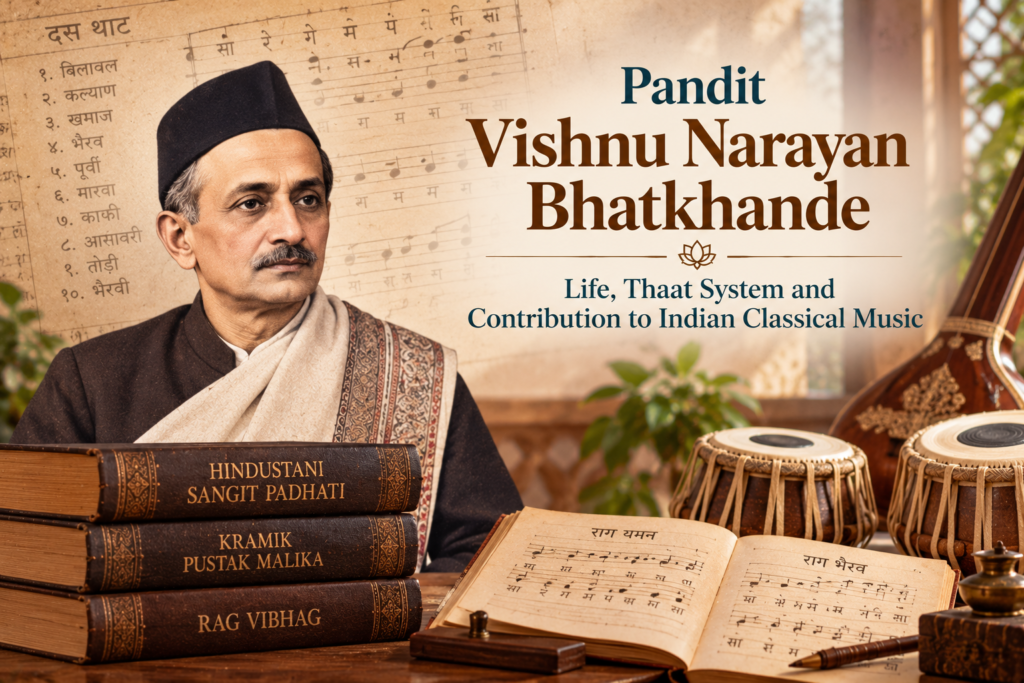
Hindustani classical music carries a vast tradition of ragas, compositions, rhythmic patterns and oral teaching. For generations, musicians passed their knowledge from teacher to student, preserving the distinctive style of their gharana through practice and performance. During the late nineteenth and early twentieth centuries, Pandit Vishnu Narayan Bhatkhande undertook an important task: studying these musical traditions, documenting their theory and developing a systematic approach to teaching them. His work helped shape the way Hindustani classical music is studied in music schools and universities today.
Bhatkhande is especially remembered for his classification of ragas into ten thaats and for his influential books on music theory. His contribution extended into music notation, curriculum development and the study of historical Indian music texts. Understanding his life offers a valuable perspective on how India’s classical music tradition has been documented and taught across generations.
Who was Pandit Vishnu Narayan Bhatkhande?
Pandit Vishnu Narayan Bhatkhande was an Indian musicologist, scholar and music reformer who lived from 1860 to 1936. He is widely recognized for his role in organizing the theoretical study of Hindustani classical music and making its principles accessible to students through written materials.
Born on 10 August 1860, Bhatkhande initially pursued a career in law. During his college years, however, he developed a strong interest in music and began studying vocal music and the sitar. He also explored the theoretical foundations of Indian music, reading classical treatises and learning from established musicians.
Over time, his interest developed into a sustained programme of musical research. Bhatkhande travelled to different regions, met musicians from various traditions and examined the relationship between practical performance and written music theory. His work brought together knowledge preserved through oral teaching and ideas discussed in historical Sanskrit texts.
Why is Bhatkhande important in Indian classical music?
Bhatkhande’s influence comes from the way he organized, recorded and presented musical knowledge. Hindustani music had long relied on oral instruction, in which a teacher demonstrated a raga and the student learned its movements through listening, repetition and practice. Each gharana also maintained its own stylistic characteristics and teaching methods.
Bhatkhande studied these traditions and worked towards a more structured system of music education. His publications described ragas, provided musical compositions in notation and presented theoretical ideas in an organized form. Consequently, students could use written materials alongside direct instruction from a teacher.
His approach became influential in formal music education across northern India. Today, his books remain important references for students learning Hindustani vocal music and its theoretical foundations.
Bhatkhande’s research and musical journeys
Bhatkhande travelled widely to learn from musicians and examine the musical practices of different regions. His research included discussions with established performers, study of traditional compositions and examination of historical works on music. These journeys helped him understand how ragas were performed and described within different musical lineages.
His research also involved the study of texts such as Bharata’s Natya Shastra and Sharngadeva’s Sangita Ratnakara. These works contain important discussions of music, performance and musical theory. By studying such sources alongside contemporary practice, Bhatkhande explored how inherited theoretical ideas related to the music performed in his own time.
He also travelled to southern India to learn about Carnatic music and its theoretical literature. This research introduced him to classification systems used in other Indian classical traditions, including the melakarta framework associated with Carnatic ragas. His work drew on this wider musical knowledge while developing a classification suited to Hindustani music.
What is the Bhatkhande thaat system?
One of Bhatkhande’s best-known contributions is the ten-thaat system, which groups many Hindustani ragas according to their underlying note structures.
In Hindustani music, the seven basic swaras are Sa, Re, Ga, Ma, Pa, Dha and Ni. Depending on the musical context, certain notes can take altered forms, commonly described as komal or tivra. Different combinations of these notes help create the distinctive melodic character of a raga.
A thaat is a parent scale used to classify ragas according to their notes. Bhatkhande selected ten widely useful thaats to organize a large body of Hindustani ragas into a practical theoretical framework. The system continues to feature prominently in music education.
The ten thaats of Hindustani classical music
| Thaat | General note characteristic | Common raga examples |
| Bilawal | All seven shuddha notes | Alhaiya Bilawal |
| Kalyan | Tivra Ma | Yaman |
| Khamaj | Komal Ni in the parent scale | Khamaj |
| Kafi | Komal Ga and komal Ni | Kafi |
| Bhairav | Komal Re and komal Dha | Bhairav |
| Bhairavi | Komal Re, Ga, Dha and Ni | Bhairavi |
| Asavari | Komal Ga, Dha and Ni | Asavari |
| Todi | Komal Re, Ga and Dha, with tivra Ma | Miyan ki Todi |
| Marwa | Komal Re and tivra Ma | Marwa |
| Poorvi | Komal Re, komal Dha and tivra Ma | Poorvi |
These are broad classification examples. A raga’s identity also depends on its characteristic movements, important notes, phrases, ornamentation and performance conventions.
The ten-thaat system gives students a useful starting point when comparing ragas. For example, learning about the Kalyan thaat introduces the note structure associated with ragas such as Yaman. Students can then explore how Yaman develops its own identity through characteristic phrases, melodic movement and performance practice.
However, the thaat framework serves primarily as a classification tool. It cannot fully explain the personality of every raga, and some ragas do not fit neatly into a single parent-scale category. Their individual grammar and traditional presentation remain essential to understanding them.
Bhatkhande’s books and written notation
Bhatkhande’s publications helped establish a lasting reference system for the study of Hindustani classical music. Two major works associated with him are Hindustani Sangeet Paddhati and Kramik Pustak Malika.
Hindustani Sangeet Paddhati
Hindustani Sangeet Paddhati presents Bhatkhande’s ideas about music theory, ragas and the principles underlying Hindustani music. The work draws on historical scholarship as well as his research into living musical traditions.
The series was originally published in Marathi, with later Hindi editions making its material accessible to a wider readership. Its systematic approach helped students engage with music theory through a structured course of study.
Kramik Pustak Malika
Kramik Pustak Malika is another major contribution. This multi-volume series contains a substantial collection of vocal compositions presented through a notation system developed and promoted by Bhatkhande.
Written notation gives students a reference for understanding a composition’s melodic structure and learning its phrases. It also supports the study of repertoire across different stages of musical training. Nevertheless, notation works best alongside listening and instruction, since the finer details of a raga emerge through musical expression, ornamentation and the teacher’s demonstration.
Together, these publications became foundational resources in the formal teaching of Hindustani classical music.
Bhatkhande’s role in modern music education
Bhatkhande helped advance the development of institutional music education in India. Alongside other important music reformers, including Pandit Vishnu Digambar Paluskar, he supported systems through which students could study classical music through organized courses and graded instruction.
In 1926, Bhatkhande established a music institution in Lucknow with support from local patrons Rai Umanath Bali and Rai Rajeshwar Bali. It was named Marris College of Music and later became associated with the institution now known as Bhatkhande Sanskriti Vishwavidyalaya.
This institutional work helped make music education available through a formal academic structure. Students could pursue systematic study of vocal music, instruments, theory and performance. The approach also supported the development of syllabuses, examinations and reference materials that shaped music education in later decades.
His legacy therefore includes both the theoretical study of ragas and the educational structures through which generations of musicians have learned them.
Bhatkhande and the relationship between theory and practice
The study of Hindustani classical music brings together two closely connected forms of learning. Theory gives students a language for understanding musical structure, while practical training develops the ability to hear, reproduce and express that structure through sound.
Bhatkhande’s work helped students understand ideas such as swara, raga, thaat and musical notation. These concepts provide a foundation for further study, especially when learners begin comparing ragas and examining their melodic patterns.
Practical training remains equally important. A student may understand a raga’s scale and still need considerable practice to recognize its characteristic phrases, shape its notes and communicate its emotional character. Listening to experienced musicians, singing under guidance and repeating compositions gradually build this understanding.
Bhatkhande’s written system and the traditional teacher-student relationship can therefore be understood as complementary parts of music education. Books offer structure and reference, while the living musical tradition brings those ideas into practice.
The connection between Bhatkhande, ragas and Nada Yoga
Bhatkhande’s work is particularly relevant to anyone exploring the deeper dimensions of Indian classical music. His research organized the theoretical study of ragas, while the practice of learning a raga requires sustained listening, attention to pitch and sensitivity to the movement of sound.
These qualities also have a meaningful connection with Nada Yoga, the yogic approach to sound and listening. In Nada Yoga, practitioners explore sound through attentive awareness, vocal practice, mantra and meditation. The tradition encourages students to observe how sound unfolds and how attention changes through listening.
A student learning a raga develops a detailed awareness of swaras, intervals, melodic phrases and subtle variations in pitch. Through repeated practice, listening becomes more refined, and the student learns to recognize the character of a musical phrase as it develops over time.
This creates a useful point of connection between classical music education and Nada Yoga. Bhatkhande’s contribution belongs primarily to musicology and music education, while Nada Yoga has its own philosophical and contemplative foundations. Studying both can offer complementary perspectives on the role of sound in Indian traditions.
At Nada Yoga School in Rishikesh, the study of Nada Yoga brings together sound, mantra, Indian classical music and contemplative practice. Students interested in these connections can explore the Nada Yoga teacher training course to learn more about the school’s approach to sound and traditional yogic practices.
Bhatkhande’s lasting legacy
Pandit Vishnu Narayan Bhatkhande helped create a framework through which Hindustani classical music could be studied in a systematic and widely accessible way. His ten-thaat classification, written works and contribution to institutional music education continue to influence how students learn ragas and understand their theoretical foundations.
His legacy also highlights the value of bringing scholarship into conversation with musical practice. Historical texts can illuminate musical ideas, written notation can preserve compositions, and direct learning from experienced musicians can carry the expressive details of a tradition from one generation to the next.
For anyone interested in Indian classical music, Bhatkhande’s work provides a useful starting point for exploring the structure of ragas and the history of music education. His contribution remains an important chapter in the continuing study and practice of Hindustani music.
Frequently asked questions
Who was Pandit Vishnu Narayan Bhatkhande?
Pandit Vishnu Narayan Bhatkhande (1860–1936) was an Indian musicologist and music reformer known for organizing the theoretical study of Hindustani classical music, classifying ragas through the ten-thaat system and publishing influential music education books.
What is Bhatkhande famous for?
He is best known for the ten-thaat classification of Hindustani ragas, his books Hindustani Sangeet Paddhati and Kramik Pustak Malika, and his contribution to structured music education.
What are the ten thaats of Bhatkhande?
The ten thaats are Bilawal, Kalyan, Khamaj, Kafi, Bhairav, Bhairavi, Asavari, Todi, Marwa and Poorvi. They provide a practical framework for classifying many Hindustani ragas.
What is Kramik Pustak Malika?
Kramik Pustak Malika is a multi-volume collection of Hindustani vocal compositions presented using Bhatkhande’s notation system. It remains a significant reference in classical music education.
Did Bhatkhande compose ragas?
His principal contribution was musicological research, classification, notation and education. He studied and documented the existing musical tradition, helping students understand ragas through a structured theoretical framework.
What is the difference between a raga and a thaat?
A thaat is a parent-scale classification used to group ragas according to their notes. A raga is a melodic framework with its own characteristic phrases, movements and performance conventions.