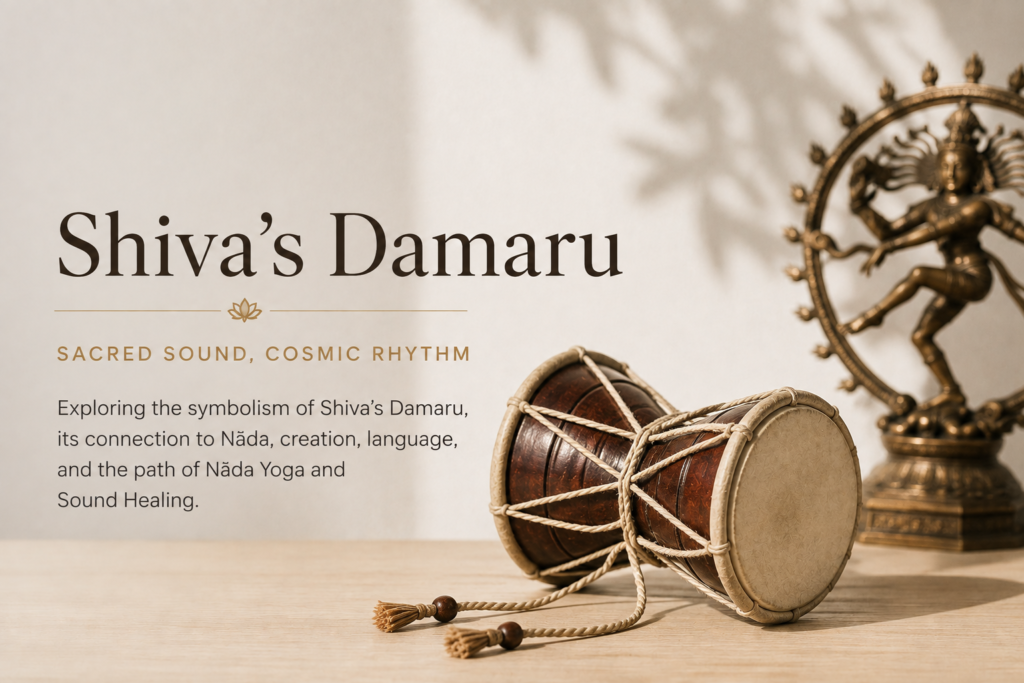
Among the many symbols associated with Lord Shiva, the Damaru, or Damru, is one of the most distinctive. This small hourglass-shaped drum appears prominently in representations of Shiva as Nataraja, the cosmic dancer, where he holds it in his raised right hand while a flame appears in the other.
The Damaru carries several layers of meaning. At the most immediate level, it is a traditional percussion instrument associated with rhythm and sound. Within Shaiva traditions and the iconography of Nataraja, however, its sound takes on a much deeper symbolic meaning. The drum represents the primordial sound associated with creation, while Shiva’s cosmic dance represents the continuous movement of creation, preservation, transformation, and dissolution.
For anyone interested in Nāda Yoga, sound healing, Indian classical music, or meditation, the Damaru offers an especially interesting subject. It brings together sound, rhythm, breath, movement, language, mythology, and the ancient Indian understanding of Nāda.
What Is the Damaru?
The Damaru is a small double-headed percussion instrument with an hourglass-shaped body. Two drumheads cover the wider ends of the instrument, while its centre narrows into a waist. Traditional versions often use cords with small beaters attached to them. When the player rotates the drum, the beaters strike the two membranes and create a rapid rhythmic sound.
Although the Damaru has a particularly strong association with Lord Shiva, it belongs to a wider family of hourglass-shaped drums found across South Asia and neighbouring regions. Its religious significance developed alongside its practical function as a percussion instrument, giving the Damaru both musical and symbolic importance.
Its small size makes it easy to carry and play with one hand. The sound is short, rhythmic, and repetitive, giving the instrument a character very different from the sustained resonance of a Tanpura or singing bowl.
That difference is important when we look at the Damaru from the perspective of sound.
The instrument does not create a continuous drone. Instead, it creates a sequence of sounds that unfold through time.
Why Does Shiva Hold a Damaru?
The meaning of the Damaru becomes especially clear in the image of Shiva Nataraja.
Nataraja represents Shiva as the cosmic dancer. His dance expresses the continuous movement of existence, bringing together creation and dissolution within a single symbolic image.
In Chola-period representations of Nataraja, the Damaru appears in Shiva’s upper right hand. The Metropolitan Museum of Art describes the drum as representing the primordial sound of creation, while the fire in Shiva’s other raised hand represents destruction.
The symbolism creates a powerful relationship between sound and transformation.
The Damaru produces sound.
The sound initiates rhythm.
The rhythm accompanies movement.
Shiva’s movement becomes the cosmic dance.
In this way, a simple percussion instrument becomes a symbol of creation itself.
The Damaru and the Cosmic Dance
The Nataraja image presents existence as a process of continuous movement rather than something fixed and static.
Day changes into night. Seasons move through cycles. The breath enters and leaves the body. The heartbeat continues its rhythm. Creation gives way to transformation, and transformation eventually gives rise to new forms.
The Damaru represents this rhythmic principle.
Its sound arises, remains for a brief moment, and disappears. Another sound follows, creating a pattern through repetition.
This makes the Damaru a particularly appropriate instrument for representing the rhythm of existence.
The Damaru and Nāda
The Sanskrit word Nāda occupies an important place in Indian approaches to music and spirituality. Depending on its context, Nāda can refer to sound, tone, resonance, or more subtle forms of vibration.
In Nāda Yoga, sound becomes a means through which attention can be refined and awareness can become more inward and concentrated.
The traditional symbolism surrounding Shiva’s Damaru connects its sound with primordial vibration and creation. The idea belongs to a philosophical and spiritual framework rather than serving as a scientific explanation of the physical origin of the universe.
This distinction is worth preserving.
The Damaru does not provide a literal acoustic representation of the Big Bang or a scientifically measurable “sound of creation.” Instead, its symbolism expresses an ancient philosophical idea that creation emerges through vibration, movement, and Nāda.
Nāda Brahma and the Idea of Sound as Creation
The expression Nāda Brahma is commonly understood as referring to the relationship between sound and the ultimate reality described in Indian philosophy.
Within this perspective, sound can become a way of contemplating the nature of existence. The Damaru embodies this idea visually and musically because its vibration becomes a symbol for the beginning of movement and manifestation.
The symbolism is simple but profound.
A vibration creates sound. Sound creates rhythm. Rhythm gives structure to movement. Movement becomes part of the cosmic dance.
The Damaru therefore provides a tangible way of contemplating an abstract philosophical idea.
The Damaru and the Rhythm of Life
Human beings naturally experience the world through rhythm.
Our breathing follows cycles. Walking has a rhythm. Speech contains patterns of stress and timing. Music depends on rhythm. Sleep and waking follow cycles, while the natural world moves through recurring patterns of day, night, seasons, tides, and other processes.
The Damaru expresses this principle through one of the simplest forms of musical organisation: the beat.
Unlike a melodic instrument, it does not need to establish a sequence of notes. Its primary function is rhythmic.
The repeated sound gives the listener a sense of movement through time.
Rhythm Before Melody
Rhythm provides one of the fundamental ways in which we organise sound.
Once a rhythmic pattern has been established, other sounds can interact with it. Melody can move against the beat, singers can coordinate their voices with it, and dancers can organise physical movement around it.
Indian music contains an extraordinarily sophisticated rhythmic tradition, and percussion instruments play an essential role within it.
The Damaru represents a much smaller and more ritualised expression of this broader relationship between sound, rhythm, and movement.
How Does a Damaru Produce Its Sound?
The physical mechanism of the Damaru is relatively simple.
Two membranes cover the opposite ends of the instrument, and small beaters attached to cords around the central waist strike the membranes as the drum rotates.
Each impact creates a short vibration. Rapid rotation produces a sequence of impacts that the ear perceives as a rhythmic rattling sound.
The resulting sound depends on several physical characteristics, including:
- The size and shape of the drum
- The material of the drumheads
- The tension of the membranes
- The size and material of the beaters
- The speed of rotation
- The technique used by the player
These characteristics demonstrate an important principle in sound studies: an instrument’s sound comes from the interaction of its physical construction and the way a musician plays it.
The Damaru is therefore both a sacred symbol and a functioning acoustic instrument.
The Damaru as a Traditional Indian Percussion Instrument
The Damaru exists within the much larger history of percussion in India.
Classical Indian traditions contain numerous percussion instruments used in music, theatre, dance, ritual, and devotional practice. The Nāṭyaśāstra, one of the foundational texts of Indian performing arts, discusses several categories of instruments and gives considerable attention to percussion.
The Damaru occupies a more specialised position within this musical world because of its strong association with Shiva.
Its sound is primarily rhythmic rather than melodic. Its compact form makes it suitable for ritual and devotional contexts, while its connection with Nataraja gives it a symbolic role that extends beyond ordinary musical performance.
Shiva’s Damaru and the Origin of Language
One of the most fascinating traditional associations of Shiva’s Damaru connects its sound with language and Sanskrit grammar.
According to a traditional account, Shiva produced a series of sounds from his Damaru during his cosmic dance. These sounds became associated with the fourteen Māheśvara Sūtras, which play an important role in the grammatical system associated with Pāṇini.
The tradition therefore connects the Damaru not only with music but also with speech, language, knowledge, and the organisation of sound. Traditional Indian accounts of Nataraja and the Damaru have consequently linked the instrument with the emergence of linguistic knowledge.
It is important to present this as a traditional account rather than a historical claim that the physical instrument literally produced the Sanskrit language.
Its significance lies in the symbolism.
The same vibration that represents creation also becomes associated with the formation of meaningful sound.
From Sound to Language
There is a beautiful philosophical progression within this idea.
Sound begins as vibration. Human beings organise sound into recognisable patterns. Those patterns become speech, and speech carries meaning.
Language then allows knowledge, stories, philosophy, and experience to move from one person to another.
Within the traditional symbolism of Shiva’s Damaru, sound therefore becomes a bridge between creation and knowledge.
This idea also has a natural connection with mantra practice, where sound, pronunciation, rhythm, repetition, and meaning come together.
The Damaru and Mantra Practice
Mantra practice provides another example of how repetition can transform our relationship with sound.
A mantra is traditionally repeated with attention to pronunciation, rhythm, breath, and awareness. The repeated pattern gives the mind a stable object of concentration.
The Damaru operates through a different form of repetition, but the rhythmic principle creates an interesting parallel.
The beat repeats.
The attention follows it.
The pattern becomes familiar.
The mind begins to anticipate the next sound.
In contemplative practices, repetition can therefore provide a structure through which attention becomes more focused.
The Damaru reminds us that rhythm can be much more than an element of music. It can also shape how we experience time and attention.
What Is the Connection Between the Damaru and Nāda Yoga?
The connection between Shiva’s Damaru and Nāda Yoga is primarily philosophical and symbolic.
Nāda Yoga explores sound as a means of developing concentration and awareness. The practice can begin with external sounds and gradually encourage more subtle forms of listening.
The Damaru represents sound in an active and rhythmic form.
Each beat appears and disappears.
The listener experiences sound followed by silence, followed by another sound.
This creates an opportunity to observe the changing nature of auditory experience.
Listening Between the Beats
When we listen closely to a rhythmic instrument, we eventually become aware of more than the beats themselves.
We notice the spaces between them.
Silence gives rhythm its definition. Without those spaces, individual beats would merge into an undifferentiated stream of sound.
This principle appears throughout music and also offers a useful point of contemplation.
The practitioner can observe the sound as it arises, experience it while it remains present, and notice the moment when it disappears.
The silence that follows becomes part of the experience.
From External Sound to Inner Listening
Many contemplative sound practices begin with something that can be heard externally.
A Tanpura provides a drone. A singing bowl creates resonance. A mantra provides repeated vocal sound. A Damaru establishes rhythm.
With attentive practice, the object of listening can become more subtle.
This does not mean that the Damaru itself produces a mystical “inner sound.” Rather, the external sound can become a support for developing the quality of attention.
The instrument provides the sound.
The practitioner develops the listening.
This distinction is central to approaching Nāda Yoga with depth and clarity.
The Damaru in Sound Healing
The Damaru can also be considered within the wider landscape of sound healing, although its role differs from that of singing bowls, gongs, tuning forks, or other sustained-resonance instruments.
Its defining acoustic quality is rhythm rather than a long sustained tone.
Rhythm can provide structure to a practice, mark transitions, create a sense of movement, and give attention an identifiable auditory pattern.
At the same time, scientific research specifically examining the therapeutic effects of the Damaru remains limited. There is therefore no strong basis for claiming that the instrument can treat a particular illness or produce a guaranteed physiological effect.
Its value in sound-based practices can instead be explored through:
- Rhythmic awareness
- Focused listening
- Meditation
- Breath and movement
- Devotional practice
- Ritual and symbolism
- Musical exploration
- Cultural connection
This approach allows the instrument to be appreciated without attaching unsupported medical claims to it.
Why Rhythm Matters in Sound Healing
Modern discussions of sound healing often focus heavily on frequency, but rhythm deserves equal attention.
Rhythm influences how we experience time. A repeated pattern creates expectation, establishes continuity, and can encourage movement or focused attention.
The Damaru demonstrates this through a remarkably simple mechanism.
A sound occurs.
Another follows.
The mind begins to recognise a pattern.
The pattern creates anticipation.
Attention begins to follow the rhythm.
This relationship between sound, rhythm, and attention provides an important perspective for anyone studying sound-based practices.
The Damaru Compared With Other Sound Healing Instruments
Different instruments create very different acoustic experiences. Understanding these differences can help practitioners choose instruments according to the purpose and character of a session.
Damaru
The Damaru is primarily rhythmic. Its short, repeated sounds create pulse, movement, and repetition.
Singing Bowl
A singing bowl creates sustained resonance with a complex mixture of fundamental and higher frequency components. Its gradual decay makes it particularly suitable for attentive listening and meditation.
Gong
A gong produces a broad and evolving sound spectrum. Its sound can continue developing long after the initial strike.
Tanpura
The Tanpura produces a continuous tonal drone that establishes a stable reference for Indian classical music and can also support contemplative listening.
Shankha
The Shankha combines breath with sustained resonance and has a long-standing role in Indian ritual and spiritual traditions.
These instruments demonstrate why sound healing cannot be reduced to one type of frequency.
Different instruments provide different acoustic experiences and different opportunities for attention.
The Damaru and the Symbolism of Ākāśa
In the traditional Indian elemental framework, ākāśa is often associated with space or ether and is traditionally connected with sound.
This concept belongs to an Indian philosophical system and should not be treated as simply another name for the physical atmosphere through which sound travels.
The philosophical concept of ākāśa operates within a different framework from modern physics.
Within that traditional framework, however, the association between space and sound adds another layer to the symbolism of the Damaru.
Sound emerges and travels through space.
The drum creates vibration.
The vibration becomes audible.
The listener receives it.
The sound eventually disappears into silence.
This relationship between sound, space, and perception offers a rich subject for contemplation.
The Hourglass Shape of the Damaru
The distinctive shape of the Damaru has also inspired symbolic interpretations.
Its two wider ends meet at a narrow central point, creating a visual relationship between two sides and a centre.
Different Shaiva and Tantric traditions have offered different interpretations of this form, so there is no single explanation that should be treated as universal.
At a broader symbolic level, however, the shape can represent relationship, transition, and connection.
Two sides meet at the centre.
Sound emerges from movement around that centre.
Rhythm develops through the alternation of sound and silence.
The form itself therefore lends naturally to philosophical reflection.
The Damaru as a Symbol of Transformation
Transformation sits at the heart of Shiva’s symbolism.
As Nataraja, Shiva embodies a universe in which creation and destruction exist within an ongoing cycle.
The Damaru represents the creative principle through its association with primordial sound, while the fire in Shiva’s other hand represents dissolution. The surrounding dance brings these opposing movements into a single image.
The symbolism offers a useful reflection for anyone working with sound.
Every sound begins.
Every sound changes.
Every sound ends.
Nothing remains exactly as it was.
Even a sustained sound changes as its harmonics evolve and its amplitude gradually decreases.
In this sense, the physical experience of listening can itself become a contemplation of impermanence.
Learning to Listen Through the Damaru
The Damaru can become an interesting listening exercise even outside its religious context.
Rather than simply hearing the instrument as a background sound, listen carefully to its rhythm.
Notice the first beat.
Notice how the second beat relates to the first.
Observe the spaces between the sounds.
Notice when you begin to anticipate the next beat.
Then notice what happens when the rhythm stops.
The silence after the final beat can be just as interesting as the sound itself.
This kind of practice develops a quality of listening that is valuable in music, meditation, and sound-based practices.
The Damaru in Modern Sound Practice
Traditional Indian instruments increasingly appear in contemporary yoga, meditation, and sound healing environments. When the Damaru enters these settings, it is important to recognise both its acoustic character and its cultural significance.
Using the instrument respectfully means understanding where it comes from and the traditions with which it is associated.
For a practitioner, this context can deepen the experience.
The Damaru is not simply another percussion instrument to add to a collection of sound healing tools. Its connection with Shiva, Nataraja, Nāda, rhythm, and traditional Indian thought gives it a particular cultural identity.
Understanding that identity allows modern practitioners to work with the instrument more thoughtfully.
Studying Traditional Sound in Rishikesh
Rishikesh has long attracted students interested in yoga, meditation, Indian philosophy, music, and contemplative practices.
For students undertaking nada yoga teacher training in Rishikesh, learning about traditional instruments within their cultural and philosophical contexts can add depth to practical training.
A sound healing course in Rishikesh may introduce students to instruments such as singing bowls, gongs, tuning forks, drums, and other sound-producing instruments. Learning how these instruments behave acoustically helps practitioners develop greater sensitivity when creating sound-based sessions.
The Damaru offers a different lesson because its importance extends beyond acoustics.
It demonstrates how sound can carry mythology, ritual, philosophy, devotion, rhythm, and cultural memory.
What Shiva’s Damaru Can Teach Us About Sound Healing
The symbolism of the Damaru offers several useful lessons for anyone exploring sound healing.
Sound is dynamic. Every sound exists through movement and changes over time.
Rhythm organizes time. Repeated patterns create structure and anticipation.
Silence is part of listening. The spaces between sounds give rhythm and music their shape.
Attention changes perception. The same sound can reveal different qualities when we listen more carefully.
Tradition gives sound meaning. The Damaru carries religious, philosophical, musical, and cultural associations that cannot be separated completely from the instrument.
Frequency is only one part of sound. Rhythm, timbre, resonance, duration, intensity, context, and the listener all influence the experience.
These principles extend well beyond the Damaru. They apply to the wider world of Indian music, meditation, sound healing traditions, and Nāda Yoga.
The Deeper Meaning of the Damaru
Perhaps the most fascinating aspect of Shiva’s Damaru is the way it connects something ordinary with something philosophical.
At one level, it is a small percussion instrument.
At another, it represents rhythm and movement.
Within the symbolism of Nataraja, it represents the primordial sound associated with creation.
Traditional accounts connect it with the emergence of language and knowledge.
Within the context of Nāda Yoga, it invites us to consider sound as an object of attention.
These layers do not have to be reduced to one interpretation.
The Damaru can be appreciated as an instrument, a religious symbol, a cultural artifact, and a philosophical metaphor.
Conclusion
Shiva’s Damaru is much more than a small drum held in the hand of Nataraja. It is an instrument with a distinct acoustic character and a symbol carrying centuries of religious, artistic, and philosophical meaning.
Within Nataraja’s cosmic dance, its sound represents the primordial vibration associated with creation, while the accompanying fire represents dissolution. Together, they express the cyclical movement of existence.
For those exploring Nāda Yoga, the Damaru offers another way to contemplate the nature of listening. Its rhythm draws attention to movement, repetition, anticipation, and the silence that exists between sounds.
For students of sound healing, it also provides an important reminder that sound is much broader than frequency. Rhythm, resonance, timbre, duration, cultural meaning, attention, and context all contribute to our experience.