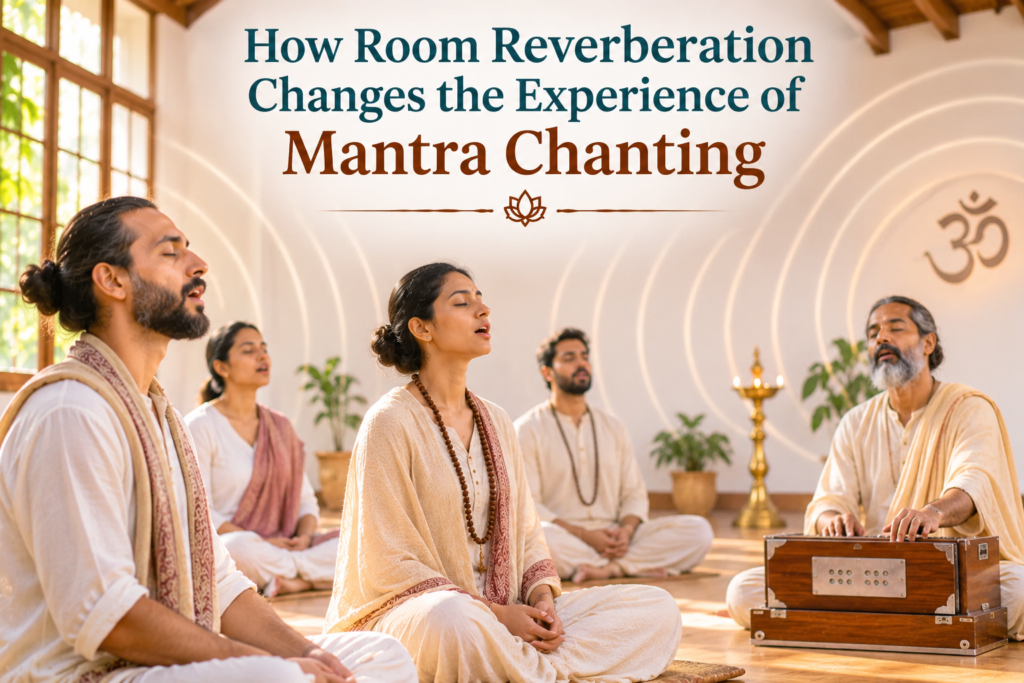
Mantra chanting is shaped by the interaction between the human voice and the space in which it is produced. When a person chants in a small room, a temple hall, or an open courtyard, the same mantra can sound noticeably different. The voice may feel close and direct in one setting, while in another it continues to resonate after the syllables have been spoken. These differences arise partly from room acoustics, particularly reverberation.
Room reverberation describes the persistence of sound in an enclosed space after the original sound source stops. It develops when sound waves reflect from walls, ceilings, floors, and other surfaces, reaching the listener at slightly different times. During mantra chanting, these reflections influence how clearly syllables can be heard, how the voice blends with the surrounding sound, and how the overall chanting experience feels.
Understanding reverberation is useful for anyone interested in Sanskrit chanting, Vedic recitation, group mantra practice, or the acoustic design of meditation spaces. It also helps explain why some rooms support clear articulation while others create a rich, sustained sound that can make individual words harder to distinguish.
This article explores the science of room reverberation, its influence on mantra chanting, the acoustic characteristics of different spaces, and practical ways to create a comfortable environment for vocal practice.
What is room reverberation?
Room reverberation occurs when sound continues to reach a listener through multiple reflections after the original sound has stopped. When a person chants, the voice travels directly towards the listener while also reflecting from nearby surfaces. These reflected sounds arrive at different times and combine with the direct sound.
The result depends on the dimensions of the room, the materials used in its construction, the amount of sound absorption, and the positions of the singer and listener.
A room with hard stone walls, a high ceiling, and a stone floor may sustain sound for longer than a room containing carpets, curtains, upholstered furniture, and other absorbent materials. Large halls can also develop complex reflections because sound travels over longer distances before returning to the listener.
Reverberation is commonly measured using reverberation time, or RT60. This describes the time required for sound energy to decrease by 60 decibels after the sound source stops, under the relevant measurement conditions.
For example, a room with an RT60 of approximately 0.3 seconds will generally allow sound to decay relatively quickly. A room with an RT60 of 2 seconds will sustain sound for considerably longer. These figures are illustrative, and the actual reverberation time of a room varies with frequency.
During mantra chanting, reverberation affects the relationship between successive syllables. If reflections continue for too long, the sound of one syllable can overlap with the next. When the decay is suitably controlled, the voice can retain a sense of fullness while remaining intelligible.
How sound behaves inside a room
To understand the role of reverberation in chanting, it helps to examine three related acoustic concepts: direct sound, early reflections, and late reverberation.
Direct sound
Direct sound travels from the chanter to the listener without first reflecting from a surface. It carries important information about pronunciation, pitch, vocal tone, and the timing of each syllable.
In a chanting session, direct sound helps listeners recognise Sanskrit words and follow the rhythm of the recitation. The clarity of direct sound depends partly on the distance between the chanter and listener, the orientation of the voice, and the presence of competing sounds.
Early reflections
Early reflections reach the listener shortly after the direct sound. They may arrive from the floor, ceiling, side walls, or other nearby surfaces.
When their timing and intensity are suitable, these reflections can make the voice sound fuller and more present. They can also help listeners perceive the sound of a group of chanters as a coherent whole.
However, reflections that arrive with problematic timing or from particular directions may interfere with clarity. A strong reflection from a nearby wall, for example, can produce an audible echo or colour the sound of the voice.
Late reverberation
Late reverberation consists of reflections that continue arriving after the initial direct sound and early reflections. These reflections become increasingly dense as sound energy moves around the room.
Late reverberation gives a space its characteristic sense of acoustic persistence. In mantra chanting, it can create a sustained sound field in which the end of a phrase continues to resonate after the chanter has stopped vocalising.
The effect depends on the room and the chanting style. Sustained vowels may blend naturally with the reverberant field, while rapidly articulated syllables can become difficult to distinguish when reflected sound accumulates.
Why reverberation matters during mantra chanting
Mantras contain specific syllables, vowel lengths, consonant sounds, and rhythmic patterns. Room acoustics influence how these elements reach the listener.
1. Clarity of Sanskrit pronunciation
Sanskrit chanting often requires careful attention to vowel length, aspiration, consonant placement, and the timing of syllables. These features contribute to the accurate recitation of a mantra.
A room with excessive reverberation can blur successive syllables because reflected sound from one part of the chant continues into the next. This is particularly noticeable when a mantra contains rapid consonant sequences or closely spaced syllables.
For example, a Sanskrit phrase recited at a measured pace may remain clear in a moderately reverberant room. When the same phrase is recited quickly in a highly reverberant hall, the reflected sound may make individual syllables harder to identify.
A room with controlled reverberation generally supports clear pronunciation and makes it easier for students to follow a teacher’s recitation.
2. The perception of sustained vowels
Many mantras include vowels that are held for a particular duration. When a chanter sustains a vowel, the room continues to reflect the sound as the voice gradually changes or stops.
This can create an impression of continuity between the voice and the surrounding space. A sustained vowel may seem to extend beyond the moment of vocal production because its reflections remain audible.
The effect can be particularly noticeable during chanting that includes long vowel sounds, such as the sustained vocalisation associated with Om.
Reverberation can contribute to the perceived fullness of these sounds. However, the duration and quality of the original vocalisation remain important, and excessive reverberation can make the ending of a vowel less distinct.
3. The rhythm of group chanting
In group mantra chanting, participants need to coordinate their voices. They follow the teacher, maintain a shared pace, and recognise the beginning and ending of each phrase.
Reverberation influences the timing information available to the group. When a room has a long decay time, the sound of one person’s voice may remain audible while others begin the next syllable.
This can create a dense acoustic texture, especially when many people chant simultaneously. The group may sound fuller, yet it can become harder to hear individual voices or detect small differences in timing.
Moderate reverberation can support a sense of collective vocal sound, provided that the syllables remain clear. The appropriate acoustic environment depends on whether the practice emphasises precise recitation, unison singing, or sustained communal chanting.
4. Vocal effort and self-monitoring
Room acoustics influence how a chanter hears their own voice. In a reflective space, the voice may seem fuller because sound reaches the ears through both direct and reflected paths.
This can affect how loudly a person chooses to chant. Some people may reduce their vocal effort when the room provides sufficient acoustic support, while others may raise their voice to compensate for a noisy or poorly balanced environment.
The relationship is individual and depends on the room, the number of participants, and the position of the chanter.
A comfortable chanting space allows participants to hear their own voices without needing to compete with the room or other singers. This can make it easier to maintain steady vocal production and accurate pronunciation.
5. Attention and the experience of listening
Reverberation also changes the way attention is directed during chanting. A relatively dry room allows the listener to hear the beginning and end of each sound with clear separation. A more reverberant room provides a longer acoustic tail that remains audible after the vocal source has stopped.
Some practitioners may find sustained reverberation helpful when attending to long vowels or the decay of a chant. Others may prefer a clearer acoustic environment because it supports precise listening and articulation.
These responses vary between individuals and contexts. Reverberation can influence the listening experience, but it does not automatically produce a particular mental or spiritual state.
The relationship between mantra chanting and the sound of Om
Om, also written as Aum, is a prominent sacred syllable in several Indian religious and philosophical traditions. Its chanting provides a useful example of how vocal production and room acoustics interact.
When a person chants Om, the sound usually develops through a vocal sequence that includes an open vowel and a closing nasal resonance, although pronunciation and interpretation vary between traditions. The voice contains multiple frequencies, and each part of the sound interacts differently with the room.
A reflective room may sustain the vowel and the final nasal sound, creating an extended acoustic decay. In a room with greater absorption, the sound may fade more quickly, allowing the listener to hear the natural end of the vocalisation more distinctly.
The acoustic result depends on several factors, including the pitch of the voice, vocal technique, room dimensions, surface materials, and the position of the listener.
It is useful to distinguish the acoustic properties of Om from its philosophical and spiritual interpretations. The Upanishads discuss Om in relation to contemplation and the nature of reality, while acoustics describes how the vocal sound travels and reflects within a physical space. These perspectives address different aspects of the chanting experience.
Reverberation in temples, meditation rooms and yoga halls
Different spaces create different acoustic conditions. Traditional places of worship, domestic meditation rooms, and modern yoga studios may have distinct reverberation characteristics because of their construction and intended use.
Temple interiors
Many traditional temples contain stone floors, masonry walls, and high ceilings. These materials tend to reflect sound, although the actual acoustics vary significantly according to the building’s dimensions, furnishings, openings, and architectural features.
When people chant inside such a space, reflections can combine individual voices into a sustained sound field. The resulting reverberation may support certain forms of communal chanting and devotional singing.
However, temples vary widely. A small shrine, a pillared hall, and a large enclosed temple chamber can have very different acoustic properties.
Meditation rooms
Meditation rooms are often designed to provide a relatively quiet environment. Their acoustic character depends on room size, construction, furnishings, and the amount of sound absorption.
A small room with a few soft furnishings may have a relatively short reverberation time. Such an environment can be useful for individual mantra practice, especially when the practitioner wants to hear each syllable clearly.
A room that is excessively dry may sound less spacious, although this is not necessarily a disadvantage for focused recitation. The preferred acoustic balance depends on the practice.
Yoga halls
Yoga halls frequently accommodate group activities, spoken instruction, chanting, and meditation. Their acoustic requirements can therefore differ from those of a small room used for individual practice.
A large hall with hard surfaces may develop long reverberation times, making spoken instructions difficult to understand. If the room is used for Sanskrit recitation, this can also affect the clarity of pronunciation.
Acoustic treatment can help reduce excessive reverberation. Curtains, suitable acoustic panels, and other absorptive materials may improve speech and chanting clarity when placed appropriately.
The aim is to establish an environment in which the teacher’s voice reaches participants clearly and the group can maintain a comfortable vocal level.
What is the ideal reverberation time for mantra chanting?
There is no single reverberation time that suits every form of mantra chanting. The appropriate value depends on the size of the room, the number of participants, the pace of recitation, and the balance between clarity and sustained sound.
Speech and precise verbal recitation generally benefit from relatively controlled reverberation because the listener needs to distinguish successive syllables. Group singing can often accommodate a longer reverberation time, although excessive reverberation can still blur rhythm and articulation.
For a small room used for spoken instruction and individual chanting, a relatively short reverberation time may provide sufficient clarity. A larger room used for group chanting may benefit from a somewhat longer decay, depending on its dimensions and the style of practice.
Rather than choosing a number without considering the space, it is useful to assess the room through listening and, when appropriate, acoustic measurement.
Three questions can guide the assessment:
- Can participants understand the teacher’s Sanskrit pronunciation?
- Can the group hear the start and end of each phrase clearly?
- Does the room allow voices to sound full without producing a persistent wash of overlapping sound?
If the answer to these questions is generally yes, the room may provide a suitable acoustic environment for the intended practice.
How to improve room acoustics for mantra chanting
Improving the acoustic environment does not always require extensive construction. A few carefully chosen adjustments can make a noticeable difference, although their effectiveness depends on the room.
Use appropriate sound-absorbing materials
Hard surfaces reflect sound, while porous materials such as suitable acoustic panels and heavy curtains can absorb part of the sound energy.
If a yoga hall has excessive reverberation, acoustic panels placed on appropriate wall or ceiling areas can reduce the persistence of reflected sound. Curtains may also contribute to absorption, depending on their thickness, material, and placement.
Ordinary decorative fabrics do not always provide significant acoustic treatment. Purpose-designed materials are more predictable when the aim is to control reverberation.
Consider the floor and ceiling
Flooring and ceiling construction influence how sound reflects through the room. Stone, tile, and concrete generally reflect sound strongly, while suitable carpeted surfaces absorb some sound, particularly at higher frequencies.
Ceiling height and shape also affect the paths taken by reflections. Large rooms with high ceilings may require more deliberate acoustic treatment than small rooms.
Any changes should consider the room’s intended use, maintenance requirements, fire safety, and other building constraints.
Arrange participants thoughtfully
The positions of the teacher and participants influence how direct sound reaches the group.
Placing the teacher where participants have a clear line of hearing can improve intelligibility. Arranging participants so that they are reasonably close to the main voice source may also reduce the need for excessive vocal volume.
In larger halls, suitable sound reinforcement may help, although microphone placement and speaker configuration require care to avoid feedback and uneven sound distribution.
Control background noise
Traffic, fans, air conditioning, neighbouring activities, and movement within the room can compete with the chanting voice.
Reducing avoidable background noise helps participants hear pronunciation and timing more clearly. Mechanical systems should be considered when selecting or preparing a space, particularly if the room will be used for quiet recitation.
Test the room with actual chanting
A simple listening test can reveal problems that are difficult to identify from the room’s appearance alone.
Ask one person to chant a short phrase at a comfortable volume while others listen from different positions. Notice whether the syllables remain distinct and whether the final sounds persist into the next phrase.
Repeat the test with a longer sustained vowel and a faster passage. These different vocal patterns can reveal whether the room supports both sustained sound and clear articulation.
For a more precise assessment, an acoustic professional can measure reverberation time across different frequency bands and recommend suitable treatment.
How reverberation differs from echo and resonance
Reverberation is often confused with echo and resonance, although these terms describe different acoustic phenomena.
Reverberation occurs when many sound reflections overlap and persist after the original sound. It produces a continuous acoustic decay rather than a clearly separated repetition.
Echo is a reflection that arrives sufficiently late to be heard as a distinct repetition of the original sound. A large hall, courtyard, or long corridor may produce an audible echo when sound reflects from a distant surface.
Resonance refers to the enhanced response of a system at particular frequencies. In a room, certain frequencies may become stronger because of its dimensions and acoustic modes. Musical instruments also have resonant properties that influence their tone.
During mantra chanting, all three phenomena may influence the sound. Reverberation affects the overall decay, an echo may create a distinct repeat, and room resonance can colour particular pitches.
Understanding the difference helps practitioners describe what they hear and identify the appropriate way to improve a space.
Room reverberation and the science of sound healing
Room acoustics are also relevant to sound meditation and sound healing sessions, where practitioners may use singing bowls, gongs, chimes, voice, or other instruments.
These sound sources have different acoustic characteristics. A singing bowl may produce a sustained tone with several partial frequencies, while a gong can produce a complex sound with a broad frequency range and changing spectral content.
When these sounds are produced in a reverberant room, reflected energy can extend their audible decay. If several instruments are played in quick succession, their reverberant tails may overlap, creating a dense acoustic texture.
This overlap can be desirable in some musical settings, although it may also make individual sounds harder to distinguish. Careful spacing between instruments can help preserve clarity while allowing the room to contribute to the overall sound.
Room acoustics should be considered alongside sound level, instrument placement, participant distance, and individual sensitivity. A longer reverberation time does not automatically make a session more relaxing or therapeutic, and acoustic measurements alone cannot establish a medical benefit.
For a related exploration of these principles, see a future article on harmonics, overtones, and resonance in singing bowls and other sound healing instruments.
Frequently asked questions about room reverberation and mantra chanting
What does reverberation mean in mantra chanting?
Reverberation is the persistence of sound caused by reflections from surfaces within a room. During mantra chanting, these reflections can extend the audible decay of syllables and influence how clearly successive sounds are heard.
Is a room with more reverberation better for chanting?
A longer reverberation time can give chanting a fuller, more sustained sound, but excessive reverberation can blur pronunciation and rhythm. The most suitable acoustic environment depends on the type of chanting, the size of the group, and the room itself.
Why does Om sound different in different rooms?
The sound of Om changes according to the room’s dimensions, surface materials, reverberation, and the position of the listener. The pitch and vocal technique of the chanter also influence the result.
Do temples have better acoustics for mantra chanting?
Some temples provide a sustained acoustic environment because of their hard surfaces and architectural design. Others may produce excessive reverberation or uneven sound distribution. Whether a space is acoustically suitable depends on the style of chanting and the building’s particular characteristics.
How can a yoga studio reduce excessive reverberation?
Suitable acoustic panels, curtains, and other sound-absorbing materials can reduce reflected sound. The best approach depends on the room’s construction and intended use. Testing the room with actual chanting can help identify the areas that need attention.
What is the difference between reverberation and resonance?
Reverberation describes the persistence of reflected sound after the original source stops. Resonance describes the enhanced response of a system at particular frequencies. Both can influence the tone and duration of a chant inside a room.
Conclusion
Room reverberation plays an important role in shaping how mantra chanting sounds and how clearly it can be heard. Reflections from walls, ceilings, floors, and other surfaces influence the duration, fullness, and intelligibility of the voice. These effects become particularly noticeable during sustained vowels, group recitation, and chanting in large halls or temples.
A suitable acoustic environment balances vocal clarity with an appropriate degree of sound persistence. Individual mantra practice may benefit from relatively controlled reverberation, while some forms of group chanting can accommodate a longer decay time. The right balance depends on the room, the chanting style, and the needs of the participants.
Understanding room acoustics helps yoga teachers, musicians, and meditation practitioners make informed decisions about the spaces in which they work. By paying attention to reverberation, background noise, participant arrangement, and vocal level, they can create an environment that supports clear recitation and attentive listening.