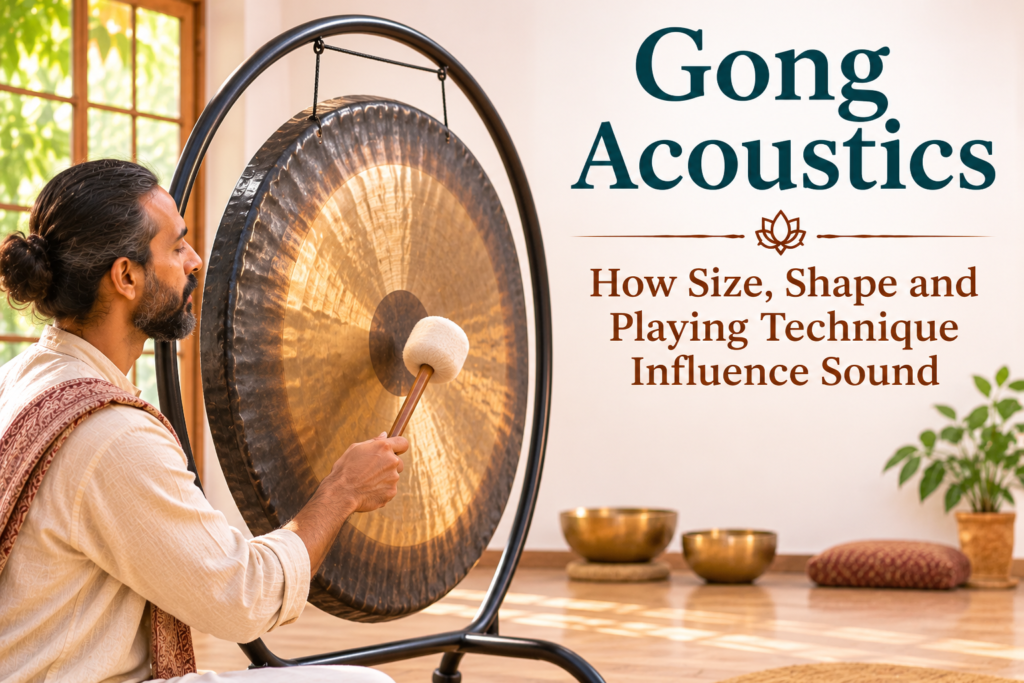
A gong can produce a deep rumble, a bright metallic tone or a long, shimmering wash of sound. Its acoustic character depends on several factors, including its size, shape, metal composition and playing technique. Even a small change in the way a musician strikes the gong can create a noticeably different sound.
Gongs have a long history in musical and ceremonial traditions across Asia. Today, they also appear in meditation sessions, sound healing practices, concerts and musical performances. Their wide range of tones makes them interesting instruments for both musicians and people exploring sound.
Understanding gong acoustics helps explain why two gongs can sound completely different, even when they look similar. It also shows how musicians can use different mallets and striking techniques to explore the instrument’s full range.
How does a gong produce sound?
A gong belongs to a group of instruments known as idiophones. These instruments produce sound through the vibration of their own material. Unlike a drum, which uses a stretched membrane, a gong produces sound when its metal body vibrates.
When a musician strikes the gong with a mallet, the impact creates vibrations across its surface. These vibrations travel through the metal and produce sound waves in the surrounding air.
The gong produces several frequencies at the same time. Together, they create its characteristic tone and texture.
These frequencies include:
- Fundamental frequency: The lowest prominent frequency in a sound.
- Overtones: Higher frequency components that contribute to the sound’s character.
- Resonance: The way the gong continues to vibrate after the initial strike.
- Decay: The gradual reduction in sound intensity after the instrument is played.
Unlike many tuned musical instruments, some gongs produce complex tones without a clearly defined single pitch. Their sound can change as the vibration develops.
For example, a large Chinese tam-tam may begin with a deep, low sound. Over the following seconds, higher frequencies can become more prominent, creating a bright and shimmering effect.
1. How gong size influences sound
The diameter of a gong has a significant influence on its acoustic behaviour. However, size works together with thickness, shape and material. Therefore, two gongs with similar diameters may still produce different tones.
Large gongs
Large gongs generally have greater vibrating surfaces and can produce strong low-frequency sounds. Their resonance often develops over a longer period, depending on their construction and playing technique.
When struck gently, a large gong may produce a soft, deep vibration. As the sound develops, additional frequencies can emerge and create a complex acoustic texture.
This makes large gongs useful for musical passages that require a gradual build-up of sound.
Medium-sized gongs
Medium-sized gongs offer a wide range of tonal possibilities. Their sound can combine lower resonance with clear higher frequencies.
Musicians often use them in musical performances and sound-based sessions because they can produce noticeable changes in tone with different mallets and striking positions.
Small gongs
Small gongs generally have a more compact vibrating surface. Depending on their design, they can produce brighter and more clearly defined tones.
They may also respond quickly to lighter strikes. As a result, musicians can use them for rhythmic patterns, accents and shorter musical phrases.
An important point: A larger gong does not automatically produce a lower or longer-lasting sound. Its metal thickness, curvature, central shape and suspension also influence the result.
2. How gong shape changes its acoustic character
The shape of a gong affects how its metal surface vibrates. Even small differences in curvature can change the frequencies it produces.
Traditional gongs come in several forms. Some have a raised centre, while others have a relatively flat surface or a shaped rim.
Flat gongs
<escape> </escape>Flat gongs have a relatively even central surface. Their sound depends on the metal, thickness, diameter and the way the instrument is made.
Some flat gongs produce a broad range of frequencies and a complex, shimmering sound. Their vibration patterns can change significantly according to the striking position.
Bossed gongs
Bossed gongs have a raised central area, often called a boss or nipple. The central shape changes the way the metal vibrates and influences the instrument’s tonal characteristics.
Many traditional Asian gongs use this design. Depending on their construction, they can produce a more defined pitch than large, flat tam-tams.
The raised centre also provides a specific area for playing. Musicians can use different striking positions around the boss to explore changes in tone.
Tam-tam gongs
The tam-tam is a large, generally flat gong with a distinctive rim. It is especially known for its complex sound and gradual development after a strike.
When a musician strikes a tam-tam with a soft mallet, the initial sound may be deep and relatively simple. As the vibration continues, higher frequencies can become stronger. This creates the familiar shimmering effect associated with orchestral tam-tams.
The role of the rim
The outer rim also affects how a gong vibrates. Its curvature and thickness influence the movement of the metal surface.
A turned or shaped rim can change the relationship between different vibration patterns. As a result, the rim contributes to the gong’s overall sound and resonance.
3. The influence of metal and thickness
Gongs are commonly made from bronze, brass, copper-based alloys and, in some cases, steel.
Each material has different physical properties. These include density, stiffness and internal damping. Together, they influence how the gong vibrates and how long its sound continues.
Metal composition
The composition of the metal affects its acoustic behaviour. Bronze, for example, is widely used in traditional gong making because it can be shaped and worked to produce a range of tonal characteristics.
However, the name of the metal alone cannot predict how a gong will sound. Manufacturing methods and the instrument’s geometry also play important roles.
Metal thickness
Thickness influences the stiffness and vibration of the gong.
A thicker section generally resists bending more strongly than a thinner section. This can change its natural vibration frequencies and the way energy moves through the instrument.
Thinner sections may respond differently to an impact and can produce a different balance of frequencies. The final sound depends on the thickness distribution across the entire gong.
Traditional manufacturing
Traditional gong makers use processes such as casting, forging and hammering to shape the metal. These methods influence the gong’s surface, thickness and internal stresses.
Some makers also adjust the instrument through careful hammering or grinding. Such changes can alter its vibration patterns and tonal characteristics.
Research into gong acoustics confirms that small variations in geometry and manufacturing can influence the instrument’s natural frequencies and sound spectrum.
4. Understanding vibration and overtones
A gong produces sound through several vibration patterns, often called vibration modes or normal modes.
Each mode describes a particular way in which the metal surface moves. Some areas move strongly, while others remain relatively still.
When a musician strikes the gong, the impact activates several of these modes. The position and force of the strike influence which modes receive more energy.
This explains why striking the centre and striking near the edge can produce different sounds.
What are overtones?
Overtones are frequencies above the fundamental frequency. They contribute to the timbre of an instrument.
For example, two gongs may produce sounds with similar fundamental frequencies. However, their overtones may differ. As a result, one may sound darker while the other sounds brighter.
In many gongs, these frequencies do not follow the simple harmonic pattern found in instruments such as strings. Instead, they can form a complex and sometimes inharmonic spectrum.
This is one reason why a gong can produce a rich, evolving sound.
Why does a gong’s sound change after a strike?
The sound of a gong can change noticeably over time. Immediately after the strike, certain vibration modes may dominate. As the sound continues, energy can move between different modes.
In large tam-tams, this process can create a gradual shift from a low initial sound towards a brighter, shimmering texture.
The listener therefore hears an evolving sound rather than a single unchanging tone.
5. How mallet choice influences gong sound
The mallet plays an important role in shaping the sound of a gong. Its weight, size, material and softness influence how energy enters the metal.
Using different mallets on the same gong can produce noticeably different results.
Soft mallets
Soft mallets usually have padded or fabric-covered heads. They create a gentler impact and can bring out fuller, smoother tones.
A larger soft mallet can produce a broad sound with a gradual development. Musicians often use this type of mallet when they want the gong to build slowly.
Medium-hard mallets
Medium-hard mallets provide a firmer impact. They can produce a clearer attack and bring out a stronger range of higher frequencies.
They are useful when the musician wants a more defined sound with a noticeable beginning.
Hard mallets
Hard mallets create a sharper impact. They can produce bright, metallic sounds with a strong initial attack.
However, excessive force can make the sound harsh. It may also prevent the gong from developing its full resonance.
The best mallet depends on the gong’s construction and the sound the musician wants to create.
6. How playing technique changes the sound
The musician’s technique has a direct influence on the gong’s acoustic response. The same instrument can produce a wide range of sounds through changes in striking position, pressure, speed and movement.
Single strike
A single strike is the simplest way to play a gong. The musician strikes the surface once and allows the sound to develop.
The result depends on the mallet, striking point and force. A gentle strike may produce a subtle resonance, while a stronger strike can create a fuller and more powerful sound.
Striking position
The point where the mallet touches the gong affects the vibration patterns that develop.
A central strike may activate a different combination of modes from a strike closer to the outer region. The exact result depends on the gong’s design.
Musicians often experiment with different positions to discover the instrument’s tonal range.
Gong rolls
A gong roll involves a series of repeated strikes. When played at an appropriate speed, the individual sounds begin to merge.
The result is a continuous wash of sound that can gradually increase or decrease in intensity.
Musicians may use one or two mallets depending on the size and design of the gong. Soft mallets often help the separate strikes blend smoothly.
Damping
Damping means reducing or stopping the vibration of the instrument.
A musician may use a hand or another suitable method to control how long the gong continues to sound. This technique creates a shorter, more controlled ending.
Damping is useful when a performance requires a clear rhythmic pattern or a sudden stop.
Friction playing
Some gongs can also produce sound through friction. A suitable friction mallet or bow moves along the surface and creates sustained vibrations.
This technique can produce unusual tones and continuous sound effects. The result depends on the gong’s surface, the tool used and the amount of pressure applied.
7. How gong acoustics influence sound healing sessions
Gongs have become familiar instruments in contemporary sound healing sessions. Practitioners use them to create sustained tones, changing textures and layers of vibration.
Their acoustic qualities make them suitable for sessions that involve attentive listening and relaxation.
A gong can begin with a gentle sound and gradually develop into a fuller acoustic experience. The musician can then reduce the intensity and allow the sound to fade.
Different gongs also create different listening experiences. A large gong may produce a broad, deep resonance, while a smaller gong may create brighter tones and sharper accents.
During a sound healing session, the practitioner considers several factors:
- Volume: The sound should remain comfortable for the participants.
- Playing distance: The position of the gong influences how strongly its sound reaches the listener.
- Mallet choice: Different mallets create different attacks and tonal qualities.
- Playing duration: The practitioner allows enough time for the sound to develop and decay.
- Room acoustics: The space affects how the sound reflects and fades.
The practitioner should also consider the participants’ comfort. Loud or sudden strikes can feel overwhelming, particularly when someone is unfamiliar with gong sessions.
For readers interested in learning how practitioners use instruments in structured sessions, the sound healing teacher training course in Rishikesh explores the practical use of sound instruments and their role in sound-based practices.
8. How to listen to the different sounds of a gong
You do not need specialist equipment to begin exploring gong acoustics. A gong, a suitable mallet and a quiet environment provide a useful starting point.
Try this simple listening exercise:
First, listen to a gentle strike. Notice the initial sound and its character. Does it seem deep, bright, soft or metallic?
Next, follow the sound as it develops. Listen for changes in pitch, brightness and intensity. Some gongs reveal higher frequencies several moments after the initial strike.
Then, observe the decay. Notice how the sound gradually fades. Some instruments retain a strong resonance, while others lose intensity more quickly.
Finally, compare different mallets. Use suitable mallets with different levels of softness. Listen to how each one changes the initial attack and the overall sound.
Keep the volume comfortable throughout the exercise. Avoid striking the gong forcefully simply to produce a louder sound.
Frequently asked questions about gong acoustics
Does a larger gong always produce a deeper sound?
Larger gongs often produce strong low-frequency sounds. However, size alone does not determine pitch or resonance. Metal thickness, shape, material and construction also influence the sound.
Why does a gong continue sounding after it is struck?
The metal continues to vibrate after the mallet makes contact. These vibrations produce sound waves that gradually lose energy. The time taken for the sound to fade depends on the gong’s construction and the surrounding environment.
What is the difference between a gong and a tam-tam?
The terms can sometimes overlap in everyday use. In orchestral contexts, a tam-tam generally refers to a large, relatively flat gong with a complex and often indefinite pitch. Other gongs, particularly bossed varieties, may produce a more clearly defined pitch.
Which mallet is best for playing a gong?
The best mallet depends on the instrument and the desired sound. Soft mallets can produce fuller tones, while harder mallets create a sharper attack. Musicians often use different mallets to explore the instrument’s range.
Why does a gong produce different sounds at different striking points?
Different striking positions activate different vibration modes. As a result, the balance of frequencies changes and the gong produces a different tonal character.
Can a gong produce sound without being struck?
Yes. Some gongs can produce sound through friction when a suitable bow or friction mallet moves across the surface. This technique creates sustained vibrations.
Final thoughts
Gong acoustics bring together instrument design, material properties and playing technique. The size and shape influence how the metal vibrates, while thickness and composition affect its natural frequencies and resonance.
The mallet and striking position then determine how these vibrations develop. Through gentle strikes, rolls, damping and friction techniques, musicians can explore a wide range of sounds from a single instrument.
Understanding these principles helps musicians make informed choices when playing or selecting a gong. It also gives sound practitioners a clearer understanding of how their instruments respond to different techniques and environments.