In yoga, the journey inward often begins with a sense of stability. Before exploring deeper meditation, subtle awareness, or higher states of consciousness, traditional yogic teachings place importance on having a steady foundation. This is where Muladhara chakra, commonly known as the root chakra, enters the conversation.
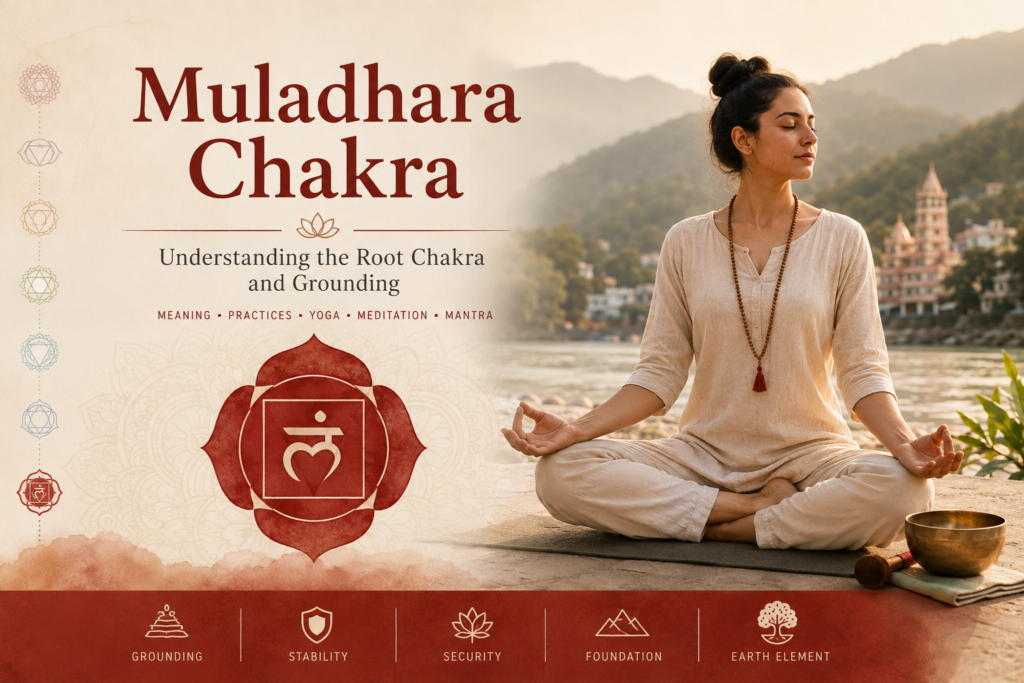
Muladhara is traditionally described as the first chakra in the seven-chakra system. Its name comes from the Sanskrit words mula, meaning root, and adhara, meaning support or foundation. Within yogic and tantric traditions, it represents grounding, stability, security, and our relationship with the basic foundations of life.
For practitioners, working with Muladhara can become a way to bring greater awareness to the body, breath, surroundings, and everyday routines. Yoga postures, meditation, pranayama, mantra, mindful movement, and time in nature are often used as grounding practices.
In contemporary writing, chakras are best presented as concepts within yogic and subtle-body traditions. They offer a traditional framework for exploring aspects of attention, experience, and spiritual practice.
Muladhara chakra at a glance
| Aspect | Muladhara chakra |
|---|---|
| Name | Mūlādhāra or root chakra |
| Meaning | Root support, foundation |
| Position | First chakra in the traditional seven-chakra system |
| Location | Base of the spine, traditionally associated with the perineum |
| Element | Earth (Prithvi) |
| Quality | Grounding, stability, support, steadiness |
| Symbol | Four-petalled lotus with the earth element represented within the chakra symbol |
| Bija mantra | LAM, traditionally chanted as “lum” |
| Deity | Ganpati |
| When balanced | Groundedness, stability, steadiness, security, greater connection with the body and present experience |
| When imbalanced | Fear, insecurity, instability, restlessness, difficulty feeling grounded |
These associations belong to the traditional yogic and subtle-body framework. Different lineages may present some details differently, while the foundational themes of Muladhara remain closely connected with grounding and support.
What is Muladhara chakra?
Muladhara chakra is traditionally regarded as the first chakra in the seven-chakra system. It is associated with the base of the body and serves as the symbolic foundation of the chakra system.
The Sanskrit name Muladhara carries the meaning of “root support.” This idea of a root provides an important clue to its traditional symbolism. A strong root gives a tree stability, allowing it to grow upward. In a similar way, Muladhara represents the foundation from which deeper yogic practices can develop.
Traditional descriptions associate Muladhara with the earth element, grounding, stability, physical existence, basic needs, and a sense of security. The chakra is commonly represented by the color red and a four-petalled lotus.
Different yoga and Tantra traditions describe the chakra system in their own ways, so details can vary across texts and lineages. The broader theme of Muladhara as a foundation remains central to many contemporary explanations of the root chakra.
Where is the root chakra located?
Traditional teachings place Muladhara at the base of the spine, around the area associated with the perineum. It occupies the foundational position in descriptions of the subtle body.
This location carries symbolic importance. The base of the body provides a natural point of reference for grounding practices. When practitioners bring attention to this area during meditation or yoga, they can use that awareness as an anchor for concentration.
It is helpful to understand this location within the traditional subtle-body framework. Chakras belong to yogic and tantric models of human experience, while modern anatomical descriptions use different structures and terminology.
What does Muladhara chakra represent?
The root chakra meaning centers around foundation and grounding.
Traditional chakra teachings connect Muladhara with several aspects of human experience, including:
- Stability
- Grounding
- Security
- Basic needs
- Connection with the earth
- Physical awareness
- Support and foundation
- A sense of belonging
- Steadiness in daily life
These qualities make Muladhara particularly relevant to people who feel scattered during their daily routines. Grounding practices can encourage attention toward the body, breath, environment, and present experience.
The root chakra also introduces an important principle in yoga: deeper practices benefit from a stable foundation. A practitioner can develop this foundation through regular asana practice, mindful breathing, meditation, and disciplined daily routines.
Muladhara and the earth element
The earth element is traditionally associated with Muladhara.
Earth represents qualities such as firmness, steadiness, structure, and support. These qualities appear throughout traditional descriptions of the root chakra. The symbolism also explains why grounding practices often involve standing postures, contact with the floor, awareness of the legs and feet, and time spent in natural surroundings.
During a grounding yoga practice, attention can move toward the physical experience of standing. Feeling the feet against the ground, noticing the distribution of weight, and observing the breath can create a simple foundation for meditation.
Nature can also become part of this practice. Walking slowly outdoors, sitting beneath a tree, observing the landscape, or simply spending a few quiet minutes with the natural environment can support a grounded state of attention.
Traditional signs associated with an imbalanced root chakra
In traditional and contemporary chakra teachings, Muladhara imbalance is often discussed through qualities such as fear, instability, insecurity, restlessness, and difficulty feeling grounded.
These descriptions belong to the language of the chakra system. They provide practitioners with a framework for self-reflection and spiritual practice.
Someone exploring root chakra balancing might therefore begin by observing questions such as:
- Do I feel grounded in my daily routine?
- Do I spend enough time paying attention to my body?
- Does my practice help me feel steady and present?
- How connected do I feel to my surroundings?
- Does my daily routine provide enough stability?
- How do I respond when life becomes uncertain?
These questions can turn chakra practice into a reflective process. They encourage awareness of everyday experience and can help a practitioner identify areas where greater steadiness may be useful.
Root chakra yoga: poses for Muladhara
Yoga provides many practical ways to explore grounding. Root chakra yoga commonly emphasizes standing postures, stable seated positions, awareness of the feet and legs, and postures that create a strong relationship with the ground.
Here are several traditional yoga poses that can work well within a grounding-focused practice.
Tadasana, or Mountain Pose
Tadasana is one of the simplest standing postures and an excellent starting point for Muladhara chakra yoga.
Stand with the feet grounded and allow the body to rise naturally through the crown of the head. Keep the attention on the soles of the feet and observe how the body distributes weight.
Tadasana creates an opportunity to experience stability through stillness. Even a few minutes of attentive standing can become a grounding practice when combined with slow breathing.
Malasana, or Garland Pose
Malasana brings attention toward the lower body and creates a strong connection between the feet and the floor.
From a standing position, lower into a comfortable squat while keeping the feet grounded. The posture requires awareness of balance, mobility, and breath.
Practitioners should adapt the pose according to their physical capacity. Props can provide additional support when needed.
Virabhadrasana, or Warrior Pose
Warrior postures can bring a strong sense of stability and presence to a yoga practice.
Virabhadrasana I and II involve active engagement of the legs and feet. The practitioner maintains awareness of the ground while coordinating movement, breath, and posture.
For a root chakra practice, the emphasis can remain on steadiness rather than intensity.
Vrikshasana, or Tree Pose
Tree Pose introduces balance into grounding practice.
At first, balancing on one leg may seem to contradict the idea of stability. In practice, it can teach a useful lesson about grounding. Stability involves continuous awareness and adjustment.
Keep the standing foot firmly connected with the floor and allow the breath to remain steady. The gaze can rest on one point to support concentration.
Balasana, or Child’s Pose
Balasana offers a quieter form of grounding.
The body rests close to the floor while the breath becomes easier to observe. This makes Child’s Pose useful during transitions or at the end of a grounding-focused yoga session.
Allow the posture to remain comfortable and supported. A bolster or folded blanket can help create greater ease.
Sukhasana, or Easy Pose
A comfortable seated posture provides a simple foundation for meditation.
Sit with the spine naturally upright and allow the hands to rest comfortably. Bring attention toward the points where the body meets the floor.
From here, the practitioner can move naturally into root chakra meditation, breath awareness, or mantra practice.
How to balance the root chakra through yoga
Root chakra balancing can begin with simple practices that bring attention back to the body and present moment.
A grounding sequence might begin with Tadasana, continue through standing postures such as Warrior Pose, move into Malasana, and finish with Balasana or Sukhasana.
The quality of attention matters throughout the practice. Notice the feet, legs, pelvis, breath, and points of contact with the floor. Slow transitions can help maintain awareness from one posture to the next.
A regular yoga practice also creates rhythm in daily life. Practising at a consistent time can become a grounding ritual in itself.
Root chakra meditation
Root chakra meditation traditionally focuses attention on grounding, stability, the base of the body, and the earth element.
Begin by sitting comfortably. Allow the spine to remain naturally upright and let the hands rest on the thighs or in the lap.
Close the eyes if that feels comfortable. Bring attention to the natural movement of the breath.
Next, notice the points where the body touches the floor. Feel the weight of the body and observe the support beneath you.
You can then bring gentle awareness toward the base of the spine. Stay with the breath and allow the mind to settle around this point of attention.
Some traditional practices incorporate visualization of the color red or the earth element. Others use mantra as a focal point.
The practice can remain simple. A few quiet minutes of steady attention can provide a useful foundation for deeper meditation.
Root chakra mantra and the LAM bija mantra
Mantra holds an important place in many yogic traditions. For Muladhara, the bija mantra LAM is traditionally associated with the root chakra.
A practitioner can repeat LAM aloud, softly, or internally during meditation.
When chanting aloud, pay attention to the sound itself. Notice its beginning, continuation, and ending. Observe the vibration created by the voice and the changing quality of the breath.
This approach creates a natural connection between root chakra mantra practice and Nada Yoga. Nada Yoga explores sound and attentive listening as part of a broader yogic discipline. Mantra provides one pathway through which sound can become an object of concentration.
The traditional association of LAM with Muladhara belongs to the chakra and mantra systems of yoga and Tantra. Practitioners can engage with it as a contemplative practice while respecting its traditional context.
Pranayama for grounding
Breath awareness can support a grounding-oriented practice.
Slow, comfortable breathing encourages attention toward the present experience. A practitioner can begin with simple observation of the natural breath before introducing a structured pranayama technique.
For example, sit comfortably and observe the movement of the abdomen and rib cage. Feel the breath moving through the body without trying to force its rhythm.
Grounding pranayama can also be combined with seated meditation. After several minutes of conscious breathing, bring attention toward the base of the body and the sensation of sitting on the ground.
Traditional yoga offers many pranayama methods, so instruction from an experienced teacher can help practitioners choose an appropriate practice.
Muladhara and Mula Bandha
The concept of Mula Bandha, often translated as the root lock, also connects with the foundational symbolism of Muladhara.
Bandhas are traditional yogic techniques involving muscular and energetic control. Mula Bandha is generally explored around the pelvic floor and is taught within specific yoga practices.
Because bandha practice requires appropriate instruction, beginners benefit from learning it from a qualified teacher. The technique should develop gradually alongside an established asana and pranayama practice.
This gives the practitioner a more complete understanding of how Muladhara appears across different areas of traditional yoga.
Grounding practices beyond the yoga mat
Root chakra practices can extend into everyday life.
Grounding can begin with simple awareness. During a walk, notice the sensation of each step. While eating, give attention to the texture, temperature, and taste of the food. When sitting, notice the support of the chair or floor beneath the body.
Time in nature can also provide a valuable grounding practice. Walking through a forest, sitting near a river, or spending quiet time outdoors gives the mind an opportunity to shift away from constant activity.
A consistent daily routine can support the same quality. Regular sleep, meals, movement, meditation, and periods of quiet can create a sense of structure that complements a yoga practice.
These everyday practices make the symbolism of the root chakra easier to understand through direct experience.
Sound, Nada Yoga and Muladhara
Sound offers another pathway into a grounding practice.
In Nada Yoga, sound becomes an object of awareness. The practitioner may work with mantra, vocalization, music, listening, or other forms of sound practice depending on the tradition and method being followed.
For someone exploring Muladhara, vocal chanting can provide a steady point of concentration. Repeating a mantra such as LAM gives the mind a clear object while the practitioner remains aware of breath and bodily sensation.
A singing bowl can also be used within a broader meditation or sound practice. The practitioner can listen carefully as the sound begins, develops, fades, and eventually becomes silence.
This approach places emphasis on attentive listening. Sound becomes part of a practice of presence.
At a yoga school in Rishikesh, practitioners may encounter Nada Yoga within the broader context of Hatha Yoga, meditation, mantra, and Indian classical music. Rishikesh has a long-standing connection with yoga traditions, making it a meaningful environment for studying these practices in a structured setting.
A simple root chakra practice for beginners
A beginner can create a short Muladhara chakra meditation and yoga practice using a few familiar techniques.
Start in Tadasana and spend several breaths feeling the feet against the floor. Move slowly through a few standing postures while keeping attention on stability and breathing.
After the standing practice, sit comfortably in Sukhasana. Observe the natural breath for several minutes.
If mantra practice feels appropriate, repeat LAM slowly for a few rounds. Listen carefully to the sound and notice the silence that follows each repetition.
Finish by sitting quietly for another minute or two.
The entire practice can take around 10 to 15 minutes. With regular practice, the sequence can become a simple daily grounding ritual.
How Muladhara relates to the other chakras
Muladhara occupies the first position in the traditional seven-chakra system.
The chakra system is commonly presented as a progression from foundational aspects of human experience toward increasingly subtle dimensions of awareness. Muladhara provides the starting point for this symbolic journey.
The second chakra, Svadhisthana, is traditionally associated with qualities such as creativity and emotional flow. Manipura relates to personal power and transformation. Anahata is associated with the heart and compassion, while Vishuddha relates to expression and communication. Ajna is connected with inner awareness, and Sahasrara occupies the crown position.
This framework provides the foundation for a broader exploration of the chakras. Each chakra can be studied through its traditional symbolism, associated practices, mantras, meditation methods, and place within the wider yogic system.
Muladhara chakra in traditional yoga practice
The root chakra provides an accessible entry point into the traditional chakra system because its central themes relate closely to grounding and stability.
Asana gives the practitioner a physical way to explore these qualities. Meditation develops focused awareness. Pranayama brings attention to the breath, while mantra introduces sound as a contemplative object.
Together, these practices create a multidimensional approach to grounding.
For students studying yoga in Rishikesh, exploring Muladhara can also open the door to a deeper study of Hatha Yoga, meditation, mantra, subtle-body traditions, and Nada Yoga.
Frequently asked questions about Muladhara chakra
What is Muladhara chakra?
Muladhara is traditionally described as the first chakra in the seven-chakra system. Its name means root support or foundation, and it is associated with grounding, stability, security, and the earth element.
What is the root chakra associated with?
The root chakra is traditionally associated with grounding, stability, basic needs, security, physical awareness, and connection with the earth.
Where is Muladhara chakra located?
Traditional yogic descriptions place Muladhara at the base of the spine, around the area associated with the perineum.
Which yoga poses are good for the root chakra?
Tadasana, Malasana, Virabhadrasana, Vrikshasana, Balasana, and Sukhasana can all be incorporated into a grounding-focused root chakra yoga practice.
What is the root chakra mantra?
LAM is traditionally regarded as the bija mantra associated with Muladhara chakra. It can be used as a focal point during mantra meditation.
How can I practise root chakra meditation?
Sit comfortably, bring awareness to the breath and the points where the body meets the floor, and gradually focus attention toward the base of the body. Traditional practices may also include visualization, the earth element, or the LAM mantra.
What element is associated with Muladhara?
The earth element, known as Prithvi in Sanskrit, is traditionally associated with Muladhara. Earth represents qualities such as stability, firmness, and support within this framework.
What is the relationship between Muladhara and grounding?
Grounding is one of the central themes traditionally connected with Muladhara. Practices involving steady asana, breath awareness, meditation, mantra, and mindful contact with the earth can support a grounding-oriented practice.
Begin with the root
Muladhara gives the chakra system its foundation. Its traditional symbolism invites practitioners to explore stability, grounding, awareness of the body, and connection with the earth.
A meaningful root chakra practice can remain simple. Standing with awareness, breathing steadily, sitting quietly, repeating a mantra, or listening carefully to sound can each become a doorway into greater presence.
As the first chakra in the traditional system, Muladhara also provides the starting point for exploring the remaining six chakras. From this foundation, the journey continues through Svadhisthana, Manipura, Anahata, Vishuddha, Ajna, and Sahasrara.
For anyone beginning a deeper study of yoga and subtle-body traditions, understanding Muladhara chakra offers a natural first step. The practice begins with grounding, attention, and a steady relationship with the present moment.