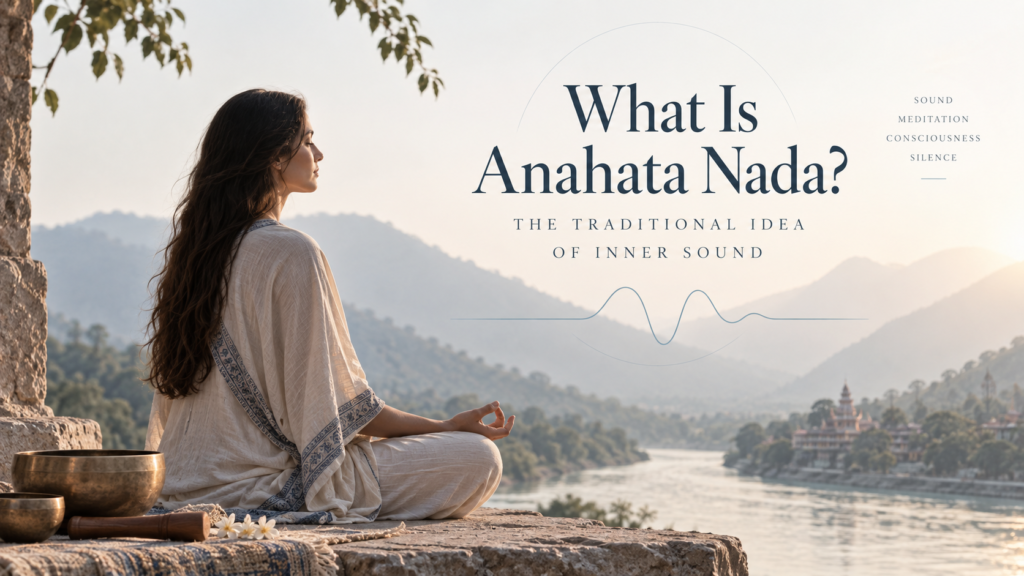
Sound occupies a fascinating place in the traditional teachings of Yoga. We experience sound through music, speech, mantra, chanting, nature, and countless everyday activities. Nada Yoga takes this familiar experience and turns it into a deeper practice of listening and concentration.
Within this tradition, Anahata Nada refers to what is commonly translated as “unstruck sound” or “inner sound.” The idea points toward a subtle form of sound described in traditional yogic texts and associated with meditation, concentration, and inner awareness.
The concept can feel mysterious when we first encounter it. However, its meaning becomes easier to approach when we understand how traditional teachings describe sound at different levels. Anahata Nada belongs to a broader philosophy in which sound can serve as a pathway toward deeper concentration and quieter states of awareness.
What does Anahata Nada mean?
The Sanskrit word Anahata carries meanings such as unstruck, unbeaten, or untouched by striking. Nada refers to sound, resonance, or a subtle vibration. Together, the expression Anahata Nada is commonly translated as “unstruck sound.”
Ordinary sound usually has an identifiable physical source. A musician plays a string, a person speaks through the voice, or a hand strikes a bell. The resulting sound travels through the environment and reaches the ear.
Traditional Yoga uses the idea of Anahata Nada to describe a subtler experience. Yogic texts associate this inner sound with deep concentration and meditation, giving it a place within the contemplative study of Nada.
This distinction creates an interesting starting point for understanding the practice. External sound gives the mind something to hear, while inner sound belongs to a subtler field of meditative experience.
The journey from outer sound to inner listening
Imagine sitting beside the Ganges in Rishikesh during the early morning. The river moves steadily in the background, birds call from the trees, temple bells sound in the distance, and voices rise and disappear along the riverbank.
At first, your attention may move naturally between these different sounds. Gradually, you can choose one sound and listen to it with greater care. The movement of the river becomes a single field of attention, and details that usually pass unnoticed begin to become clearer.
After some time, the practice can become less about identifying individual sounds and more about observing the act of listening itself. Attention becomes steadier, while the surrounding sounds become part of a wider experience.
Traditional Nada Yoga develops this principle further. External sound can provide a starting point for concentration, and deeper practice can lead toward increasingly subtle experiences of sound and silence.
Why listening matters in Nada Yoga
Listening forms an essential part of Nada Yoga because sound gives the mind a clear object of attention. A practitioner can work with mantra, music, the human voice, or natural sounds while gradually developing greater sensitivity.
Consider a sustained musical note. A casual listener may hear one continuous tone, while a trained musician can notice pitch, resonance, texture, movement, and subtle changes within the same sound.
Mantra practice offers a similar opportunity. Each syllable has its own pronunciation, rhythm, and place within the complete chant. Careful listening allows the practitioner to become familiar with these qualities through repetition.
As a result, Nada Yoga encourages a more refined relationship with sound. Listening becomes an active practice that can support concentration and awareness.
Anahata Nada in traditional yogic texts
Traditional Yoga Upanishads discuss Nada in relation to meditation and inner experience. The Nada Bindu Upanishad gives particular attention to internal sound and describes a practice in which the practitioner focuses on increasingly subtle auditory experiences.
The text uses several descriptions to convey these experiences. Among them are sounds compared with the ocean, clouds, drums, bells, flute, veena, and buzzing bees. These images belong to the language of traditional yogic meditation and provide a way to describe subtle auditory phenomena.
The text also places emphasis on concentration. As the practitioner continues listening, attention becomes increasingly absorbed in the sound. This process gives Nada a role within a larger contemplative discipline.
Therefore, Anahata Nada becomes easier to understand when viewed alongside the traditional practices of meditation, concentration, and inner listening.
Why is Anahata Nada called “unstruck sound”?
The expression becomes clearer when we look at the way ordinary sound arises.
A tabla produces sound when the hands strike its surface. A veena produces sound when its strings vibrate. The human voice creates audible sound through the movement of breath and the vocal system.
Each example involves a physical action that produces an audible result.
Traditional descriptions of Anahata Nada point toward a subtler form of sound experienced inwardly. The term “unstruck” distinguishes this experience from sounds produced through ordinary physical contact.
This idea belongs to the philosophical and contemplative language of traditional Yoga. Understanding it within that framework gives the concept greater clarity.
Anahata Nada and the subtle body
The word Anahata also appears in the traditional chakra system, where Anahata refers to the heart chakra.
Yogic traditions connect sound, prana, subtle centers, and meditation through several different models. Some traditional sources associate inner sound with the heart region, while other teachings describe Nada through different subtle-body relationships.
These ideas form part of the traditional yogic understanding of the subtle body. They provide a framework for meditation and spiritual practice within specific Indian philosophical traditions.
For this reason, students can benefit from studying these concepts within their original context. Different texts and lineages can present variations, so careful study helps preserve the distinctions between different teachings.
The four levels of sound
Anahata Nada also connects with the traditional idea of four levels of sound: Para, Pashyanti, Madhyama, and Vaikhari.
These four terms appear in Indian philosophical and yogic discussions of sound and speech. Vaikhari refers to articulated audible speech, while the other levels describe increasingly subtle stages within the traditional model.
This framework gives us another perspective on the relationship between inner and outer sound. A spoken mantra begins as audible expression, yet traditional philosophy examines the subtler stages involved in sound, thought, language, and expression.
Consequently, the study of Nada can extend well beyond vocal chanting. It can include questions about how sound emerges, how attention interacts with sound, and how subtle experience relates to consciousness.
Anahata Nada and mantra practice
Mantra provides a practical starting point for anyone interested in sound-based meditation.
When you chant a mantra, the experience begins with the voice. Breath supports the sound, the mouth shapes each syllable, and the ear receives the finished phrase.
With repetition, your relationship with the mantra can change. At first, you may focus on remembering the words and pronunciation. Later, attention can move toward rhythm, resonance, breath, and the spaces between phrases.
Eventually, the mantra can become familiar enough for you to recognize its rhythm internally. The memory of the sound remains even after the voice becomes quiet.
Traditional Nada practices explore this relationship between sound and inner awareness at a deeper level. Mantra can therefore serve as one pathway into the broader study of Nada.
What might Anahata Nada sound like?
Traditional texts use many images to describe inner sound. Their descriptions include musical and natural sounds such as bells, flutes, drums, buzzing bees, flowing water, and distant thunder.
These descriptions belong to a traditional system of meditation. Individual experiences can vary, and personal auditory sensations can arise for many different reasons.
A calm approach therefore helps during meditation. Allow sounds and sensations to arise naturally while keeping your attention relaxed and steady.
Traditional study also benefits from guidance. A teacher familiar with Nada Yoga can explain the terminology, practices, and philosophical framework surrounding inner sound.
The role of concentration
Concentration gives the practice its direction.
When you listen to a sound carefully, your attention has a clear object. Each time the mind moves toward another thought, you can gently return to the sound.
Repeated practice can strengthen this ability to remain attentive. The sound becomes increasingly familiar, and the mind can settle more easily around it.
Traditional Nada teachings describe a further progression toward subtle sound. The practitioner develops a refined form of listening and gradually explores quieter levels of experience.
In this context, Anahata Nada represents a stage within a larger contemplative journey.
From external sound to subtle sound
A simple listening exercise can help illustrate this progression.
Begin with a sound that you can clearly hear. A mantra, singing bowl, musical note, or natural sound can provide a suitable starting point.
Listen carefully to its beginning, continuation, and ending. Notice its pitch, volume, rhythm, and resonance. As the sound fades, remain attentive to the silence that follows.
Next, allow your awareness to become quieter. Listen to the surrounding environment while keeping your attention relaxed.
With regular practice, you may become more sensitive to subtle aspects of listening. This experience provides a practical foundation for understanding why traditional Nada Yoga places such importance on sound and awareness.
Why silence matters in Nada Yoga
Sound and silence exist together in every listening experience.
When a mantra ends, the final syllable gradually fades. A short period of quiet follows, and that quiet can become part of the meditation.
The same experience occurs with music. A note begins, continues, and eventually disappears into silence. Careful listening allows you to notice the transition instead of immediately moving toward another sound.
Traditional Nada teachings give this transition deeper significance. The Nada Bindu Upanishad describes increasingly subtle forms of Nada and ultimately points toward a state beyond sound.
For this reason, silence can become an important part of sound-based meditation. The practitioner learns to remain attentive as the experience moves from audible sound toward greater subtlety.
Anahata Nada and Indian classical music
Indian classical music offers a rich field for developing attentive listening. Musicians spend years refining their sensitivity to pitch, shruti, rhythm, resonance, and tonal movement.
A single note can therefore become a detailed listening experience. The musician learns to recognize subtle qualities that casual listening may overlook.
Nada Yoga shares an interest in this refinement of hearing, although the two traditions have their own distinct purposes and methods. Music can train the ear, while Nada Yoga places that refined attention within a yogic and contemplative framework.
Students who study Indian classical music alongside Nada Yoga can therefore develop a deeper appreciation of sound. Listening becomes increasingly precise, while awareness remains at the center of the practice.
Anahata Nada and meditation
Meditation gives the concept of inner sound a practical context.
During a sound-based meditation, the practitioner can begin with an audible object and gradually refine attention. The voice, mantra, musical note, or natural sound becomes a support for concentration.
As the practice continues, external distractions may become less prominent. Attention can remain with the chosen sound for longer periods, creating a more stable meditative experience.
Traditional teachings describe inner sound within this broader process. Anahata Nada becomes part of an exploration of subtle perception, concentration, and awareness.
The practice calls for patience. A practitioner can focus on developing attentive listening and allow experiences to unfold naturally.
A simple listening practice
A simple exercise can introduce the basic principle behind Nada Yoga.
Find a quiet place and sit comfortably. Take a few natural breaths and allow your body to settle before choosing one sound as your focus.
Listen to that sound carefully for several minutes. Notice its pitch, rhythm, volume, resonance, and movement. When another thought or sound attracts your attention, gently return to the chosen sound.
After several minutes, allow your attention to open to the complete soundscape around you. Listen to nearby sounds, distant sounds, your breathing, and the moments of quiet between them.
Finally, sit quietly for a few minutes and observe what you experience. This practice develops attentive listening and creates a useful foundation for deeper sound meditation.
Should you try to hear Anahata Nada?
Curiosity can encourage deeper study, while patience keeps the practice grounded.
Traditional Nada Yoga develops through concentration, discipline, meditation, and guidance. A practitioner can therefore approach Anahata Nada as a subject of study and contemplation.
Experiences during meditation can vary from person to person. An internal tone, humming sensation, ringing sound, or another auditory experience can have many possible causes.
For this reason, the practice works best when approached with openness and discernment. Study the traditional teachings, develop concentration gradually, and allow personal experiences to remain part of your own process.
Anahata Nada and Nada Yoga teacher training
Students undertaking Nada Yoga teacher training can explore Anahata Nada within a wider study of mantra, meditation, Indian classical music, sound, and yogic philosophy.
The subject connects several important areas of practice. Mantra develops familiarity with sacred sound, music develops the ear, meditation develops concentration, and Nada Yoga brings these experiences into a broader contemplative framework.
Practical listening exercises can support this study. Students can observe pitch, resonance, rhythm, voice, silence, and the relationship between external and internal attention.
Understanding Anahata Nada through its traditional context
Anahata Nada becomes much easier to understand when we approach it through the traditions that describe it.
The concept belongs to a broader exploration of sound, meditation, subtle perception, and consciousness. Traditional texts use symbolic language and descriptions of inner experience to guide this exploration.
Modern conversations about inner sound can sometimes separate the concept from its original context. Returning to traditional sources allows us to understand the terminology with greater care.
This approach also creates space for personal experience. Meditation remains an experiential practice, while traditional teachings provide a framework for interpreting that experience.
From sound toward silence
Nada Yoga begins with listening.
A practitioner may start with a mantra, a musical note, the human voice, or the sounds of nature. Through steady attention, the practice can become increasingly subtle.
Anahata Nada represents one of the deepest ideas within this traditional exploration. The concept directs attention toward inner sound and invites contemplation of what happens as listening becomes more refined.
Sound then becomes part of a larger movement toward silence. The practitioner listens, concentrates, observes, and gradually becomes more aware of the space surrounding every sound.
For students exploring Nada Yoga teacher training, this journey offers a rich area of study. It connects traditional philosophy with practical experiences of mantra, music, meditation, listening, and silence.
Perhaps the most useful place to begin remains simple: give sound your full attention. When you listen carefully, even a familiar sound can reveal layers that ordinary hearing often overlooks.