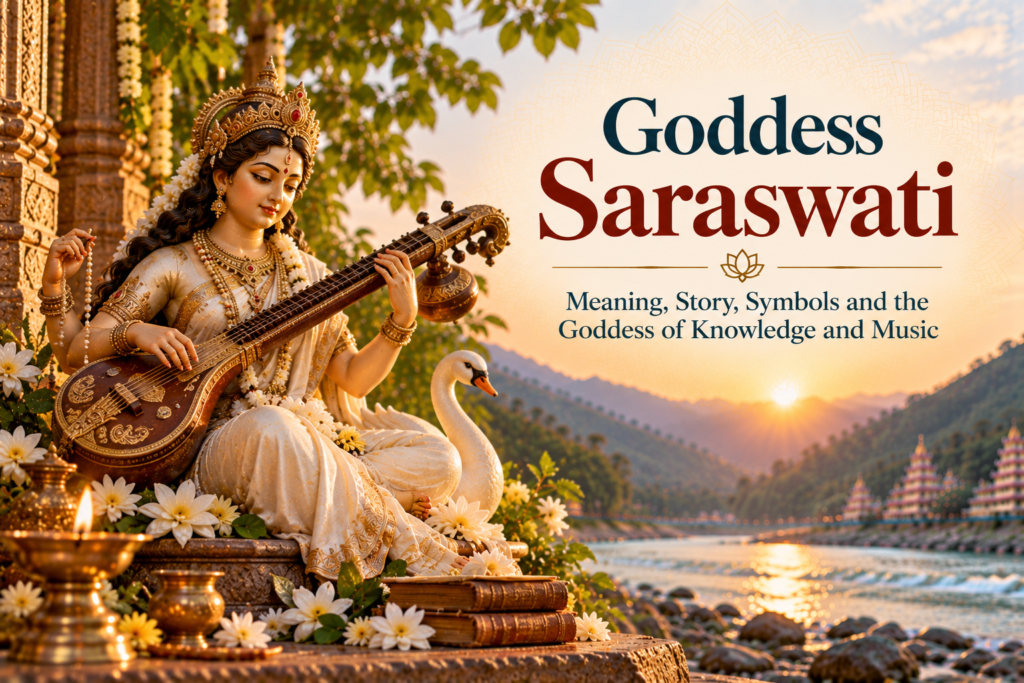
A musician spends years learning to recognise the subtle qualities of a note. A student returns to a difficult subject until its meaning becomes clear, while a poet searches for words that express an experience with precision. Hindu traditions honour these pursuits through Goddess Saraswati, the divine embodiment of knowledge, speech, music and the arts.
Saraswati holds a special place in Indian spiritual and cultural life. Students pray to her before beginning their studies, musicians seek her blessings before performances, and artists invoke her during important creative beginnings. Her presence connects the pursuit of knowledge with discipline, clarity and the ability to express what the mind understands.
Her story also carries a long history. Vedic literature presents Saraswati in connection with a sacred river and divine power, while later Hindu traditions develop her identity as the Goddess of learning, speech and artistic expression. Exploring her stories and symbols reveals why Saraswati remains an important figure in education, music, literature and spiritual practice.
Who is Goddess Saraswati?
Goddess Saraswati, also spelled Sarasvati, is worshipped in Hindu traditions as the Goddess of knowledge, wisdom, speech, music and the arts. Devotees associate her with learning, eloquence, creative expression and the cultivation of understanding. Her name appears in religious literature spanning several historical periods, reflecting the changing ways in which Indian traditions have understood her divine qualities.
Saraswati occupies an important position in Shakta and other Hindu traditions. She is frequently described as part of the Tridevi, alongside Lakshmi and Parvati, who represent different aspects of divine feminine power. Saraswati embodies knowledge and artistic expression, Lakshmi represents prosperity and auspiciousness, and Parvati expresses strength and several forms of divine motherhood.
Her familiar image shows a serene figure dressed in white, holding a veena and sacred texts. A swan often accompanies her, and some depictions include a lotus or a rosary. These symbols communicate her relationship with learning, refined perception, music and spiritual contemplation.
Students, teachers, musicians, writers and scholars continue to worship Saraswati. Her blessings hold particular significance when people begin a course of study, learn an instrument, compose music or develop a new creative skill.
Saraswati in the Vedas and ancient Indian tradition
Saraswati has a long history in Indian religious literature. In the Rigveda, one of the oldest collections of Vedic hymns, she appears prominently as a river and a divine presence associated with nourishment, power and sacred inspiration. The hymns praise her through imagery connected with flowing water and divine strength.
Over time, Saraswati became closely associated with Vāc, the personification of speech in Vedic tradition. Later texts developed her identity as the Goddess of learning, language, music and the arts. This historical development shows how her role expanded across religious literature and devotional practice. R. U. S. Prasad’s study of Saraswati examines these connections across the Vedas, Brahmanas, epics and Puranas.
The river Saraswati also carries an important place in discussions of ancient Indian geography and history. Scholars have proposed different identifications for the river described in Vedic texts, and its precise historical course remains debated. The sacred river and the Goddess of knowledge share a rich religious history, with later traditions bringing water, speech, learning and divine inspiration into a connected symbolic world.
This background gives Saraswati a distinctive place in Hindu thought. Her identity brings together the flow of water, the expression of speech and the transmission of knowledge across generations.
The story of Goddess Saraswati
Hindu traditions preserve several stories about Saraswati, reflecting the different roles she occupies in religious literature. Many devotional accounts associate her with Brahma, the creator deity, and describe her as the divine source of speech, knowledge and the arts.
In one widely circulated Puranic tradition, Saraswati emerges through the creative power associated with Brahma and brings order, expression and clarity to creation. Her presence allows beings to communicate, learn and recognise the world through language and knowledge. This account expresses her importance within the wider process of creation.
Other traditions focus on Saraswati’s relationship with sacred speech and the Vedas. Through her association with learning and eloquence, she becomes a guardian of knowledge and a source of inspiration for sages, teachers and students. Devotional literature often invokes her before the study or recitation of sacred texts.
These accounts communicate a shared theme: knowledge requires the ability to understand, organise and express experience. Saraswati embodies these qualities through her association with language, music, memory and discernment.
What does Goddess Saraswati represent?
Saraswati represents the cultivation of knowledge and the responsible use of creative ability. Her symbolism encourages students and artists to develop patience, practise carefully and approach learning with respect.
Knowledge and wisdom
Saraswati is widely worshipped as the Goddess of knowledge. Her association with sacred texts, education and intellectual inquiry makes her especially important to students and teachers. Devotees seek her blessings for concentration, understanding and the ability to apply what they learn.
Wisdom also involves discernment. Learning becomes useful when a person can evaluate information, recognise meaningful connections and make thoughtful decisions. Saraswati’s traditional role encourages the cultivation of these abilities.
Speech and communication
Language allows people to share ideas, preserve traditions and express subtle experiences. Saraswati’s connection with Vāc places speech at the centre of her symbolism. Her worship honours clear expression, thoughtful communication and the responsible use of words.
This association also extends to poetry, literature, debate and the recitation of sacred texts. In these practices, the choice of words, their pronunciation and their meaning all contribute to effective expression.
Music and artistic expression
Saraswati holds a special place in Indian music because of her association with the veena. Musicians invoke her as a source of inspiration and as a symbol of disciplined artistic practice. Her worship also extends to dance, poetry, painting and other creative traditions.
Learning an art requires sustained attention, regular practice and sensitivity to detail. Saraswati’s symbolism reflects these qualities, encouraging practitioners to develop their skills with care.
Clarity and discernment
Traditional depictions of Saraswati often present her with a calm expression and graceful posture. These features suggest composure, clarity and a measured approach to learning. Her worship encourages a thoughtful relationship with knowledge and creative work.
Understanding the symbols of Goddess Saraswati
Saraswati’s traditional image contains several symbols associated with her divine qualities. The veena, sacred texts, rosary, lotus, swan and white clothing each contribute to the meaning of her iconography. Their precise arrangement varies across artistic and regional traditions.
The veena
The veena is one of Saraswati’s most recognisable attributes. This classical Indian string instrument connects her with music, rhythm, melody and artistic knowledge. Its presence reflects the importance of disciplined musical training and the refinement of listening.
Playing a veena requires coordination between the hands, careful control of pitch and sustained attention to sound. Musicians learn to recognise the relationship between notes and shape phrases through practice. Saraswati’s association with the instrument therefore represents the union of knowledge and artistic skill.
The veena also provides a natural connection to Nada Yoga, a tradition that explores sound through listening, vocal practice and contemplation. Music students can approach the instrument as a reminder of the attention and patience required to understand sound deeply.
Sacred texts and books
Saraswati is frequently depicted with a manuscript or book, symbolising learning, scripture and the preservation of knowledge. Sacred texts have played an important role in Indian traditions through recitation, memorisation, commentary and teaching.
Her association with books also extends to modern education. Students often place their textbooks and notebooks near an image of Saraswati during Vasant Panchami or Saraswati Puja, seeking blessings for their studies. The custom expresses respect for learning and the teachers who transmit knowledge.
The rosary
Some depictions show Saraswati holding a rosary, often called a mala. The rosary represents spiritual practice, repetition and contemplation. Its presence connects intellectual learning with sustained attention and inner discipline.
A mala may also serve as a practical aid during mantra recitation. Practitioners move through its beads as they repeat a mantra, helping maintain a steady rhythm of practice.
The white lotus
The lotus appears in many Hindu images as a symbol of purity, beauty and spiritual unfolding. In Saraswati’s iconography, it reinforces her association with clarity and refined understanding. Its presence also connects her with the wider symbolism of the lotus across Hindu religious art.
The swan
The swan, known as hamsa in Sanskrit, commonly appears as Saraswati’s vehicle. Traditional interpretations associate the swan with discernment and the ability to distinguish between different qualities or states. This symbolism fits Saraswati’s role as the Goddess of wisdom and understanding.
Some devotional explanations describe the swan as capable of separating milk from water. This image serves as a traditional metaphor for discernment, expressing the ability to recognise what is valuable and meaningful.
White clothing
Saraswati’s white clothing represents purity, simplicity and clarity in many devotional interpretations. White also creates a visual association with calmness and focused learning. Her image encourages an approach to knowledge grounded in sincerity and discipline.
Saraswati and Indian classical music
The relationship between Saraswati and music reaches across devotional practice, artistic traditions and the symbolism of the veena. Musicians invoke her before performances, music lessons and new creative undertakings. In this setting, Saraswati represents the knowledge and dedication required to develop musical ability.
Indian classical music demands close attention to pitch, rhythm, phrasing and the character of a raga. Students begin by developing a reliable sense of swara, then gradually learn to recognise how notes interact and how melodic phrases communicate a particular mood. Regular practice builds both technical control and a refined musical ear.
Saraswati’s veena offers a fitting symbol for this learning process. The instrument connects the physical act of producing sound with the mental discipline required to understand music. Through practice, a musician learns to shape each note carefully and listen to the relationships that give a melody its character.
Her association with music also extends to devotional singing. Saraswati Vandana, bhajans and other hymns allow practitioners to express reverence through melody and language. These traditions preserve Sanskrit verses and devotional compositions while creating opportunities for shared musical practice.
Saraswati and Nada Yoga
Nada Yoga explores the role of sound in attention, meditation and spiritual practice. Its methods may include mantra chanting, attentive listening, voice work and the observation of sustained tones. The tradition encourages practitioners to develop awareness of sound and its relationship with concentration.
Saraswati’s association with music, speech and knowledge creates a natural point of connection with these practices. Learning to chant a mantra, sing a Sanskrit verse or play a musical instrument requires attention to pronunciation, pitch, rhythm and timing. These skills develop through careful instruction and repeated practice.
For example, a student learning a Saraswati mantra can begin by listening to its pronunciation and understanding its meaning. Repeating the mantra slowly encourages awareness of each syllable, while listening to its rhythm helps the student maintain a steady pace. The practice brings language and sound together through focused repetition.
Saraswati’s symbolism also reminds students that artistic learning requires patience. A musician may spend years refining a single phrase or understanding the subtle movement of a raga. This commitment to learning connects the devotional ideal of Saraswati with the daily discipline of music education.
At Nada Yoga School, students can explore Indian classical music, mantra, kirtan and sound-based practices alongside yoga studies. Those interested in the relationship between music and contemplative practice can learn more about the Nada Yoga teacher training course in Rishikesh.
Saraswati Vandana and Saraswati mantras
Saraswati Vandana refers to devotional prayers offered to Goddess Saraswati. Schools, music institutions and cultural programmes often begin with a Saraswati invocation, seeking blessings for learning, artistic expression and successful study.
One well-known Sanskrit prayer begins with the words Ya Kundendu Tusharahara Dhavala. It describes Saraswati through images of the moon, snow, white garments and the veena, creating a portrait of purity, beauty and learning.
Another widely recited verse begins with Saraswati Namastubhyam. Students often use this prayer before studying or beginning a new learning activity.
Saraswati Namastubhyam
सरस्वति नमस्तुभ्यं वरदे कामरूपिणि ।
विद्यारम्भं करिष्यामि सिद्धिर्भवतु मे सदा ॥
Transliteration:
Saraswati namastubhyam varade kamarupini,
Vidyarambham karishyami siddhir bhavatu me sada.
Meaning:
Salutations to Goddess Saraswati, the giver of blessings and the fulfiller of worthy aspirations. I am beginning my studies, and may my efforts meet with success.
This prayer expresses a student’s intention to approach learning with respect and dedication. Families and educational institutions may recite it at the beginning of the academic year, before examinations or during Saraswati Puja.
For meaningful practice, students can learn the Sanskrit pronunciation from a reliable teacher or recording. Understanding the words alongside their recitation can help connect the sound of the prayer with its devotional purpose.
Vasant Panchami and Saraswati Puja
Vasant Panchami, also known as Basant Panchami, marks an important occasion for Saraswati worship in many parts of India. The festival falls on the fifth lunar day of the bright half of the Hindu month of Magha, according to the traditional calendar. It also welcomes the spring season in many regional traditions.
During Saraswati Puja, devotees offer flowers, fruits, sweets and other items according to local customs. Schools and educational institutions organise prayers, while musicians and artists seek blessings for their studies and creative work. Yellow clothing and decorations appear in many celebrations because of their association with spring, vitality and the mustard blossoms of the season.
In some communities, children begin their formal education through a ceremony known as Vidyarambham or by a related regional name. Families introduce young learners to letters and writing, marking the beginning of their educational journey.
Saraswati Puja also has a place in music schools and cultural institutions. Teachers may arrange instruments, books and manuscripts for worship, expressing gratitude for the knowledge passed down through generations.
Saraswati and the tradition of learning
Saraswati’s place in Hindu culture extends beyond formal education. Her symbolism encompasses the transmission of knowledge through teachers, artistic lineages, sacred recitation and practical experience. These forms of learning preserve traditions while allowing students to develop their own understanding.
In Indian classical music, a student learns through listening, imitation, correction and repeated practice. A teacher demonstrates a phrase, explains its structure and guides the student through the details of performance. Over time, the learner develops greater independence and sensitivity.
Similar processes appear in Sanskrit study, philosophy, dance and other traditional disciplines. Knowledge grows through a combination of study, guidance and personal effort. Saraswati provides a devotional focus for these activities, reminding practitioners to respect both the subject and the process of learning.
Her symbolism also encourages responsible use of knowledge. Communication can educate, music can bring people together, and thoughtful expression can preserve cultural memory. These qualities help explain why Saraswati remains meaningful in classrooms, music studios, libraries and homes.
How to honour Goddess Saraswati in daily life
Devotees honour Saraswati through prayer, mantra chanting, offerings and the study of sacred texts. Many also express devotion through their everyday commitment to learning. A student may begin the day with a short prayer, while a musician may invoke Saraswati before practising an instrument.
A simple daily practice can begin by sitting quietly and offering a short Saraswati Vandana. Read or recite the words at a comfortable pace, paying attention to their pronunciation and meaning. Afterwards, spend time studying, writing, reading or practising music with a clear intention.
Keeping books and instruments organised can also express respect for the learning process. Students may dedicate a few minutes each day to reviewing their work, listening carefully to a musical phrase or revisiting a concept that requires further attention. Such habits bring Saraswati’s symbolism into practical life.
The central idea is steady engagement with knowledge. Prayer can establish an intention, while consistent study and practice help turn that intention into a meaningful pursuit.
Frequently asked questions about Goddess Saraswati
What is Goddess Saraswati known for?
Goddess Saraswati is worshipped as the Goddess of knowledge, wisdom, speech, music and the arts. Students, teachers, musicians and artists seek her blessings for learning, clear expression and creative work.
What is the meaning of Saraswati?
Saraswati has a long history in Sanskrit and Vedic literature, where the name is associated with a sacred river and divine presence. Later Hindu traditions develop her identity as the Goddess of speech, knowledge, music and learning.
Why does Saraswati hold a veena?
The veena represents music and artistic knowledge. Its presence connects Saraswati with melody, disciplined practice and the cultivation of musical skill.
Why is the swan associated with Saraswati?
The swan, or hamsa, serves as Saraswati’s traditional vehicle in many depictions. Devotional interpretations connect it with discernment, wisdom and the ability to recognise meaningful distinctions.
When is Saraswati Puja celebrated?
Saraswati Puja is widely celebrated on Vasant Panchami, which falls during the Hindu month of Magha. Some regions and traditions also honour Saraswati during other festivals and periods of study or worship.
Which mantra is recited for Goddess Saraswati?
Devotees recite several prayers and mantras, including Saraswati Namastubhyam and the Saraswati Vandana beginning Ya Kundendu Tusharahara Dhavala. Schools and music institutions often use these prayers before study or artistic activities.
What is the connection between Saraswati and Nada Yoga?
Saraswati’s association with music, speech and learning creates a connection with practices involving attentive listening, mantra chanting and vocal training. Nada Yoga explores sound as a focus for awareness and contemplation, while Saraswati represents the knowledge and artistic discipline that support musical study.
Final thoughts
Goddess Saraswati represents the pursuit of knowledge through study, speech, music and creative expression. Her stories and symbols have shaped Indian devotional traditions, while her presence in educational institutions and music schools continues to inspire students and artists.
The veena connects her with the discipline of music, the sacred text represents the preservation of knowledge, and the swan symbolises discernment. Together, these attributes express a tradition that values learning, careful practice and thoughtful communication.
Through Saraswati Vandana, Vasant Panchami and everyday study, devotees honour the Goddess in ways that connect spiritual intention with practical effort. For students of Indian classical music and Nada Yoga, Saraswati remains a meaningful symbol of attentive listening, artistic development and the lifelong pursuit of understanding.