Every tradition has a few extraordinary individuals who appear at just the right moment to preserve knowledge that might otherwise fade into history. For the ancient science of Nada Yoga, one such figure was Dr. Dattatreya Rama Rao Parvatikar, affectionately known throughout India as Veena Baba.
Today, Nada Yoga is studied by yoga practitioners, musicians, sound healers, and spiritual seekers across the world. Courses are taught in ashrams and yoga schools, books are written on the philosophy of sound, and researchers continue to explore the effects of vibration on the human body and mind. Yet only a few decades ago, this sacred tradition was known to a relatively small circle of practitioners.
Much of the credit for bringing Nada Yoga back into public awareness belongs to Veena Baba.
He was not simply a gifted musician. He was a yogi, a researcher, an inventor, a teacher, and above all, a seeker who dedicated his life to discovering the spiritual potential hidden within sound. While many musicians spent their lives perfecting performance, Veena Baba pursued something far deeper. He wanted to understand why the ancient sages described the universe as Nada Brahma, the Divine manifesting as sound, and how a human being could experience that truth directly.
His journey took him from the plains of Karnataka to the sacred Himalayas, from rigorous musical training to years of spiritual practice, and from quiet meditation to becoming one of the most respected ambassadors of Nada Yoga in modern India.
This is the story of a man whose life reminds us that music is not only something we hear. When approached with awareness and discipline, it becomes a path that leads inward.
Early Life: A Childhood Surrounded by Learning
Dr. Dattatreya Rama Rao Parvatikar was born in 1916 in the town of Guledgudda, located near Badami in present-day Karnataka. He was born into a cultured family where education, discipline, and Indian traditions formed an important part of everyday life.
His father, Professor Rama Rao Parvatikar, was a respected academic, while his mother, Vatsala Bai, nurtured an atmosphere of devotion and cultural appreciation within the home. Growing up in such an environment allowed young Dattatreya to develop both intellectual curiosity and spiritual sensitivity from an early age.
The India of his childhood was very different from the modern world. Classical music was deeply respected, temples remained centres of cultural life, and many ancient traditions were still preserved through oral teaching. Music was not merely performed on stage. It accompanied rituals, festivals, meditation, and devotional practices.
These surroundings left a lasting impression on the young boy.
Unlike many children who admired music for its beauty alone, Dattatreya became fascinated by the silence that followed every note. He listened carefully to temple chants, devotional singing, and the resonance of traditional instruments. Somewhere within those sounds, he sensed there was a deeper mystery waiting to be understood.
Years later, that quiet curiosity would become the foundation of his life’s work.
The Beginning of a Musical Journey
As he grew older, Dattatreya devoted himself wholeheartedly to the study of Indian classical music. He approached learning with remarkable discipline, believing that true mastery required patience rather than talent alone.
His education gradually introduced him to several traditional instruments, each offering a unique understanding of vibration and resonance.
Over the years, he became proficient in:
- Rudra Veena
- Vichitra Veena
- Sitar
- Swarmandal
Among these, the Rudra Veena occupied a special place in his heart.
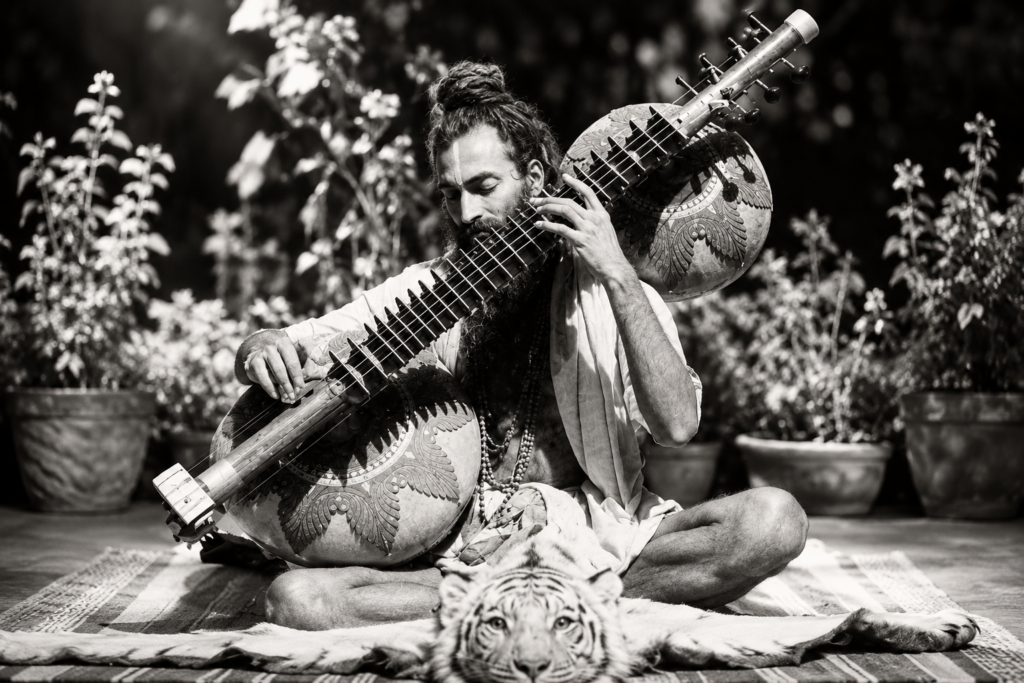
Unlike instruments designed for speed or virtuosity, the Rudra Veena encourages slow, deliberate playing. Every note is allowed to breathe, every vibration lingers in the surrounding space, and every phrase invites deep concentration from both the musician and the listener.
For Dattatreya, this instrument became much more than a means of musical expression.
It became his companion in meditation.
Hours of daily practice gradually transformed his understanding of music. He realized that the true purpose of practice was not to impress an audience. It was to refine one’s own awareness.
The longer he played, the more he experienced that sound had the power to quiet the mind instead of stimulating it.
This insight would eventually shape his entire philosophy of Nada Yoga.
Looking Beyond Performance
During the early twentieth century, Indian classical music was receiving increasing recognition as a performing art. Musicians travelled widely, gave concerts, and gained admiration for their technical brilliance.
Dattatreya respected this tradition, but he felt something essential had been overlooked.
Ancient yogic scriptures described music very differently.
Texts such as the Nada Bindu Upanishad, Hatha Yoga Pradipika, and Shiva Samhita spoke about sound as a means of meditation. They described how attentive listening could eventually lead a practitioner beyond external sound and into the experience of Anahata Nada, the subtle inner sound perceived during deep states of meditation.
These teachings fascinated him.
Instead of asking how music could entertain people, he began asking very different questions.
- Why did ancient yogis consider sound a spiritual practice?
- Could music transform consciousness?
- Was there a relationship between vibration, breath, and meditation?
- Could disciplined listening become a path to Self-realization?
The search for answers gradually changed the direction of his life.
Music was no longer simply an art.
It had become his yoga.
A Calling Toward the Himalayas
Many spiritual seekers eventually feel drawn toward the Himalayas, where countless sages have lived, meditated, and taught for centuries.
Dattatreya was no exception.
His inner search led him north to Badrinath, one of India’s most sacred pilgrimage destinations. Surrounded by towering Himalayan peaks, ancient temples, and the flowing waters of the Alakananda River, Badrinath offered the silence he had long been seeking.
There, he embraced an exceptionally simple way of life.
His days were shaped by discipline rather than comfort. Instead of pursuing recognition, he devoted himself to spiritual practice, meditation, scriptural study, and long hours of veena sadhana.
A typical day included:
- Rising before sunrise
- Meditation and yogic practices
- Hours of veena practice
- Study of spiritual scriptures
- Quiet contemplation
- Guiding sincere visitors who wished to learn
Those who met him often remarked on his calm presence. He spoke very little, preferring silence over unnecessary conversation. Yet when he played the veena, the music expressed what words could not.
Pilgrims who happened to hear him often stopped in their tracks.
Some listened for a few minutes.
Others remained seated for hours.
Many later recalled that his music created an atmosphere unlike any ordinary performance. Instead of excitement, it brought stillness. Instead of applause, it invited contemplation.
Without seeking fame, Dattatreya had quietly begun touching the lives of countless visitors who came to the Himalayas searching for something beyond words.
Little did they know that this quiet musician would soon become known across India by a name that perfectly reflected his life and his devotion.
Veena Baba.