For thousands of years, civilizations across India, Tibet, Egypt, Greece, and many other cultures have used sound as a tool for healing, meditation, and spiritual development. Ancient yogis described the universe itself as vibration, while modern science explains that everything around us exists in the form of energy and frequency.
Today, sound healing has become increasingly popular across wellness centers, yoga studios, hospitals, and therapeutic settings. Singing bowls, gongs, tuning forks, chanting, and vocal toning are now used by practitioners worldwide to promote relaxation and emotional well-being.
But an important question remains.
Is there scientific evidence of sound healing?
The short answer is yes, although the research is still developing. Modern studies suggest that sound-based practices may help reduce stress, improve mood, support meditation, lower anxiety, and positively influence brain activity. However, researchers also agree that more large-scale clinical trials are needed before sound healing can be considered a replacement for conventional medical treatment.
In this article, we’ll explore what current scientific research says, how sound affects the body and brain, and why ancient practices continue to attract the attention of modern science.
What Is Sound Healing?
Sound healing is the intentional use of vibrations, frequencies, music, and voice to support physical, emotional, mental, and spiritual well-being.
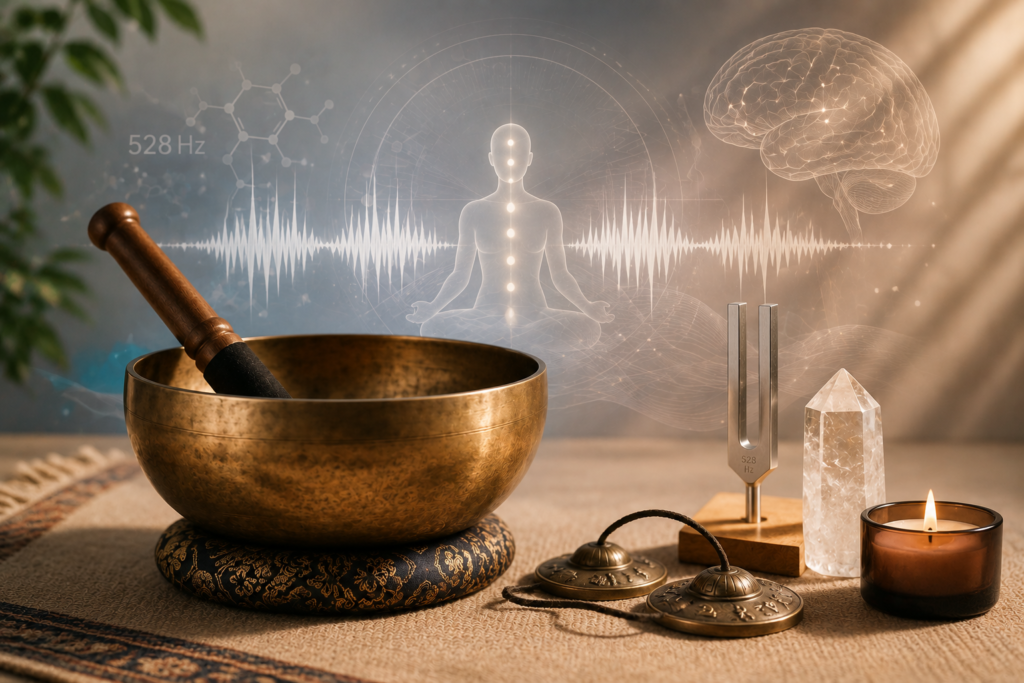
Different traditions use different methods, including:
- Tibetan singing bowls
- Crystal singing bowls
- Gongs
- Tuning forks
- Mantra chanting
- Vocal toning
- Indian classical music
- Nada Yoga
- Nature sounds
Unlike simply listening to music, sound healing often combines focused intention, resonance, breathing practices, and meditation to influence the nervous system.
Why Scientists Are Interested in Sound Healing
The human body constantly responds to sound.
Sound waves travel through the air and can also travel through tissues, bones, and fluids. Our ears convert these vibrations into electrical signals that the brain interprets.
Researchers are particularly interested in how certain sounds influence:
- Brainwave activity
- Heart rate
- Breathing patterns
- Stress hormones
- Nervous system regulation
- Emotional processing
Rather than claiming mystical effects, many modern studies focus on measurable physiological responses.
The Science Behind Sound and the Human Body
Sound Is Vibration
Every sound begins as vibration.
When a singing bowl is struck, it creates pressure waves that travel through the surrounding air. These vibrations reach the ear, where tiny hair cells convert them into nerve signals sent to the brain.
This process activates multiple areas responsible for:
- Hearing
- Memory
- Emotion
- Attention
- Motor coordination
Because sound engages many regions simultaneously, researchers believe it may influence both psychological and physiological states.
The Nervous System Response
One of the strongest scientific findings is that calming sounds can activate the parasympathetic nervous system, often called the “rest and digest” system.
When this system becomes more active:
- Heart rate slows
- Breathing becomes deeper
- Blood pressure may decrease
- Muscles relax
- Stress hormones begin to reduce
This explains why many people report feeling deeply relaxed after a sound healing session.
What Research Says About Sound Healing
Although research is still growing, several studies provide encouraging findings.
Reduced Stress and Anxiety
Stress reduction is currently one of the best-supported benefits of sound healing.
A frequently cited observational study involving participants in Tibetan singing bowl meditation found significant reductions in:
- Tension
- Anger
- Fatigue
- Depression
- Anxiety
Participants also reported increased feelings of spiritual well-being after a single session.
While more controlled research is needed, these findings suggest sound meditation may be an effective relaxation practice.
Improved Mood
Music therapy has long been used in hospitals and mental health settings.
Research consistently shows that carefully selected sound can:
- Improve emotional regulation
- Reduce negative mood
- Increase feelings of calm
- Promote emotional expression
Sound healing builds upon these principles by combining vibration with mindful awareness.
Better Sleep
Although research specifically on singing bowls and sleep remains limited, studies on relaxing music and sound therapy show improvements in:
- Sleep quality
- Time taken to fall asleep
- Night-time awakenings
Since stress and anxiety are major causes of insomnia, relaxation through sound may indirectly improve sleep.
Brainwave Changes
Electroencephalogram (EEG) studies have shown that meditation and rhythmic sound practices can influence brainwave activity.
Many sound healing sessions encourage the brain to shift toward:
Alpha waves
Associated with calm focus, creativity, and relaxed awareness.
Theta waves
Linked with meditation, deep relaxation, visualization, and memory processing.
While more research is needed specifically on sound healing instruments, these changes are consistent with many meditative practices.
Singing Bowl Research
Singing bowls are among the most studied instruments in modern sound healing.
Researchers believe their unique harmonic overtones may encourage deep relaxation by providing complex auditory stimulation.
Current findings suggest singing bowl meditation may help:
- Lower stress
- Improve mood
- Increase relaxation
- Support mindfulness practices
Importantly, these studies generally measure psychological outcomes rather than proving direct healing of disease.
This distinction is important because scientific accuracy builds trust.
Sound Healing and the Brain
The Limbic System
The limbic system controls emotions, motivation, and memory.
Sound has direct access to this emotional network.
This explains why hearing a particular melody can instantly trigger powerful memories or emotional responses.
Healing sounds may similarly encourage emotional regulation by influencing these brain regions.
Neuroplasticity
Modern neuroscience has shown that the brain constantly changes through experience.
Meditation, mindfulness, music training, and repetitive auditory stimulation can all contribute to neuroplastic changes.
Although research on sound healing itself is still developing, scientists are exploring whether regular sound meditation could produce similar long-term effects.
Frequency, Resonance, and Scientific Reality
One of the most misunderstood aspects of sound healing involves frequency.
Many internet articles claim that specific frequencies automatically heal diseases or repair organs.
Current scientific evidence does not support these claims.
Instead, researchers understand that:
- Different frequencies create different auditory experiences.
- Resonance affects physical materials differently.
- The nervous system responds uniquely to rhythm, harmony, and vibration.
- Psychological context also plays a major role.
In other words, sound healing appears to work through a combination of neurological, emotional, and physiological mechanisms rather than magical frequencies alone.
The Role of Meditation
Many benefits attributed to sound healing may actually come from combining sound with meditation.
During a sound bath, participants often experience:
- Slow breathing
- Reduced external distractions
- Closed-eye relaxation
- Mindfulness
- Present-moment awareness
These elements alone are already known to reduce stress and improve emotional health.
Sound acts as an anchor that helps many people enter a meditative state more easily.
Can Sound Healing Reduce Pain?
Pain research offers another promising area.
Some studies suggest music therapy and sound-based interventions may reduce the perception of pain by:
- Distracting attention
- Lowering anxiety
- Promoting relaxation
- Reducing muscle tension
This does not mean sound cures the underlying condition.
Instead, it may help people manage pain more comfortably alongside conventional treatment.
What Science Still Cannot Confirm
It is important to separate evidence from speculation.
At present, there is no strong scientific evidence that sound healing alone can:
- Cure cancer
- Eliminate infections
- Repair damaged organs
- Replace surgery
- Replace medication for serious illnesses
Responsible sound healing practitioners view their work as complementary rather than alternative medicine.
Used alongside medical care, sound healing may support relaxation, emotional balance, and overall well-being.
Why More Research Is Needed
Many existing sound healing studies have limitations.
Common challenges include:
- Small participant groups
- Lack of placebo controls
- Different instruments and techniques
- Short follow-up periods
- Subjective outcome measurements
Researchers continue to investigate how different sound practices affect the nervous system using advanced technologies such as EEG, MRI, and heart rate variability analysis.
As the field grows, stronger evidence will help clarify which methods provide the greatest benefits.
Ancient Wisdom Meets Modern Science
Ancient yogic traditions have long described reality as vibration.
In Nada Yoga, often translated as the Yoga of Sound, practitioners believe inner transformation begins by refining one’s awareness of sound, from external vibrations to the subtle inner sound known as Anahata Nada.
Modern neuroscience approaches the subject differently, focusing on measurable changes in brain activity, nervous system regulation, and emotional health.
Although the language differs, both perspectives recognize that sound profoundly influences human experience.
This meeting point between ancient wisdom and scientific research makes sound healing one of the most fascinating areas of modern wellness.
If you are interested in experiencing these practices firsthand, joining a structured Sound Healing Teacher Training allows you to study traditional instruments, the science behind vibration, meditation techniques, and practical applications under experienced teachers. At Nada Yoga School in Rishikesh, students learn both the traditional philosophy of Nada Yoga and contemporary understanding of sound healing, creating a balanced approach grounded in experience and knowledge.
Is Sound Healing Scientifically Proven?
The most accurate answer is nuanced.
Scientific research supports several benefits of sound healing, particularly for relaxation, stress reduction, anxiety management, mood improvement, and meditation.
However, the evidence is still evolving.
Rather than viewing sound healing as a miracle cure, it is better understood as a complementary wellness practice that supports the body’s natural ability to relax and restore balance.
As more high-quality research emerges, our understanding of how vibration influences the mind and body will continue to deepen.
For now, both ancient traditions and modern science agree on one important point: sound has a remarkable ability to influence the human experience.
Frequently Asked Questions
Is sound healing backed by science?
Yes. Scientific studies suggest sound healing can reduce stress, anxiety, and promote relaxation. However, more large-scale clinical research is needed to confirm many of its broader therapeutic claims.
Does sound healing actually work?
Many people experience benefits such as improved mood, reduced stress, and deeper relaxation. These effects are supported by growing research, though results vary between individuals.
Are singing bowls scientifically proven?
Research on Tibetan singing bowls indicates they may help reduce stress and improve emotional well-being. Current evidence supports their use as a relaxation tool rather than as a cure for disease.
Can sound healing replace medical treatment?
No. Sound healing should be viewed as a complementary practice that supports overall wellness. It should not replace professional medical diagnosis or treatment.
Why do sound healing sessions feel so relaxing?
Calming sounds may activate the parasympathetic nervous system, slow breathing, reduce muscle tension, and encourage brainwave states associated with meditation and relaxation. These physiological responses contribute to the deeply calming experience many participants report.