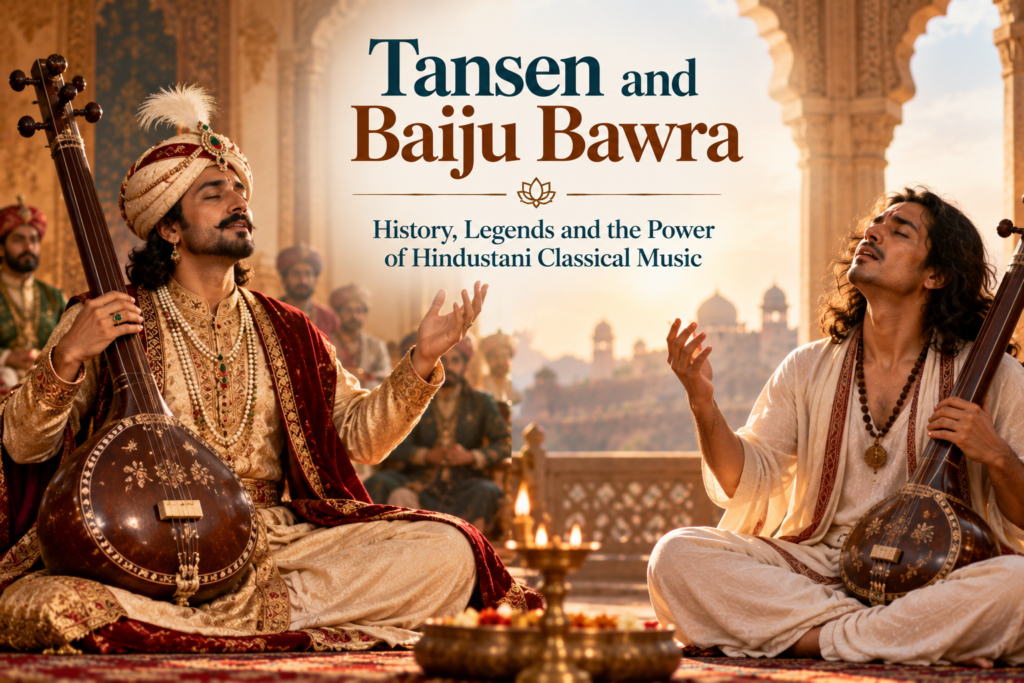
Indian classical music remembers certain musicians through their compositions and musical achievements, while others live on through stories that have travelled across generations. Miyan Tansen and Baiju Bawra belong to both worlds. Their names are closely associated with the development of Hindustani classical music, particularly the Dhrupad tradition and the historic musical culture of Gwalior.
Tansen became one of the most celebrated musicians of Emperor Akbar’s court during the sixteenth century. Baiju Bawra, also known in historical discussions through the name Nayak Bakshu, occupies a more uncertain place between documented musical history and popular legend. Stories describe him as a formidable singer whose talent could challenge even Tansen, creating one of India’s most enduring musical rivalries.
Their stories offer an opportunity to explore the history of Dhrupad, the importance of musical training, the relationship between court patronage and spiritual practice, and the way Indian traditions understand the power of sound. By examining both historical records and popular accounts, we can appreciate the musical world associated with these two celebrated names.
Who was Miyan Tansen?
Miyan Tansen was a major Hindustani classical musician who lived during the sixteenth century. He became a leading vocalist in the court of the Mughal emperor Akbar and is remembered for his contribution to Dhrupad, his musical compositions and the traditions that developed around his name. Historical accounts place him among the most distinguished musicians of his period.
Tansen’s early life is described differently across biographical traditions. He is commonly associated with the Gwalior region, which had developed into an important centre of North Indian music under the patronage of its rulers. His early training is traditionally linked with Swami Haridas, the saint, poet and musician associated with Vrindavan. Later accounts also discuss connections with the Sufi mystic Muhammad Ghaus of Gwalior.
The details of Tansen’s education and religious affiliations remain subjects of historical discussion. Nevertheless, his association with Akbar’s court is well established in accounts of Mughal musical culture. Abul Fazl’s Ain-i-Akbari, an important source for the administration and cultural life of Akbar’s empire, includes information about musicians and identifies Tansen within this musical environment.
Tansen’s importance extends beyond his reputation as a gifted singer. He became a central figure in the history of Hindustani music, and several compositions and ragas are associated with his name. Ragas such as Miyan ki Todi and Miyan ki Malhar remain familiar within the classical repertoire, although the precise history of individual ragas and their attribution requires careful study.
Who was Baiju Bawra?
Baiju Bawra is remembered in Indian musical folklore as an exceptionally gifted Dhrupad singer. Popular accounts place him in the musical world of fifteenth- and sixteenth-century Gwalior, where musicians received patronage from rulers and developed influential traditions of classical performance. His name is frequently linked with Tansen through stories of rivalry and musical contests.
The historical picture is complicated by the limited evidence available about Baiju’s life. Many details of his biography come from later traditions, and the dates, personal relationships and dramatic episodes associated with him cannot all be independently verified. The name Baiju Bawra is often connected in historical discussions with Nayak Bakshu, a musician remembered in accounts of the Gwalior tradition. The precise relationship between these names and the stories surrounding Baiju remains a subject that requires caution.
Nayak Bakshu, in particular, appears in historical accounts of musicians associated with the Gwalior court and later rulers. The Ain-i-Akbari refers to a musician named Bakhshu, while later music histories discuss his reputation and place within the development of Dhrupad. These references provide a firmer historical starting point than many of the dramatic stories told about Baiju Bawra.
The distinction matters because Baiju’s musical reputation has grown through folklore, performance traditions and popular culture. His story continues to represent the image of a singer whose mastery comes from deep dedication to music. Even when particular episodes remain uncertain, the continued remembrance of Baiju shows how strongly music shapes cultural memory.
The musical world of Gwalior
Gwalior played an important role in the development of North Indian classical music. Its rulers supported musicians, poets and scholars, creating an environment in which musical forms could develop through teaching, performance and royal patronage. During the reign of Raja Man Singh Tomar in the late fifteenth and early sixteenth centuries, Gwalior became particularly associated with the development and refinement of Dhrupad.
Dhrupad is one of the oldest major surviving styles of Hindustani classical vocal music. It is known for its measured presentation of a raga, the use of sustained notes, carefully shaped melodic movement and a strong sense of rhythmic structure. A performance often begins with an extended alap, allowing the singer to introduce the raga gradually before moving into a composition accompanied by percussion.
The style demands patience and a detailed understanding of musical grammar. Singers develop control over pitch, breath, resonance and ornamentation, while learning how to unfold a raga over time. The result can feel both intellectually precise and deeply contemplative, with every phrase contributing to the larger movement of the performance.
The musical culture of Gwalior developed through the contributions of several musicians, patrons and teachers. Tansen became its most famous figure through his association with Akbar, while names such as Nayak Bakshu also appear in accounts of the region’s musical history. Their stories belong to a wider tradition in which musical knowledge was preserved through teaching lineages and sustained practice.
Tansen and Baiju Bawra: The story of their rivalry
The rivalry between Tansen and Baiju Bawra is among the best-known stories in Indian musical folklore. Popular versions describe two exceptional singers whose abilities were tested in a musical contest. In some tellings, Tansen represents the celebrated court musician, while Baiju appears as an independent master whose talent can challenge the reputation of the imperial court.
These accounts vary in their details. Some describe a contest arranged through royal patronage, while others connect the rivalry with Baiju’s personal struggles and his relationship with people close to him. Certain versions give Baiju a decisive victory, presenting his musical mastery as a force capable of overcoming the status and influence surrounding Tansen.
The historical evidence for a specific contest between Tansen and Baiju remains uncertain. Their rivalry should therefore be understood as a popular tradition rather than a firmly documented event. The stories reveal how audiences imagined the qualities of a great musician and how musical skill became a subject of dramatic storytelling.
The contrast between a court musician and a wandering or independent singer also gives the legend a wider meaning. Tansen’s association with Akbar’s court reflects the importance of royal patronage in the development of classical music. Baiju’s legendary independence offers a different image of artistic dedication, in which music becomes the central pursuit of a person’s life.
Through this rivalry, generations of listeners have explored questions about talent, training, recognition and the purpose of artistic practice. The legend remains compelling because it gives human form to the challenge of measuring musical greatness.
Swami Haridas and the tradition of the guru
Swami Haridas is traditionally remembered as an important teacher in Tansen’s musical life. He was a saint, poet and musician associated with the devotional traditions of Vrindavan. His compositions are closely linked with the worship of Radha and Krishna, and his musical practice is remembered as an expression of devotion.
The relationship between Swami Haridas and Tansen appears prominently in later biographies and devotional accounts. One popular story describes Akbar wishing to hear Haridas sing after learning about his reputation from Tansen. According to the tale, Tansen deliberately sang a phrase incorrectly to prompt his teacher to demonstrate the proper musical expression. Haridas then sang the composition with such feeling that Akbar recognized the difference between technical accomplishment and music arising from deep inner absorption.
The story has been retold in many forms, and its historical details are difficult to establish. Its enduring value lies in the understanding of music that it conveys. Technical skill, according to the story, develops through training, while profound musical expression also involves attention, feeling and a deep relationship with the music itself.
The guru-shishya tradition has played a major role in Indian classical music. Students learn through close observation, repetition, correction and sustained practice under a teacher’s guidance. Over time, they develop an understanding of a raga that includes its structure, characteristic phrases, emotional character and possibilities for improvisation.
This method of learning also explains why classical music cannot be understood through written notation alone. Notation can record important details, yet the subtleties of intonation, phrasing, ornamentation and expression are often transmitted through listening and direct instruction.
Dhrupad and the discipline of musical expression
Dhrupad provides an important context for understanding the musical traditions associated with Tansen and Baiju. The style places emphasis on a deliberate unfolding of the raga, careful intonation and a balance between melodic development and rhythmic structure. Performers often spend considerable time establishing the mood and tonal character of the raga before introducing the composition.
The alap is central to this process. The singer explores the notes and characteristic movements of the raga without a fixed rhythmic cycle, gradually revealing its musical identity. This requires close attention to the relationship between notes, the movement of the voice and the spaces that shape each phrase.
When the composition begins, rhythm becomes more prominent. The singer works with the tala and the text of the composition, shaping phrases in relation to the percussion accompaniment. The interaction between melodic freedom and rhythmic structure gives Dhrupad its distinctive character.
The style also has devotional associations, with compositions addressing deities, rulers and other subjects depending on the period and setting. During the Mughal era, Dhrupad flourished in courtly environments as well as in religious and regional traditions. Its history therefore reflects a rich exchange between artistic patronage, spiritual life and musical innovation.
Tansen is closely associated with the refinement and transmission of Dhrupad within the Mughal court. Baiju and Nayak Bakshu appear in traditions connected with the broader musical world of Gwalior. Together, their names help bring attention to a period when musicians and patrons contributed to the development of one of North India’s most influential classical forms.
The legends of ragas and the power of music
Indian musical traditions preserve many stories about ragas possessing extraordinary powers. Tansen is famously associated with the legend of Raga Deepak, which supposedly produced such intense heat that lamps ignited when he sang it. Another popular account connects his singing of Megh Malhar or Miyan ki Malhar with the arrival of rain.
These stories belong to the legendary image of Tansen and should be distinguished from historical evidence. Their popularity reflects a traditional understanding of music as an art capable of affecting the listener profoundly and shaping the atmosphere of a place. The stories also express the belief that a raga, performed with complete mastery, carries a distinctive emotional and aesthetic force.
Ragas have particular melodic frameworks, characteristic movements and associations with different moods. Their effect depends on musical details such as intonation, timing, phrasing, tempo and the skill of the performer. Listeners may experience a raga as peaceful, joyful, solemn or emotionally moving, although responses differ between individuals and cultural contexts.
The legend of Deepak and Malhar transforms these experiences into dramatic narratives. Fire and rain become symbols of music’s ability to influence human feeling and imagination. The stories continue to attract audiences because they express the sense of wonder that a powerful musical performance can create.
Music, devotion and Nada Yoga
The stories surrounding Tansen, Baiju Bawra and Swami Haridas also invite reflection on the relationship between music and spiritual practice. In several Indian traditions, music serves devotional purposes through the singing of hymns, repetition of sacred names and contemplation of sound. These practices bring together vocal expression, listening and focused attention.
Nada Yoga, often described as the yoga of sound, offers a distinct framework for exploring this relationship. The Sanskrit word nada means sound, and Nada Yoga uses sound and attentive listening as supports for contemplation. Depending on the tradition, its practices may include mantra, vocal exercises, Indian classical music and meditation on subtle sound.
Dhrupad and Nada Yoga have points of connection through their attention to sustained tones, disciplined listening and the development of awareness through sound. A singer learning to hold a note must pay close attention to breath, pitch and resonance. A listener following a raga can likewise observe how musical phrases emerge, develop and resolve.
Their purposes and methods remain distinct. Dhrupad is a musical genre with its own repertoire, performance conventions and training traditions, while Nada Yoga belongs to a wider yogic framework concerned with sound and contemplation. Studying them together can help students appreciate the many ways Indian traditions have explored the relationship between sound, attention and spiritual life.
At Nada Yoga School in Rishikesh, students can explore traditional sound practices alongside yoga philosophy, mantra chanting and Indian classical music. Those interested in structured study can learn more about the Nada Yoga teacher training program.
What the stories of Tansen and Baiju Bawra teach us
The stories of these musicians offer several ways to understand the discipline of classical music. Their traditions emphasize the importance of sustained practice, careful listening and guidance from experienced teachers. They also show how artistic reputation develops through a combination of musical achievement, patronage, storytelling and cultural memory.
Tansen’s historical association with Akbar’s court demonstrates how royal support could create opportunities for musicians and help their work reach influential audiences. The legends surrounding Baiju Bawra present a different image of musical dedication, emphasizing personal commitment and the ability of a performer to command attention through skill.
The stories of Swami Haridas add another dimension by connecting music with devotion. His remembered role as a teacher highlights the importance of the relationship between musical technique and inner discipline. Across these narratives, music becomes a practice that demands both knowledge and personal commitment.
These lessons remain relevant to students of Indian classical music today. Mastery develops gradually through repetition, attentive listening and a willingness to refine one’s understanding. A raga reveals its depth over time, and every performance offers new possibilities for expression.
The lasting legacy of Tansen and Baiju Bawra
Tansen remains one of the most influential names in Hindustani classical music. His association with Akbar’s court, his remembered contribution to Dhrupad and the musical traditions linked with his name have secured his place in Indian cultural history. His legacy survives through compositions, teaching lineages, musical scholarship and the continuing performance of ragas associated with him.
Baiju Bawra occupies a more complex position, where historical references and folklore meet. His association with Nayak Bakshu and the Gwalior musical tradition gives the story a historical context, while the details of his legendary rivalry with Tansen remain difficult to verify. The endurance of his name reflects the important role that oral storytelling plays in preserving India’s musical heritage.
Together, these figures represent a period when Dhrupad developed within a vibrant musical culture shaped by teachers, performers, patrons and devotional traditions. Their stories encourage a deeper appreciation of Hindustani classical music and the discipline required to learn it.
For contemporary students, their legacy offers a reminder that music grows through practice, listening and the transmission of knowledge. The historical record helps us understand the musicians who shaped the tradition, while the legends preserve the sense of wonder that has surrounded their art for centuries.
Frequently asked questions
Were Tansen and Baiju Bawra real historical musicians?
Tansen is well documented in historical accounts of Akbar’s court. Baiju Bawra is a more uncertain figure, and his biography is largely known through later traditions. Some historical discussions connect his name with Nayak Bakshu, a musician associated with Gwalior, although the precise relationship between the two remains difficult to establish.
Did Tansen and Baiju Bawra compete in a musical contest?
Popular stories describe a musical contest between them, sometimes presenting Baiju as the winner. The available evidence does not establish a specific contest as a verified historical event, so the story is best treated as musical folklore.
Who was Tansen’s guru?
Tansen is traditionally associated with Swami Haridas, the saint-musician of Vrindavan. Later accounts also connect him with Muhammad Ghaus of Gwalior. The details of his early education vary across historical and devotional sources.
What is Dhrupad?
Dhrupad is a major style of Hindustani classical vocal music known for its measured development of a raga, sustained notes, careful intonation and structured compositions. Its history is closely connected with musical centres such as Gwalior and the court culture of North India.
Did Tansen really light lamps by singing Raga Deepak?
The story of Raga Deepak is a famous legend associated with Tansen. It expresses the traditional belief in the extraordinary power of ragas, although the supernatural event itself is not established by historical evidence.
How are Tansen and Nada Yoga connected?
Tansen’s musical legacy provides a useful context for exploring the importance of sound and attentive listening in Indian traditions. Nada Yoga approaches sound through a yogic and contemplative framework, while Dhrupad is a classical musical genre. Both can encourage careful attention to pitch, resonance and the unfolding of sound.
Conclusion
Tansen and Baiju Bawra remain enduring figures in the cultural imagination of Indian classical music. Tansen’s historical role in Akbar’s court and the musical traditions associated with his name are supported by a range of historical accounts. Baiju’s story combines references to the Gwalior musical world with legends that have continued to grow through oral tradition and popular culture.
Their stories provide a window into the development of Dhrupad, the importance of the guru-shishya tradition and the place of music in both courtly and devotional life. They also remind us that a musical tradition is preserved through performances, teaching, scholarship and the stories people continue to tell about its great musicians.