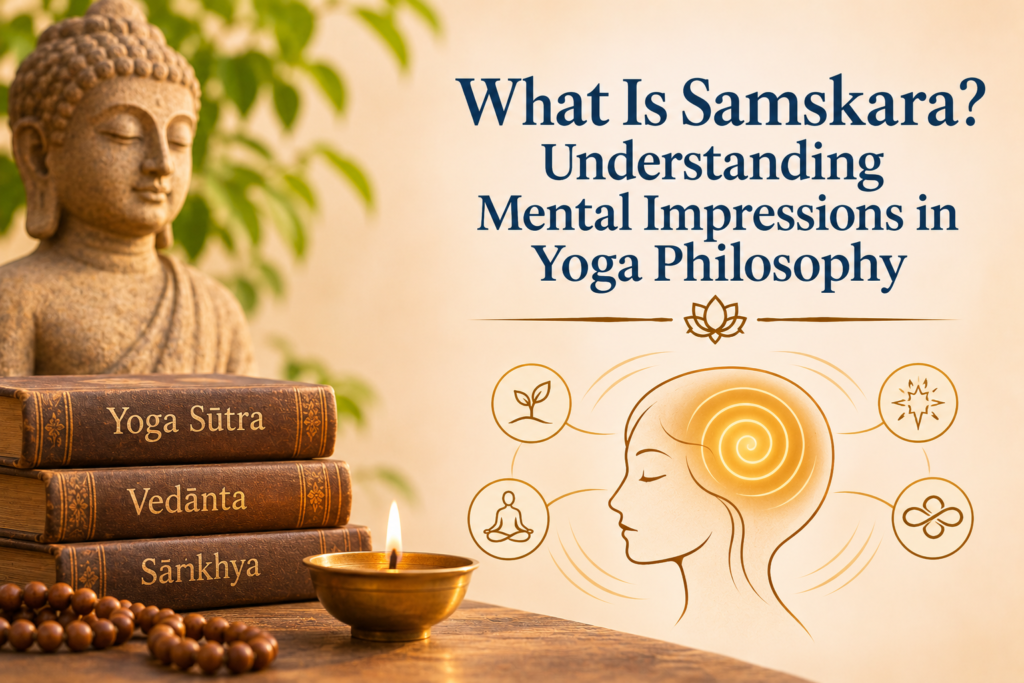
In yoga philosophy, the mind carries impressions from past experiences, thoughts, emotions and actions. These impressions influence how a person interprets situations, responds to challenges and develops habits. The Sanskrit term Samskara describes these subtle mental imprints, which gradually shape patterns of behaviour and influence the direction of the mind.
The concept of Samskara is central to understanding the mind in classical yoga philosophy. It explains how experiences leave lasting impressions, how repeated thoughts and actions strengthen particular tendencies, and why certain reactions appear automatically. Studying Samskara also offers insight into meditation, self-awareness and the process of transforming habitual patterns through yoga practice.
What Does Samskara Mean in Yoga?
The Sanskrit word Samskara is commonly understood as an impression, mental formation or residual imprint created through experience. It refers to the subtle influence that thoughts, actions, emotions and perceptions leave within the mind.
Every experience can contribute to the formation of a Samskara. When someone repeatedly responds to a situation with anger, for example, that response may gradually become familiar. Over time, similar circumstances can trigger the same reaction with very little conscious reflection.
Positive experiences also leave impressions. Acts of kindness, disciplined practice, generosity, concentration and regular meditation can strengthen constructive mental tendencies.
Samskaras therefore influence the way the mind operates. They contribute to habitual patterns, emotional responses, preferences and recurring thoughts. In yoga philosophy, understanding these impressions forms an important part of understanding the mind and its behaviour.
Samskara in Patanjali’s Yoga Sutras
The concept of Samskara holds an important place in the Yoga Sutras of Patanjali, one of the foundational texts of classical yoga philosophy.
Patanjali explains how mental activities create impressions and how these impressions influence future mental activity. Yoga Sutra 1.5 introduces the five categories of mental fluctuations, known as Vrittis. These include valid knowledge, misconception, conceptualisation, sleep and memory. Mental activity and experience contribute to the formation of impressions that influence subsequent states of mind.
In Sutra 1.18, Patanjali describes a state of deep concentration in which ordinary mental activity becomes quiet and only latent impressions remain. This passage refers to a condition in which the mind has moved beyond its usual fluctuations, while subtle impressions continue to exist.
Another important reference appears in Sutra 3.9, which explains the transformation of the mind through the weakening of impressions associated with outward activity and the emergence of impressions associated with restraint. This process illustrates how sustained yogic practice can gradually change the dominant tendencies of the mind.
Through these teachings, Patanjali presents the mind as a field shaped by accumulated impressions. Regular yoga practice influences this field and gradually supports greater mental stability, concentration and awareness.
How Are Samskaras Formed?
Samskaras develop through repeated experiences and mental activity. A single experience may leave an impression, while repetition can strengthen it until it becomes a familiar pattern.
Several aspects of daily life contribute to the formation of mental impressions.
Thoughts and Repeated Mental Activity
The thoughts a person repeatedly entertains can establish lasting mental tendencies. Repeatedly worrying about future events, for instance, may strengthen a habit of anticipating difficulties. Similarly, regular reflection on gratitude can encourage a more appreciative outlook.
The mind becomes familiar with the patterns it repeatedly follows. Consequently, certain thoughts may arise automatically when similar situations appear.
This relationship between thought and impression is an important subject in yoga meditation, where practitioners learn to observe mental activity without becoming completely absorbed in it.
Actions and Habits
Actions also contribute to Samskara formation. When an action is repeated, it becomes easier for the mind and body to reproduce it.
A person who regularly practises meditation develops familiarity with sitting quietly and observing the mind. Someone who repeatedly reacts impulsively may strengthen that response instead.
This relationship between action and impression explains why yoga places importance on disciplined daily practice. Consistent actions gradually influence the tendencies that guide future behaviour.
Emotional Experiences
Strong emotions can leave particularly noticeable impressions. Experiences involving fear, anger, attachment or happiness may remain influential long after the original event has passed.
For example, a difficult experience involving public speaking may create an association between speaking in front of others and anxiety. When a similar situation arises, the earlier impression may influence the person’s response.
Emotional impressions can also develop through positive experiences. Repeated experiences of trust, compassion and emotional steadiness can support healthier responses in future situations.
Sensory Experiences
The senses constantly provide information to the mind. Sounds, images, tastes, smells and physical sensations can all contribute to the impressions that accumulate through daily experience.
In yoga philosophy, sensory activity is closely connected with the movement of the mind. The repeated pursuit of particular sensory experiences can strengthen attachments and preferences, influencing where attention naturally moves.
Pratyahara, the withdrawal of the senses, addresses this relationship by encouraging practitioners to develop greater control over their attention and sensory engagement.
Practices involving breath awareness, mantra and sound meditation can also help practitioners observe how sensory experiences influence the mind. You can explore this relationship further in our article on Nada Yoga, the yoga of sound.
Samskara, Vasana and Karma: Understanding the Relationship
Samskara is closely related to two other important Sanskrit concepts: Vasana and Karma. These terms describe different aspects of how past experiences and actions influence future behaviour.
Samskara: The Mental Impression
Samskara refers to the impression left by an experience, thought or action. It represents the subtle trace that remains within the mind after an event has passed.
For example, repeatedly experiencing anxiety in unfamiliar situations may leave an impression that influences future reactions.
Vasana: The Underlying Tendency or Desire
Vasana refers to a latent tendency, inclination or desire that influences behaviour. These tendencies are often associated with accumulated impressions and can motivate a person to repeat familiar experiences.
For instance, a person who repeatedly seeks approval may develop a strong tendency to look for external validation. This inclination can influence decisions, relationships and personal priorities.
Samskara and Vasana are closely connected. Samskara describes the impression, while Vasana often refers to the tendency or inclination that develops through accumulated impressions. Their precise relationship varies across philosophical traditions.
Karma: Action and Its Consequences
Karma refers to action and its consequences. In Indian philosophy, actions carry consequences that may influence future experiences and circumstances.
Samskaras can influence the actions a person performs, while repeated actions can create further impressions. This relationship helps explain how established patterns continue through repeated behaviour.
Together, these concepts provide a framework for understanding the relationship between experience, mental tendencies and action.
How Samskaras Influence Daily Life
Samskaras influence many ordinary experiences, including relationships, decision-making, emotional responses and personal habits.
Consider someone who has experienced repeated criticism. Over time, this person may develop an impression that criticism indicates personal failure. When receiving feedback, they might immediately become defensive or anxious, even when the feedback is constructive.
Another person who regularly practises patience may gradually develop a tendency to pause before responding during difficult conversations. Their previous experiences of mindful action can influence how they approach future situations.
These examples illustrate how past impressions shape present responses. Recognising such patterns allows a person to observe habitual reactions and make more conscious choices.
Samskaras also influence spiritual practice. A mind accustomed to constant stimulation may initially find meditation difficult. With regular practice, however, the mind can gradually become familiar with stillness and sustained attention.
The Role of Samskara in Meditation
Meditation plays an important role in understanding and working with Samskaras. During meditation, practitioners observe thoughts, emotions and mental reactions as they arise.
This observation can reveal patterns that usually remain unnoticed during daily activity. A recurring thought may point towards an established impression, while a familiar emotional response may reveal an underlying tendency.
In yoga, meditation develops the capacity to observe mental activity without immediately following every thought or reaction. Through this process, practitioners become increasingly aware of the impressions influencing their behaviour.
Regular meditation also supports the development of mental steadiness. As attention becomes more stable, habitual reactions can gradually lose some of their influence.
Patanjali’s teaching on Abhyasa and Vairagya provides a useful foundation for this process.
Abhyasa refers to consistent practice directed towards mental stability. It involves returning to the practice regularly with patience and commitment.
Vairagya refers to dispassion or non-attachment. It involves reducing the mind’s dependence on particular experiences, desires and outcomes.
Together, Abhyasa and Vairagya support the gradual transformation of mental tendencies. Consistent practice establishes constructive impressions, while non-attachment helps reduce the influence of habitual cravings and reactions.
Meditation is explored through different approaches in traditional yoga. Students interested in the wider relationship between meditation, philosophy and daily practice can learn more about 200-hour Yoga Teacher Training at Nada Yoga School, where meditation, yoga philosophy, pranayama and self-study form part of the curriculum.
Can Samskaras Be Changed?
Yoga philosophy describes the possibility of transforming mental impressions through sustained practice and self-awareness. Since repeated thoughts and actions contribute to the formation of Samskaras, developing new patterns can gradually influence the tendencies already present in the mind.
This process requires patience because deeply established impressions may continue to influence behaviour even after a person becomes aware of them.
Several yogic practices support this transformation.
Practising Awareness
Self-observation helps practitioners recognise recurring thoughts and emotional responses. When a familiar reaction appears, they can observe its presence and examine the circumstances that trigger it.
This awareness creates an opportunity to respond with greater care. Over time, recognising a pattern can reduce the likelihood of repeating it automatically.
Developing Positive Habits
Regular habits can establish constructive mental impressions. Meditation, pranayama, mantra repetition, study and mindful action provide opportunities to strengthen discipline and concentration.
For example, practising five minutes of meditation each morning establishes a consistent routine. As the practice becomes familiar, returning to a quiet and attentive state may become easier.
Following Ethical Principles
The Yamas and Niyamas provide ethical guidelines for daily life in Ashtanga Yoga. Principles such as Ahimsa (non-violence), Satya (truthfulness), Santosha (contentment) and Svadhyaya (self-study) encourage practitioners to examine their actions and develop greater awareness.
Applying these principles consistently can influence the impressions formed through everyday decisions and relationships.
Practising Non-Attachment
Non-attachment helps reduce the mind’s dependence on particular outcomes. When a person becomes less attached to praise, possessions or external approval, familiar patterns of craving may gradually weaken.
Vairagya encourages a balanced relationship with experiences. It allows practitioners to participate in daily life while developing greater freedom from habitual reactions.
A Practical Exercise for Observing Samskaras
Understanding Samskara becomes useful when the concept is connected with personal observation. The following exercise can help identify recurring mental patterns.
Step 1: Choose a recurring reaction
Think of a situation that regularly produces a similar emotional response. It could involve criticism, disagreement, uncertainty or a particular social situation.
Step 2: Observe the thoughts
Notice the thoughts that appear when the situation occurs. Pay attention to repeated assumptions, expectations or memories.
Step 3: Identify the emotional response
Observe whether the situation produces fear, irritation, sadness, attachment or another emotion. Notice how the body responds as well.
Step 4: Examine the pattern
Consider whether the reaction has appeared in similar situations before. Reflect on whether past experiences may have influenced the response.
Step 5: Practise a conscious response
When the situation appears again, pause and observe the reaction before acting. A few moments of mindful breathing can help create space for a more considered response.
Repeating this exercise encourages self-awareness and helps practitioners recognise the impressions influencing their daily behaviour.
Samskara and the Path of Yoga
The study of Samskara offers an important perspective on the relationship between past experiences and present mental activity. It explains how repeated thoughts, actions and emotional responses gradually establish patterns that influence behaviour.
In classical yoga, understanding these impressions forms part of the wider process of understanding and disciplining the mind. Through Abhyasa, Vairagya, meditation and ethical living, practitioners work towards greater awareness and mental steadiness.
The concept also gives practical meaning to regular yoga practice. Every time a person returns to meditation, observes a reaction with patience or chooses a thoughtful response, they participate in shaping the tendencies of the mind.
Samskara therefore remains a valuable concept for anyone studying yoga philosophy. It encourages careful observation of habitual patterns and highlights the role of consistent practice in developing a more balanced and attentive mind.
The deeper study of yoga philosophy connects these concepts with meditation, self-inquiry, breath awareness and the wider purpose of yoga. Through regular practice, philosophical understanding gradually becomes something that can be observed and experienced in everyday life.