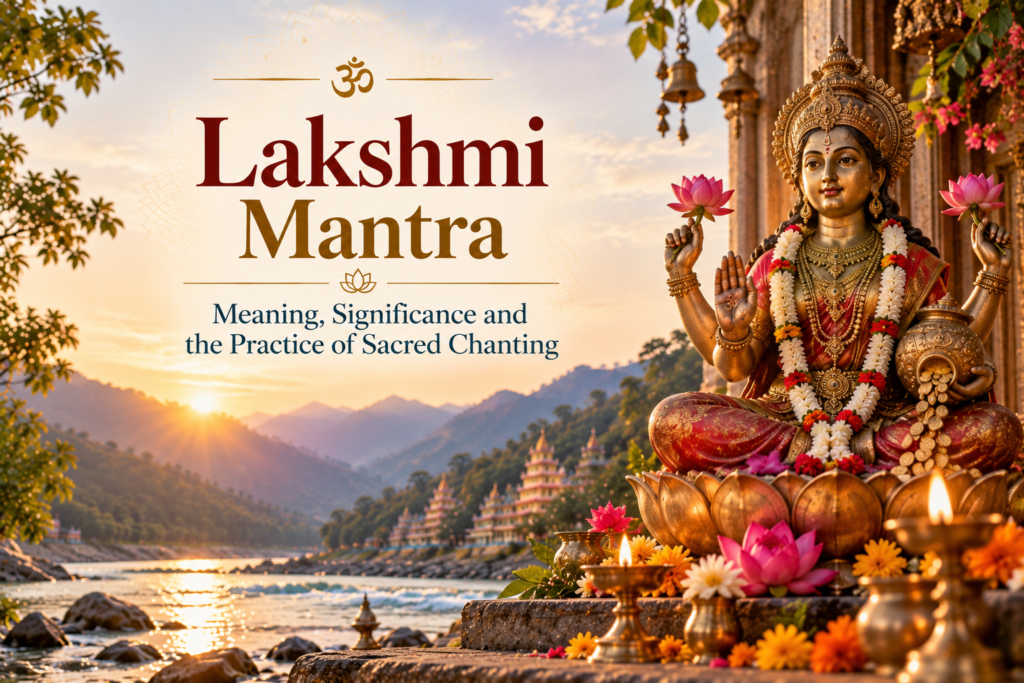
There is a particular quality in the word Śrī. Across Indian spiritual and cultural traditions, it carries associations with auspiciousness, beauty, abundance, grace and well-being. The same principle appears in the worship of Goddess Lakshmi, whose presence is traditionally connected with prosperity, nourishment, harmony and the flourishing of life.
Among the many Lakshmi mantras used in Hindu traditions, one of the simplest and most widely recited is:
ॐ श्रीं महालक्ष्म्यै नमः ॥
Om Śrīṃ Mahālakṣmyai Namaḥ
The mantra expresses reverence toward Mahalakshmi and includes Śrīṃ, a traditional bīja or seed syllable associated with Lakshmi. Different traditions preserve several Lakshmi mantras, including longer Mahalakshmi mantras, Lakshmi Gayatri and verses from the Sri Sukta.
For practitioners of yoga, mantra and Nada Yoga, this short mantra offers a focused practice of sound, repetition, devotion and attentive listening. Its simplicity also makes it suitable for learning Sanskrit pronunciation and developing a regular japa practice.
What is the Lakshmi mantra?
The mantra Om Śrīṃ Mahālakṣmyai Namaḥ is a traditional invocation of Goddess Mahalakshmi.
The Sanskrit can be written as:
ॐ श्रीं महालक्ष्म्यै नमः ॥
Transliteration:
Oṃ Śrīṃ Mahālakṣmyai Namaḥ
A simple translation is:
“I bow to Goddess Mahalakshmi.”
The word Śrīṃ is traditionally treated as a Lakshmi bīja, or seed syllable. Because a bīja carries significance through sound and traditional usage, it is approached differently from an ordinary Sanskrit word with a direct dictionary translation.
The mantra therefore combines sacred sound with an expression of reverence.
Understanding the words of the mantra
Each part of the mantra contributes to its overall meaning.
Om
Om, or Oṃ, is the sacred syllable used throughout many Indian spiritual traditions. It appears in practices involving meditation, prayer, mantra and Vedic recitation.
Within this mantra, Om establishes the opening sound of the invocation.
Śrīṃ
Śrīṃ is traditionally associated with Lakshmi and the principle of Śrī. The syllable is used as a bīja mantra in Lakshmi worship.
The idea of Śrī carries associations with auspiciousness, abundance, beauty, grace and flourishing. The sound itself becomes an important part of the practice.
Mahālakṣmyai
Mahālakṣmyai means “to Mahalakshmi.”
The grammatical form -yai indicates the feminine dative, conveying the sense of offering or directing the salutation toward the goddess.
Namaḥ
Namaḥ means “salutation,” “reverence” or “I bow.”
The final word gives the mantra its devotional movement. The practitioner turns attention toward Lakshmi and offers reverence through sound.
The meaning of Lakshmi in Hindu tradition
Lakshmi is widely revered as the goddess associated with prosperity, auspiciousness, beauty and abundance. She is traditionally connected with Vishnu, and many forms of Lakshmi worship emphasize the harmonious relationship between prosperity and righteous living.
The concept of prosperity within Hindu traditions can extend across different dimensions of life. Material resources form one aspect, while nourishment, beauty, generosity, stability and auspiciousness also appear within the broader symbolism surrounding Lakshmi.
This wider understanding helps place Lakshmi mantra practice within a spiritual context. The mantra becomes an expression of reverence toward the qualities represented by the goddess.
Lakshmi and the symbolism of the lotus
The lotus is one of the most recognizable symbols associated with Lakshmi.
The flower grows from water and rises above its surroundings while retaining its distinctive beauty. In Lakshmi iconography, the lotus is associated with purity, beauty, auspiciousness and spiritual unfolding.
Lakshmi is frequently depicted seated or standing upon a lotus, often holding lotus flowers in her hands.
This symbolism also offers a contemplative image for mantra practice. A practitioner can visualize the lotus while chanting, allowing the image to support concentration.
The relationship between Lakshmi and Vishnu
Lakshmi is traditionally described as the consort of Lord Vishnu. Their relationship appears throughout Vaishnava traditions and iconography.
Vishnu represents preservation and cosmic order within the familiar Hindu understanding of the Trimurti, while Lakshmi is associated with Śrī, prosperity and auspiciousness.
Their relationship can be contemplated as a meeting of sustaining order and flourishing life.
This connection also appears in Lakshmi mantras and related devotional practices. Longer Lakshmi mantras sometimes directly refer to Vishnu, while Lakshmi Gayatri traditions include the expression Viṣṇu-patnyai, referring to the wife or consort of Vishnu.
Lakshmi mantra and sacred sound
A mantra becomes a lived practice through sound.
When Om Śrīṃ Mahālakṣmyai Namaḥ is chanted, the practitioner works with several elements simultaneously. The breath supports the voice, the mouth shapes Sanskrit sounds, the ears receive the recitation and the mind follows the repeated sequence.
This creates a simple form of concentrated listening.
The practice becomes especially interesting from the perspective of Nada Yoga, where sound and listening provide important avenues for cultivating awareness. Repetition gives the mind a stable object, while careful listening brings attention toward the qualities of the sound itself.
For this reason, mantra practice can be approached as both devotion and sound meditation.
How to pronounce Om Śrīṃ Mahālakṣmyai Namaḥ
A useful transliteration is:
Om Shreem Mahalakshmyai Namah
The Sanskrit pronunciation can be practiced slowly:
Oṃ | Śrīṃ | Mahālakṣmyai | Namaḥ
The sound Śrīṃ deserves particular attention because it contains the long ī sound followed by the nasal resonance represented by ṃ.
The word Mahālakṣmyai also benefits from careful pronunciation. The kṣm sound occurs in the middle of the word, followed by yai.
Finally, Namaḥ ends with the visarga sound represented by ḥ. Sanskrit chanting traditions give careful attention to such details because pronunciation contributes to the sound structure of the mantra.
Lakshmi mantra and japa
Japa refers to the repetition of a mantra.
A practitioner may repeat the Lakshmi mantra quietly, softly or mentally, depending on the tradition and personal practice.
The repetition creates continuity. Each cycle begins with Om, moves through Śrīṃ and Mahālakṣmyai, and concludes with Namaḥ.
A mala can provide a physical structure for the practice. Traditional japa often uses a mala with 108 beads, although the appropriate method can vary between traditions.
For beginners, a shorter practice can be useful. Eleven or twenty-seven repetitions allow the practitioner to become familiar with pronunciation before establishing a longer session.
A simple Lakshmi mantra meditation
Begin by sitting comfortably in a quiet space. Allow the spine to remain naturally upright and take several relaxed breaths.
Once the breathing becomes steady, bring attention to the mantra:
Om Śrīṃ Mahālakṣmyai Namaḥ.
Repeat it slowly and clearly. Listen to the sound after producing it, allowing each repetition to complete before beginning the next.
After several repetitions, the voice can become softer. The practitioner may eventually continue the mantra mentally while maintaining awareness of the breath.
Complete the practice by sitting quietly for a few minutes.
This final silence provides an opportunity to notice the effect of sustained repetition and attentive listening.
Lakshmi mantra and meditation
Mantra can support meditation by giving the mind a consistent object of attention.
Thoughts may arise during practice, while the repeated mantra provides a familiar point to which attention can return. Over time, the rhythm of repetition can become increasingly natural.
Lakshmi mantra practice also introduces an element of devotional contemplation. The practitioner can reflect on the qualities associated with Lakshmi while repeating her name.
In this way, the practice combines sound, meaning and remembrance.
Lakshmi mantra and Nada Yoga
Nada Yoga is concerned with the relationship between sound and awareness. Traditional approaches can include mantra, vocal practice, musical sound and attentive listening.
The Lakshmi mantra provides a clear example of how a short Sanskrit phrase can become a sustained sound practice.
At first, attention may remain focused on pronunciation. With practice, the practitioner may become increasingly aware of resonance, rhythm, breath and the silence surrounding each repetition.
The mantra can therefore serve as an entry point into deeper listening.
At Nada yoga teacher training in Rishikesh, mantra chanting, Indian classical music and Nada Yoga form part of a broader exploration of sacred sound and yogic practice.
Lakshmi mantra and the meaning of abundance
The word abundance is frequently associated with Lakshmi, yet the traditional symbolism of Śrī extends into several areas of life.
Prosperity can be contemplated through the ability to nourish oneself and others. Beauty can be understood through harmony and appreciation. Generosity connects resources with responsible action, while auspiciousness points toward a life aligned with dharma.
This broader perspective can influence the way the mantra is practiced.
Instead of focusing only on material gain, the practitioner can use the mantra as a reminder to cultivate gratitude, generosity, balance and responsible use of resources.
Such contemplation keeps the practice connected with the wider symbolism of Lakshmi.
Other Lakshmi mantras
There are several Lakshmi mantras across Hindu traditions. The exact wording and usage can vary according to lineage and practice.
One longer Mahalakshmi mantra commonly presented in contemporary devotional collections is:
ॐ श्रीं ह्रीं श्रीं कमले कमलालये प्रसीद प्रसीद ।
ॐ श्रीं ह्रीं श्रीं महालक्ष्म्यै नमः ॥
Om Śrīṃ Hrīṃ Śrīṃ Kamale Kamalālaye Prasīda Prasīda
Om Śrīṃ Hrīṃ Śrīṃ Mahālakṣmyai Namaḥ.
This version invokes Lakshmi through the imagery of the lotus and includes the seed syllables Śrīṃ and Hrīṃ.
Another important tradition is the Lakshmi Gayatri, which is presented in several textual forms:
ॐ श्री महालक्ष्म्यै च विद्महे
विष्णु पत्न्यै च धीमहि ।
तन्नो लक्ष्मी प्रचोदयात् ॐ ॥
Om Śrī Mahālakṣmyai ca Vidmahe
Viṣṇu Patnyai ca Dhīmahi
Tanno Lakṣmīḥ Prachodayāt Om.
Lakshmi worship also includes the Sri Sukta, Lakshmi Ashtakam, Lakshmi Sahasranama and various other stotras and namavalis. Sanskrit Documents preserves a large collection of Lakshmi-related texts, including Sri Sukta, Mahalakshmi Stotram, Lakshmi Sahasranama and Lakshmi mantras.
Lakshmi mantra and the Sri Sukta
The Sri Sukta is one of the important Vedic texts associated with Sri and Lakshmi worship.
Its opening verse begins:
ॐ हिरण्यवर्णां हरिणीं
सुवर्णरजतस्रजाम् ।
चन्द्रां हिरण्मयीं लक्ष्मीं
जातवेदो म आवह ॥
The hymn describes Lakshmi through imagery connected with radiance, beauty, abundance and auspiciousness.
The Sri Sukta has a different structure from the short Lakshmi mantra. A mantra such as Om Śrīṃ Mahālakṣmyai Namaḥ can be repeated as a compact japa practice, while Sri Sukta provides an extended Vedic hymn for recitation. Sanskrit Documents lists Sri Sukta among its Lakshmi texts.
Is Lakshmi mantra only about wealth?
Lakshmi is strongly associated with wealth and prosperity, so this aspect naturally appears in her worship. Her symbolism also extends toward beauty, nourishment, auspiciousness, harmony and flourishing.
For this reason, practitioners can approach Lakshmi mantra as a practice of cultivating a broader relationship with prosperity.
The mantra can become a reminder to appreciate what is already present, use resources responsibly and develop qualities that support a harmonious life.
Such an approach also gives the practice a contemplative dimension beyond material aspiration.
When can Lakshmi mantra be chanted?
Lakshmi mantra can be incorporated into a regular meditation or devotional routine.
Many contemporary Lakshmi practices give particular importance to Friday, and Lakshmi worship is also prominent during Diwali. Traditional practices vary across regions, families and lineages, so the exact timing and ritual details can differ.
For a simple daily practice, consistency can be more useful than creating an elaborate routine. A quiet morning or evening period can provide enough space for focused chanting.
How many times should Lakshmi mantra be chanted?
There are several traditional approaches to mantra repetition. 108 repetitions are commonly associated with japa practice, particularly when using a mala.
Beginners can start with a smaller number while learning the pronunciation. The practice can then gradually develop into a longer session.
The quality of attention remains important throughout the repetition. Each cycle can be treated as a complete act of chanting and listening.
Does Lakshmi mantra have benefits?
Traditional Hindu practice associates Lakshmi mantra with devotion to Lakshmi and contemplation of prosperity, auspiciousness and abundance.
It is useful to distinguish traditional spiritual beliefs from scientifically established effects. Chanting can certainly provide a structured opportunity for repetition, breath awareness, focused attention and contemplative practice. Claims that a mantra directly produces financial outcomes belong to the realm of religious belief and traditional practice.
The deeper value of the practice can therefore be explored through devotion, concentration, gratitude and attentive listening.
Lakshmi mantra as a morning practice
Morning provides a natural setting for mantra because the mind is transitioning from sleep into the activities of the day.
A practitioner can sit quietly after waking, light a lamp if that forms part of their tradition, and begin with several slow breaths. The Lakshmi mantra can then be repeated at a comfortable pace.
The practice can end with a moment of gratitude for the resources, relationships and opportunities already present in life.
This approach gives the mantra a practical place within a daily routine.
Lakshmi mantra in group chanting
Mantra becomes a different experience when practiced collectively.
Several voices chanting the same Sanskrit phrase create a shared rhythmic field. Each person contributes their voice while also listening to the voices around them.
This relationship between individual sound and collective sound has a strong connection with Indian musical traditions. Kirtan, mantra chanting and devotional singing all demonstrate how repetition can become a shared practice of remembrance.
For students exploring Nada Yoga, group chanting can also develop awareness of pitch, rhythm, pronunciation and listening.
A deeper way to approach Lakshmi mantra
The mantra can be approached at several levels.
At the first level, the practitioner learns the pronunciation.
Next comes repetition, allowing the mantra to become familiar through japa.
Then comes meaning. Understanding Lakshmi, Śrīṃ and Namaḥ gives the sound a philosophical and devotional context.
Finally, the practitioner can explore silence. After the final repetition, remaining quietly aware allows attention to settle beyond the words.
This movement from sound to meaning and from meaning toward silence is especially relevant to a sound-based yogic practice.
Final thoughts
The Lakshmi mantra offers a simple way to enter the world of Sanskrit chanting and devotional practice. The mantra Om Śrīṃ Mahālakṣmyai Namaḥ combines the sacred syllable Om, the Lakshmi-associated bīja Śrīṃ, the name Mahalakshmi and the gesture of reverence expressed through Namaḥ.
Lakshmi represents a rich field of contemplation. Prosperity, beauty, nourishment, auspiciousness and generosity all form part of the wider symbolism surrounding her worship.
Through regular chanting, the practitioner becomes familiar with the sound of the Sanskrit while developing steadiness of attention. From a Nada Yoga perspective, each repetition can become an exercise in producing sound, hearing sound and eventually appreciating the silence that follows.
The mantra therefore offers a practice that can be approached through devotion, meditation, Sanskrit, japa and sacred sound.
Frequently asked questions
What is the Lakshmi mantra?
A commonly recited Lakshmi mantra is:
Om Śrīṃ Mahālakṣmyai Namaḥ
It is a traditional invocation of Mahalakshmi and includes Śrīṃ, a Lakshmi-associated seed syllable.
What does Om Śrīṃ Mahālakṣmyai Namaḥ mean?
A simple meaning is “I bow to Goddess Mahalakshmi.” Śrīṃ is traditionally treated as a bīja associated with Lakshmi and Śrī.
What is Śrīṃ?
Śrīṃ is traditionally used as a bīja syllable associated with Lakshmi. Its significance comes primarily through its sound and traditional usage rather than through a direct English translation.
How many times can Lakshmi mantra be chanted?
108 repetitions are commonly used in japa practice. Beginners can establish the pronunciation through shorter sessions and gradually increase the number of repetitions.
Can Lakshmi mantra be used for meditation?
Yes. The repeated sound can provide a steady object of attention, while the meaning of the mantra can support devotional contemplation.
What is the best time to chant Lakshmi mantra?
Morning and evening can both provide suitable periods for practice. Friday and Diwali have particular significance in many Lakshmi worship traditions.
What is the connection between Lakshmi mantra and Nada Yoga?
The mantra creates a practice of sound and attentive listening. Chanting engages breath and voice, while listening brings awareness to pronunciation, resonance, rhythm and silence.