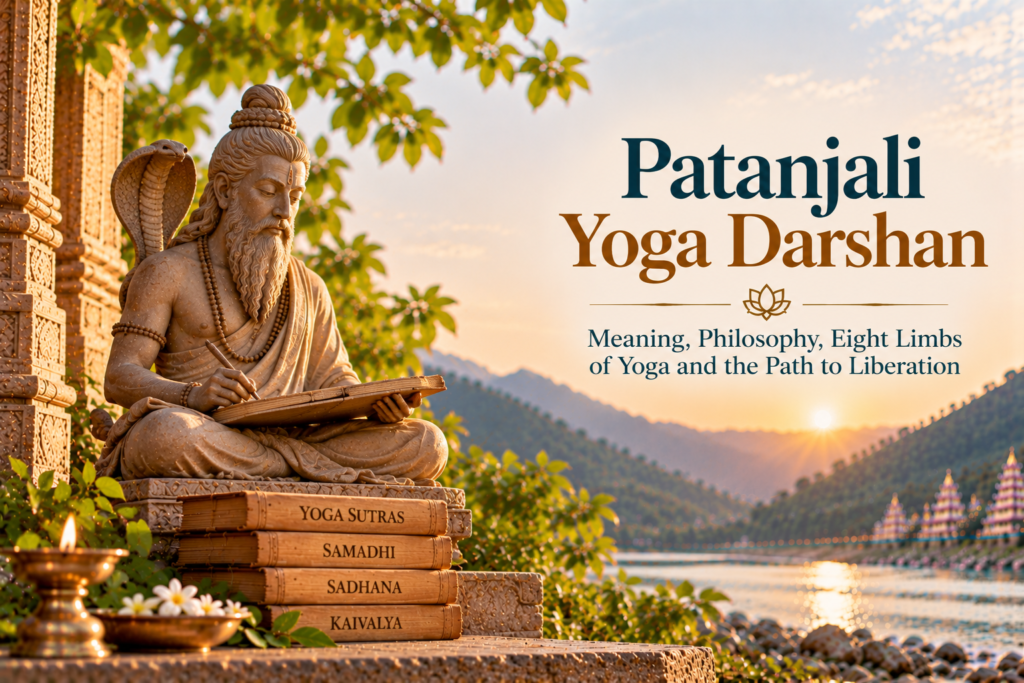
Yoga is often introduced through physical postures, breathing exercises and meditation. However, the philosophical foundation of classical Yoga reaches much deeper, exploring the nature of the mind, the source of suffering and the possibility of spiritual freedom. These ideas are presented systematically in Patanjali Yoga Darshan, one of the six orthodox schools of Indian philosophy.
Traditionally associated with Maharishi Patanjali, the Yoga Sutras explain how disciplined practice, ethical living and meditation can help a person understand the movements of the mind. The text presents yoga as a complete path that brings together personal conduct, concentration and the study of consciousness.
For students exploring traditional yoga in India, Patanjali’s philosophy provides valuable context for understanding Hatha Yoga, meditation, pranayama and other practices taught in a traditional yoga teacher training course. Its teachings also offer a foundation for those who wish to explore yoga beyond physical exercise and develop a deeper understanding of its philosophical roots.
At the heart of the system lies a famous Sanskrit sutra:
योगश्चित्तवृत्तिनिरोधः ॥
Yogaś citta-vṛtti-nirodhaḥ
Yoga is the stilling of the fluctuations of the mind.
This definition introduces the central purpose of Patanjali’s Yoga Darshan. Through sustained practice and detachment, the practitioner learns to observe mental activity and recognize the distinction between changing experiences and the conscious principle that witnesses them.
What is Patanjali Yoga Darshan?
The Sanskrit word Darshan means vision, perspective or philosophical understanding. Patanjali Yoga Darshan refers to the philosophical system presented in the Yoga Sutras of Patanjali, a foundational text of classical Indian Yoga.
The Yoga Sutras contain concise Sanskrit aphorisms covering the nature of the mind, meditation, ethical discipline, concentration and liberation. Traditionally attributed to Maharishi Patanjali, the text is generally placed by scholars in the early centuries of the Common Era, although its precise date and historical development remain subjects of academic discussion.
Patanjali’s philosophy is closely related to Samkhya Darshan, another of India’s six orthodox philosophical schools. Both traditions distinguish between Purusha, the principle of consciousness, and Prakriti, the material nature from which the mind, senses and physical world arise. Patanjali’s system places particular emphasis on practical methods that help a practitioner recognise this distinction.
The ultimate goal is Kaivalya, commonly understood as liberation or the complete independence of Purusha from the processes of Prakriti. Ethical conduct, breath regulation, concentration and meditation all contribute to this path.
The Yoga Sutras of Patanjali and their four chapters
The Yoga Sutras are organised into four chapters known as Padas. Each chapter explores a different aspect of yoga, moving from the nature of the mind to disciplined practice, advanced concentration and liberation.
1. Samadhi Pada: The chapter on meditative absorption
The first chapter introduces the definition of yoga and explains the movements of the mind, known as Chitta Vrittis. Patanjali discusses concentration, sustained practice, detachment and different forms of Samadhi.
This chapter establishes the philosophical direction of the entire text. It explains how the mind becomes absorbed in thoughts, memories and perceptions, and how consistent practice can develop greater steadiness.
2. Sadhana Pada: The chapter on practice
The second chapter focuses on the practical discipline required for spiritual development. It introduces Kriya Yoga, the five Kleshas and the eight limbs of yoga.
For students attending a yoga teacher training course in Rishikesh, this chapter offers a particularly useful foundation. Its teachings connect ethical conduct, personal discipline, posture, breath regulation and meditation within one philosophical framework.
3. Vibhuti Pada: The chapter on yogic attainments
The third chapter explains Dharana, Dhyana and Samadhi, together known in combination as Samyama. It describes the refined concentration that may arise when these practices are applied together.
Patanjali also discusses extraordinary capacities, known as Vibhutis or Siddhis, that traditional accounts associate with advanced yogic concentration. The text cautions practitioners against becoming attached to such attainments, since attachment can distract from liberation.
4. Kaivalya Pada: The chapter on liberation
The fourth chapter examines consciousness, mental impressions, karma and the final freedom of Purusha from Prakriti. It explains how discriminative knowledge leads towards Kaivalya.
This chapter completes the philosophical journey by returning to the fundamental question of classical Yoga: how can consciousness be understood in its own nature, free from identification with changing mental activity?
Together, these four chapters provide the framework for studying Patanjali Yoga Darshan, from its basic definition of yoga to its understanding of liberation.
The five types of Chitta Vritti
Patanjali explains that the mind experiences different kinds of modifications, known as Chitta Vrittis. These movements shape perception, memory, imagination and the way a person responds to daily experiences.
Yoga Sutra 1.5 states that mental modifications can be painful or non-painful. Sutra 1.6 then identifies five principal types, giving students a useful framework for understanding mental activity.
| Chitta Vritti | Meaning | Explanation |
| Pramana | Correct knowledge | Knowledge gained through valid means |
| Viparyaya | Misconception | Incorrect understanding of an experience |
| Vikalpa | Imagination | Conceptual knowledge shaped by words and ideas |
| Nidra | Sleep | A mental state associated with the experience of absence |
| Smriti | Memory | Retention and recollection of past experiences |
Pramana: Correct knowledge
Pramana refers to accurate knowledge. Patanjali identifies three sources: direct perception (Pratyaksha), inference (Anumana) and reliable testimony (Agama). These means help the mind form an understanding of an object or situation.
Viparyaya: Misconception
Viparyaya occurs when the mind misunderstands something. A familiar example is mistaking a rope for a snake in dim light. The perception creates fear until clearer observation corrects the error.
Vikalpa: Imagination
Vikalpa refers to conceptual knowledge formed through words and ideas. Language allows people to imagine places, events and possibilities, including things they have never experienced directly. These mental constructions are useful in daily life, yet they remain movements of the mind.
Nidra: Sleep
Nidra is the mental modification associated with sleep. Patanjali includes it among the Vrittis because sleep also has a particular relationship with mental experience.
Smriti: Memory
Smriti is the retention and recollection of previous experiences. Memories influence present perception and often shape responses to familiar situations. Through yoga, practitioners learn to observe these patterns and develop greater steadiness of attention.
Abhyasa and Vairagya: The foundation of mental discipline
Patanjali explains in Yoga Sutras 1.12–1.16 that the mind becomes steady through two complementary principles: Abhyasa and Vairagya. They support the gradual development of concentration and help practitioners relate to thoughts, desires and experiences with greater clarity.
Abhyasa: Sustained practice
Abhyasa means consistent and dedicated practice. It involves repeatedly directing attention towards steadiness, concentration and the chosen object of meditation.
Patanjali explains that practice becomes firmly established when it continues for a long time, without interruption and with sincere commitment. Regular meditation, breath awareness and disciplined living can support this process.
Vairagya: Detachment
Vairagya refers to freedom from excessive attachment and craving. It encourages a balanced relationship with sensory experiences, possessions, personal achievements and desires.
Through detachment, the practitioner gradually reduces the mind’s dependence on changing external conditions. Together, Abhyasa and Vairagya form an essential foundation for classical Yoga practice.
Purusha and Prakriti in Patanjali Yoga Darshan
Patanjali’s philosophy draws on the Samkhya distinction between Purusha and Prakriti. These two principles explain the relationship between consciousness and the changing world of mental and physical experience.
Purusha: The conscious witness
Purusha refers to pure consciousness, the witnessing principle that observes experience. It is understood as distinct from the changing activities of the mind and body.
Thoughts, emotions, memories and sensory experiences belong to the field of Prakriti. Purusha represents the conscious principle through which these experiences are known.
Prakriti: The source of mental and physical nature
Prakriti is the fundamental material nature from which the mind, intellect, ego, senses and physical world arise. Its activity is explained through three qualities called Gunas: Sattva, Rajas and Tamas.
These qualities influence mental tendencies, behaviour and perception. Their changing combinations help explain the different conditions of the mind.
Why this distinction matters
Ordinary experience involves identifying closely with thoughts, emotions, roles and bodily sensations. Patanjali’s system teaches the practitioner to recognise the distinction between these changing experiences and the witnessing consciousness.
This discernment is known as Viveka Khyati. In classical Yoga, its development is essential to liberation because it weakens the mistaken identification of Purusha with the processes of Prakriti.
The three Gunas in Yoga philosophy
The three Gunas describe the qualities through which Prakriti operates. They influence the mind, behaviour and the wider natural world.
| Guna | Meaning | Characteristics |
| Sattva | Clarity and harmony | Calmness, balance, knowledge |
| Rajas | Activity and passion | Desire, movement, restlessness |
| Tamas | Inertia and heaviness | Dullness, confusion, resistance |
Sattva is associated with clarity and understanding. When this quality predominates, the mind tends towards calmness, discernment and concentration. Yogic practice aims to cultivate conditions that support this clarity.
Rajas represents activity, ambition and desire. It supports movement and engagement with the world, while an excessive influence can make sustained concentration difficult. Awareness and regular practice help the practitioner observe restless tendencies.
Tamas represents inertia and obscurity. It can appear as heaviness, confusion or resistance to action. Appropriate activity, discipline and attentive practice help create a more balanced mental state.
In Patanjali’s philosophy, the final goal involves freedom from identification with all three Gunas. Sattva supports the path towards clarity, while Kaivalya represents liberation from the binding influence of Prakriti.
The five Kleshas: Causes of suffering
Patanjali identifies five fundamental afflictions known as Kleshas. Described in the second chapter of the Yoga Sutras, these afflictions influence perception, create attachment and contribute to suffering.
| Klesha | Meaning | Explanation |
| Avidya | Ignorance | Misunderstanding the nature of reality |
| Asmita | Egoism | Identifying awareness with the mind |
| Raga | Attachment | Attraction towards pleasurable experiences |
| Dvesha | Aversion | Resistance towards painful experiences |
| Abhinivesha | Clinging to life | Deep attachment to continued existence |
Avidya: Ignorance
Avidya is the root of the other Kleshas. It involves misunderstanding what is permanent and impermanent, what brings lasting freedom and what keeps the mind bound to changing experiences. This confusion encourages identification with the body, thoughts and personal identity.
Asmita: Egoism
Asmita develops when the power of awareness becomes identified with the intellect and the sense of individuality. A person may define themselves through achievements, opinions, relationships or social roles. Yogic contemplation gradually develops a clearer understanding of this identification.
Raga: Attachment
Raga refers to attachment towards pleasurable experiences. The mind remembers pleasant sensations and develops a desire to repeat them. When attachment becomes strong, happiness may appear dependent on external circumstances.
Dvesha: Aversion
Dvesha is the tendency to resist experiences associated with pain. Previous difficulties can shape present reactions and create habits of avoidance. Through awareness and disciplined practice, the practitioner learns to observe these reactions with greater steadiness.
Abhinivesha: Clinging to life
Abhinivesha describes a deep instinctive attachment to continued existence. Patanjali considers it a powerful tendency that can remain even in people with considerable knowledge. The practice of yoga addresses the fears and attachments associated with this condition.
Ashtanga Yoga: The eight limbs of Patanjali
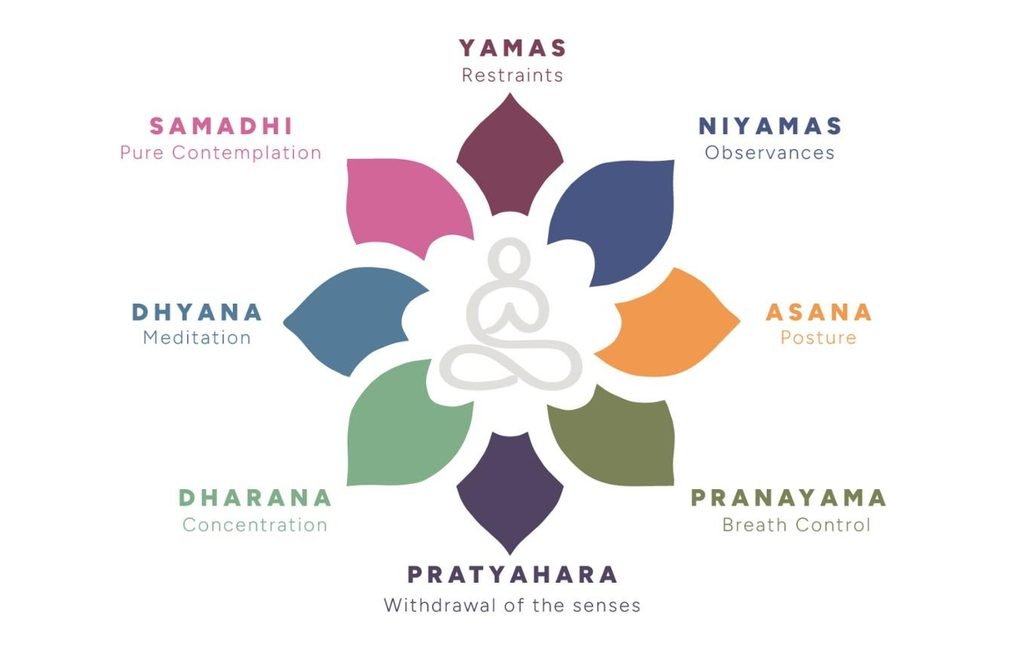
One of the best-known teachings of Patanjali Yoga Darshan is Ashtanga Yoga, the eight-limbed path described in Yoga Sutra 2.29. The Sanskrit word Ashta means eight, while Anga means limb or component.
The eight limbs form an integrated system of ethical living, personal discipline, physical steadiness, breath regulation, sensory withdrawal, concentration, meditation and absorption. They prepare the practitioner for deeper awareness and support the ultimate goal of liberation.
1. Yama: Ethical restraints
Yama concerns how a person relates to other living beings and the surrounding world. Patanjali identifies five Yamas that establish the ethical foundation of yoga.
- Ahimsa: Non-violence in thought, speech and action.
- Satya: Truthfulness and honest communication.
- Asteya: Non-stealing and respect for what belongs to others.
- Brahmacharya: Regulation of sensual desire and disciplined use of energy.
- Aparigraha: Non-possessiveness and freedom from excessive accumulation.
These principles encourage responsibility in everyday relationships. They also support meditation by reducing the conflicts and disturbances that arise from harmful behaviour.
2. Niyama: Personal observances
Niyama refers to personal disciplines that support inner development. Patanjali identifies five Niyamas.
- Saucha: Purity and cleanliness of body and mind.
- Santosha: Contentment and acceptance.
- Tapas: Discipline, austerity and sustained effort.
- Svadhyaya: Self-study and study of sacred teachings.
- Ishvara Pranidhana: Devotion or surrender to Ishvara.
The Niyamas help establish discipline and a steady approach to spiritual practice. Together with the Yamas, they prepare the mind for meditation.
3. Asana: Steady posture
Asana refers to the posture adopted for yogic practice. Patanjali gives a concise definition in Yoga Sutra 2.46:
स्थिरसुखमासनम् ॥
Sthira-sukham āsanam
Posture should be steady and comfortable.
Within Patanjali’s system, Asana prepares the body for sustained meditation. A stable posture reduces physical distraction and allows the practitioner to maintain attention for longer periods.
The elaborate physical posture systems familiar in contemporary yoga developed through later traditions, including Hatha Yoga. Understanding this historical context helps students appreciate the specific role of Asana in the Yoga Sutras.
4. Pranayama: Regulation of breath
Pranayama involves regulating inhalation, exhalation and the intervals between them. Patanjali introduces it after establishing the importance of a steady posture.
Breath regulation supports the preparation of the mind for concentration. Traditional yoga also understands breath through its relationship with Prana, the vital life force.
5. Pratyahara: Withdrawal of the senses
Pratyahara describes the withdrawal of the senses from their usual engagement with external objects. Attention gradually turns inward as sensory distractions become less dominant.
This limb creates a transition between the external disciplines and the internal practices of concentration and meditation.
6. Dharana: Concentration
Dharana means fixing attention on a chosen object, place or point of focus. The practitioner learns to direct awareness towards one thing and return to it whenever attention wanders.
A mantra, the breath or a visual point can serve as the focus. Consistent practice develops the ability to sustain attention.
7. Dhyana: Meditation
Dhyana refers to the continuous flow of attention towards the chosen object. Concentration becomes more sustained, with fewer interruptions from unrelated thoughts.
Patanjali presents Dhyana as a deeper stage of meditation, developing from the practice of Dharana.
8. Samadhi: Meditative absorption
Samadhi is a state of deep absorption in which awareness becomes profoundly concentrated on its object. Patanjali describes several forms and stages of Samadhi throughout the Yoga Sutras.
These states are important to the path towards discriminative knowledge and Kaivalya. The eight limbs work together, with ethical conduct and personal discipline supporting the deeper stages of meditation.
Kriya Yoga: The practice of disciplined action
Patanjali introduces Kriya Yoga in Yoga Sutra 2.1 as a practical approach to weakening the Kleshas and preparing the practitioner for Samadhi. It consists of three elements:
- Tapas: Discipline, austerity and sustained effort.
- Svadhyaya: Self-study and the study or recitation of sacred teachings.
- Ishvara Pranidhana: Devotion and surrender to Ishvara.
These practices connect everyday effort with the deeper purpose of yoga. Tapas develops commitment, Svadhyaya encourages reflection, and Ishvara Pranidhana cultivates devotion.
Kriya Yoga is particularly useful for understanding how Patanjali’s philosophy connects spiritual aspiration with daily habits. The practitioner develops awareness through disciplined action and gradually reduces the influence of mental afflictions.
Ishvara and the importance of Om
Patanjali introduces Ishvara in the first chapter of the Yoga Sutras. Ishvara is described as a special Purusha, untouched by the afflictions, actions, karmic consequences and latent impressions that influence ordinary experience.
This concept gives Patanjali’s Yoga a devotional dimension alongside its relationship with Samkhya philosophy. Devotion to Ishvara can serve as a method for developing concentration and overcoming obstacles.
Yoga Sutra 1.27 identifies Pranava, commonly understood as Om, as the sound-symbol of Ishvara.
तस्य वाचकः प्रणवः ॥
Tasya vācakaḥ praṇavaḥ
Pranava is the designation or expression of Ishvara.
In the following sutra, Patanjali recommends the repetition of Pranava and contemplation of its meaning. This practice, often described as Om Japa, directs attention towards the sound and its significance.
The teaching provides a meaningful connection with Nada Yoga, which explores meditation through sound and attentive listening. Both traditions use sound as a focus for contemplation, while maintaining distinct philosophical frameworks and practices.
Samyama: Concentration, meditation and absorption
Patanjali uses the term Samyama for the combined application of Dharana, Dhyana and Samadhi upon a chosen object. These three practices represent progressively refined stages of attention.
Dharana establishes concentration, Dhyana develops its continuity, and Samadhi brings the mind into deep absorption. Their integration can lead to forms of insight described in the Vibhuti Pada.
Patanjali also discusses extraordinary capacities that may arise through advanced concentration. He cautions practitioners against becoming attached to these attainments, since the desire for special powers can divert attention from the purpose of liberation.
The deeper value of Samyama lies in the development of sustained concentration and discriminative knowledge. It helps the practitioner understand the distinction between the changing activities of the mind and the witnessing consciousness.
Kaivalya: The ultimate goal of Patanjali Yoga Darshan
Kaivalya is the final goal of Patanjali’s Yoga Darshan. It is commonly translated as liberation, independence or isolation, describing the complete freedom of Purusha from the processes of Prakriti.
Ordinary experience involves identification with the body, senses, thoughts and emotions. Through sustained yogic practice, the practitioner develops Viveka Khyati, the clear discrimination between consciousness and the changing activities of nature.
As this knowledge becomes firmly established, the binding influence of the Gunas comes to an end for Purusha. Consciousness is understood in its own nature, free from the mistaken identification that produces bondage.
Kaivalya represents the culmination of the path. Ethical discipline, meditation, concentration and knowledge contribute to this freedom, giving the eight limbs their wider philosophical purpose.
Patanjali Yoga Darshan and modern yoga practice
Many contemporary yoga classes focus on physical postures, flexibility, strength and breathing exercises. These practices have developed through a long history of yoga traditions, including Hatha Yoga. Patanjali’s Yoga Sutras provide a broader philosophical framework in which Asana is one limb among eight.
Ethical conduct, personal discipline, sensory withdrawal, concentration and meditation all have essential roles in this system. Studying these teachings helps yoga practitioners understand how physical practice fits within the wider purpose of yoga.
For aspiring teachers, this knowledge can enrich lesson planning and philosophical discussions with students. A strong understanding of the Yoga Sutras can also support the study of yoga history, Sanskrit terminology, meditation and the ethical responsibilities of teaching.
Students considering a 200-hour yoga teacher training in Rishikesh may find Patanjali’s philosophy especially relevant when comparing course curricula. A comprehensive traditional yoga teacher training programme may include Yoga Philosophy, Yoga Sutras, Hatha Yoga, pranayama, meditation and practical teaching methodology.
Those who wish to deepen their understanding after foundational training can explore a 300-hour yoga teacher training course in Rishikesh, depending on their previous qualifications and learning goals. When choosing a course, students should review the actual syllabus, teaching hours, faculty experience and the balance between theory and practice.
For students interested in the philosophical foundations of yoga, Nada Yoga School in Rishikesh offers a setting in which classical Hatha Yoga, meditation, mantra and Nada Yoga can be explored together. Reviewing the school’s course curriculum can help prospective students identify the programme that best matches their interests in traditional yoga education.
Patanjali Yoga Darshan and Nada Yoga
Patanjali’s teachings have an interesting relationship with Nada Yoga through their shared interest in concentration, meditation and the inward direction of awareness.
In Patanjali’s system, Om is presented as Pranava, the sound-symbol of Ishvara. Its repetition and contemplation are recommended as methods for developing concentration. Nada Yoga explores the experience of sound through practices such as mantra, attentive listening, music and meditation.
Both approaches can use sound as a focus for sustained attention. For example, a practitioner may repeat Om while observing its pronunciation and resonance, or listen carefully to a sustained musical tone while noticing how attention moves. Such practices offer opportunities to cultivate concentration and develop a more attentive relationship with sound.
Patanjali Yoga Darshan provides a philosophical account of consciousness and liberation, while Nada Yoga develops a contemplative approach centred on sound. Studying these traditions together can deepen an understanding of meditation within India’s wider spiritual heritage.
How to study the Yoga Sutras of Patanjali
A meaningful study of the Yoga Sutras begins with the definition of yoga in the first chapter. Understanding Chitta, Vrittis, Abhyasa and Vairagya provides a foundation for exploring the remaining teachings.
The second chapter is especially useful for students interested in practical discipline. Its discussions of Kriya Yoga, the Kleshas and the eight limbs explain how ethical conduct and meditation support spiritual development.
The third and fourth chapters require closer attention to concentration, Samyama, discriminative knowledge and liberation. Because the sutras use concise Sanskrit expressions, reading them alongside a reliable translation and traditional commentary can clarify their meaning.
For beginners, the commentary traditionally attributed to Vyasa is an important source for understanding the classical interpretation of the text. Students can also compare modern translations and scholarly studies to explore how different commentators understand particular sutras.
Frequently asked questions about Patanjali Yoga Darshan
Who was Maharishi Patanjali?
Maharishi Patanjali is traditionally recognised as the author of the Yoga Sutras, a foundational text of classical Yoga philosophy. The text presents a systematic approach to meditation, mental discipline, ethical conduct and liberation.
How many Yoga Sutras are there?
The Yoga Sutras are commonly counted as containing 195 or 196 sutras, depending on the edition and counting convention. They are organised into four chapters: Samadhi Pada, Sadhana Pada, Vibhuti Pada and Kaivalya Pada.
What is the main teaching of Patanjali Yoga Darshan?
Its central teaching is expressed through Yogaś citta-vṛtti-nirodhaḥ, which describes yoga as the stilling of the fluctuations of the mind. Patanjali explains how sustained practice and detachment support concentration and the recognition of pure consciousness.
What are the eight limbs of yoga?
The eight limbs are Yama, Niyama, Asana, Pranayama, Pratyahara, Dharana, Dhyana and Samadhi. Together, they form the practical path described by Patanjali for developing ethical discipline, concentration and meditative awareness.
What is the difference between Patanjali Yoga and Hatha Yoga?
Patanjali Yoga Darshan presents a philosophical and meditative system centred on mental discipline and liberation. Hatha Yoga developed through traditions that place particular emphasis on physical postures, breath regulation, cleansing practices, mudras and other methods of preparing the body and mind.
What is Chitta Vritti Nirodha?
Chitta refers to the mind-field, Vritti means its modifications or movements, and Nirodha refers to their restraint or stilling. Together, the expression describes the central aim of Patanjali’s Yoga.
What is Kaivalya in Patanjali Yoga?
Kaivalya is the final state of liberation in which Purusha is completely independent of Prakriti. It represents freedom from identification with the changing activities of the mind and material nature.
Why is Om important in Patanjali Yoga?
Patanjali identifies Om, or Pranava, as the sound-symbol of Ishvara. Yoga Sutras 1.27–1.29 recommend its repetition and contemplation as methods of developing concentration and turning awareness inward.
Is Patanjali Yoga Darshan relevant for yoga teacher training?
Yes. The Yoga Sutras provide a philosophical foundation for understanding meditation, ethics, concentration and the purpose of yogic practice. Students enrolling in a 200-hour yoga teacher training course or advanced yoga teacher training programme can use these teachings to deepen their understanding of traditional yoga.
Final thoughts
Patanjali Yoga Darshan presents yoga as a complete philosophical path involving ethical living, personal discipline, meditation and the understanding of consciousness. Its teachings explain how mental activity shapes ordinary experience and how sustained practice can lead towards greater clarity and spiritual freedom.
The eight limbs provide a practical structure for this journey, while the distinction between Purusha and Prakriti explains its philosophical foundation. Through Abhyasa, Vairagya and discriminative knowledge, the practitioner gradually moves towards Kaivalya, the ultimate freedom described in the Yoga Sutras.
For anyone studying Indian philosophy or pursuing a deeper understanding of yoga, Patanjali’s teachings offer an essential foundation. They also provide valuable context for exploring meditation, mantra chanting, breath awareness and contemplative practices such as Nada Yoga.