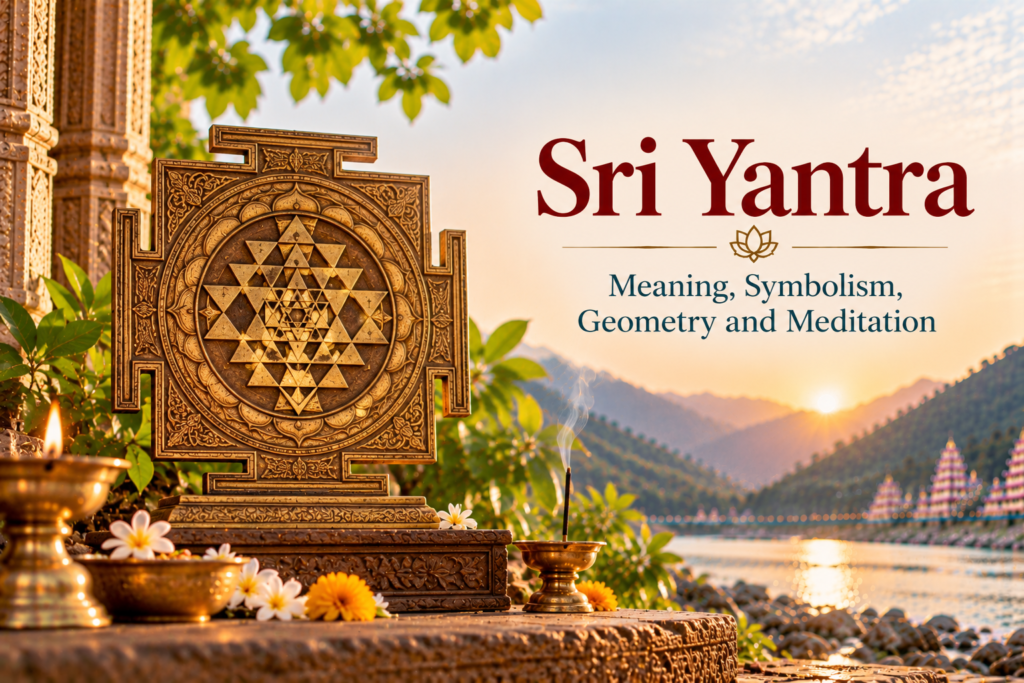
Across India, spiritual traditions use geometric designs to support worship and meditation. The Sri Yantra is one of the most important examples. Also known as the Shri Chakra or Sri Chakra, it holds a central place in Sri Vidya, a Hindu tradition devoted to Goddess Lalita Tripurasundari.
The Sri Yantra features nine interlocking triangles, lotus petals and an outer square. At its centre sits the Bindu, a small point that draws the entire design together. Each layer has a specific place within the pattern, guiding the practitioner’s attention towards the centre.
Within the Shakta tradition of Hinduism, the Sri Yantra represents the Goddess and the relationship between consciousness, creative power and the universe. Practitioners explore its meaning through mantra, ritual worship and meditation. Teachers also pass its traditional knowledge from one generation to the next.
For students of Indian philosophy and meditation, the Sri Yantra offers a way to understand sacred geometry within its spiritual context. Its connection with visual concentration and mantra also makes it an interesting subject for anyone exploring traditional yoga practices.
The nine interlocking triangles of the Sri Yantra
The Sri Yantra contains nine principal triangles. Four point upwards, while five point downwards. Together, they form a complex pattern of forty-three smaller triangles around the central Bindu.
Within Sri Vidya, the upward-pointing triangles represent Shiva, who symbolises consciousness. Meanwhile, the downward-pointing triangles represent Shakti, the Goddess’s creative power. Their interlocking forms express the close relationship between these two principles.
The intersections also give the Sri Yantra its distinctive appearance. Each triangle forms part of a larger arrangement, and the resulting pattern creates several smaller triangular spaces around the centre.
In Sri Vidya worship, these spaces carry specific symbolic and ritual meanings. Practitioners approach the Sri Yantra as a sacred form of the Goddess and follow a traditional sequence through its different enclosures.
The four upward-pointing triangles
The four upward-pointing triangles represent Shiva within traditional Sri Vidya symbolism. Their orientation expresses the principle of consciousness, which plays an important role in the tradition’s understanding of reality.
The five downward-pointing triangles
The five downward-pointing triangles represent Shakti, the dynamic power associated with the Goddess. Within this tradition, Shakti expresses the creative force through which the universe takes form.
The union of Shiva and Shakti
Together, the nine triangles form one integrated design. Their relationship symbolises the union of consciousness and creative power, a central theme in Shakta and Tantric traditions.
The pattern also invites reflection on unity and diversity. Although the Sri Yantra contains many individual shapes, every triangle belongs to the same overall design.
The Bindu: The centre of the Sri Yantra
The word Bindu means point or dot in Sanskrit. In the Sri Yantra, the Bindu occupies the centre and holds a special place in Sri Vidya.
Practitioners associate the Bindu with Lalita Tripurasundari, the supreme Goddess worshipped in this tradition. It marks the centre around which the entire geometric structure takes shape.
The Bindu also provides a natural focus for visual concentration. A practitioner can begin by observing the outer boundaries and then gradually bring the gaze towards the centre. This movement reflects the structure of Sri Chakra worship, in which practitioners approach the central point through successive enclosures.
In addition, the Bindu offers a subject for philosophical reflection. The Sri Yantra places one central point within a complex arrangement of shapes. This design encourages contemplation on the relationship between unity and the many forms that emerge from it.
The lotus petals and outer square
The Sri Yantra includes two lotus rings and an outer square. These elements surround the interlocking triangles and complete the traditional design. Each one also has a specific place within Sri Vidya worship.
The eight-petalled lotus
The inner lotus ring contains eight petals. Within Sri Vidya, this enclosure has its own associated deities and a particular role in the sequence of ritual worship.
The lotus also carries important meanings across Indian spiritual traditions. Religious art and literature often associate it with divine presence, beauty and spiritual significance. In the Sri Yantra, the eight-petalled ring connects the central triangles with the surrounding layers.
The sixteen-petalled lotus
The outer lotus ring contains sixteen petals. Like the inner ring, it forms a distinct enclosure within the Sri Chakra and carries specific associations in traditional Sri Vidya worship.
Together, the two lotus rings create a layered structure around the central triangles. They also help explain why practitioners understand the Sri Yantra as a sacred diagram with several connected stages.
The Bhupura: The square with four gates
The outer boundary is called the Bhupura. It usually appears as a square with four openings that face the cardinal directions. The square marks the boundary of the sacred diagram and provides its formal entrances.
The square, lotus rings and triangles each contribute to the overall design. When viewed together, they form a unified structure with specific geometric, symbolic and ritual meanings.
The nine enclosures of the Sri Chakra
In Sri Vidya, practitioners study the Sri Yantra through nine enclosures known as Navavarana. Each enclosure has a traditional name and its own associations with deities and mantras.
During Navavarana Puja, practitioners worship these layers according to the teachings of their Sri Vidya lineage. The ritual usually begins at the outer enclosure and proceeds towards the central Bindu. Each stage follows established practices and carries its own significance.
The nine enclosures are commonly identified as follows:
| Enclosure | Traditional name | General significance |
|---|---|---|
| 1 | Trailokya Mohana Chakra | The outer square and entrance to the sacred diagram |
| 2 | Sarvasha Paripuraka Chakra | The sixteen-petalled lotus |
| 3 | Sarva Samkshobhana Chakra | The eight-petalled lotus |
| 4 | Sarva Saubhagya Dayaka Chakra | The enclosure of fourteen triangles |
| 5 | Sarvartha Sadhaka Chakra | The outer group of ten triangles |
| 6 | Sarva Rakshakara Chakra | The inner group of ten triangles |
| 7 | Sarva Rogahara Chakra | The enclosure of eight triangles |
| 8 | Sarva Siddhiprada Chakra | The central triangle |
| 9 | Sarvanandamaya Chakra | The central Bindu |
These names belong to the traditional ritual system of Sri Vidya. Their full interpretation involves particular mantras, deities and forms of worship. Details may vary between lineages.
The nine enclosures show how the Sri Yantra functions as both a geometric diagram and a ritual structure. For trained practitioners, each layer forms part of a carefully ordered process of worship and contemplation.
Sri Yantra meditation: How to practise visual concentration
The Sri Yantra can serve as a focus for visual concentration. Within Sri Vidya, practitioners use the diagram as part of a wider system that may include mantra, ritual offerings and guidance from a qualified teacher.
Beginners can also explore the design through a simple concentration exercise. This practice introduces the geometry and encourages careful observation.
Step 1: Prepare a quiet space
First, choose a comfortable place where you can sit steadily for a few minutes. Place a clear image of the Sri Yantra at eye level. Make sure you can see the central point and surrounding shapes without straining your eyes.
Step 2: Observe the complete design
Next, look at the Sri Yantra as a whole. Notice the outer square, the lotus petals, the interlocking triangles and the central Bindu. Take your time as you become familiar with the relationship between these elements.
Step 3: Bring your attention towards the centre
After observing the full design, allow your gaze to settle gradually on the Bindu. Your attention may wander during the exercise. When this happens, gently return your gaze to the central point.
The aim is to practise sustained attention while observing a complex visual pattern.
Step 4: Maintain natural breathing
As you continue to observe the Sri Yantra, keep your breathing comfortable and natural. You can also pay attention to each breath if this helps you remain focused.
Step 5: Finish with quiet reflection
After several minutes, close your eyes if that feels comfortable. Notice how your attention feels after the exercise. You may briefly recall the central point or sit quietly before ending the practice.
This exercise introduces general visual concentration. Formal Sri Vidya meditation and Navavarana worship involve additional traditional elements. Therefore, anyone who wishes to undertake these practices should learn from a qualified teacher within the relevant lineage.
What are the traditional benefits of Sri Yantra worship?
Sri Yantra worship holds an important place in Sri Vidya. Devotees worship Goddess Lalita Tripurasundari through the diagram and follow traditional practices that may include prayer, mantra and ritual offerings.
Traditional teachings associate Sri Yantra worship with auspiciousness, prosperity, spiritual insight and devotion to the Goddess. These meanings belong to the religious tradition in which practitioners use the yantra.
Some people also use the Sri Yantra for visual concentration. Its detailed geometry gives the eyes a clear subject to observe, while the central Bindu provides a point to which attention can return. As a result, the practice can become part of a personal meditation routine, although individual experiences vary.
It is important to understand these uses within their proper context. Religious traditions explain the spiritual significance of the Sri Yantra, while claims that it guarantees wealth, success or specific health outcomes require separate evidence.
Within Sri Vidya, the Sri Yantra’s central role remains its connection with the Goddess and its use in ritual worship.
Sri Yantra and Sri Meru: Understanding the difference
People often encounter the Sri Yantra as a flat, two-dimensional diagram. However, some traditions also represent its geometry in three dimensions through a structure known as Sri Meru or Meru Chakra.
The flat Sri Yantra displays the interlocking triangles, lotus rings and outer square on one surface. This form allows viewers to observe the relationships between the central Bindu and the surrounding enclosures.
Sri Meru presents the sacred structure in three dimensions, with its levels rising towards the centre. Certain traditions use this form in Sri Chakra worship, and its construction and ritual use depend on the specific practice.
Both forms belong to the wider Sri Vidya tradition. Although their physical structures differ, they share closely connected symbolic and ritual meanings.
Sri Yantra and the relationship between geometry and consciousness
The Sri Yantra brings geometric precision together with religious symbolism. Its intersecting lines create a complex arrangement, while the central Bindu gives the entire design a single focal point.
Within Sri Vidya, practitioners interpret this structure through the Goddess, the manifestation of the universe and the movement of worship towards the centre. The diagram provides a visual framework for contemplating these themes.
The Sri Yantra also interests people who study mathematics and traditional Indian art. Constructing its nine triangles in the intended arrangement requires careful attention to proportion and alignment. Their intersections create the smaller triangular spaces that give the design its distinctive form.
However, geometric complexity alone does not establish supernatural effects or scientific properties. The spiritual meaning of the Sri Yantra comes from the religious traditions that use and interpret it.
Sri Yantra, yoga and meditation
Indian spiritual traditions offer several approaches to concentration and inner awareness. For example, Patanjali’s Yoga Sutras discuss mental discipline and meditative absorption. Sri Vidya, meanwhile, places the Sri Yantra within a devotional and ritual tradition centred on Goddess Lalita Tripurasundari.
Although these traditions have distinct philosophical foundations, both give attention an important role in contemplative practice. Patanjali describes Dharana as the practice of fixing the mind on a chosen object. A person can use the Sri Yantra for general visual concentration, while formal Sri Vidya contemplation follows its own traditional methods.
Studying these differences helps students develop a broader understanding of India’s contemplative heritage. Traditional yoga education may cover Patanjali’s teachings, meditation and mantra. Specialised Sri Vidya practices, however, generally require guidance from teachers within that tradition.
Nada Yoga offers another approach to contemplation through sound and attentive listening. By studying visual concentration alongside sound-based meditation, students can explore the range of methods found across Indian spiritual traditions. Each approach retains its own teachings and purpose.
Students considering yoga teacher training in Rishikesh can review each school’s curriculum to understand how it teaches philosophy, meditation and mantra. Those interested in sound and contemplative practice can also explore Nada Yoga Teacher Training in India.
Frequently asked questions about Sri Yantra
What is the Sri Yantra?
The Sri Yantra, also known as the Sri Chakra, is a sacred geometric diagram central to Sri Vidya, a tradition of Hindu Shakta worship. It contains nine interlocking triangles surrounded by lotus petals and an outer square. The Bindu sits at its centre.
What does the Sri Yantra symbolise?
Within Sri Vidya, the Sri Yantra represents Goddess Lalita Tripurasundari and the relationship between Shiva, Shakti and the manifested universe. Practitioners also use its layered structure in ritual worship and contemplation.
How many triangles are there in the Sri Yantra?
The traditional Sri Yantra contains nine principal interlocking triangles. Four point upwards, while five point downwards. Their intersections form forty-three smaller triangles around the central region.
What is the meaning of the Bindu?
Bindu means point or dot. At the centre of the Sri Yantra, it serves as the focal point of the design. In Sri Vidya, practitioners associate it with the presence of Goddess Lalita Tripurasundari.
What are the nine enclosures of the Sri Yantra?
The nine enclosures, known as Navavarana, form the layers through which ritual worship proceeds towards the central Bindu. Each enclosure has a traditional name and specific associations with deities and mantras.
Can beginners meditate on the Sri Yantra?
Yes. Beginners can use an image of the Sri Yantra for simple visual concentration. They can observe its geometry and gently return their attention to the central point. Formal Sri Vidya meditation and ritual worship involve additional practices that are best learned from a qualified teacher.
What is the difference between Sri Yantra and Sri Meru?
The Sri Yantra usually appears as a flat geometric diagram. Sri Meru is a three-dimensional form associated with the same sacred structure and used in certain Sri Chakra worship traditions.
Does the Sri Yantra guarantee prosperity?
Traditional Sri Vidya worship associates the Sri Yantra with auspiciousness and prosperity. These associations belong to religious belief. The diagram itself cannot be established as a guarantee of financial success or other specific outcomes.
Is the Sri Yantra connected with yoga?
The Sri Yantra belongs primarily to the Sri Vidya tradition of Shakta worship. However, it can also serve as a visual focus for concentration, creating a practical connection with contemplative methods found in yoga. Formal Sri Vidya practice and Patanjali’s Yoga system retain their distinct teachings and aims.
Final thoughts
The Sri Yantra brings together sacred geometry, devotional symbolism and a structured approach to worship. Its nine interlocking triangles, lotus rings, outer square and central Bindu form a unified design with deep significance within Sri Vidya.
For devotees, the diagram represents Goddess Lalita Tripurasundari and provides a focus for mantra, ritual and contemplation. For students of Indian spiritual traditions, it offers an opportunity to explore the relationship between geometry, religious symbolism and meditative attention.
Studying the Sri Yantra alongside yoga philosophy, mantra and Nada Yoga can also introduce students to the variety of India’s contemplative traditions. Each offers its own methods and teachings, giving practitioners different ways to explore attention, devotion and spiritual understanding.