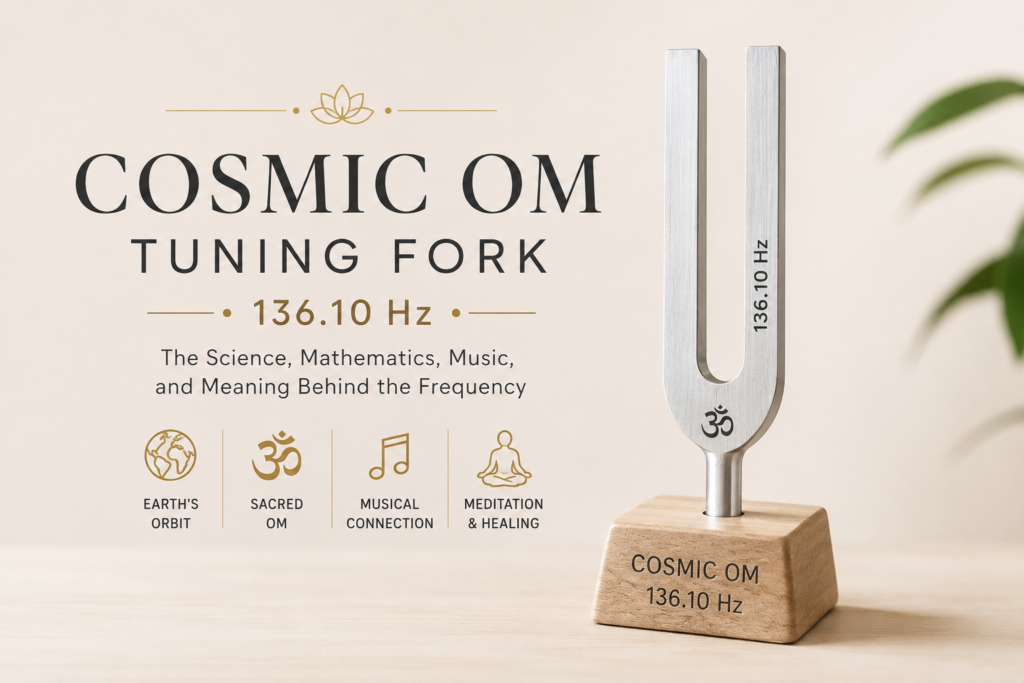
Among all tuning forks used in sound healing, meditation, and Nada Yoga, the Cosmic OM Tuning Fork is one of the most widely recognized. Instrument makers tune the Cosmic OM tuning fork to approximately 136.10 Hz, and practitioners associate it with the sacred syllable Om (AUM), the Earth’s annual orbit around the Sun, and the musical note C♯ in the A = 432 Hz tuning system.
Its popularity has grown rapidly among yoga practitioners, meditation teachers, and students enrolled in sound healing teacher training in Rishikesh. Yet despite its widespread use, many people are unaware of the mathematics and astronomy that give rise to this remarkable frequency.
This article explores the origin of the 136.10 Hz frequency, explains the calculations behind it, examines its musical relationship to 432 Hz tuning, reviews what modern science says about chanting and sound, and separates established facts from claims that remain speculative.
What Is Frequency?
Frequency measures how many times a vibration repeats every second.
Scientists measure frequency in Hertz (Hz):
- 1 Hz = one vibration per second
- 100 Hz = one hundred vibrations every second
- 1,000 Hz = one thousand vibrations every second
Every vibrating system generates its own frequency. Musical instruments, vocal cords, tuning forks, strings, air columns, and even planetary movements can all be described mathematically using frequency.
The Earth’s Orbit as a Frequency
The Earth completes one revolution around the Sun in approximately:
365.2422 days
Converting this period into seconds:
365.2422 × 24 × 60 × 60
= 31,556,926 seconds
Frequency is simply the inverse of time:
Frequency = 1 ÷ Time
Therefore:
1 ÷ 31,556,926
≈ 0.00000003169 Hz
or about 31.69 nanohertz.
This frequency is incredibly slow and lies far below the range of human hearing.
For comparison, the average human ear detects sounds between approximately:
- 20 Hz
- 20,000 Hz
Clearly, Earth’s orbital frequency cannot be heard directly.
How Does an Astronomical Cycle Become Audible?
Music uses a simple mathematical relationship known as the octave.
Every octave doubles the frequency.
For example:
- 100 Hz
- 200 Hz
- 400 Hz
- 800 Hz
Each doubling represents one octave.
Applying this same principle to Earth’s orbital frequency gives:
0.00000003169 Hz × 2³²
≈ 136.10 Hz
After 32 successive doublings, the Earth’s orbital cycle falls within the audible spectrum.
This is why the Cosmic OM tuning fork is often described as representing the 32nd octave of Earth’s year.
Importantly, this does not mean that Earth physically produces a 136.10 Hz sound. Rather, the orbital frequency is mathematically transposed upward by octaves while preserving its proportional relationship.
Why the 32nd Octave?
The number 32 is not mystical. It is simply the number of octave doublings required to move Earth’s orbital frequency from nanohertz into the range of human hearing.
The process is:
Earth’s orbital period
↓
31.69 nanohertz
↓
Double the frequency 32 times
↓
136.10 Hz
The octave relationship remains mathematically exact because each step multiplies the previous frequency by two.
The Musical Connection
The Cosmic OM frequency aligns closely with the musical note C♯ in a tuning system where:
A4 = 432 Hz
In this system:
- C♯1 ≈ 34.03 Hz
- C♯2 ≈ 68.05 Hz
- C♯3 ≈ 136.10 Hz
- C♯4 ≈ 272.20 Hz
- C♯5 ≈ 544.40 Hz
For this reason, many instrument makers refer to the Cosmic OM tuning fork as the C♯ OM Tuning Fork.
Why Is 432 Hz Connected to Cosmic OM?
Modern musical instruments are generally tuned to the international standard:
A = 440 Hz
However, some musicians, yoga practitioners, and sound healing facilitators prefer tuning instruments to:
A = 432 Hz
Within this tuning framework, the mathematically derived Earth-year frequency aligns closely with C♯ at approximately 136.10 Hz, creating an elegant relationship between music and astronomical cycles.
Although 432 Hz has attracted considerable attention online, there is no scientific consensus that it possesses unique biological or therapeutic properties compared with 440 Hz. Current evidence suggests that preference for one tuning over another is largely aesthetic, musical, or cultural rather than physiologically established.
Why Is It Called the Cosmic OM Frequency?
The syllable Om (AUM) has been revered for thousands of years within Hindu, Buddhist, Jain, and yogic traditions. Classical texts describe it as the primordial vibration underlying creation and as a powerful aid for meditation and contemplation.
During the twentieth century, researchers and instrument makers explored ways to translate astronomical cycles into audible musical pitches using octave relationships. The Earth’s orbital frequency, when shifted upward by 32 octaves, produced approximately 136.10 Hz, which corresponds closely to C♯ in the 432 Hz tuning system.
Because many practitioners found this pitch particularly comfortable for chanting Om, it gradually became known as the Cosmic OM frequency.
Today it remains one of the most widely used tuning forks in Nada Yoga and sound healing teacher training programs.
What Does Modern Research Say?
While the specific frequency of 136.10 Hz has not been shown to possess unique medical properties, scientific research has investigated the broader effects of chanting, meditation, and sustained vocalization.
One frequently cited pilot functional MRI study found that chanting Om was associated with reduced activity in several limbic brain regions involved in emotional processing, including the amygdala and hippocampus. The authors proposed that the vibration generated during chanting may influence neural activity through mechanisms that deserve further investigation, although the study was small and exploratory.
More recent reviews examining the neuroscience of chanting conclude that mantra recitation and repetitive vocal practices may influence attention, breathing patterns, emotional regulation, and autonomic nervous system activity. However, researchers consistently emphasize that larger, well-controlled studies are needed before drawing strong clinical conclusions.
This distinction is important because the benefits observed in meditation research cannot automatically be attributed to one specific frequency, such as 136.10 Hz.
What Science Supports
Current evidence supports several statements with confidence:
- Earth’s orbital period can be expressed mathematically as a frequency.
- Octave transposition is a standard principle in acoustics and music theory.
- Raising Earth’s orbital frequency by 32 octaves yields approximately 136.10 Hz.
- This frequency closely matches the musical note C♯ within the 432 Hz tuning system.
- Tuning forks generate stable and measurable frequencies suitable for acoustic applications.
These conclusions are based on established mathematics, physics, and acoustics.
Claims That Remain Unproven
Many websites also claim that the Cosmic OM frequency:
- balances specific chakras,
- resonates with DNA,
- aligns the body with planetary energy,
- cures disease,
- produces unique healing unavailable through other frequencies.
At present, these claims have not been validated by mainstream scientific evidence.
Many practitioners report feeling calmer, more focused, or more deeply relaxed when using the Cosmic OM tuning fork. These experiences are meaningful on a personal level, but they should be understood as subjective experiences rather than proven medical outcomes.
How the Cosmic OM Tuning Fork Is Used
The 136.10 Hz tuning fork is commonly incorporated into:
- meditation sessions,
- Om chanting,
- breath awareness practices,
- yoga classes,
- Nada Yoga,
- mindfulness training,
- sound baths,
- relaxation sessions,
- personal spiritual practice.
Many practitioners strike the fork before meditation to establish a stable reference tone, while others pair it with vocal chanting to encourage steady breathing and sustained attention.
Within a comprehensive sound healing teacher training, students typically learn not only how to use the Cosmic OM tuning fork but also the principles of acoustics, listening skills, ethics, contraindications, and evidence-informed sound practices.
Learning About the Cosmic OM Frequency Through Sound Healing Teacher Training
Understanding the Cosmic OM frequency involves much more than memorizing a number. A quality sound healing teacher training in Rishikesh combines traditional yogic wisdom with modern acoustics, anatomy, and meditation practices.
Students often explore:
- the physics of sound and vibration,
- tuning forks and singing bowls,
- Nada Yoga philosophy,
- mantra chanting,
- breath awareness,
- therapeutic listening,
- practical sound meditation techniques,
- responsible application of sound-based practices.
By learning both the scientific principles and the cultural traditions behind frequencies such as 136.10 Hz, practitioners develop a balanced understanding that respects ancient knowledge while remaining grounded in current evidence.
Final Thoughts
The Cosmic OM Tuning Fork (136.10 Hz) represents a fascinating intersection of astronomy, mathematics, music, and spiritual tradition.
Its frequency is derived by mathematically transposing Earth’s orbital period upward through 32 octaves, transforming an imperceptibly slow astronomical cycle into an audible musical tone. Musically, it aligns closely with C♯ in the 432 Hz tuning system, while culturally it has become deeply connected with the chanting of Om and the practice of Nada Yoga.
Although current scientific research does not support claims that 136.10 Hz possesses unique healing powers, studies on meditation and Om chanting suggest that these practices may positively influence relaxation, attention, and emotional regulation when incorporated into a consistent mindfulness practice. As research continues to evolve, the Cosmic OM tuning fork remains a meaningful bridge between scientific curiosity, musical harmony, and centuries of contemplative tradition.
Frequently Asked Questions (FAQs)
Why is it called the 32nd octave of the Earth?
The Earth’s orbital frequency is approximately 31.69 nanohertz, which is far below the range of human hearing. Each octave doubles a frequency, and after 32 doublings, the frequency becomes approximately 136.10 Hz. Therefore, the Cosmic OM tuning fork is described as representing the 32nd octave of the Earth’s yearly orbit.
Is the Cosmic OM frequency scientifically proven to heal the body?
There is currently no scientific evidence demonstrating that 136.10 Hz has unique healing properties or can treat medical conditions. Research does support the benefits of meditation, controlled breathing, and mantra chanting for relaxation and stress reduction, but claims that this specific frequency heals disease, balances chakras, or resonates with DNA remain unverified by mainstream scientific research.
Why do some practitioners prefer 432 Hz instead of 440 Hz?
Supporters of 432 Hz tuning believe it offers a more natural or harmonious listening experience and creates elegant mathematical relationships with astronomical cycles, including the Earth’s orbit. However, scientific studies have not established that 432 Hz produces unique physical or biological effects compared with the international standard of 440 Hz. Preference between the two tuning systems is generally considered a matter of musical taste, tradition, or personal experience.
How is the Cosmic OM tuning fork used in meditation?
Practitioners often strike the tuning fork before meditation to create a sustained tone that encourages focused attention. It may also accompany Om chanting, breath awareness exercises, mindfulness practices, yoga sessions, or sound baths to help establish a calm and consistent auditory environment.
Can beginners use a Cosmic OM tuning fork?
Yes. The Cosmic OM tuning fork is suitable for beginners as well as experienced practitioners. It is commonly used during personal meditation, yoga practice, and introductory sound healing sessions. Learning proper techniques through a structured sound healing teacher training can help practitioners use tuning forks safely and effectively.
Where can I learn to use Cosmic OM tuning forks professionally?
A comprehensive sound healing teacher training in Rishikesh provides practical instruction on tuning forks, singing bowls, Nada Yoga, mantra chanting, meditation, sound therapy principles, ethics, and the science of acoustics. These programs combine traditional yogic knowledge with modern research, helping students develop both theoretical understanding and practical skills for professional practice.
References
- Kalyani BG, Venkatasubramanian G, Arasappa R, et al. Neurohemodynamic Correlates of OM Chanting: A Pilot Functional Magnetic Resonance Imaging Study. International Journal of Yoga, 2011.
- Perry A, et al. Neural Correlates of Chanting: A Systematic Review. WIREs Cognitive Science, 2025.
- Tomasino B, Fabbro F. Meditation-related activations are modulated by the practices needed to obtain them. Frontiers in Human Neuroscience, 2013.