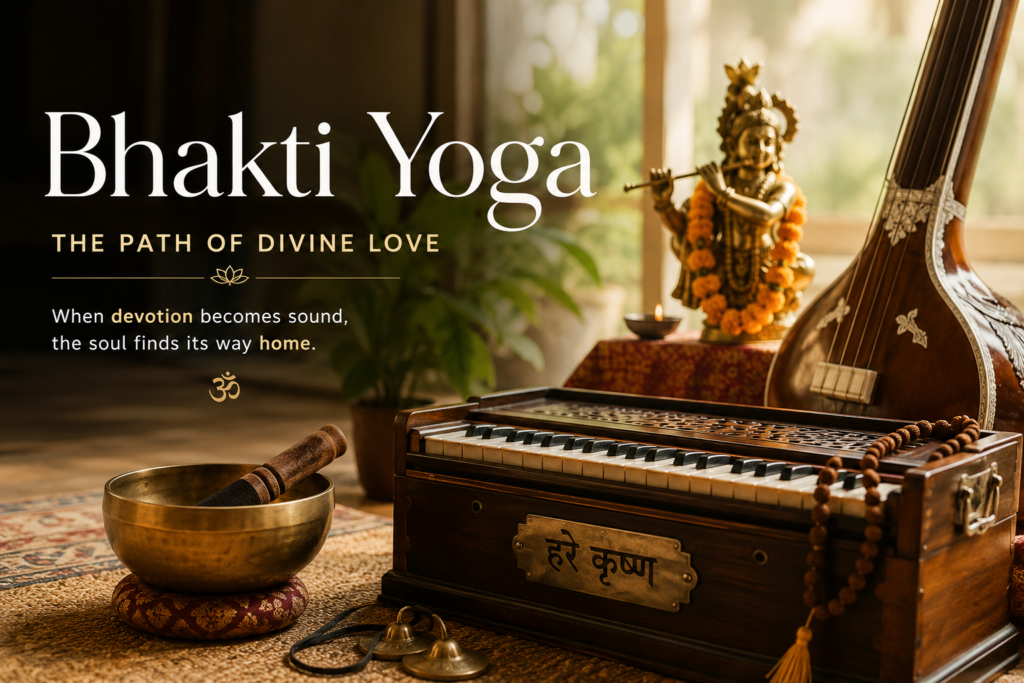
“The highest form of worship is not performed with the hands, but with the heart.”
Among the many paths described in yogic philosophy, Bhakti Yoga stands apart as the path of unconditional love and devotion. While Karma Yoga emphasizes selfless action, Jñāna Yoga focuses on wisdom, and Rāja Yoga cultivates meditation, Bhakti Yoga invites us to awaken the heart. It teaches that the deepest spiritual transformation begins not through intellectual achievement alone but through sincere love for the Divine.
Throughout history, saints, yogis, poets, and musicians have followed this path with unwavering devotion. Their lives remind us that spirituality is not only about discipline or knowledge. It is also about cultivating humility, gratitude, compassion, and complete surrender.
For practitioners of Nada Yoga, devotion plays an especially important role. Sound without devotion remains a vibration that reaches the ears. However, when the same sound arises from a heart filled with love, it becomes a sacred offering. Every mantra, every kirtan, and every note of devotional music becomes a bridge between the individual soul and the Divine.
What Does Bhakti Mean?
The Sanskrit word Bhakti (भक्ति) comes from the verbal root Bhaj (भज्), which means:
- To love
- To worship
- To serve
- To share
- To participate in the Divine
The word Yoga comes from another Sanskrit root, Yuj (युज्), meaning “to unite.”
Together, these two words beautifully describe Bhakti Yoga as the path of union with the Divine through love, devotion, service, and surrender.
Unlike devotion motivated by fear or personal gain, authentic Bhakti asks for nothing in return. Instead, it encourages practitioners to love simply because love itself becomes the highest spiritual practice.
Bhakti According to the Scriptures
The essence of Bhakti has been beautifully described in several classical texts. Among the most celebrated is the Nārada Bhakti Sūtras, where Sage Narada offers one of the shortest yet most profound definitions of devotion.
नारदभक्तिसूत्र २
सा त्वस्मिन् परमप्रेमरूपा।
Transliteration
Sā tvasmin parama-prema-rūpā.
Translation
“Bhakti is of the nature of supreme love for the Divine.”
Although this definition is remarkably brief, it captures the heart of Bhakti Yoga. Devotion is not merely emotional expression or ritual worship. Rather, it is the experience of complete love directed toward the Divine.
Another important description appears in the Śrīmad Bhāgavata Purāṇa.
श्रीमद्भागवतपुराण १.२.६
स वै पुंसां परो धर्मो यतो भक्तिरधोक्षजे।
अहैतुक्यप्रतिहता ययात्मा सुप्रसीदति॥
Transliteration
Sa vai puṁsāṁ paro dharmo yato bhaktir adhokṣaje,
ahaituky apratihatā yayātmā suprasīdati.
Translation
“The highest duty of humanity is that by which one develops loving devotion to the Supreme Lord. Such devotion is causeless and uninterrupted, and through it the soul becomes completely satisfied.”
In other words, true fulfillment arises not from external achievements but from cultivating unconditional devotion.
The Origins of Bhakti Yoga
The roots of Bhakti extend deep into India’s spiritual heritage.
The Ṛgveda, one of the world’s oldest sacred texts, contains hymns filled with praise, gratitude, and reverence for the Divine. Later, the Upaniṣads expanded this vision by teaching that the same Supreme Reality exists within every living being.
Perhaps the most influential presentation of Bhakti appears in the Bhagavad Gītā. In Chapter 12, Lord Krishna explains that loving devotion is one of the most direct and accessible paths to realizing the Divine.
The Śrīmad Bhāgavata Purāṇa develops these teachings even further through the inspiring lives of Prahlāda, Dhruva, Hanuman, Ambarīṣa, and the Gopīs of Vṛndāvana. Although each devotee followed a unique path, they all demonstrated that sincere love has the power to dissolve the ego and awaken spiritual wisdom.
Consequently, Bhakti became one of the most influential traditions in Indian spirituality, inspiring countless saints, poets, musicians, and seekers throughout history.
Bhakti and Nada Yoga
Among all the yogic traditions, Nada Yoga offers one of the most beautiful expressions of devotion.
Nada Yoga teaches that the universe originates from Nāda, the primordial vibration from which all creation emerges. Yet sound alone is not enough to transform consciousness.
Instead, devotion gives sound its spiritual power.
When a mantra is repeated with love, it becomes meditation.
When sacred music is performed with sincerity, it becomes prayer.
Likewise, when silence is entered with complete surrender, practitioners gradually become aware of Anāhata Nāda, the unstruck inner sound described in yogic scriptures.
For this reason, experienced teachers often describe Bhakti as the heart of Nada Yoga.
Students enrolled in a Nada Yoga Teacher Training in Rishikesh explore this relationship in depth. Alongside Indian classical music, mantra chanting, meditation, and yogic philosophy, they discover how devotion transforms sound into a powerful tool for inner awakening.
The Nine Forms of Bhakti
One of the most famous teachings on devotion appears in the Śrīmad Bhāgavata Purāṇa (7.5.23–24), where nine complementary forms of Bhakti are described.
Sanskrit
श्रवणं कीर्तनं विष्णोः स्मरणं पादसेवनम् ।
अर्चनं वन्दनं दास्यं सख्यमात्मनिवेदनम् ॥
इति पुंसार्पिता विष्णौ भक्तिश्चेन्नवलक्षणा ।
क्रियेत भगवत्यद्धा तन्मन्येऽधीतमुत्तमम् ॥
Together, these nine practices offer different ways to cultivate devotion according to one’s temperament and daily life.
1. Śravaṇam (Listening)
Everything begins with listening. Hearing sacred teachings, scriptures, devotional music, and mantras opens the heart while preparing the mind for meditation. In Nada Yoga, attentive listening becomes the first doorway to inner sound.
2. Kīrtanam (Chanting)
Kirtan involves joyfully singing or reciting the names of the Divine. More importantly, it combines breath, rhythm, melody, and devotion into a deeply meditative practice.
3. Smaraṇam (Remembrance)
This practice encourages continuous remembrance of the Divine throughout daily life. As a result, ordinary activities gradually become opportunities for spiritual awareness.
4. Pāda-sevanam (Service)
Serving the Divine symbolizes humility and gratitude. At the same time, serving others with compassion reflects the same spirit of devotion.
5. Arcanam (Worship)
Traditional worship includes offerings of flowers, incense, light, and mantra. Eventually, these external rituals encourage practitioners to discover the Divine within their own hearts.
6. Vandanam (Prayer)
Prayer allows us to express gratitude, hope, reverence, and surrender. Even a few moments of sincere prayer each day can cultivate greater humility and inner peace.
7. Dāsyam (Selfless Service)
This form of Bhakti teaches complete dedication without attachment to recognition or reward. Hanuman remains one of the greatest examples of this selfless attitude.
8. Sakhyam (Divine Friendship)
Some devotees experience the Divine as a trusted friend rather than a distant deity. Arjuna’s relationship with Lord Krishna beautifully illustrates this intimate connection.
9. Ātma-nivedanam (Complete Surrender)
Finally, the highest expression of Bhakti is complete self-surrender. Every thought, action, success, and challenge is lovingly offered to the Divine until the sense of separation gradually disappears.
Practicing Bhakti in Everyday Life
Many people believe Bhakti requires elaborate rituals or constant participation in religious ceremonies. In reality, devotion begins with ordinary moments performed wholeheartedly.
Preparing a meal with gratitude.
Repeating a mantra during meditation.
Listening attentively to devotional music.
Helping someone without expecting appreciation.
Offering each day’s work with sincerity.
Although these actions appear simple, they gradually transform daily life into spiritual practice.
Above all, Bhakti teaches that every sincere act performed with love becomes an expression of devotion.
Why Bhakti Yoga Matters Today
Modern life often encourages speed, competition, and constant productivity. While these qualities can help us achieve external success, they rarely provide lasting inner peace.
Bhakti Yoga offers another perspective.
Instead of asking us to accomplish more, it encourages us to love more deeply.
Rather than strengthening the ego, it invites humility.
Similarly, instead of chasing endless achievements, it reminds us to cultivate gratitude and presence.
Because of this timeless message, Bhakti continues to inspire spiritual seekers around the world.
Final Thoughts
Bhakti Yoga is much more than a devotional practice. It is a way of living that transforms everyday actions into sacred offerings and ordinary experiences into opportunities for spiritual growth.
For practitioners of Nada Yoga, devotion gives meaning to every mantra, every note, and every vibration. Through sincere love, sound becomes meditation. Through meditation, silence naturally emerges. Within that silence, yogic tradition teaches that the eternal Nāda Brahman, the Divine vibration underlying all existence, reveals itself.
If you wish to experience this relationship between devotion, music, mantra, and meditation more deeply, joining a Nada Yoga Teacher Training in Rishikesh offers an authentic opportunity to study these timeless teachings. By learning from experienced teachers in the birthplace of yoga, students not only develop practical skills in mantra chanting, Indian classical music, and meditation but also discover how Bhakti transforms sound into a profound path of inner awakening.