Have you ever noticed how certain sounds seem to quiet the mind almost effortlessly? The gentle resonance of a singing bowl, the sustained tone of a tuning fork, or the rhythmic chanting of a mantra can create a sense of calm that feels very different from simply listening to music.
For centuries, cultures around the world have used sound to support meditation, spiritual practice, and emotional well-being. Today, modern science is beginning to explore one fascinating aspect of this relationship between sound and the brain: binaural beats.
Among the many instruments used in sound healing, brain-tuner tuning forks, also known as binaural beat tuning forks, stand out because they work differently from ordinary tuning forks. Instead of producing a single tone, they work in pairs. Each fork produces a slightly different frequency, allowing the brain to perceive an entirely new rhythmic pulse.
Researchers have studied binaural beats for decades within neuroscience, psychology, and auditory science. Although scientists continue to investigate their effects, the phenomenon itself is well established. As a result, Brain Tuner tuning forks have become popular tools for meditation, relaxation, and professional tuning fork therapy.
In this guide, you’ll discover how Brain Tuner tuning forks work, the mathematics behind binaural beats, their connection to brainwave activity, what current research says, and how students learn to use these fascinating instruments during a Sound Healing Teacher Training in Rishikesh.
What Are Brain Tuner Tuning Forks?
At first glance, Brain Tuner tuning forks look similar to ordinary tuning forks. However, their purpose is entirely different.
Traditional tuning forks produce a single frequency and are commonly used to tune musical instruments or demonstrate acoustic principles. Brain Tuner tuning forks, on the other hand, always work as a matched pair. Each fork produces a slightly different frequency, allowing the brain to process two separate tones simultaneously.
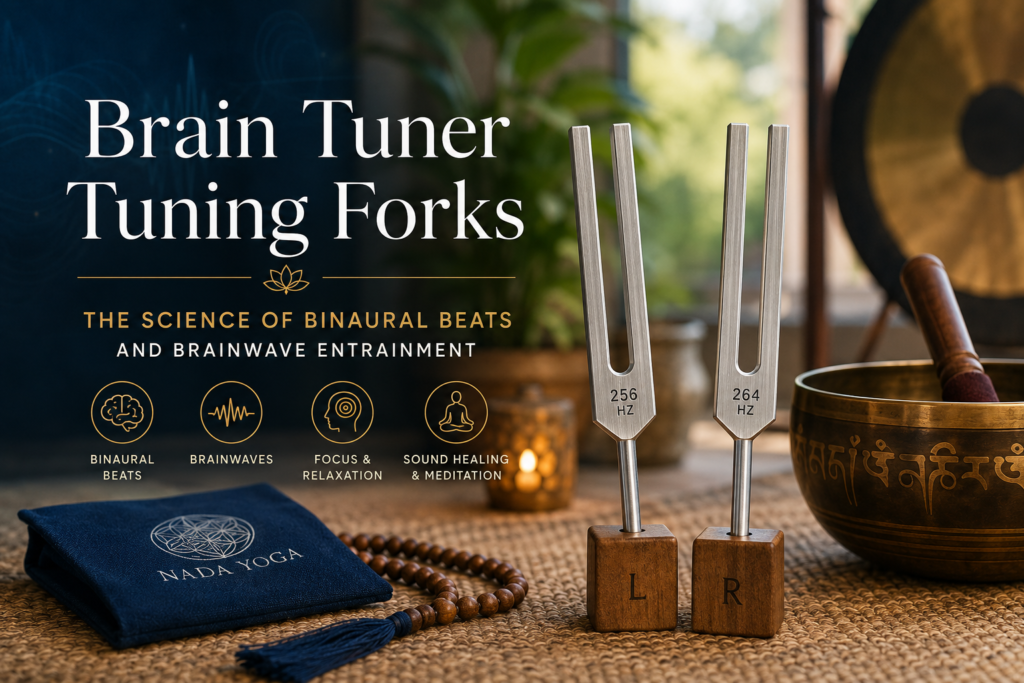
For example, one tuning fork might produce a frequency of 256 Hz, while the other produces 264 Hz.
When a practitioner gently strikes both forks and holds one near each ear, each ear receives a different sound. Instead of hearing only two independent tones, many listeners perceive a gentle rhythmic pulsing that seems to emerge between them.
Interestingly, neither tuning fork creates this pulse.
Instead, the listener’s auditory system generates it internally.
This remarkable auditory illusion is known as a binaural beat, and it forms the scientific foundation of Brain Tuner tuning forks.
Understanding Binaural Beats
To understand binaural beats, imagine attending a concert where two musicians play nearly identical notes.
One musician plays 200 Hz, while the other plays 208 Hz.
Your ears receive two separate frequencies at exactly the same time. Instead of hearing only two distinct notes, your brain detects the small difference between them and creates the perception of a slow rhythmic pulse.
In this example, the calculation is straightforward.
208 Hz − 200 Hz = 8 Hz
Although no physical 8 Hz sound wave exists in the room, many listeners perceive an eight-cycle rhythmic beat internally.
This perceived rhythm is called a binaural beat.
Scientists emphasize an important distinction here. The binaural beat is not a sound wave traveling through the air. Instead, the brain creates the experience by comparing the frequencies reaching each ear.
This process makes binaural beats one of the most fascinating examples of how the brain actively interprets sensory information.
The Mathematics Behind Brain Tuner Tuning Forks
One of the reasons Brain Tuner tuning forks fascinate both musicians and scientists is their beautifully simple mathematics.
The perceived binaural beat depends entirely on the difference between the two frequencies.
The formula looks like this:
Beat Frequency = |Right Frequency − Left Frequency|
Let’s look at several examples.
| Left Fork | Right Fork | Perceived Beat |
|---|---|---|
| 200 Hz | 204 Hz | 4 Hz |
| 200 Hz | 206 Hz | 6 Hz |
| 256 Hz | 266 Hz | 10 Hz |
| 300 Hz | 310 Hz | 10 Hz |
| 400 Hz | 406 Hz | 6 Hz |
Notice something interesting.
The tuning forks themselves produce completely different pitches. However, the brain ignores the actual pitch when calculating the binaural beat. Instead, it focuses only on the frequency difference.
Because of this principle, manufacturers can design tuning fork sets that correspond to different brainwave ranges while still using comfortably audible carrier frequencies.
Why Does the Frequency Difference Matter?
Not every pair of tuning forks produces a binaural beat.
In fact, the brain only creates this auditory illusion when the two frequencies remain relatively close together.
For example, these combinations often work well:
- 200 Hz and 202 Hz
- 200 Hz and 206 Hz
- 256 Hz and 266 Hz
However, imagine increasing the difference dramatically.
If one tuning fork produces 200 Hz while the other produces 260 Hz, most people simply hear two separate notes instead of a rhythmic pulse.
Consequently, Brain Tuner tuning forks usually maintain a frequency difference below 30 Hz. Many manufacturers design their instruments with differences between 1 Hz and 20 Hz because these ranges closely correspond to common brainwave frequencies measured by EEG.
Understanding Brainwaves
The human brain continuously produces tiny electrical impulses that allow billions of neurons to communicate with one another.
Scientists measure this activity using Electroencephalography (EEG), a non-invasive method that records electrical signals from the scalp.
Although brain activity constantly changes, researchers commonly group these electrical patterns into several frequency ranges associated with different mental states.
Understanding these ranges helps explain why Brain Tuner tuning forks often target specific binaural beat frequencies.
Delta Waves (0.5–4 Hz)
Delta waves are the slowest brainwaves and are most commonly associated with deep, dreamless sleep.
During this stage, the body carries out many restorative processes that support physical recovery.
For example, a Brain Tuner pair producing a 2 Hz binaural beat might use:
- Left Fork: 200 Hz
- Right Fork: 202 Hz
The perceived difference falls within the Delta range.
Theta Waves (4–8 Hz)
Theta waves frequently appear during deep meditation, vivid imagination, dreaming, and creative thinking.
Many experienced meditators naturally spend more time in this frequency range during extended practice.
For instance, if one tuning fork produces 200 Hz while the other produces 206 Hz, the brain perceives a 6 Hz binaural beat.
Because of this association, Theta remains one of the most popular ranges used during meditation sessions and relaxation practices.
Alpha Waves (8–13 Hz)
Alpha waves are commonly associated with relaxed wakefulness.
Imagine sitting quietly with your eyes closed while remaining fully awake. Your brain often produces increased Alpha activity during these moments.
Many meditation practitioners value Alpha because it represents a balance between relaxation and alert awareness.
A typical Brain Tuner pair designed for Alpha might include:
- Left Fork: 256 Hz
- Right Fork: 266 Hz
Together, these frequencies produce a perceived 10 Hz binaural beat.
Beta Waves (13–30 Hz)
Unlike Alpha and Theta, Beta waves are associated with active thinking.
People often exhibit stronger Beta activity while solving problems, concentrating on complex tasks, studying, or engaging in conversation.
For example:
- Left Fork: 200 Hz
- Right Fork: 220 Hz
The difference creates a 20 Hz binaural beat, which falls comfortably within the Beta range.
Gamma Waves (Above 30 Hz)
Gamma waves represent the fastest commonly discussed brainwave category.
Researchers continue studying Gamma activity because it may relate to attention, learning, and higher cognitive processing.
Some modern Brain Tuner systems include Gamma-frequency pairs. However, many traditional five-piece sets focus primarily on Delta, Theta, Alpha, and Beta because these ranges are more commonly used during meditation and sound healing practices.
How Do Brain Tuner Tuning Forks Work?
Although the idea behind binaural beats sounds complex, the process itself is surprisingly simple. Brain Tuner tuning forks rely on the way the human auditory system processes sound rather than on any special electronic technology. As a result, they offer an entirely acoustic approach to creating binaural beats.
A practitioner begins by gently striking both tuning forks with an activator. Then, they hold one fork near the left ear and the other near the right ear. Each ear receives a slightly different frequency, but the two tones remain close enough for the brain to compare them.
Instead of treating the sounds as completely separate, the auditory system analyzes the small difference between the two frequencies. Neural pathways within the brainstem and auditory cortex work together to process these incoming signals. Consequently, many listeners perceive a slow rhythmic pulse that matches the difference between the two frequencies.
Importantly, the tuning forks never produce this rhythmic beat in the surrounding air. The listener experiences it because the brain interprets the two tones in a unique way. This distinction makes binaural beats different from physical sound waves that instruments like singing bowls or gongs create.
Unlike digital recordings, Brain Tuner tuning forks also produce natural acoustic vibrations. Many practitioners appreciate this purely mechanical quality because it allows them to combine scientific principles with traditional sound healing practices.
Why Do Brain Tuner Tuning Forks Use Higher Carrier Frequencies?
One question often surprises people who are new to binaural beats.
If the goal is to create an 8 Hz or 10 Hz brainwave-related beat, why don’t the tuning forks simply produce those frequencies directly?
The answer lies in the limits of human hearing.
Most people hear sounds between approximately 20 Hz and 20,000 Hz. Frequencies below this range become increasingly difficult or impossible to perceive as audible tones.
For example, a pure 10 Hz sound falls below the normal threshold of hearing. Even if a speaker or tuning fork could produce it, you would not hear it as a clear musical note.
Instead, Brain Tuner tuning forks use higher frequencies, often between 100 Hz and 500 Hz, because these tones are comfortably audible. The brain then compares the two frequencies and generates the slower binaural beat internally.
Consider this example:
- Left Fork: 256 Hz
- Right Fork: 264 Hz
Both frequencies are easy to hear.
However, because they differ by 8 Hz, the brain perceives an 8 Hz binaural beat.
This clever approach allows practitioners to work with frequencies that relate to common EEG brainwave ranges while still using sounds that the ears can detect clearly.
Brain Tuner Tuning Forks vs. Digital Binaural Beats
Today, many people first encounter binaural beats through smartphone apps, streaming platforms, or meditation recordings. While these recordings and Brain Tuner tuning forks rely on the same auditory principle, they create the experience in different ways.
Digital binaural beats use headphones to deliver separate frequencies directly to each ear. Software generates the tones electronically, making it easy to produce a wide range of frequency combinations.
Brain Tuner tuning forks take a completely different approach.
Instead of relying on electronic equipment, practitioners create the tones acoustically by striking two precisely tuned forks. This hands-on method introduces an element of human interaction that many sound healing practitioners value.
Additionally, tuning forks produce both audible sound and gentle mechanical vibration. Although practitioners typically position Brain Tuners near the ears rather than on the body, the natural resonance of the forks contributes to the overall listening experience.
Neither approach is inherently better than the other. Instead, each serves different purposes. Digital recordings provide convenience for personal listening, whereas tuning forks offer a more interactive and tactile experience that integrates naturally into professional sound healing sessions.
What Does Scientific Research Say?
Binaural beats have attracted scientific attention for several decades, and researchers continue to investigate how they influence the human brain.
The first point is clear. Scientists recognize binaural beats as a genuine auditory phenomenon. When each ear receives a slightly different frequency, the brain can perceive a rhythmic beat equal to the difference between those frequencies. Numerous studies have confirmed this basic principle.
However, the effects of binaural beats on mental and emotional states remain an active area of research.
Some studies suggest that listening to binaural beats may support:
- Relaxation
- Reduced stress and anxiety
- Improved focus
- Meditation
- Mood regulation
- Better sleep quality
At the same time, other studies report smaller or inconsistent effects. Individual responses vary considerably, and factors such as the listening environment, session length, expectations, and personal differences may all influence the outcome.
Because of these variations, researchers generally avoid claiming that binaural beats can reliably place every person into a specific brainwave state or produce guaranteed therapeutic benefits.
Instead, current evidence suggests that binaural beats may support relaxation and meditation for many people, while their broader clinical applications require additional high-quality research.
This balanced perspective helps separate established science from exaggerated marketing claims. Rather than viewing Brain Tuner tuning forks as miracle devices, practitioners often use them as one tool within a broader sound healing practice that includes mindful listening, breath awareness, meditation, and traditional therapeutic instruments.
How Are Brain Tuner Tuning Forks Used in Sound Healing?
Professional sound healing sessions rarely rely on a single instrument. Instead, practitioners combine different tools to create rich and immersive sound experiences.
Brain Tuner tuning forks often complement instruments such as Tibetan singing bowls, crystal singing bowls, gongs, Koshi chimes, monochords, and the human voice.
A practitioner may begin a session by encouraging the client to settle into a relaxed position and focus on steady breathing. Once the mind begins to quiet, the practitioner introduces the paired tuning forks near each ear to create the binaural beat effect.
As the session continues, they may incorporate singing bowls, mantra chanting, or gentle vocal toning to deepen the experience. This layered approach encourages mindful listening while exposing the participant to a variety of harmonic textures and vibrations.
Within the tradition of Nada Yoga, practitioners view sound as more than a collection of frequencies. Ancient yogic teachings describe sound as a pathway toward concentration, meditation, and inner awareness. Therefore, many sound healing practitioners combine modern acoustic knowledge with these traditional practices rather than treating them as separate disciplines.
By blending scientific understanding with centuries of contemplative wisdom, Brain Tuner tuning forks become part of a holistic approach that supports relaxation, mindfulness, and personal exploration.
Learning to Use Brain Tuner Tuning Forks in a Sound Healing Teacher Training
Understanding the science behind Brain Tuner tuning forks is an excellent starting point, but theory alone cannot replace hands-on experience. Like any sound healing instrument, tuning forks require proper technique, careful listening, and an understanding of when and how to use them.
A comprehensive sound healing teacher training in Rishikesh combines scientific knowledge with practical application. Students not only learn how binaural beats work but also develop the skills to use Brain Tuner tuning forks confidently and responsibly within sound healing sessions.
During training, students typically explore:
- The physics of sound and vibration
- How binaural beats are created
- Different brainwave frequency ranges
- Safe and effective tuning fork techniques
- Active listening and observation skills
- Integrating tuning forks with other sound healing instruments
- The philosophy of Nada Yoga and mindful listening
Rather than focusing solely on frequencies, students learn to understand the person receiving the session. Every individual responds differently to sound, so experienced practitioners pay close attention to comfort, feedback, and the overall experience instead of trying to achieve a predetermined outcome.
Many training programs also introduce students to a wide range of complementary instruments, including Tibetan singing bowls, crystal singing bowls, gongs, Koshi chimes, monochords, and the healing potential of the human voice. As students gain confidence, they learn how each instrument contributes to a balanced and immersive sound healing session.
This integrated approach reflects an important principle of Nada Yoga, which views sound as a tool for cultivating awareness rather than simply producing specific frequencies. Consequently, students develop both technical knowledge and a deeper appreciation for the transformative role of mindful listening.
Conclusion
Brain Tuner tuning forks offer a fascinating example of how science, mathematics, and sound come together to create a unique listening experience. By presenting two slightly different frequencies to each ear, they allow the brain to perceive a binaural beat, a phenomenon that has captured the interest of neuroscientists, psychologists, musicians, and meditation practitioners alike.
Although the mathematics behind binaural beats is remarkably simple, the way our brains process these sounds remains an intriguing area of scientific research. Studies continue to explore how binaural beats may support relaxation, attention, meditation, and emotional well-being. At the same time, researchers emphasize that individual responses vary, and current evidence does not support exaggerated claims about guaranteed therapeutic outcomes.
Within sound healing, Brain Tuner tuning forks serve as one instrument among many. Practitioners often combine them with Tibetan singing bowls, crystal singing bowls, gongs, mantra chanting, and other traditional practices to create immersive and mindful sound experiences. Instead of relying on a single technique, they draw upon a variety of methods to support relaxation and self-awareness.
If you would like to explore these instruments beyond theory, joining a Sound Healing Teacher Training in Rishikesh offers an opportunity to study Brain Tuner tuning forks within the broader tradition of Nada Yoga. Through a combination of scientific understanding, practical experience, and ancient yogic wisdom, you’ll gain the knowledge and confidence to incorporate therapeutic sound into your personal practice or professional journey.
Frequently Asked Questions
Are Brain Tuner tuning forks scientifically proven?
Yes and no. Scientists have clearly established that binaural beats are a genuine auditory phenomenon. When each ear receives a slightly different frequency, the brain can perceive a rhythmic beat equal to the frequency difference. However, researchers continue to study whether binaural beats consistently influence relaxation, focus, sleep, or other mental states. While many studies report promising results, the evidence remains mixed, and responses vary between individuals.
Do Brain Tuner tuning forks create sound waves inside the air?
No. The tuning forks produce two separate audible frequencies. Your brain then compares those frequencies and creates the perception of a binaural beat. In other words, the rhythmic pulse exists as an auditory perception rather than as a physical sound wave in the surrounding air.
Can Brain Tuner tuning forks change brainwaves?
Current research has not shown that binaural beats can reliably force the brain into specific brainwave states. Some studies suggest they may encourage relaxation or support meditation for certain people, but scientists continue to investigate how these effects occur and how consistent they are across different individuals.
Do I need headphones to experience binaural beats?
Digital binaural beats require headphones because each ear must receive a different frequency. Brain Tuner tuning forks achieve the same principle acoustically by placing one tuning fork near each ear, so they do not rely on electronic audio equipment.
Can beginners use Brain Tuner tuning forks?
Yes. Beginners can learn the basic techniques with proper guidance. However, anyone who plans to offer professional sound healing sessions should complete structured training to understand both the scientific principles and the practical application of tuning forks within a safe and ethical framework.
Are Brain Tuner tuning forks only used for meditation?
Not at all. Practitioners commonly incorporate them into relaxation sessions, mindfulness practices, yoga classes, breathwork, and holistic sound healing sessions. Additionally, many people use them as part of their personal meditation routine because they encourage focused listening and present-moment awareness.