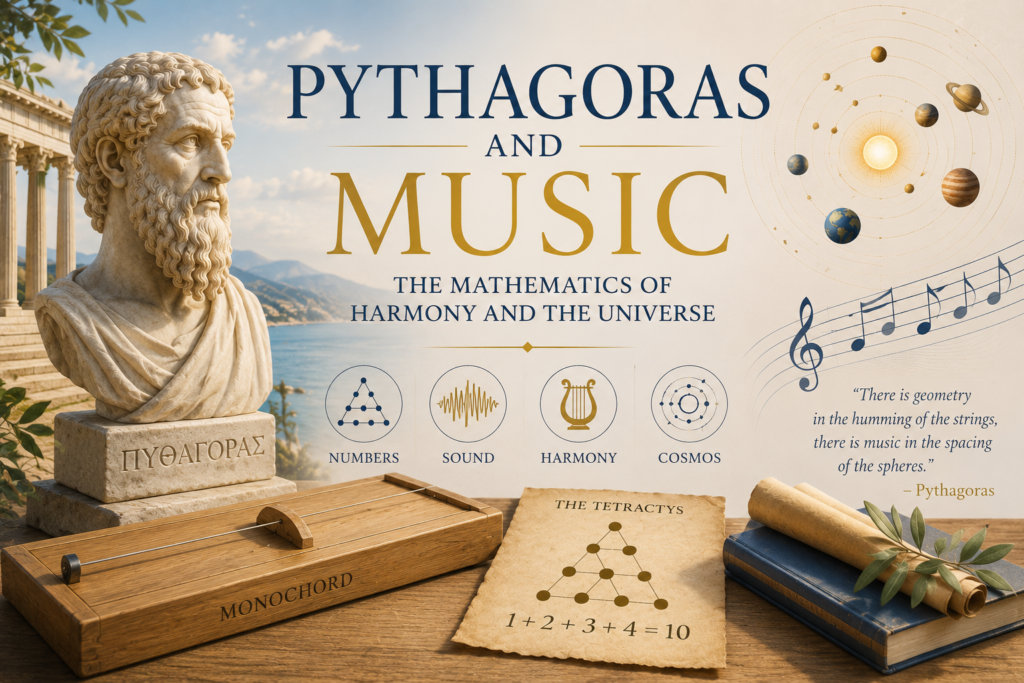
Have you ever wondered why certain musical notes sound naturally pleasing together? Why does a melody feel balanced, while another seems tense or unresolved? Is harmony simply a matter of personal taste, or does it reflect something much deeper about the universe itself?
More than 2,500 years ago, a Greek philosopher asked these very questions. His search for answers led to discoveries that forever changed mathematics, music, philosophy, and our understanding of sound. That philosopher was Pythagoras of Samos, a name most people associate with a famous geometry theorem. Yet his greatest legacy extends far beyond triangles.
Pythagoras believed that the universe follows a hidden order, one that can be understood through numbers, proportion, and harmony. To him, music was not merely entertainment. Instead, it offered a glimpse into the mathematical structure of reality itself.
This remarkable perspective continues to inspire musicians, scientists, philosophers, and spiritual seekers today. It also creates an interesting bridge to the ancient Indian tradition of Nada Yoga, where sound is regarded as a pathway to self-discovery and higher consciousness. Although these traditions developed independently, both recognized that sound reveals something profound about the nature of existence.
In this article, we’ll explore who Pythagoras was, how he uncovered the mathematics behind musical harmony, what the famous Harmony of the Spheres truly means, and why his ideas remain relevant in today’s study of music, sound healing, and contemplative practices.
Who Was Pythagoras?
Pythagoras was born on the Greek island of Samos around 570 BCE. While history remembers him as one of the world’s greatest mathematicians, he lived a life that blended philosophy, science, spirituality, and education in ways that were unusual for his time.
After traveling extensively throughout the ancient world, he eventually settled in Croton, a Greek city in southern Italy. There, he founded a philosophical community where students devoted themselves to much more than mathematics. They studied music, astronomy, geometry, ethics, meditation, and disciplined living because they believed these subjects revealed different aspects of the same universal truth.
For the Pythagoreans, learning was never limited to acquiring knowledge. Instead, education became a way to transform one’s character. Students cultivated self-discipline, practiced moderation, reflected on moral questions, and explored the relationships between numbers, nature, and the cosmos.
This holistic approach might sound surprisingly familiar to anyone who has studied yoga. Traditional yogic education also combines philosophy, disciplined practice, meditation, and self-inquiry rather than treating knowledge as purely intellectual.
Although Pythagoras lived in ancient Greece and the sages of India developed their teachings independently, both traditions encouraged students to seek harmony within themselves before attempting to understand the world around them.
The Revolutionary Idea That Changed Everything
Many philosophers before Pythagoras tried to explain the world through physical elements such as earth, water, fire, or air. Pythagoras took an entirely different approach.
He proposed a simple but revolutionary idea.
Everything is governed by numbers.
At first glance, this statement may seem abstract. However, the Pythagoreans gave it a much deeper meaning than simply counting objects.
To them, numbers represented the hidden relationships that shaped every aspect of reality.
They believed that mathematical patterns appeared everywhere:
- The movement of celestial bodies
- The proportions of geometric shapes
- The cycles of nature
- The growth of living organisms
- The structure of architecture
- The harmony of music
Rather than seeing mathematics as an invention of the human mind, they viewed it as the language through which the universe expressed its order.
Today, modern science often reaches remarkably similar conclusions. Physicists describe the laws of nature using mathematical equations. Engineers rely on numerical relationships to build bridges and spacecraft. Musicians analyze rhythm, pitch, and harmony through measurable frequencies.
Although the methods have evolved dramatically, the central insight remains surprisingly familiar: patterns govern the natural world.
The Discovery That Connected Music and Mathematics
Among Pythagoras’ many contributions, one stands above the rest because it transformed the study of music forever.
He discovered that harmonious musical intervals follow simple mathematical ratios.
According to historical accounts, Pythagoras explored this relationship using an instrument known as the monochord. This simple device consisted of a single string stretched across a wooden board with a movable bridge that allowed different sections of the string to vibrate.
As he experimented with different string lengths, he noticed something extraordinary.
Certain proportions consistently produced beautiful, stable sounds, while others created tension or dissonance.
For example, when he divided the vibrating string exactly in half, the resulting note sounded perfectly harmonious with the original note. Although the pitch became higher, the ear still recognized both notes as deeply connected.
This relationship became known as the octave, expressed mathematically as the ratio:
2 : 1
Next, he discovered another pleasing interval by dividing the string according to the ratio:
3 : 2
Musicians now recognize this interval as the perfect fifth, one of the most consonant and stable relationships in music.
He also identified another important proportion:
4 : 3
This produced the perfect fourth, another interval that has remained fundamental to music across countless cultures.
These discoveries revealed something remarkable.
Harmony was not random.
Instead, it emerged whenever simple numerical relationships governed vibrating strings.
Why Simple Ratios Sound Beautiful
Imagine two people swinging on playground swings.
If both swings move at exactly the same rhythm, they stay synchronized naturally.
Now imagine one swing moves twice as fast as the other.
Even though their speeds differ, they still meet at regular intervals because their movements follow a simple relationship.
Sound behaves in a remarkably similar way.
When two musical notes share simple mathematical ratios, their sound waves align repeatedly over time. Consequently, our ears perceive these combinations as stable and harmonious.
Let’s look at a few examples.
| Musical Interval | Ratio |
|---|---|
| Octave | 2 : 1 |
| Perfect Fifth | 3 : 2 |
| Perfect Fourth | 4 : 3 |
Although modern acoustics explains these relationships using wave physics rather than philosophy, Pythagoras recognized the underlying mathematical patterns long before scientists understood the mechanics of sound.
His observations transformed music from an intuitive art into something that could also be studied scientifically.
More importantly, they suggested that beauty itself might arise from order, proportion, and balance.
That idea would eventually shape philosophy, architecture, astronomy, and even spiritual traditions for centuries to come.
Music as a Window Into the Universe
For many people, discovering mathematical relationships in music would have been enough.
Pythagoras, however, took the idea much further.
He asked an even bigger question.
If harmony appears in music because of mathematical proportion, could the entire universe operate according to the same principle?
This question became the foundation of Pythagorean philosophy.
He believed that harmony extended far beyond musical instruments. Nature itself displayed balance through proportion. The changing seasons followed predictable cycles. Geometric forms revealed elegant relationships. Even the movements of celestial bodies appeared orderly rather than chaotic.
To the Pythagoreans, these patterns pointed toward a universe governed by harmony rather than randomness.
This broader understanding of harmony continues to resonate with many traditions today. In Nada Yoga, practitioners also regard sound as more than audible vibration. Through attentive listening, mantra, and meditation, they seek to experience the deeper harmony that underlies both the individual and the cosmos.
The Harmony of the Spheres: When the Cosmos Becomes Music
As Pythagoras continued exploring the relationship between mathematics and music, his curiosity expanded beyond vibrating strings. If simple numerical ratios created harmony in music, he wondered whether the same principles also governed the universe itself.
This idea eventually became known as the Harmony of the Spheres, one of the most influential concepts in the history of Western philosophy.
Despite its poetic name, the Harmony of the Spheres does not suggest that planets literally produce audible music. Instead, it expresses a philosophical vision of the cosmos. The Pythagoreans believed that the movements of celestial bodies followed perfect mathematical relationships, just as harmonious musical intervals arise from simple numerical ratios.
In other words, the universe itself could be understood as a perfectly ordered composition.
Every planet, every star, and every natural cycle formed part of a grand cosmic harmony governed by proportion rather than chance.
Although modern astronomy explains planetary motion through gravity and physics rather than musical ratios, the underlying idea remains surprisingly familiar. Scientists still describe the universe using mathematical laws, and many of nature’s most beautiful patterns continue to emerge through numbers and geometry.
From the spiral of a galaxy to the orbit of planets, mathematics continues to reveal an astonishing level of order throughout the cosmos.
Harmony Beyond Music
Pythagoras never limited harmony to musical instruments. Instead, he saw it everywhere.
He believed harmony appeared in:
- Geometry and mathematical relationships
- The movements of heavenly bodies
- Architectural design
- Natural growth patterns
- Human character
- Ethical living
To him, harmony meant balance between different parts of a greater whole.
When these relationships remained balanced, beauty naturally emerged.
When balance disappeared, disorder followed.
This simple principle influenced countless philosophers after Pythagoras. Plato embraced many of these ideas, while Renaissance artists and architects later used mathematical proportion to create some of history’s most celebrated works.
Even today, architects carefully design buildings using proportion and symmetry because balanced forms often feel naturally pleasing to the human eye. Similarly, musicians continue to arrange melodies and harmonies using relationships first explored more than two thousand years ago.
Pythagoras reminded us that harmony is not simply something we hear. It is something we recognize wherever order, balance, and proportion exist.
The Pythagorean Scale
Pythagoras’ discoveries did more than explain why certain notes sound harmonious. They also laid the foundation for one of history’s earliest tuning systems.
Rather than choosing notes randomly, he generated an entire musical scale by repeatedly applying one simple ratio.
That ratio was the perfect fifth, expressed mathematically as 3:2.
Starting with a single note and continuing to move through perfect fifths, the Pythagoreans constructed a complete musical system that later became known as Pythagorean tuning.
For centuries, musicians across Europe relied on this method because it produced beautifully pure fifths and reflected the mathematical principles that fascinated the Pythagorean school.
Modern Western instruments generally use equal temperament, a tuning system that distributes small compromises across every note so musicians can comfortably play in every key.
Even so, Pythagorean tuning remains one of the greatest milestones in the history of music theory. More importantly, it demonstrated that music follows consistent mathematical relationships rather than arbitrary rules.
This realization transformed music from an intuitive art into a discipline that musicians could analyze, teach, and refine through observation.
The Sacred Tetractys
Among all the symbols associated with Pythagoras, none held greater significance than the Tetractys.
At first glance, it appears remarkably simple.
Ten points arranged in four rows.
        •
      • •
    • • •
  • • • •
Yet for the Pythagoreans, this symbol represented the very structure of existence.
Each row carried symbolic meaning.
One represented unity, the source from which everything emerges.
Two symbolized duality, polarity, and the existence of complementary forces.
Three represented harmony because it united opposing principles into balance.
Four symbolized stability, structure, and the material world.
Together these numbers produce:
1 + 2 + 3 + 4 = 10
To the Pythagoreans, ten represented completeness and perfection.
Students even took oaths upon the Tetractys because they regarded it as a symbol of the mathematical order woven throughout the universe.
Although modern mathematics no longer assigns mystical qualities to numbers in this way, the Tetractys continues to fascinate philosophers, musicians, and historians because it reflects humanity’s enduring search for meaning through patterns.
Music as a Path to Inner Balance
Today, people often think of music primarily as entertainment. We listen while driving, exercising, or relaxing after work.
The Pythagoreans viewed music very differently.
For them, music possessed an ethical and spiritual purpose.
Historical accounts suggest that members of the Pythagorean community used carefully chosen melodies to calm emotional disturbances, cultivate inner balance, and prepare the mind for contemplation. Rather than distracting the listener, music encouraged clarity, discipline, and self-reflection.
This practice reflected their broader philosophy. Just as a well-tuned instrument produces harmonious sound, a balanced mind creates a harmonious life.
In many ways, this perspective still resonates today. Researchers continue to explore how music influences mood, attention, memory, and emotional regulation. Although modern science explains these effects through neuroscience rather than philosophy, both perspectives recognize that sound can shape human experience in meaningful ways.
This understanding also forms the foundation of many contemporary sound healing practices. Whether practitioners work with singing bowls, tuning forks, gongs, or the human voice, they often use sound to encourage relaxation, focused awareness, and mindful presence.
The Immortality of the Soul
Pythagoras’ philosophy extended far beyond mathematics and music.
He also believed that the soul was immortal.
According to the Pythagorean tradition, the soul survives physical death and continues its journey through successive lives. Therefore, every action, every choice, and every effort toward self-improvement contributes to its ongoing development.
For this reason, students devoted themselves to ethical living, disciplined study, contemplation, mathematics, and music. They believed these practices gradually purified the soul and prepared it for higher wisdom.
This belief later influenced the philosophy of Plato and became an important part of Western intellectual history.
Interestingly, this idea also creates another point of dialogue with Indian philosophy. Although the two traditions developed independently, both encourage inner transformation through disciplined practice and view knowledge as something that shapes the whole person rather than simply expanding the intellect.
Pythagoras Through the Lens of Modern Science
More than twenty-five centuries have passed since Pythagoras first experimented with a monochord, yet many of his observations continue to resonate with modern science. Although researchers now explain sound using acoustics, physics, and neuroscience rather than philosophy, they still recognize the remarkable insight behind many of his discoveries.
For example, modern acoustics confirms that vibrating strings produce frequencies that follow predictable mathematical relationships. The length, tension, and mass of a string determine its pitch, while simple numerical ratios create the consonant musical intervals that Pythagoras first identified.
Scientists also understand why these intervals sound pleasing.
When two notes share simple frequency ratios, their sound waves align regularly, producing stable patterns that our auditory system perceives as consonance. More complex ratios create wave interactions that feel less stable and often sound dissonant.
Pythagoras could not explain these phenomena using wave mechanics because that science did not yet exist. Nevertheless, his experiments revealed the mathematical principles that underlie musical harmony, making him one of the earliest pioneers in the scientific study of sound.
At the same time, modern science has refined or challenged some aspects of Pythagorean philosophy.
For instance, researchers do not conclude that numbers possess mystical powers simply because they appear in nature. Likewise, science does not support the idea that a particular audible frequency automatically produces unique healing effects solely because of its numerical value.
Instead, studies suggest that music influences the human body and mind through a complex interaction of acoustics, psychology, physiology, memory, attention, and emotion. Researchers continue to investigate these mechanisms, especially in fields such as music therapy, neuroscience, and sound perception.
This balanced perspective allows us to appreciate Pythagoras’ extraordinary contributions without overstating claims that current scientific evidence does not support.
Where Pythagoras Meets Nada Yoga
Although Pythagoras lived in ancient Greece and the sages of Nada Yoga developed their teachings in India, both traditions invite us to look beyond sound as simple entertainment.
Instead, they encourage us to experience sound as a doorway to understanding ourselves and the universe. Their approaches, however, begin from different directions. Pythagoras approached harmony through mathematics. By studying numerical relationships, he concluded that order, balance, and proportion shape both music and the cosmos. The yogic tradition begins elsewhere. Rather than measuring sound mathematically, Nada Yoga encourages direct experience through meditation, mantra, breath, and deep listening. Practitioners gradually refine their awareness until they experience Nāda, the subtle vibration that yogic texts describe as the foundation of creation.
One tradition studies harmony through numbers. The other studies harmony through consciousness. Far from contradicting one another, these perspectives complement each other beautifully. Pythagoras helps us understand how harmony appears in the external world. Nada Yoga invites us to experience that harmony within ourselves.
This shared appreciation for sound continues to inspire musicians, meditators, scientists, and spiritual seekers across cultures. It also reminds us that the study of sound can be both intellectual and experiential.
Students who wish to immerse themselves in this living tradition often choose a Nada Yoga Teacher Training in Rishikesh, where Indian classical music, mantra chanting, yogic philosophy, meditation, and traditional practices come together in an authentic learning environment. Here, sound becomes more than an object of study. It becomes a practical path toward concentration, self-awareness, and inner transformation.
Why Pythagoras Still Matters Today
It would be easy to think of Pythagoras as simply an ancient philosopher whose ideas belong in history books. Yet his influence surrounds us every day. Every musician who studies scales, intervals, or harmony builds upon principles that can be traced back to his discoveries. Every scientist who analyzes sound waves relies on the mathematical relationships that fascinated him more than two thousand years ago. Every architect who designs with proportion and symmetry reflects the same search for balance that inspired the Pythagoreans. Even practitioners of meditation and sound healing continue to explore questions that Pythagoras first asked centuries ago.
- Why does harmony affect us so deeply?
- Why do certain sounds calm the mind while others create tension?
- How are mathematics, vibration, and consciousness connected?
Modern research continues to investigate these questions through neuroscience and acoustics. Meanwhile, contemplative traditions continue exploring them through direct experience.
Together, these perspectives remind us that curiosity has always driven human understanding.
Discovering the Science and Practice of Sound
Reading about harmony offers valuable insight, but experiencing sound directly reveals an entirely different dimension of learning.
When you hear the sustained resonance of a Tibetan singing bowl, feel the vibration of a tuning fork, or participate in mantra chanting, abstract concepts become lived experiences. You begin to notice how rhythm, resonance, silence, and attentive listening work together to create a deeply immersive practice.
A comprehensive Sound Healing Course in Rishikesh brings these elements together by combining traditional yogic wisdom with modern scientific understanding. Students explore the physics of sound alongside practical training with singing bowls, tuning forks, gongs, vocal practices, and meditation. Rather than focusing on theory alone, the course encourages participants to develop both technical knowledge and mindful awareness through direct experience.
This balanced approach reflects the spirit of both Pythagoras and Nada Yoga. One tradition reminds us to appreciate the mathematical beauty of harmony, while the other teaches us to experience that harmony through attentive listening and inner stillness.
Conclusion
More than twenty-five centuries after his lifetime, Pythagoras continues to shape the way we understand music, mathematics, philosophy, and the science of sound. His greatest contribution was not simply identifying numerical ratios or developing an early tuning system. Rather, he encouraged humanity to see harmony as a universal principle woven throughout nature.
His experiments showed that beautiful music follows mathematical relationships. His philosophy suggested that these same principles extend far beyond musical instruments and reveal an underlying order within the cosmos itself.
The sages of Nada Yoga approached the same mystery from a different direction. Instead of beginning with mathematics, they began with meditation and direct experience. Together, these traditions offer two complementary ways of understanding sound: one through reason and observation, the other through practice and inner awareness.
Whether you approach sound as a musician, a scientist, a yoga practitioner, or simply a curious learner, the journey leads toward the same timeless question.
Can harmony help us understand ourselves and the universe more deeply?
Frequently Asked Questions
Did Pythagoras invent music theory?
Pythagoras did not invent music itself, but he profoundly influenced the development of Western music theory by demonstrating that harmonious musical intervals follow simple mathematical ratios. His discoveries laid the foundation for centuries of musical study.
What is the Harmony of the Spheres?
The Harmony of the Spheres is a philosophical concept that describes the universe as an orderly system governed by mathematical relationships similar to those found in music. It does not suggest that planets literally produce audible sounds.
What is Pythagorean tuning?
Pythagorean tuning is an early tuning system built by stacking perfect fifths, which follow the ratio of 3:2. Although modern instruments generally use equal temperament, Pythagorean tuning remains an important milestone in the history of music.
How is Pythagoras connected to Nada Yoga?
The two traditions developed independently, yet both recognize that sound reflects a deeper universal order. Pythagoras explored harmony through mathematics and proportion, while Nada Yoga explores it through meditation, mantra, and the direct experience of sacred sound.
Does modern science support Pythagoras’ ideas?
Modern acoustics confirms many of Pythagoras’ observations about musical intervals and mathematical relationships. However, science explains these phenomena through physics and wave behavior rather than assigning mystical qualities to numbers.