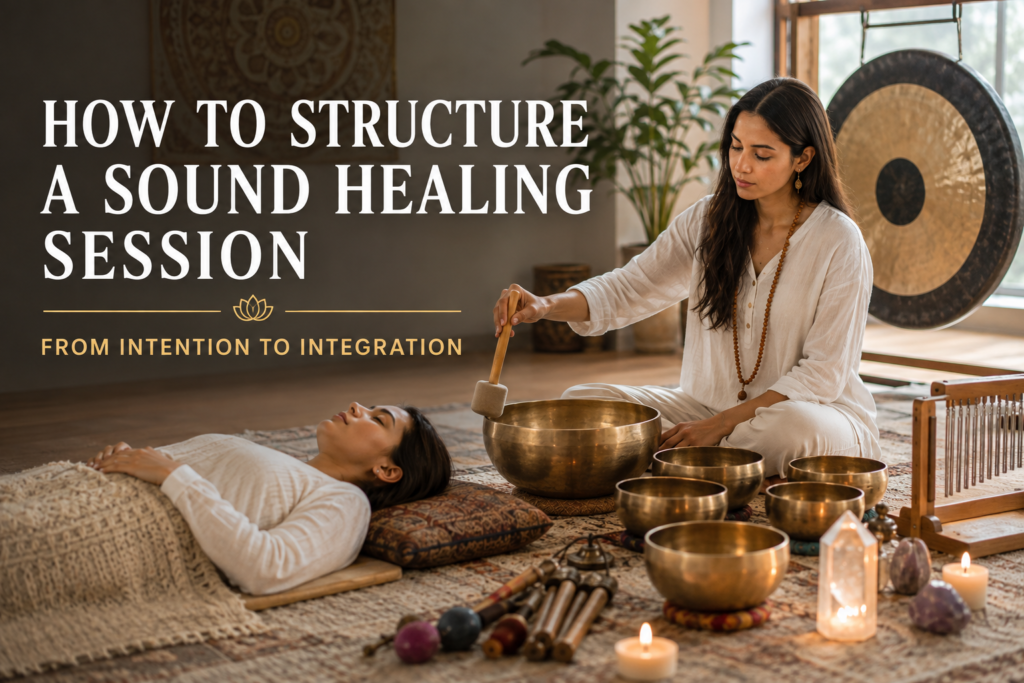
A sound healing session can appear simple from the outside. A practitioner may sit among singing bowls, gongs, chimes or other instruments while participants lie down and listen. Yet creating a thoughtful session requires considerably more than knowing how to play an instrument.
The quality of a sound healing session depends on how the practitioner prepares the space, chooses the instruments, manages volume and timing, introduces sound, creates periods of silence and responds to the people in the room. The sequence matters because sound affects attention continuously. Too much sound can become tiring, while poorly planned transitions can make it difficult for participants to settle.
For anyone learning sound healing, understanding session structure is therefore an important step toward developing a responsible and consistent practice. A well-designed session gives sound a clear role from beginning to end, allowing participants to settle into the experience and return gradually to ordinary awareness.
What is a sound healing session?
A sound healing session is a guided practice in which sound is used as part of relaxation, meditation, attentive listening or contemplative work. Depending on the practitioner and setting, a session may involve singing bowls, gongs, chimes, drums, tuning forks, voice, mantra or other instruments.
The term “sound healing” is used broadly, so the actual format can vary considerably. Some sessions focus primarily on relaxation and sound meditation, while others incorporate breathwork, guided meditation, yoga or other practices.
It is also important to distinguish a sound-based wellness session from medical treatment. Research on singing bowls has reported promising findings around outcomes such as anxiety, mood and relaxation, but systematic reviews also point to limitations in the current evidence and the need for better-designed studies.
For this reason, a sound healing practitioner should describe the practice realistically. Sound can be used to create an environment for relaxation, meditation and attentive listening without making claims that go beyond the available evidence.
Why session structure matters
A collection of instruments does not automatically create a coherent sound healing session.
Imagine entering a room where several instruments are being played at different volumes without a clear sequence. Even if each instrument sounds beautiful individually, the overall experience may feel crowded or difficult to follow.
A structured session provides a sense of progression. The practitioner can move from quieter sounds toward fuller resonance, introduce instruments gradually and allow enough time between sounds for participants to notice what they are hearing.
A useful sound healing session generally considers several elements:
- The intention of the session
- The needs and expectations of the participants
- The physical environment
- Instrument selection
- Volume and intensity
- Duration
- Transitions
- Silence and rest
- The closing process
These elements work together. Changing one can influence the experience of everything that follows.
1. Begin with a clear intention
Before choosing an instrument, determine what the session is intended to support.
The intention might be relaxation, meditation, attentive listening, grounding or creating a quiet space for reflection. A group sound bath may have a broad intention, while an individual session can be adapted more closely to the participant and the setting.
The intention does not need to be complicated.
A practitioner might decide that the session will focus on slowing down after a demanding day. Another session might be designed around meditation and sustained listening. A session following a yoga practice may have a quieter closing phase to help participants transition from movement into stillness.
Having a clear intention helps guide practical decisions about the soundscape.
It also prevents the practitioner from using instruments simply because they are available.
2. Prepare the space
The room is part of the sound healing experience.
Before participants arrive, consider the acoustics, seating or lying arrangements, lighting, temperature and potential sources of interruption. Hard surfaces can create strong reflections and reverberation, while softer materials tend to absorb more sound.
The size and shape of the room also influence how instruments are perceived.
A gong that feels appropriate in a large room may become overwhelming in a smaller space. Similarly, a singing bowl placed close to a participant may sound very different from the same bowl played from several metres away.
Consider these practical details
Before beginning, check:
- Where participants will lie or sit
- Where each instrument will be positioned
- Whether everyone can hear comfortably
- Whether the room has excessive echo
- Whether outside noise is likely to interrupt the session
- Whether the temperature is comfortable
- Whether participants have enough space to settle without feeling crowded
A calm environment does not require a perfectly silent room. The objective is to create conditions in which participants can comfortably direct their attention toward the practice.
3. Help participants settle
The beginning of a sound healing session should generally give participants time to arrive physically and mentally.
This might involve a short explanation of what will happen, a few minutes of quiet breathing or a simple guided relaxation. Participants should know that they can adjust their position, open their eyes or leave the practice if they become uncomfortable.
This introductory period is important because people rarely enter a session with identical levels of attention.
One participant may arrive relaxed. Another may have spent the previous hour in traffic or working on a demanding task.
A gradual beginning gives everyone an opportunity to settle before the sound becomes the main focus.
4. Introduce sound gradually
Once participants are settled, the practitioner can begin introducing sound.
Starting gently allows people to become familiar with the acoustic environment. A single singing bowl, soft chime or quiet vocal tone can provide a simple point of attention before additional instruments are introduced.
The first sound also establishes the volume of the session.
This is especially important with instruments capable of producing significant acoustic energy, such as gongs and large drums. Starting at a high intensity leaves little room to build the experience.
A gradual progression provides greater control.
Why volume matters
Volume is one of the simplest aspects of sound healing to overlook.
An instrument can sound beautiful at a moderate level and uncomfortable when played too loudly or too close to someone. Participants also differ in their sensitivity to sound, so a volume that feels comfortable to one person may feel excessive to another.
A responsible practitioner should therefore treat volume as an essential part of session design rather than as an afterthought.
5. Choose instruments according to their role
Each instrument contributes a different quality to the soundscape.
Singing bowls can provide sustained tones and resonances that work well during quieter sections. Gongs can introduce broader and more complex layers of sound. Chimes create lighter, shorter sounds that can be useful during transitions. Drums can introduce rhythm and grounding, while the human voice can connect sound directly with breath and language.
A practitioner does not need to use every instrument available.
In fact, limiting the number of instruments can often create a clearer experience.
Common sound healing instruments
| Instrument | Possible role in a session |
|---|---|
| Singing bowls | Sustained tones, resonance and gentle transitions |
| Gong | Broad, layered and evolving sound |
| Chimes | Light transitions and moments of release |
| Drum | Rhythm, pulse and grounding |
| Tuning forks | Focused tones and listening exercises |
| Voice | Mantra, toning, chanting and breath-related practices |
| Tanpura | Continuous drone and tonal listening |
The purpose of this table is not to assign fixed effects to each instrument. A practitioner can use the same instrument in different ways depending on the intention, environment and participants.
6. Create a progression through the session
A well-structured sound healing session usually has a sense of movement.
The progression does not need to be dramatic. It may be as subtle as moving from a single sustained tone into a richer combination of sounds and gradually returning to simplicity.
One possible structure could be:
- Arrival: Participants settle into a comfortable position.
- Grounding: Gentle sound or guided breathing establishes attention.
- Opening: The practitioner introduces one or two primary instruments.
- Development: Additional sounds create a fuller soundscape.
- Peak: The session reaches its greatest level of sonic activity or intensity.
- Release: The practitioner gradually reduces the number and volume of sounds.
- Silence: Participants have time to experience the absence of deliberate sound.
- Integration: Attention returns to the body, breath and surrounding environment.
This is only one framework. The exact structure can change according to the purpose and length of the session.
The role of silence in sound healing
Silence deserves as much attention as sound.
If an instrument is played continuously, the listener may have little opportunity to distinguish one sound from another. Periods of silence create contrast and allow the auditory system and attention to settle.
Silence also makes the next sound more noticeable.
This is particularly relevant when working with singing bowls or other resonant instruments. Allowing a bowl to decay naturally before introducing another sound gives participants an opportunity to hear the full duration of the resonance.
The same principle applies to a gong.
A gong does not stop sounding the moment the practitioner stops striking it. The resonance continues to develop and decay. Allowing that process to unfold can be much more effective than immediately introducing another instrument.
In this sense, silence is not simply a break between techniques. It is part of the structure of the session.
How to work with singing bowls
Singing bowls are among the most widely used instruments in contemporary sound healing.
A practitioner can create different experiences through striking, rubbing or combining techniques. The resulting sound depends on the bowl, the mallet, the playing technique, the environment and the listener’s position.
Research into singing bowl practices is growing. A 2025 systematic review identified 19 clinical studies published between 2008 and 2024 and reported potential benefits related to anxiety, depression, sleep and psychological wellbeing, while also noting the need to interpret the evidence carefully.
This makes it useful to approach singing bowls with curiosity rather than certainty.
Allow the bowl to develop naturally
One common mistake is moving too quickly from one bowl to another.
After striking a bowl, allow its resonance to develop. Listen to how the initial tone changes and how the sound gradually becomes quieter.
This creates a natural space for attentive listening.
The practitioner can then introduce another bowl when the first sound has sufficiently decayed, creating a sense of dialogue between the instruments.
How to work with a gong
A gong can produce a broad and evolving sound that occupies considerably more acoustic space than a small singing bowl.
For this reason, gong work requires particular attention to volume, distance and timing.
The instrument does not need to be played forcefully to create an interesting sound. Different areas of the gong and different striking techniques can produce different layers of resonance.
A practitioner learning gong sound healing should therefore spend time understanding the instrument itself before introducing it into a group session.
The goal is to control the instrument rather than allowing the instrument to control the session.
Using the human voice
The human voice can be one of the most direct sound healing instruments because it connects sound with breath.
Depending on the practice, a practitioner may use:
- Humming
- Toning
- Vowel sounds
- Mantra
- Sanskrit chanting
- Guided vocal breathing
Voice work can also create a natural bridge between sound healing and Nada Yoga.
In Nada Yoga, sound and attentive listening can become part of a contemplative practice. The voice provides an immediate way to explore the relationship between breath, vibration, pitch and awareness.
For practitioners studying sound in the context of yoga, this can open a broader understanding of why sound does not have to come from an external instrument to become part of a meditative practice.
Sound healing and the listener’s attention
The experience of a sound healing session depends partly on what the listener brings to it.
Expectation can influence perception. Previous experiences with music or meditation can shape how someone responds to a particular sound. Cultural associations can also influence whether a person finds a sound calming, meaningful, unfamiliar or distracting.
This is one reason there is no single sound that will produce exactly the same experience for every participant.
A practitioner should therefore avoid presenting a particular frequency, instrument or musical note as though it has an identical effect on everyone.
The role of the practitioner is to create appropriate conditions for listening rather than dictate what participants should experience.
Individual sound healing sessions and group sound baths
Sound can be used in both individual and group settings, but the structure changes according to the format.
Individual sessions
An individual session allows greater personalisation. The practitioner can adjust the choice of instruments, volume, positioning and duration according to the participant’s comfort and the purpose of the session.
This format can also allow more conversation before and after the practice.
Group sound baths
A group sound bath requires greater attention to the shared environment. Participants may have different levels of experience and different sensitivities to sound.
The practitioner therefore needs to consider:
- Room size
- Instrument placement
- Overall volume
- Clear instructions
- Transitions
- Duration
- Participant comfort
A group session can create a strong shared listening environment, but it also requires the practitioner to design the experience so that no individual participant is overlooked.
Common mistakes in sound healing sessions
Learning how to use sound effectively involves understanding what to avoid as well as what to practise.
Using too many instruments
More instruments do not automatically create a richer experience. When too many sounds are introduced without a clear reason, the soundscape can become difficult to follow.
Playing too loudly
Intensity should have a purpose. Excessive volume can create discomfort and make relaxation difficult.
Removing silence from the session
Continuous sound can become tiring. Allowing instruments to decay naturally and creating quiet spaces gives participants time to process what they are hearing.
Treating every participant the same
People have different experiences with sound. A practitioner should remain attentive to verbal and non-verbal signs of discomfort and allow participants to adjust their position or step away when needed.
Making unsupported healing claims
Sound healing can be presented as a relaxation, meditation or wellbeing practice without claiming that a particular frequency or instrument can cure a medical condition.
Research into singing bowls and related sound practices is developing, but the evidence remains limited and heterogeneous. Current reviews support continued research rather than definitive claims about clinical treatment.
How to close a sound healing session
The closing stage deserves as much attention as the opening.
After a period of sustained sound, suddenly stopping the session and asking participants to sit up can feel abrupt. A gradual return gives the body and attention time to transition.
The practitioner might allow a few minutes of silence before introducing a soft closing sound. Participants can then be guided to notice their breathing, physical surroundings and contact with the floor.
A simple closing sequence can include:
- Allowing the final instrument to fade naturally.
- Sitting in silence for several minutes.
- Bringing attention back to the breath.
- Inviting gentle movement of the hands and feet.
- Allowing participants to sit quietly before leaving the practice.
- Offering water and an opportunity to share their experience if appropriate.
The aim is not to tell participants what they should have experienced. It is to give them space to notice their own experience.
Integration is part of the practice
A sound healing session does not necessarily end when the final instrument becomes silent.
The period immediately afterward can be useful for reflection.
Participants may notice changes in their level of relaxation, their attention or simply their perception of the surrounding environment. Some may want to sit quietly, while others may prefer to move and talk.
There is no need to force a particular response.
For practitioners, this is also an opportunity to develop better session design. Listening to participant feedback can reveal whether the volume was comfortable, whether the pacing felt natural and whether the closing gave enough time for integration.
Over time, these observations can help a practitioner develop a more refined approach.
What should you learn before conducting sound healing sessions?
Playing an instrument is only one part of becoming a sound healing practitioner.
A well-rounded approach also requires an understanding of how to work with people and how to create a safe, coherent session.
Important areas of study include:
- Basic acoustics and sound perception
- Instrument techniques
- Session planning
- Listening and observation
- Meditation and relaxation practices
- Group facilitation
- Participant communication
- Space and instrument placement
- Appropriate use of volume
- Ethical boundaries
- Practical considerations and safety
This is where structured sound healing teacher training can become valuable. A dedicated programme can give students time to practise instruments, observe sessions, experiment with sequencing and receive feedback from experienced teachers.
For students interested in studying these practices within the broader traditions of yoga and Indian sound, a sound healing teacher training in Rishikesh can also provide exposure to mantra, meditation, Nada Yoga and Indian musical traditions alongside contemporary sound practices.
Building your own sound healing practice
There is no single formula that every practitioner needs to follow.
The strongest sessions usually develop from a clear understanding of the purpose, the participants and the instruments rather than from copying a fixed sequence.
A useful starting framework is:
- Define the intention. Know what the session is designed to support.
- Understand the participants. Consider experience, comfort and individual needs.
- Prepare the space. Pay attention to acoustics, positioning and potential distractions.
- Select a small number of instruments. Choose them according to their role within the session.
- Create a progression. Move deliberately between quieter and fuller sections.
- Use silence. Allow sounds to develop and decay rather than filling every moment.
- Observe the room. Adjust volume, pacing or technique when necessary.
- Close gradually. Give participants time to return their attention to the body and surroundings.
- Reflect afterward. Use your observations and participant feedback to improve future sessions.
This framework leaves room for creativity while maintaining a clear structure.
Final thoughts
A good sound healing session is built through many small decisions.
The practitioner chooses when to introduce a sound, how loudly to play it, how long to let it resonate and when to leave the room quiet. The instruments matter, but so do the space, the pacing, the listener and the intention behind the session.
Research into sound-based practices continues to develop. Recent reviews of singing bowl research suggest potential benefits in areas such as relaxation, anxiety and psychological wellbeing, while also highlighting limitations in the quality and consistency of existing studies.
That makes careful practice especially important.
Sound healing does not need exaggerated promises to be meaningful. A thoughtfully structured session can give people an opportunity to slow down, listen carefully and spend time in a quieter state of attention.
For the practitioner, the deeper skill lies in learning how to create those conditions with awareness.
The instruments provide the sound. The practitioner provides the structure, attention and space in which that sound can be experienced.