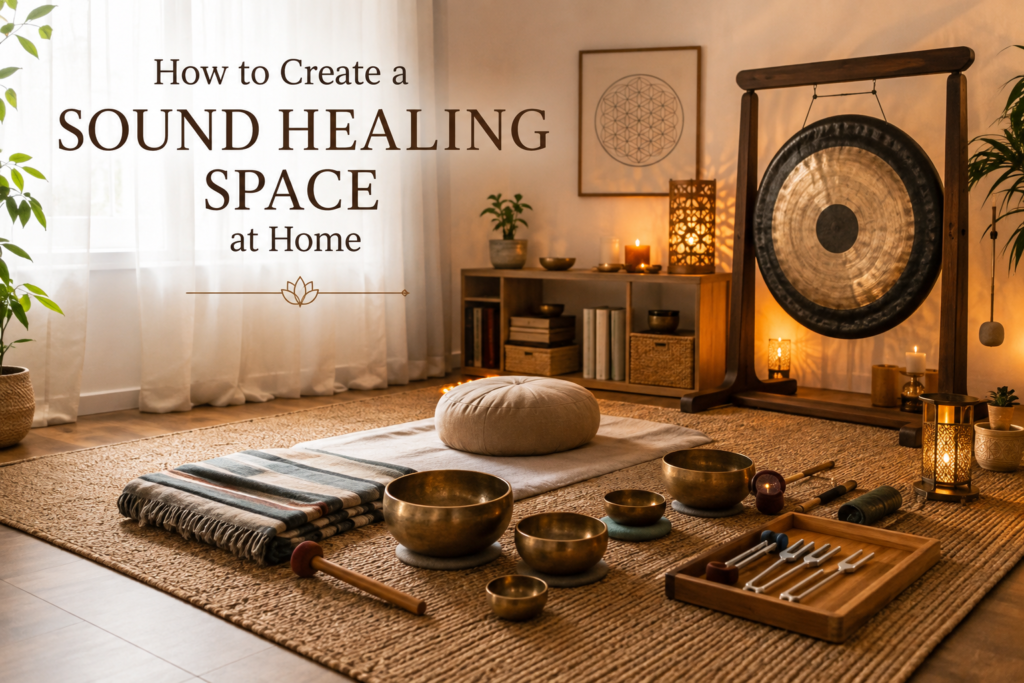
Creating a sound healing space at home does not require a large room, expensive equipment or a collection of instruments. What matters most is creating an environment where sound can be heard comfortably and where you can give your attention to the practice without unnecessary distractions.
A home sound healing space can be as simple as a quiet corner with a meditation cushion and one singing bowl. It can also become a dedicated room for regular sound meditation, personal practice or, with appropriate training and planning, professional sound healing sessions.
The way the space is arranged will influence how you experience sound. Room size, surfaces, furniture, instrument placement, lighting and background noise all contribute to the overall environment. A thoughtful setup therefore begins with the room itself rather than with the instruments.
What is a sound healing space?
A sound healing space is an area arranged specifically for sound-based practices such as sound meditation, singing bowl practice, mantra, listening exercises or sound healing sessions.
The space does not need to look like a studio. A bedroom, living room, study or quiet corner can work perfectly well if it provides enough room to sit or lie comfortably and allows you to practise without frequent interruptions.
For personal practice, the basic requirements are relatively simple:
- A comfortable place to sit or lie down
- Enough space to move safely
- One or more suitable sound healing instruments
- Reasonable control over outside noise
- Comfortable temperature and lighting
- A stable surface for instruments
- Enough quiet time to practise without interruption
The purpose is to support the practice rather than create a particular aesthetic.
Choose the right room
The first decision is where your sound healing space will be located.
If you have several rooms available, choose the one that offers the best combination of privacy, comfort and acoustics. A visually beautiful room may be less suitable if it faces a busy road or has strong echoes.
Consider the surrounding noise
External noise does not need to disappear completely. In most homes, that would be unrealistic. However, constant interruptions can make meditation and attentive listening difficult.
Before choosing a room, spend a few minutes listening at different times of day. Morning traffic, construction, neighbours, household appliances and street activity can all change the acoustic environment.
If possible, choose a time for practice when the surrounding environment is relatively quiet.
Consider the size of the room
The size of the room matters because sound behaves differently in a small room and a large one.
A small room can make certain instruments feel much more intense because reflections are concentrated within a limited space. A larger room may provide greater acoustic space but can require more careful positioning of instruments and participants.
There is no ideal room size for every sound healing practice. The important thing is to understand how your instruments behave within the room you have.
Pay attention to room acoustics
Room acoustics are often overlooked when people create a sound healing room.
Sound reflects from hard surfaces such as walls, ceilings, floors, windows and large pieces of furniture. Soft furnishings such as curtains, rugs, cushions and upholstered furniture can absorb some of that energy.
An empty room with hard surfaces may therefore sound very different from the same room after adding a rug, curtains and other furnishings.
A practical way to improve the acoustics
You do not necessarily need specialist acoustic equipment for a personal home setup. You can begin with ordinary household materials.
Consider using:
- Rugs or floor coverings
- Curtains
- Cushions and blankets
- Upholstered furniture
- Bookshelves
- Soft wall furnishings
The objective is not to eliminate every reflection. Some natural resonance can be pleasant and musically useful. The aim is to create an environment where sound remains comfortable and distinguishable rather than becoming excessively reverberant.
Decide how you will use the space
The design of a home sound healing space depends largely on what you intend to do there.
A space for personal meditation has different requirements from a room used for individual sessions, and a professional sound bath for several participants requires still more planning.
For personal sound meditation
You may only need:
- A meditation cushion or yoga mat
- One or two instruments
- A comfortable place to sit or lie down
- A small storage area
- Enough open floor space
There is little reason to fill the room with instruments simply because they are available.
A single singing bowl can provide plenty of material for a focused listening practice.
For individual sound healing sessions
If you plan to work with another person, allow enough space for the participant to lie down comfortably while leaving room for you to access the instruments.
Think about where the participant’s head and feet will be positioned, where instruments will sit and how easily you can move without stepping over the person.
The arrangement should also allow you to maintain a comfortable distance from the participant when playing louder instruments.
For small group sound baths
A group setup requires more floor space and greater attention to the room’s acoustics.
Participants should be able to lie down without being crowded together, and the practitioner needs enough room to reach the instruments safely.
The number of people should be determined by the size and acoustic characteristics of the room rather than by simply trying to fit as many participants as possible.
Choosing sound healing instruments for your space
Once the room is established, you can decide which instruments are appropriate.
There is no requirement to own every instrument used in sound healing. In many cases, learning one or two instruments thoroughly is more useful than collecting many instruments without understanding how they behave.
Singing bowls
Singing bowls are particularly practical for home use because they can produce sustained tones while requiring relatively little space.
They can be struck or played around the rim, depending on the bowl and technique. Their sound also changes according to the room, the playing method and the listener’s position.
For a small sound meditation space, one well-understood singing bowl can be a useful starting point.
Gong
A gong requires more consideration because of its size and acoustic intensity.
Before adding a gong to a home sound healing room, consider the room dimensions, its distance from walls and the comfort of anyone who will be listening. A large gong in a small room can create a much stronger acoustic experience than expected.
The instrument should therefore be selected according to the space rather than the other way around.
Chimes and bells
Chimes and bells can provide lighter sounds and can be useful for transitions within a session. They also take relatively little space, making them practical additions to a smaller home setup.
Tuning forks
Tuning forks occupy very little physical space and can be used for focused listening practices. Because their sound is relatively concentrated, practitioners should understand appropriate technique and positioning before using them in sessions with other people.
Voice
Your own voice is also an important sound healing instrument.
Humming, toning, vowel sounds and mantra can all become part of a sound-based practice without requiring any equipment. This also creates a natural connection between sound healing, meditation and Nada Yoga, where sound and attentive listening have an important place.
Where should you place your instruments?
Instrument placement affects both convenience and sound.
Frequently used instruments should be easy to reach, while larger or heavier instruments should be positioned securely so that they cannot fall or become a hazard.
A simple arrangement can follow a few practical principles:
- Keep frequently used instruments within easy reach. This prevents unnecessary movement during a session.
- Give larger instruments enough space. Gongs and larger drums need room around them for safe playing.
- Keep instruments on stable surfaces. A singing bowl should not be placed where it can easily be knocked over.
- Consider the direction of sound. Experiment with positioning to understand how reflections from walls and furniture change the sound.
- Keep pathways clear. This becomes especially important if participants are lying on the floor.
- Protect delicate instruments. Store them where they will not be exposed to unnecessary moisture, dust or accidental impact.
The arrangement should allow you to move naturally through the practice rather than requiring constant adjustment.
Create a comfortable visual environment
Sound is the primary focus of the space, but visual surroundings still influence how comfortable people feel.
A sound healing room does not need elaborate decoration. Excessive visual stimulation can make a space feel busy, particularly when participants are expected to remain still for an extended period.
A simple environment with comfortable lighting and uncluttered surfaces is often sufficient.
Natural light can work well during daytime sessions, while softer artificial lighting may be useful in the evening. The important consideration is comfort rather than creating a particular style.
The same principle applies to temperature. Participants who are lying still for an extended period may feel cooler than expected, so blankets can be useful.
Make the space comfortable for longer sessions
A sound healing session may involve participants lying down for thirty minutes, an hour or longer. Small details that seem insignificant at the beginning can become important after remaining in one position for an extended period.
Consider providing:
- Yoga mats
- Cushions or bolsters
- Blankets
- Eye pillows if appropriate
- Comfortable head support
- Adequate floor space
The objective is to make it possible for participants to remain comfortable without constantly adjusting their position.
For personal practice, use whatever supports your own body. Comfort allows attention to remain with the sound rather than being dominated by physical discomfort.
Create a simple sound meditation routine
Once the room is prepared, you can begin developing a regular practice.
A home sound healing setup does not need to be used only for formal sessions. It can become a consistent place for sound meditation and attentive listening.
A simple practice might follow this sequence:
- Prepare the room. Reduce unnecessary noise and arrange your instrument.
- Settle into a comfortable position. Give yourself a few minutes before introducing sound.
- Begin with one sound. Strike or play the instrument gently and listen to its full resonance.
- Allow the sound to fade. Avoid immediately introducing another sound.
- Observe the silence. Notice the transition between sound and silence.
- Repeat gradually. Continue for several minutes without rushing.
- Finish quietly. Spend a few minutes sitting or lying in silence before returning to other activities.
This approach is intentionally simple. It allows you to become familiar with the instrument and your own response to sound before introducing more complex techniques.
Silence belongs in the sound healing space
A common mistake when setting up a sound healing practice is assuming that the room should be filled with sound throughout the session.
Silence is an important part of the experience.
When a singing bowl is struck, its resonance continues after the initial impact. When a gong is played, the sound continues evolving after the mallet has stopped moving. Allowing these sounds to decay naturally creates space for listening.
Silence also provides contrast.
If sound is continuous, individual sounds can begin to merge into the background. When periods of silence are introduced, the next sound becomes easier to notice.
For this reason, the space should not only accommodate instruments. It should also accommodate quiet.
What to avoid in a home sound healing setup
Creating a dedicated space can be enjoyable, but adding more equipment does not necessarily improve the practice.
A few common problems are worth considering.
Too many instruments
A room filled with instruments can look impressive while making the actual practice more complicated. Start with instruments you understand and use regularly.
Excessive volume
A small room can amplify the perceived intensity of certain instruments. Begin conservatively and adjust according to the space and the listener’s comfort.
Excessive visual decoration
Candles, crystals, artwork, fabrics and other decorative elements may be meaningful to some practitioners, but they are not requirements for sound healing. A cluttered environment can also make cleaning, movement and instrument placement more difficult.
Poor ventilation
Participants may remain in the room for an extended period, so fresh air and a comfortable temperature are important.
Ignoring the acoustics
A room can look peaceful and still sound harsh or excessively reverberant. Spend time listening to the room before investing in additional instruments.
Can you create a sound healing space in a small apartment?
Yes. A dedicated room is useful, but it is not essential.
A quiet corner of a bedroom or living room can become a functional sound meditation space. A foldable mat, a small storage box and one or two instruments may be enough.
The main challenge in a small home is often controlling sound rather than finding physical space.
If you live in an apartment, consider the time of day when you practise, the proximity of neighbours and the volume of your instruments. A small singing bowl may be much more practical than a large gong if you share walls with other residents.
The best home sound healing setup is therefore the one that fits the actual conditions of your home.
Creating a space for professional sound healing sessions
There is a difference between creating a personal sound meditation space and preparing a room for professional sessions.
When other people become part of the practice, the practitioner has additional responsibilities. The room needs to accommodate different bodies, comfort levels and responses to sound. Instrument volume and placement become more important, and the practitioner needs to know how to structure a session rather than simply play instruments.
A professional space should therefore consider:
- Participant comfort and accessibility
- Acoustic conditions
- Instrument placement
- Session duration
- Volume control
- Clear communication
- Practical safety
- Privacy
- Cleaning and maintenance
- Appropriate professional boundaries
For people who want to learn sound healing, structured education can help develop these skills alongside instrument practice. A sound healing course may introduce the foundations of sound, instruments and meditation, while comprehensive sound healing training can go further into session design and practical facilitation.
Those looking for a more structured professional pathway may consider a specialised sound-based teacher training course. For students interested in studying sound within the broader environment of yoga and Indian musical traditions, a sound healing teacher training in Rishikesh can provide an opportunity to explore contemporary sound healing alongside meditation, mantra and traditional sound practices.
How to develop your home practice over time
There is no need to build the perfect room from the beginning.
Start with the space you have and observe how it works.
After several sessions, you may notice that one wall creates too much reflection, that a particular instrument feels too loud in one position or that participants would be more comfortable with additional floor support.
These observations are more useful than following a rigid checklist.
As your practice develops, you can gradually make changes based on actual experience:
- Start with the essentials. Create a comfortable place to sit or lie down and choose one or two instruments.
- Listen to the room. Notice how sound behaves at different volumes and from different positions.
- Improve the acoustics. Add rugs, curtains or furnishings if the room feels excessively reflective.
- Develop your instrument skills. Learn how each instrument responds to different techniques.
- Refine the session structure. Experiment with pacing, transitions and silence.
- Add equipment selectively. Introduce new instruments when they serve a clear purpose.
- Review the experience. Pay attention to what feels comfortable and what creates unnecessary distraction.
This gradual approach keeps the focus on developing a practice rather than accumulating equipment.
A sound healing space is ultimately a place for listening
A well-designed sound healing space does not need to resemble a professional studio. It does not need a particular colour scheme, a large collection of instruments or an elaborate collection of decorative objects.
The essential elements are much simpler: a comfortable environment, suitable acoustics, appropriate instruments and enough quiet time to practise with attention.
As your experience grows, the space can become more specialised. You may add instruments, improve the acoustics or create a room suitable for working with other people. The decisions will become easier once you understand how sound behaves and how you want to use it.
For anyone beginning a sound healing practice at home, the best place to start is therefore not with buying more equipment. Start by listening to the room you already have.
Notice how sound travels through it. Notice where it becomes harsh or soft. Notice how much resonance remains after an instrument is played. Then make changes according to what you actually hear.
A sound healing space begins with the room, but its real purpose is to create the conditions in which listening can become a practice.