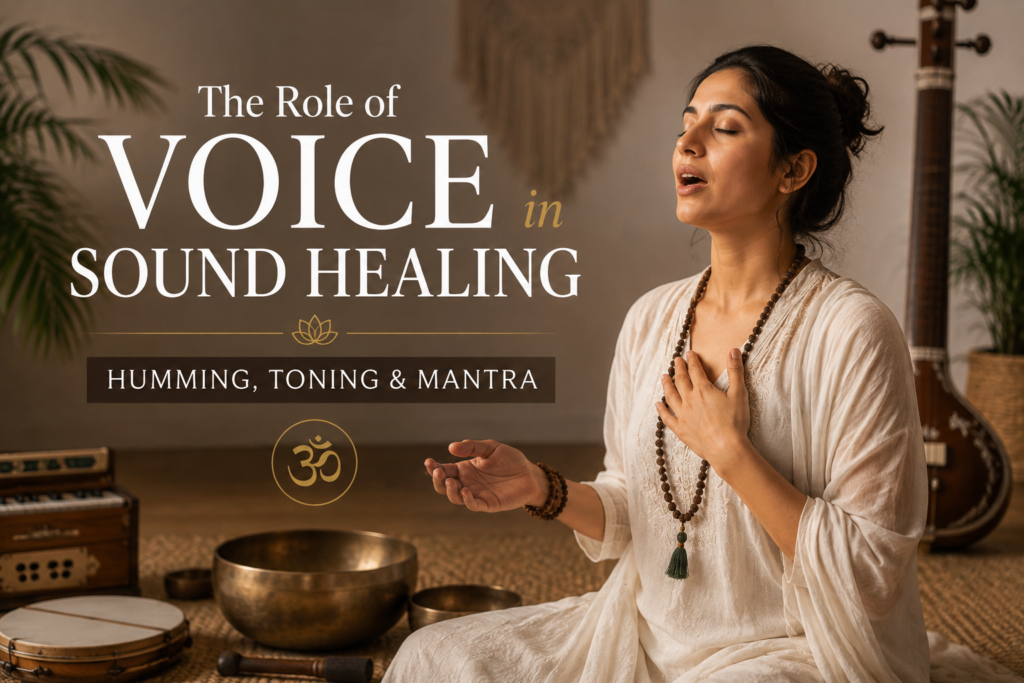
The human voice is one of the most accessible tools for working with sound. It requires no instruments and naturally brings together breath, vibration, listening and attention. For this reason, vocal practices such as humming, toning, chanting and mantra have a valuable place in many sound-based traditions.
Modern sound healing often focuses on singing bowls, gongs, tuning forks and chimes. These instruments offer a wide range of tones and textures, yet the voice creates a different kind of relationship with sound. When we use the voice, we produce the sound, hear it and experience the physical process of creating it at the same time.
This makes vocal practice particularly relevant to sound healing, meditation and Nada Yoga. It also raises practical questions about how to use the voice, how different techniques work and where traditional practices such as mantra fit within a contemporary sound healing practice.
What is vocal sound healing?
Vocal sound healing refers to the use of the human voice within practices that explore sound, relaxation, meditation and attentive listening. Depending on the approach, a session may include humming, sustained vowel sounds, vocal toning, chanting or mantra.
The term “sound healing” covers a wide range of practices, so it helps to define what a particular session aims to offer. A practitioner may use the voice to create a space for relaxation, focused listening or meditation without presenting the practice as a treatment for a medical condition.
Several factors shape the experience of vocal sound. Pitch, volume, duration, resonance, breathing, room acoustics and attention all play a role. Individual responses can also differ, which means that the same vocal practice may feel different from one person to another.
For a sound healing practitioner, this makes the voice a useful way to explore the relationship between sound, breath and attention.
Why is the human voice different from an instrument?
An external instrument creates some distance between the practitioner and the sound. When a practitioner strikes a singing bowl, for example, the bowl produces the sound and that sound travels through the surrounding space before reaching the listener.
The voice creates a much closer relationship. When you hum or sustain a vowel, your body produces the sound while your ears receive it. You can also notice physical sensations associated with vocalisation and breathing.
This direct connection makes vocal practice particularly interesting for meditation. The practitioner does not need to operate a separate instrument while listening to it. Instead, the body becomes part of the sound-producing process.
Small changes can become easier to notice as a result. A shift in pitch changes the character of the sound, while a change in breath affects its duration. The shape of the mouth can also alter the resonance.
Humming as a simple sound practice
Humming provides one of the simplest ways to begin exploring the voice. A gentle hum creates a continuous sound without requiring advanced musical training, and the practitioner can easily adjust its pitch and volume.
The practice can remain very simple. Rather than trying to produce a particular effect, you can use the sound as an object of attention and observe how it develops.
During a humming practice, you might notice:
- How the sound changes as the breath moves
- The quality of the resonance
- Subtle changes in pitch
- The difference between soft and louder humming
- Physical sensations created by vocalisation
- The transition from sound into silence
Comfort should remain the priority. Humming should feel natural, and the practitioner should avoid forcing the throat or holding the breath to extend the sound.
What is vocal toning?
Vocal toning involves producing sustained vocal sounds, often through simple vowel sounds rather than words or melodies. A practitioner might sustain sounds such as “Ah,” “Oh” or “Mm” at a comfortable pitch while allowing the breath to move naturally.
Toning encourages close attention to the qualities of the voice. Instead of following a melody or singing lyrics, the practitioner can focus on the sound itself and notice how it changes throughout the breath.
This gives toning a different character from ordinary singing. Singing may involve melody, rhythm, lyrics and musical structure, while toning can remain much more open and sustained.
For someone learning sound healing, toning can provide a straightforward introduction to working with the voice.
How to practise simple vocal toning
A basic toning practice requires very little preparation. You can practise while sitting comfortably in a quiet space or include it within a longer meditation or sound healing session.
- Find a comfortable position. Sit upright or lie down while keeping the breath easy and natural.
- Settle your breathing. Take several quiet breaths before introducing sound.
- Choose a comfortable tone. Use a pitch that feels natural rather than trying to reach a specific frequency.
- Begin softly. Sustain the tone only for as long as the breath remains comfortable.
- Listen carefully. Notice the quality, resonance and changes within the sound.
- Let the sound end naturally. Allow a short period of silence before repeating it.
- Continue without forcing. Keep the practice comfortable and give attention to the quality of listening.
With regular practice, you may become more familiar with your natural vocal range and discover how different vocal techniques change the sound.
The relationship between voice and breath
Voice and breath work together naturally. Every sustained vocal sound requires a flow of air, which gives vocal practice a direct connection with breathing awareness.
When you sustain a tone, you can notice how the sound changes as the breath continues. The final part of an exhalation may sound different from the beginning, while changes in breathing can affect the steadiness of the voice.
This observation can make vocal practice useful alongside meditation and pranayama. Rather than treating breath and sound as separate subjects, the practitioner can explore how they influence one another.
For yoga practitioners, this relationship also provides a practical connection between breath awareness, vocal work and concentration.
Mantra and the use of the voice
Mantra occupies a distinct place within yogic and Indian spiritual traditions. Many mantras belong to established practices of meditation, devotion and ritual, and their pronunciation, rhythm, meaning and context can all hold significance.
A mantra may consist of a single syllable, a word or a longer phrase. Depending on the tradition, practitioners may repeat it aloud, softly or mentally.
Repetition gives the mind a consistent object of attention. Instead of moving from one thought or subject to another, the practitioner returns to the same sound repeatedly.
This makes mantra relevant to meditation, but it should not be reduced to a generic sound healing technique. Traditional mantra practices have their own methods and contexts. Learning the pronunciation and understanding the tradition behind a mantra can therefore be an important part of responsible practice.
Mantra and Nada Yoga
Mantra and Nada Yoga share an interest in sound and attentive listening, although they represent distinct practices.
Nada Yoga explores sound and listening within a yogic and contemplative framework. Mantra provides a structured form of repeated sound that can support concentration, meditation and devotional practice.
The voice creates a direct way to explore this relationship. When a practitioner chants a mantra, they produce the sound and listen to it at the same time. Repetition can gradually make the sound familiar, allowing attention to move toward details such as pronunciation, rhythm, pitch and resonance.
For students undertaking Nada Yoga teacher training, vocal practice can therefore provide an important area of study. It offers a practical way to investigate how sound, listening and attention interact within a broader yogic practice.
Listening to your own voice
One of the most interesting aspects of vocal practice is the relationship between producing a sound and listening to it.
When you play a singing bowl, the bowl remains outside your body. With the voice, the source of the sound is directly connected with your own breathing and physical action.
As a result, small changes can become noticeable. A change in mouth position can alter resonance. A different pitch changes the character of the tone. Adjusting the breath affects the length and steadiness of the sound.
This makes the voice an instrument that can be explored through direct experience.
The practice also encourages a different kind of listening. Instead of concentrating only on whether the sound is “good” or “correct,” the practitioner can observe how it changes from one moment to the next.
Using the voice in a sound healing session
A practitioner can introduce vocal techniques into a structured sound healing session in several ways. Humming or gentle toning can provide a simple opening before the practitioner introduces external instruments. The voice can also become part of a meditation or provide a gradual transition toward silence at the end of a session.
A session might include:
- A period of quiet breathing
- Gentle humming
- Vocal toning
- Singing bowls
- Gong or chimes
- Mantra or chanting where appropriate
- Periods of silence
- A closing meditation
The practitioner should select each element according to the purpose of the session. Adding several techniques simply to create variety can make the experience feel crowded.
Participant comfort also deserves attention. Some people enjoy making sound in a group, while others prefer to listen. A well-structured session should allow participants to engage within their own comfort level.
The importance of volume and comfort
The voice does not need to be loud to become useful within sound practice. Increasing volume simply to make the sound feel stronger can create tension and vocal fatigue.
A comfortable vocal practice should stay within the practitioner’s natural range. If the throat feels strained or the breath becomes uncomfortable, the practitioner should reduce the intensity or take a break.
Group sessions require the same care. Participants have different vocal ranges and levels of experience, so a teacher should avoid asking everyone to reach a particular pitch or volume.
The quality of a vocal practice depends on control and awareness rather than sheer volume.
Common mistakes in vocal sound healing
Working with the voice may seem straightforward, but a few common mistakes can affect the quality of the practice.
Forcing the voice
Trying to produce a lower, higher or louder sound than feels comfortable can create unnecessary tension. A relaxed and sustainable approach allows the practitioner to work with the voice for longer periods.
Focusing too much on pitch
A practitioner does not need to produce an exact pitch to explore vocal sound. Comfort, listening and awareness often provide more useful points of attention than trying to reach an arbitrary frequency.
Ignoring silence
Continuous vocalisation can become tiring. Allowing each sound to finish naturally gives the practitioner and listener time to notice the transition into silence.
Treating every vocal practice as mantra
Humming, toning, chanting and mantra have different purposes and traditions. Understanding these differences helps practitioners use each practice appropriately.
Making exaggerated claims
Sound healing practitioners should describe vocal practices carefully. Someone may experience relaxation or an emotional response during a session, but a personal experience does not establish a universal therapeutic effect.
Clear communication helps maintain a responsible approach to sound healing.
Can you practise sound healing without instruments?
Yes. The human voice allows anyone to explore sound-based practices without purchasing instruments.
A beginner can start with humming, simple toning, attentive listening or an appropriate mantra practice. This can help develop an understanding of sound and attention before investing in singing bowls, gongs or other instruments.
External instruments certainly expand the possibilities of a sound healing practice. Each instrument introduces different qualities of pitch, resonance, rhythm and texture. However, instruments are not the only way to work with sound.
The voice is always available.
For this reason, vocal practice can provide a useful starting point for anyone who wants to learn sound healing.
Learning vocal sound healing professionally
Personal exploration and professional practice require different levels of preparation. Someone practising humming or toning privately can explore these techniques at their own pace, while a practitioner working with participants needs a broader understanding of sound, communication and session structure.
A structured sound healing course in Rishikesh can introduce students to instruments, sound meditation, vocal practices and basic session design. More comprehensive sound healing training can provide opportunities to practise techniques, receive feedback and learn how to combine different approaches within a session.
For a practitioner, training provides an opportunity to move beyond simply learning how to produce sounds. It can also develop the listening, communication and session-planning skills needed to work responsibly with other people.
Developing a personal relationship with the voice
The voice becomes easier to understand through regular practice. At first, humming or toning may feel unfamiliar, and much of the attention may go toward producing the sound correctly. With time, the practitioner can shift that attention toward listening.
You may begin to notice how breath changes the sound, how resonance responds to the shape of the mouth and how different pitches feel during vocalisation. These observations do not require elaborate explanations. They simply encourage greater awareness of a familiar part of everyday life.
This makes vocal practice particularly useful for sound meditation. The voice provides an object of attention while the act of producing the sound keeps the practitioner directly involved.
The voice as a foundation for sound practice
Sound healing often introduces students to instruments first. Singing bowls, gongs, chimes and tuning forks each offer valuable ways to explore sound, but the voice provides a different starting point because it connects sound directly with breath and the body.
Humming can introduce beginners to sustained sound. Toning can develop awareness of pitch and resonance. Mantra can connect sound with repetition, language and meditation. Nada Yoga can provide a broader framework for exploring sound and listening within yogic practice.
For anyone developing a sound healing practice, learning to work with the voice can therefore complement the study of instruments and deepen an understanding of attentive listening.
The process begins with something very simple: producing a comfortable sound, listening carefully and becoming aware of what changes as you continue. Over time, that simple practice can become a valuable part of a broader approach to sound, meditation and yoga.