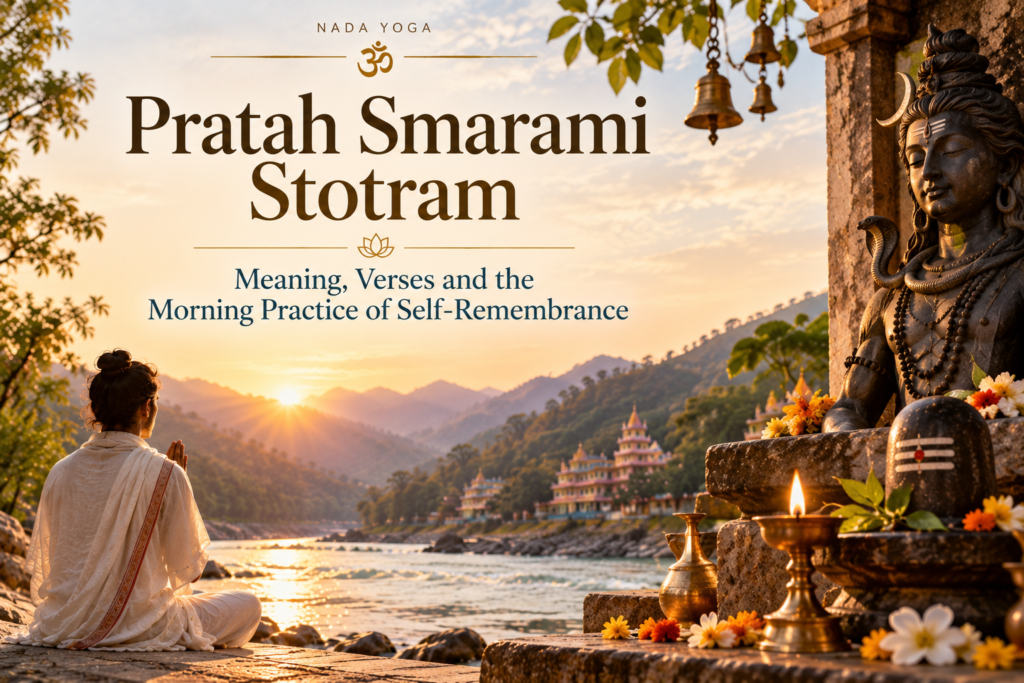
The first moments after waking often shape the direction of the day. Before conversations, responsibilities, notifications and plans begin, there is a quiet period in which attention can turn inward. The Pratah Smarami Stotram, also known as the Pratah Smarana Stotram, places this early morning awareness at the heart of spiritual practice.
Traditionally attributed to Adi Shankaracharya, this three-verse Sanskrit hymn reflects the central vision of Advaita Vedanta. Its verses contemplate the Atman, Brahman, pure consciousness, the three states of experience and the nature of reality. The hymn gradually moves from remembrance to worship and then to surrender through the words smarāmi, bhajāmi and namāmi.
For practitioners of yoga and meditation, Pratah Smarami offers a meaningful way to begin the morning. Its purpose lies in directing awareness toward the deeper Self before the ordinary identity of the day becomes active.
What is Pratah Smarami Stotram?
Pratah Smarami Stotram is a short morning prayer traditionally associated with Adi Shankaracharya. The Sanskrit word prātaḥ refers to the early morning, while smarāmi means “I remember” or “I contemplate.” The hymn is therefore connected with the practice of remembering the true nature of the Self at dawn.
The three verses explore the nature of Brahman through different forms of contemplation. The first verse turns toward the Self that remains present through waking, dreaming and deep sleep. The second contemplates the reality that lies beyond ordinary speech and thought. The third reflects on the eternal reality in which the entire world appears.
A fourth verse serves as the phalaśruti, traditionally describing the merit associated with reciting the three verses in the morning.
The hymn therefore works as a compact introduction to several important ideas within Advaita Vedanta.
Pratah Smarami Stotram in Sanskrit
Verse 1
प्रातः स्मरामि हृदि संस्फुरदात्मतत्त्वं
सच्चित्सुखं परमहंसगतिं तुरीयम् ।
यत्स्वप्नजागरसुषुप्तिमवैति नित्यं
तद्ब्रह्म निष्कलमहं न च भूतसङ्घः ॥१॥
Transliteration:
Prātaḥ smarāmi hṛdi saṃsphuradātmatattvaṃ
saccitsukhaṃ paramahaṃsagatiṃ turīyam |
yatsvapnajāgarasuṣuptimavaiti nityaṃ
tadbrahma niṣkalamahaṃ na ca bhūtasaṅghaḥ || 1 ||
The opening verse begins with remembrance. The practitioner turns attention toward the Ātma-tattva, the essential nature of the Self, described as shining within the heart.
The verse refers to sat-cit-sukha, often expressed as existence, consciousness and bliss. It also introduces turīya, the “fourth,” in relation to the familiar states of waking, dreaming and deep sleep. The verse presents Brahman as the reality that knows or remains present through these changing states.
Meaning of the first verse
The verse can be understood as a morning contemplation of the Self that remains constant while ordinary states of experience change.
Waking brings one set of experiences, dreams create another field of experience, and deep sleep provides a state in which ordinary mental activity becomes absent. The hymn directs attention toward that which is understood in Advaita Vedanta as deeper than these changing conditions.
The closing expression, tad brahma niṣkalam aham, points toward the recognition of Brahman as indivisible and beyond limitation. The verse therefore begins the practice with self-inquiry.
Verse 2
प्रातर्भजामि मनसा वचसामगम्यं
वाचो विभान्ति निखिला यदनुग्रहेण ।
यन्नेतिनेतिवचनैर्निगमा अवोचन्
तं देवदेवमजमच्युतमाहुरग्र्यम् ॥२॥
Transliteration:
Prātarbhajāmi manasāṃ vacasāmagamyaṃ
vāco vibhānti nikhilā yadanugraheṇa |
yanneti neti vacanairnigamā avocuḥ
taṃ devadevamajamacyutamāhuragryam || 2 ||
The second verse changes the language of the practice. The first verse begins with smarāmi, “I remember,” while the second uses bhajāmi, “I worship” or “I contemplate with devotion.”
Here, the object of contemplation is described as beyond the reach of ordinary mind and speech. At the same time, speech itself is said to shine through its grace. The verse then refers to the Upanishadic expression neti neti, traditionally translated as “not this, not this,” which points toward the inadequacy of limited descriptions when speaking about ultimate reality.
The final portion describes this reality through terms such as aja, unborn, and acyuta, imperishable.
Understanding the second verse
This verse brings an important dimension of Vedanta into the morning practice. Language can describe qualities, forms and experiences, while the ultimate reality described by Advaita remains beyond the boundaries of ordinary conceptual thought.
The reference to neti neti encourages a process of inquiry. A practitioner examines each limited identification and asks whether it represents the complete nature of the Self. Body, thoughts, emotions, memories and changing experiences all belong to the field of experience. The inquiry then turns toward the awareness in which these experiences appear.
For a meditation practitioner, this approach can create a quiet movement from external attention toward inner observation.
Verse 3
प्रातर्नमामि तमसः परमर्कवर्णं
पूर्णं सनातनपदं पुरुषोत्तमाख्यम् ।
यस्मिन्निदं जगदशेषमशेषमूर्तौ
रज्ज्वां भुजङ्गम इव प्रतिभासितं वै ॥३॥
Transliteration:
Prātarnamāmi tamasaḥ paramarkavarṇaṃ
pūrṇaṃ sanātanapadaṃ puruṣottamākhyam |
yasminnidaṃ jagadaśeṣamaśeṣamūrtau
rajjvāṃ bhujaṅgama iva pratibhāsitaṃ vai || 3 ||
The third verse begins with namāmi, meaning “I bow” or “I offer reverence.” The reality being contemplated is described as eternal, complete and beyond darkness.
The verse then introduces one of the well-known teaching images associated with Advaita Vedanta: the rope and snake analogy. A rope can appear to be a snake under particular conditions of perception. Once the rope is clearly recognized, the mistaken appearance is understood in relation to its underlying reality.
Similarly, the verse uses the image to describe how the world is understood within the Advaita framework as appearing in Brahman.
The rope and snake analogy in Pratah Smarami
The rope and snake image has an important place in Vedantic teaching because it demonstrates how perception can influence understanding.
Imagine seeing a rope in dim light and interpreting its shape as a snake. The fear created by that perception can feel completely real. When sufficient light reveals the rope, the perception changes through knowledge.
Pratah Smarami uses this traditional image to point toward the relationship between appearance and ultimate reality. The verse encourages contemplation of the underlying reality through which changing experiences are understood.
This teaching also explains why the hymn works particularly well as a morning meditation. Dawn itself provides a natural transition from darkness toward light, creating a simple setting for reflection on knowledge and awareness.
The three stages of Pratah Smarami
The structure of the hymn deserves attention because its three opening verbs create a gradual movement in practice.
| Verse | Sanskrit expression | Meaning | Main emphasis |
| 1 | Smarāmi | I remember | Self-awareness |
| 2 | Bhajāmi | I worship or contemplate | Devotion and inquiry |
| 3 | Namāmi | I bow | Reverence and surrender |
The progression gives the hymn a contemplative rhythm. First comes remembrance, followed by contemplation, and then reverence.
This structure can also be understood as a movement of attention. The practitioner remembers the Self, contemplates its nature and finally bows before the reality that transcends individual identity.
What does Pratah Smarami mean spiritually?
At its core, Pratah Smarami invites a practitioner to begin the day with awareness of the Self.
Ordinary morning attention quickly moves toward personal identity. A person remembers their name, responsibilities, relationships, plans and unfinished tasks. The hymn introduces another point of reference by asking the practitioner to contemplate the deeper reality described through Atman and Brahman.
Advaita Vedanta uses these concepts to investigate the relationship between individual consciousness and ultimate reality. The first verse especially brings attention to the witnessing principle associated with the three states of waking, dreaming and deep sleep.
The practice can therefore be approached as morning self-inquiry through Sanskrit prayer.
Pratah Smarami and the three states of consciousness
One of the most important philosophical ideas in the first verse is the reference to waking, dreaming and deep sleep.
During waking, the senses engage with the external world. Dreaming creates an internally experienced world shaped by the mind. Deep sleep brings a different condition in which ordinary sensory and mental activity becomes quiet.
Advaita Vedanta asks the practitioner to investigate what remains constant through these changing experiences. Pratah Smarami connects this inquiry with turīya, the “fourth” state described in Vedantic thought. The term points toward a dimension of consciousness considered distinct from the three ordinary states.
This makes the first verse especially relevant to meditation and contemplative yoga.
Why is Pratah Smarami recited in the morning?
Morning has traditionally held an important place in many Indian spiritual practices. The quiet atmosphere around dawn provides a natural opportunity for prayer, mantra, meditation and study.
Pratah Smarami uses this time to establish remembrance of the Self before the day’s activities begin. Traditional sources specifically describe the hymn as a morning recitation, and its phalaśruti states that one who recites the three verses in the morning progresses toward the supreme state.
A practitioner can therefore treat the recitation as a transition between sleep and active daily life. The words provide a contemplative direction while the rhythm of Sanskrit chanting helps gather attention.
Pratah Smarami and mantra chanting
Sanskrit chanting brings together pronunciation, breath, rhythm and attentive listening. For this reason, a stotram can become a contemplative practice when the practitioner gives full attention to the sound and meaning of the words.
Pratah Smarami has a particularly interesting relationship with Nada Yoga. Nada Yoga places deep attention on sound and listening, while the philosophical content of this stotram directs that attention toward the nature of consciousness.
At Nada Yoga School, traditional practices involving mantra, chanting, Indian classical music and Nada Yoga provide different ways of exploring the relationship between sound, attention and inner awareness.
The practice becomes especially meaningful when pronunciation and understanding work together. Listening carefully to each Sanskrit phrase allows the chant to become an experience of attentive sound rather than a mechanical repetition.
How to practice Pratah Smarami in the morning
A simple practice can begin shortly after waking. Sit comfortably in a quiet place and allow the breath to settle for a few moments. The body can remain relaxed while the attention becomes steady.
Recite the three verses slowly, giving attention to Sanskrit pronunciation and rhythm. After each verse, pause briefly and allow its meaning to settle before continuing.
The first verse can be contemplated through the question of the Self that remains present through waking, dreaming and deep sleep. The second can invite reflection on the limits of speech and thought, while the third can bring attention to the traditional rope and snake analogy.
After completing the stotram, remain seated for a few minutes. The silence after chanting can become part of the practice, allowing the sound to settle into quiet awareness.
Pratah Smarami and Advaita Vedanta
The philosophical foundation of Pratah Smarami is closely connected with Advaita Vedanta, a tradition centered on the inquiry into Brahman, Atman and the nature of reality.
The hymn repeatedly points beyond limited identification. Its first verse contemplates Brahman as the indivisible reality, the second refers to the Upanishadic method of neti neti, and the third uses the rope and snake analogy to explain appearance and underlying reality.
For this reason, Pratah Smarami can be read as a compact Vedantic meditation. Each verse gives the practitioner a different doorway into self-inquiry.
The connection between Pratah Smarami and meditation
Meditation often begins with an effort to steady attention. A traditional stotram can provide a meaningful structure for that process because the words give the mind a clear direction.
Pratah Smarami combines sound, contemplation and philosophical inquiry. The practitioner hears the Sanskrit, understands its meaning and gradually allows attention to settle on the ideas expressed through the verses.
This approach can also complement a broader yoga practice. After asana and pranayama, chanting can provide a bridge toward meditation. Likewise, a morning recitation can create a contemplative beginning before other practices or daily responsibilities.
The meaning of the final verse
The traditional phalaśruti reads:
श्लोकत्रयमिदं पुण्यं लोकत्रयविभूषणम् ।
प्रातःकाले पठेद्यस्तु स गच्छेत्परमं पदम् ॥
Transliteration:
Ślokatrayam idaṃ puṇyaṃ lokatrayavibhūṣaṇam |
Prātaḥkāle paṭhed yastu sa gacchet paramaṃ padam ||
The verse describes these three sacred verses as worthy of recitation and states that one who recites them in the morning reaches paramaṃ padam, the supreme state.
Within a traditional spiritual context, such phalaśruti verses express the value and fruit of devotional or contemplative recitation. They also complete the hymn by returning the practitioner to the purpose of the morning practice.
Pratah Smarami as a practice of remembering
The word smaraṇa, remembrance, carries particular significance in Indian spiritual traditions. Remembering can become a form of practice when it brings attention repeatedly toward a chosen truth.
Pratah Smarami applies this principle to the beginning of the day. Instead of allowing the first moments of consciousness to become completely absorbed in external concerns, the practitioner begins with remembrance of the Self.
The three verses then deepen that remembrance through contemplation, devotion and reverence. Sound gives the practice form, while meaning gives the sound direction.
Final thoughts
Pratah Smarami Stotram offers a concise morning practice rooted in Sanskrit, Vedanta and contemplative inquiry. Traditionally attributed to Adi Shankaracharya, its three verses explore the Self, Brahman, the states of consciousness, neti neti and the traditional rope and snake analogy.
Its value lies in the way the verses shape attention. The morning begins with smarāmi, remembrance, moves through bhajāmi, contemplation and devotion, and arrives at namāmi, reverence.
For those drawn to mantra chanting, meditation and Nada Yoga, Pratah Smarami offers a beautiful example of how sound can carry philosophical contemplation. Recited with clear pronunciation, attentive listening and an understanding of its meaning, the stotram can become a quiet way to begin the day with self-awareness.
Frequently asked questions
What is Pratah Smarami Stotram?
Pratah Smarami Stotram is a three-verse Sanskrit morning hymn traditionally attributed to Adi Shankaracharya. It contemplates the nature of the Self, Brahman and pure consciousness.
What does Pratah Smarami mean?
Prātaḥ smarāmi means “I remember in the morning” or “I contemplate in the early morning.” The phrase forms the opening of the first verse.
Who composed Pratah Smarami Stotram?
The stotram is traditionally attributed to Adi Shankaracharya. A traditional Advaita Vedanta source also presents it as a work of Shankaracharya.
How many verses are in Pratah Smarami Stotram?
The main hymn contains three verses. A fourth verse serves as the traditional phalaśruti, or concluding statement on the fruits of recitation.
When should Pratah Smarami be recited?
It is traditionally recited in the early morning, ideally as part of a quiet period of prayer, meditation or self-inquiry.
What is the connection between Pratah Smarami and Advaita Vedanta?
The hymn reflects several central Advaita Vedanta ideas, including Atman, Brahman, the three states of consciousness, turīya, neti neti and the rope and snake analogy.
Can Pratah Smarami be included in a Nada Yoga practice?
Yes. The stotram can be included in a practice involving Sanskrit chanting, attentive listening and meditation. Its philosophical focus also makes it suitable for contemplation after chanting, particularly within a broader Nada Yoga practice.
Is Pratah Smarami the same as Shiva Pratah Smaranam?
They are different Sanskrit hymns. Pratah Smarami / Pratah Smarana Stotram begins with prātaḥ smarāmi hṛdi saṃsphuradātmatattvaṃ and focuses on the Self and Brahman. Shiva Pratah Smaranam begins with prātaḥ smarāmi bhavabhītiharaṃ sureśaṃ and directly praises Shiva. Both are traditionally associated with Adi Shankaracharya.