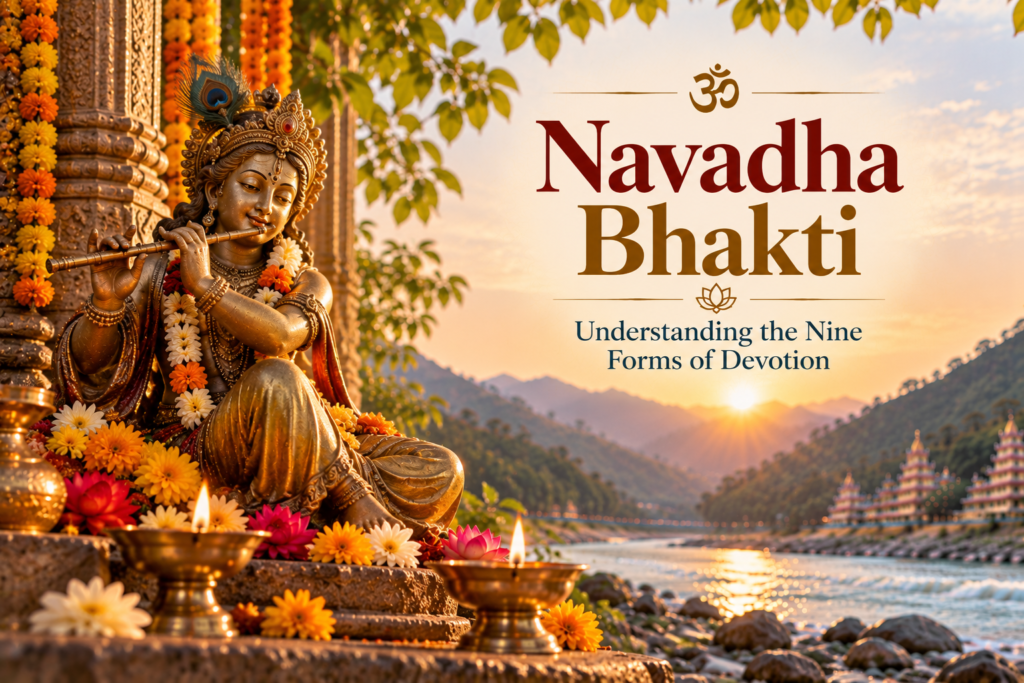
Devotion can take many forms. It can begin with listening to sacred teachings, continue through chanting and remembrance, and gradually become part of everyday actions, prayer and service. The tradition of Navadha Bhakti brings these different expressions together through nine forms of devotional practice described in the Srimad Bhagavatam.
The Sanskrit word Navadha means “ninefold,” while Bhakti refers to devotion, loving dedication and participation in the divine. Together, Navadha Bhakti describes nine traditional ways through which a devotee can cultivate a relationship with the divine.
The nine forms are Shravana, Kirtana, Smarana, Pada-sevana, Archana, Vandana, Dasya, Sakhya and Atma-nivedana. They appear in the Seventh Skandha of the Srimad Bhagavatam, where Prahlada describes these forms of devotion while speaking with his father, Hiranyakashipu.
The teaching is especially relevant to practitioners of Bhakti Yoga, mantra, kirtan and Nada Yoga because several of these practices work directly with sound, listening, remembrance and sacred recitation.
What is Navadha Bhakti?
Navadha Bhakti means the nine forms of Bhakti. The teaching is presented through Prahlada’s description of devotional practice in Srimad Bhagavatam 7.5.23-24.
The original Sanskrit verse names the nine practices:
श्रवणं कीर्तनं विष्णोः स्मरणं पादसेवनम् ।
अर्चनं वन्दनं दास्यं सख्यमात्मनिवेदनम् ॥
Śravaṇaṁ kīrtanaṁ viṣṇoḥ
smaraṇaṁ pāda-sevanam
arcanaṁ vandanaṁ dāsyaṁ
sakhyam ātma-nivedanam
The verse describes hearing and chanting about Vishnu, remembering him, serving his feet, offering worship, offering prayers, serving as a devotee, relating to him as a friend and offering everything to him.
These nine practices are often presented as separate forms, although they can naturally overlap during devotional practice. A person engaged in kirtan may also be listening, remembering and praying at the same time.
The nine forms of Navadha Bhakti
| Sanskrit | Meaning | Main expression |
| Shravana | Listening | Hearing sacred names, stories and teachings |
| Kirtana | Chanting | Singing or reciting divine names and qualities |
| Smarana | Remembrance | Keeping the divine in one’s awareness |
| Pada-sevana | Service | Serving the divine with humility |
| Archana | Worship | Offering ritual worship |
| Vandana | Prayer | Offering salutations and prayers |
| Dasya | Servanthood | Serving the divine as a devoted servant |
| Sakhya | Friendship | Developing a relationship of friendship |
| Atma-nivedana | Self-surrender | Offering oneself completely to the divine |
Each form provides a different way to cultivate devotion. Some emphasize sound and listening, while others emphasize action, worship, relationship or surrender.
1. Shravana: The practice of listening
Shravana means listening or hearing. In Navadha Bhakti, it refers to listening to the names, qualities, stories and teachings associated with the divine.
A practitioner may listen to sacred scripture, hear stories about a chosen deity, attend a spiritual discourse or listen to devotional chanting. The act of hearing becomes an active form of attention because the practitioner receives the teaching through sound and allows its meaning to settle within the mind.
The Srimad Bhagavatam places Shravana at the beginning of the ninefold list. Traditional explanations of the verse describe it as hearing about the divine name, form, qualities and activities.
This form of Bhakti has a particularly meaningful connection with Nada Yoga. Listening is central to any sound-based practice, and Shravana provides a devotional context in which attentive hearing becomes part of spiritual practice.
A practitioner listening to a mantra can pay attention to pronunciation, rhythm, pitch, resonance and meaning. Gradually, the act of listening can become more refined.
2. Kirtan: The practice of chanting
Kirtan refers to singing, chanting or glorifying the divine.
Kirtan has a strong presence across Bhakti traditions, where sacred names and devotional verses are sung individually or collectively. The voice becomes an instrument of devotion, while rhythm and melody provide a structure for sustained attention.
The relationship between Shravana and Kirtana is particularly close. A person first hears a sacred name or teaching and then gives voice to what has been heard through chanting.
This creates a natural cycle of listening and expression. The practitioner hears the sound, produces the sound and listens again.
For practitioners of Nada Yoga, Kirtans provides a direct opportunity to explore the relationship between voice, breath, pitch, rhythm and awareness.
Our Nada Yoga School organises free kirtans every tuesdays and thursdays. If you wish to be a part of it, you’re welcome at our school. Register yourself through this link: Free Kirtan in Rishikesh
3. Smarana: The practice of remembrance
Smarana means remembrance.
In Bhakti practice, Smarana refers to remembering the divine name, form, qualities or teachings. This remembrance can take place during formal meditation as well as during ordinary daily activities.
Mantra repetition can support Smarana because a sacred phrase gradually becomes familiar through repeated practice. The practitioner may repeat a mantra aloud, softly or mentally, allowing the sound and meaning to remain present in awareness.
The Srimad Bhagavatam places Smarana after Shravana and Kirtana in Prahlada’s description of the nine forms. Traditional explanations describe remembrance as continued contemplation of the divine after hearing and chanting.
This gives Smarana an important place in meditation. The mind receives a sacred form or name as an object of attention and repeatedly returns to it.
4. Pada-sevana: Service to the divine
Pada-sevana literally refers to serving the feet of the Lord. Within devotional traditions, it represents an attitude of humble service toward the divine.
The lotus feet of a deity carry rich symbolism in Indian devotional literature. They represent refuge, reverence and surrender, while serving them represents an offering of one’s actions.
Traditional explanations of the Bhagavata teaching connect Pada-sevana with devotional service according to one’s circumstances and capacity.
In a broader sense, this practice can be understood through Seva, or service offered with dedication. Caring for a temple, assisting a teacher, preparing offerings or contributing to a spiritual community can become expressions of this devotional attitude when performed as an offering.
5. Archana: Worship and offering
Archana means worship or offering.
This form of Bhakti involves expressing devotion through ritual worship. Flowers, water, incense, lamps, food and other traditional offerings can become part of the practice, depending on the particular tradition.
Archana gives physical form to devotion. The practitioner prepares an offering, performs the appropriate gestures and recites prayers or mantras while maintaining awareness of the deity being worshipped.
The Bhagavata verse specifically includes Archana among the nine forms of devotion, while traditional explanations connect it with formal worship of the deity.
The practice also demonstrates how Bhakti can engage the senses. Sight, touch, fragrance, sound and movement can all become part of a devotional ritual.
6. Vandana: Prayer and reverence
Vandana means offering salutations, prayers or expressions of reverence.
A devotee may bow before a deity, recite a stotram or offer personal prayers. The body, voice and mind can participate together in this form of devotion.
Sanskrit devotional hymns provide an important expression of Vandana. Texts such as the Shiva Mahimna Stotram, Vishnu Sahasranama and various Devi stotras allow practitioners to express reverence through sacred language and sound.
Prayer also creates a space for reflection. As the practitioner recites the words, attention can move toward the qualities represented by the deity and toward the meaning carried by the prayer.
Within a sound-based practice, Vandana also demonstrates how Sanskrit can combine meaning, pronunciation, rhythm and devotion.
7. Dasya: Devotion through service
Dasya Bhakti describes the devotional relationship in which the practitioner approaches the divine as a servant.
The Sanskrit word dasa means servant or devotee. Dasya therefore expresses humility, dedication and willingness to serve.
Hanuman is traditionally regarded as a prominent example of Dasya Bhakti through his devotion to Lord Rama. His stories throughout the Ramayana present service as an expression of complete dedication.
Dasya can also be reflected in everyday action. A practitioner can approach work, teaching, caregiving or community service with the intention of offering the action to the divine.
The emphasis rests on the attitude accompanying the action. Service becomes a spiritual practice when the practitioner performs it with dedication and reverence.
8. Sakhya: Friendship with the divine
Sakhya Bhakti means relating to the divine as a friend.
The Sanskrit word sakhya refers to friendship or companionship. This form of devotion creates a personal relationship in which the devotee experiences closeness, trust and openness toward the chosen deity.
The relationship between Krishna and Arjuna is frequently discussed in connection with friendship and spiritual companionship. Arjuna speaks openly with Krishna, asks difficult questions and receives guidance through their intimate relationship.
Sakhya Bhakti demonstrates how devotion can take a deeply personal form. The practitioner can speak inwardly to the divine, share concerns, express gratitude and seek guidance through prayer and contemplation.
9. Atma-nivedana: Complete self-offering
The ninth form is Atma-nivedana, which means offering oneself to the divine.
The Sanskrit word atma refers to the self, while nivedana carries the sense of offering, presenting or surrendering. Within Bhakti traditions, the practice represents a profound dedication of one’s life to the divine.
The Bhagavata verse describes Atma-nivedana as offering everything to the Lord. Traditional explanations associate it with dedicating one’s body, mind, words and possessions to devotional service.
This form of Bhakti brings the idea of devotion into everyday life. Actions, relationships, responsibilities and personal aspirations can all become subjects of contemplation when the practitioner approaches life as an offering.
Are the nine forms practiced in a fixed order?
The nine forms are presented in a particular order in the Srimad Bhagavatam, beginning with Shravana and ending with Atma-nivedana. That order provides a useful framework for understanding the teaching, while individual practitioners may emphasize one or several forms according to their tradition.
Traditional explanations of the Bhagavata passage also discuss the possibility of practicing one form with great dedication. The nine forms can overlap, and one devotional practice may naturally include elements of several others.
For example, a person participating in Kirtana is simultaneously hearing sacred sound. Remembering the meaning of the chant introduces Smarana, while offering the singing as worship introduces Vandana or Archana.
Navadha Bhakti therefore provides a flexible framework for devotional life.
Navadha Bhakti and sacred sound
Sound occupies an important position in the first two forms of Navadha Bhakti.
Shravana begins with hearing.
Kirtan gives sacred sound a voice.
This relationship between hearing and chanting is especially relevant to Indian spiritual traditions, where sacred knowledge has long been transmitted through oral recitation and memorization.
A practitioner of mantra can experience this relationship directly. Listening carefully to a mantra helps establish its pronunciation and rhythm, while chanting allows the practitioner to experience those sounds through the voice.
The process also encourages attentive listening. The practitioner hears the beginning of each phrase, follows its movement and notices the silence between repetitions.
Navadha Bhakti and Nada Yoga
Nada Yoga explores sound as a means of cultivating awareness. Traditional approaches to Nada Yoga can involve mantra, music, vocal practice and attentive listening.
Navadha Bhakti complements this approach through its emphasis on devotion.
Shravana provides a devotional approach to listening. Kirtana brings devotion into singing. Smarana allows the sound and meaning of the practice to remain present in the mind.
A practitioner can therefore approach a single mantra from several perspectives. The mantra can be heard as sound, repeated through the voice, contemplated through its meaning and remembered during meditation.
At Nada Yoga School in Rishikesh, practices involving Nada Yoga, Sanskrit chanting, mantra, Kirtan and Indian classical music create a broader environment for exploring this relationship between sound and awareness.
Navadha Bhakti and mantra practice
Mantra can support several forms of Navadha Bhakti at once.
When a practitioner listens to a mantra being recited, the practice becomes Shravana. When the practitioner repeats the mantra aloud, it becomes Kirtana. When the mantra continues internally after the formal chanting ends, it becomes Smarana.
A devotional mantra can also become an expression of Vandana when the words are offered as prayer.
This makes mantra a particularly versatile practice within Bhakti Yoga. Sound provides the structure, meaning gives the practice direction and devotion gives the repetition its intention.
Navadha Bhakti and Kirtan
Kirtan has a particularly strong connection with Navadha Bhakti because it combines several forms of devotion within one practice.
Participants listen to the lead singer and respond through chanting. The repeated names remain in the mind, creating an element of remembrance. The singing itself becomes an offering, while the devotional atmosphere encourages prayer and reverence.
Group Kirtan also creates a shared experience of rhythm and listening. Each participant contributes a voice while remaining attentive to the larger sound.
This makes Kirtan a natural meeting point between Bhakti Yoga, Indian music and Nada Yoga.
Navadha Bhakti in everyday life
Bhakti can extend beyond formal prayer and chanting.
Shravana can appear through listening to a spiritual teaching during the day. Smarana can arise when a practitioner remembers a mantra during a quiet moment. Seva can become part of daily responsibilities, while Vandana can take the form of a short prayer before beginning an activity.
The nine forms therefore provide different ways of bringing devotion into ordinary life.
A person may spend only a few minutes in formal practice while maintaining a devotional attitude through the rest of the day. The tradition allows spiritual practice to become connected with listening, speech, action, relationships and reflection.
A simple Navadha Bhakti practice with sound
A practitioner interested in Nada Yoga can create a simple practice around the first three forms.
Begin with Shravana by listening to a traditional mantra or devotional chant for several minutes. Give attention to the pronunciation, rhythm, pitch and resonance of the voice while allowing the meaning of the words to remain present.
Continue with Kirtana by repeating the same mantra aloud. Maintain a comfortable rhythm and allow the breath to support the sound naturally. After several repetitions, reduce the volume and eventually continue silently.
The final stage is Smarana. Let the mantra remain in the mind for a few minutes while sitting quietly. When the practice ends, allow a short period of silence before returning to ordinary activity.
This simple practice brings together listening, chanting and remembrance while creating a natural connection between Bhakti and Nada Yoga.
The deeper meaning of Navadha Bhakti
The nine forms reveal the many dimensions through which devotion can enter a person’s life. Shravana brings devotion into listening, Kirtana brings it into the voice and Smarana brings it into remembrance. Pada-sevana and Dasya express devotion through service, while Archana and Vandana give it a ritual and prayerful form.
Sakhya brings devotion into relationship through friendship and trust. Atma-nivedana takes the principle of offering into the deepest form of dedication described within this framework.
Together, these practices present Bhakti as a way of engaging the senses, mind, actions and relationships with devotional awareness.
Prahlada and the teaching of Navadha Bhakti
The teaching of Navadha Bhakti appears during an important moment in the story of Prahlada.
Hiranyakashipu asks his son to describe what he has learned from his education. Prahlada responds by describing devotion to Vishnu through the nine processes. The passage identifies these practices as a complete form of devotional service.
The story gives the teaching a memorable context. Prahlada’s devotion remains central to his character throughout the Bhagavata narrative, and the nine forms become part of the larger theological framework of Bhakti.
The passage has subsequently become one of the most frequently cited sources for the concept of Navadha Bhakti.
Navadha Bhakti and the Bhagavata Purana
The Bhagavata Purana, also known as the Srimad Bhagavatam, places Bhakti at the center of its spiritual teachings.
The text contains extensive narratives concerning Vishnu and his manifestations, especially Krishna, alongside philosophical discussions and teachings on devotional practice.
The Prahlada episode appears in the Seventh Skandha, where the nine forms of devotion are explicitly named.
This context is important because Navadha Bhakti is not simply a modern classification of devotional activities. It has a specific textual foundation in the Bhagavata tradition.
Navadha Bhakti and Bhakti Yoga
Bhakti Yoga is the broader path of spiritual practice centered on devotion.
The Bhagavad Gita discusses Bhakti alongside other approaches to spiritual life, including knowledge and dedicated action. The Bhagavata Purana develops devotional teachings through stories, philosophy and descriptions of devotional practice.
Navadha Bhakti provides a practical framework within this wider Bhakti tradition.
A practitioner can explore devotion through listening, chanting, remembrance, service, worship, prayer, friendship and surrender. Each form offers a different relationship between spiritual intention and daily practice.
Final thoughts
Navadha Bhakti presents nine traditional forms of devotion: Shravana, Kirtana, Smarana, Pada-sevana, Archana, Vandana, Dasya, Sakhya and Atma-nivedana. The teaching appears in the Srimad Bhagavatam through Prahlada’s response to Hiranyakashipu, where these nine processes are described as forms of devotion to Vishnu.
The teaching offers a broad understanding of devotional practice. Listening, chanting and remembrance engage sound and attention, while service, worship and prayer bring devotion into action. Friendship creates an intimate relationship with the divine, while Atma-nivedana represents complete self-offering.
For practitioners of Bhakti Yoga and Nada Yoga, the relationship between Shravana and Kirtana is especially meaningful. Sacred sound can be received through listening, expressed through chanting and carried into meditation through remembrance.
Navadha Bhakti ultimately shows how devotion can become part of the way a person listens, speaks, acts, remembers, serves and relates to the divine.
Frequently asked questions
What is Navadha Bhakti?
Navadha Bhakti means the nine forms of devotional practice described by Prahlada in the Srimad Bhagavatam. They are Shravana, Kirtana, Smarana, Pada-sevana, Archana, Vandana, Dasya, Sakhya and Atma-nivedana.
Who described the nine forms of Bhakti?
The nine forms are presented by Prahlada in the Seventh Skandha of the Srimad Bhagavatam, specifically in verses 7.5.23-24.
What are the nine types of Bhakti?
The nine forms are Shravana, Kirtana, Smarana, Pada-sevana, Archana, Vandana, Dasya, Sakhya and Atma-nivedana.
Which form of Bhakti involves chanting?
Kirtana involves chanting or singing the names and qualities of the divine. It has a close relationship with Shravana because the practitioner also listens to the sacred sound during the chanting process.
What is Shravana Bhakti?
Shravana Bhakti is devotion through listening. It involves hearing sacred names, stories, teachings and descriptions of the divine.
What is Smarana Bhakti?
Smarana Bhakti is devotion through remembrance. The practitioner keeps the divine name, form, qualities or teachings present in awareness through contemplation and remembrance.
What is Atma-nivedana?
Atma-nivedana means offering oneself to the divine. In the Bhagavata teaching, it represents surrendering everything to the Lord and dedicating one’s body, mind, words and possessions to devotional service.
What is the connection between Navadha Bhakti and Nada Yoga?
Shravana and Kirtana create a particularly direct connection with Nada Yoga because they involve listening and sacred vocal sound. Mantra, Kirtan and Sanskrit chanting can bring devotional practice and sound-based meditation together.
Can one person practice all nine forms of Navadha Bhakti?
Yes. A practitioner can combine the nine forms within a broader devotional practice, while also focusing deeply on one particular form. Traditional explanations of the Bhagavata teaching discuss the possibility of engaging primarily in one process while other forms naturally accompany it.