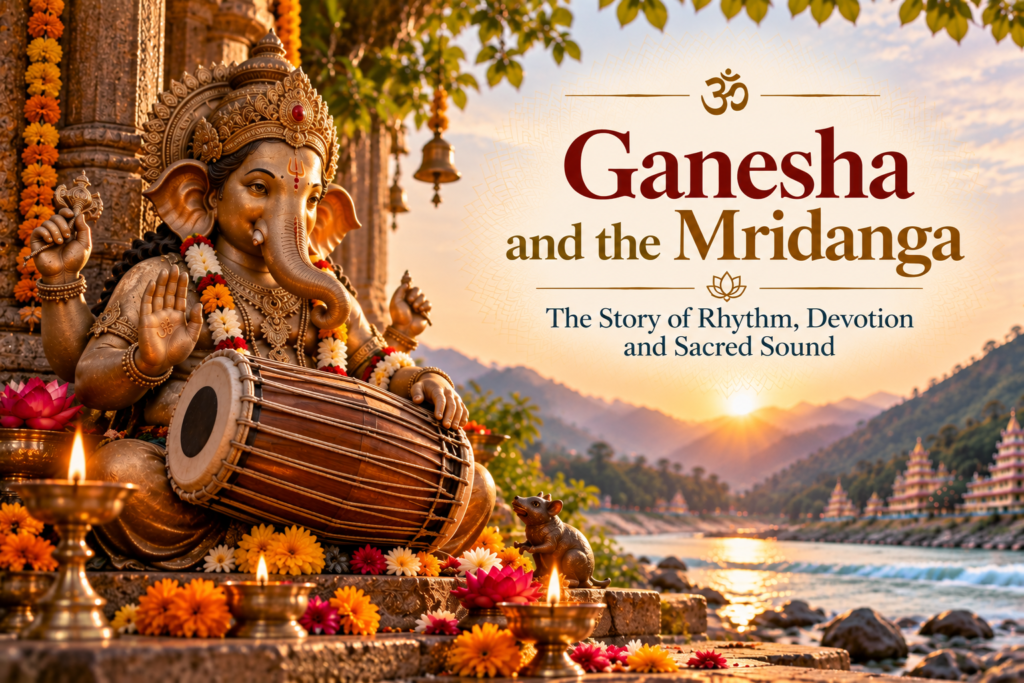
Indian musical traditions have always carried a close relationship with stories, rituals and spiritual practice. Instruments appear in temple sculpture, devotional music and classical performance, while deities are often represented as musicians, dancers or listeners. Among these images, Ganesha playing the mridanga offers a fascinating meeting point between mythology and the Indian understanding of rhythm.
Ganesha is widely associated with wisdom, auspicious beginnings and the removal of obstacles. The mridanga, a double-sided percussion instrument, belongs to a long history of Indian musical traditions involving rhythm, dance and performance. Historical and musicological sources also preserve traditional stories connecting the instrument with Shiva’s dance and Ganesha’s musicianship.
For anyone interested in Nada Yoga, Indian classical music, mantra chanting or sound healing, this connection opens a deeper way to think about percussion. A drum creates sound through physical movement, yet the experience of that sound extends into rhythm, attention, resonance and silence.
Who is Ganesha in the world of music?
Ganesha appears in many forms throughout Indian art. Alongside familiar representations associated with worship and devotion, artistic traditions also portray him as a musician holding instruments such as the drum, mridangam, tabla and veena. D’Source, an initiative of IDC School of Design at IIT Bombay, documents several such representations and connects Ganesha’s musical imagery with the tradition of invoking him at the beginning of concerts.
This association with music fits naturally with Ganesha’s traditional role at beginnings. A musical performance has its own threshold, just as a ritual, journey or spiritual practice does. Invoking Ganesha creates a moment of preparation before the first musical phrase begins.
The relationship also brings together two qualities that are central to musical practice: attention and rhythm. A musician prepares the mind before playing, listens closely to the other performers and follows the rhythmic structure of the composition. Ganesha’s presence in musical imagery reflects this wider cultural relationship between devotion and performance.
What is the mridanga?
The mridanga, also spelled mṛdaṅga, is an ancient family of double-sided Indian drums. The Sanskrit name is commonly connected with mṛd, meaning clay or earth, and aṅga, meaning body. Historical descriptions therefore associate the name with an earlier clay-bodied form of the instrument.
The instrument developed through different regional and musical traditions. The modern South Indian mridangam has a wooden barrel-shaped body with two drumheads, each producing a different range of sounds. It has become a central percussion instrument in Carnatic classical music.
Its importance extends beyond producing a steady beat. The mridangam player works with intricate rhythmic patterns, accents and tonal sounds that interact closely with singers, instrumentalists and dancers. IGNCA describes the instrument as a key source of rhythmic structure in classical music and dance.
The traditional story of Ganesha and the mridanga
One traditional account gives the mridanga a divine origin.
According to a historical account preserved in The Music of India, Brahma created the instrument as an accompaniment for Shiva’s dance following his victory over the three cities. The same account describes Ganesha as the first player of the mridanga.
This story belongs to the mythological and musical imagination surrounding the instrument. Other traditions connect the mridanga with Nandi, Shiva’s attendant, and describe Nandi as the drummer accompanying Shiva’s Tandava. D’Source’s documentation of the instrument’s traditional history also preserves this association.
These different accounts show how Indian musical traditions have preserved several layers of meaning around the same instrument. Historical development belongs to the study of music and material culture, while sacred stories explain the instrument through divine music, dance and devotion.
Why does rhythm matter in Shiva’s dance?
The relationship between the mridanga and Shiva’s dance gives rhythm an important symbolic role.
Dance depends upon movement, and movement becomes easier to perceive when rhythm provides a structure. A percussion instrument can establish a cycle, mark an accent and create a sense of anticipation as the performance unfolds.
IGNCA describes the mridangam as an instrument that brings music into a definite rhythmic structure during classical performances. Its role becomes especially clear when it accompanies dance, where the percussionist and dancer respond to one another through rhythm.
Within the traditional imagery of Shiva’s dance, rhythm therefore becomes part of the larger expression of movement and cosmic order. The drum provides an audible structure through which movement can unfold.
Ganesha’s connection with the instrument places him within this same musical world.
Ganesha as a musician
The image of Ganesha as a musician appears across Indian artistic traditions.
Some sculptures and decorative representations show him playing drums, mridangam, tabla or veena. D’Source documents this musical imagery and notes that Ganesha’s presence at the beginning of concerts provides a cultural context for these representations.
This gives Ganesha another dimension beyond the familiar image of the deity associated with beginnings and wisdom. He becomes part of the world of sangita, where music, rhythm and performance meet.
A musician can begin a performance with a Ganesha invocation.
A singer can offer a devotional composition.
A dancer can move within a rhythmic cycle.
A percussionist can establish the tala.
Each practice begins with attention.
The mridanga and the ancient Indian musical tradition
The history of the mridanga reaches deep into Indian musical literature.
IGNCA notes that Bharata’s Natyashastra contains detailed discussions of avanaddha vadya, the category of instruments that produce sound through stretched membranes. The text discusses mridanga, panava and dardara and describes different forms according to how the instruments are held and played.
This classification shows the sophistication of early Indian thinking about percussion.
A drum was understood through its construction, playing position, sound and role within performance. Rhythm itself received detailed attention as part of music and dance.
Later treatises continued this development. IGNCA’s discussion of the Nartananirnaya of Pandarika Vitthala describes detailed treatment of mrdanga playing, rhythmic structures and the contribution of percussion to dance.
The mridanga therefore belongs to a long intellectual and artistic tradition in which sound and rhythm received careful study.
From clay to the modern mridangam
The name mridanga retains a connection with clay, while the modern South Indian mridangam generally uses wood.
D’Source explains that early forms were associated with hardened clay and that the instrument later evolved toward wooden construction for greater durability. Modern instruments commonly use jackfruit wood for the body.
The two drumheads create contrasting sounds. The smaller head produces a higher tonal range, while the larger head produces deeper tones. The construction allows a skilled player to combine different strokes into complex rhythmic patterns.
This development reflects an important feature of Indian musical instruments. Their forms have continued to evolve alongside performance traditions, musical requirements and regional styles.
The ancient name therefore leads into a living musical instrument that continues to be played today.
What makes the sound of a mridanga special?
A mridanga produces sound through vibration.
The player strikes the membrane with the fingers or hand. The membrane vibrates, the body of the instrument resonates, and the surrounding air carries the resulting sound toward the listener.
Different strokes create different combinations of tone, resonance and duration.
A sharp stroke may disappear quickly.
A deeper stroke can create a fuller resonance.
A sequence of strokes can form a rhythmic phrase.
The listener therefore experiences several layers at once. There is the individual sound, the space between sounds and the larger rhythmic cycle connecting them.
This makes the mridanga particularly interesting for anyone studying sound meditation or attentive listening.
Rhythm as a form of listening
Rhythm requires active listening.
A musician must recognize where a phrase begins, where an accent falls and how one rhythmic cycle connects with the next. The listener also follows these patterns, sometimes consciously and sometimes through the body’s natural response to rhythm.
This creates a relationship between sound and attention.
When a mridanga player performs a rhythmic pattern, the listener can follow each stroke individually. With deeper familiarity, the ear begins to perceive the larger structure.
That movement from individual sound toward a complete rhythmic pattern has a natural connection with Nada Yoga.
Nada Yoga encourages sustained attention toward sound. A practitioner can begin with a clearly audible tone, rhythm or mantra and gradually develop greater sensitivity to the details within the listening experience.
Ganesha, listening and Nada Yoga
Ganesha’s large ears are frequently interpreted symbolically as an image of attentive listening.
Within a Nada Yoga perspective, this symbolism becomes especially interesting.
Listening is more than receiving sound. It requires attention.
A practitioner can hear a mridanga, yet attentive listening asks the ear to follow the character of each stroke, the changing resonance and the silence between rhythmic phrases.
The same principle applies to mantra chanting.
When chanting Om Gaṇeśāya Namaḥ, the practitioner creates the sound through the voice and then listens to it. The mantra becomes both an act of expression and an exercise in receiving sound.
This relationship between voice and listening is central to the study of Nada Yoga and mantra meditation.
The silence between two sounds
A rhythm is made from sound and space.
Consider two strokes of a mridanga. The first sound begins, resonates and fades. The second arrives after a particular interval.
That interval has meaning.
It contributes to the rhythm.
It allows the previous sound to settle.
It creates anticipation for what follows.
This makes silence an active part of musical listening.
The same principle can be found in mantra practice. After a Sanskrit phrase ends, the sound gradually disappears into silence. A practitioner who listens carefully can begin to notice this transition.
Nada Yoga provides a natural framework for this kind of attention because sound and silence both become part of the contemplative experience.
Mridanga and Indian classical music
The modern mridangam holds a central position in Carnatic classical music.
It accompanies vocalists and instrumentalists while also taking part in more elaborate rhythmic passages. The performer works within established tala structures and responds to the melodic movement of the music. IGNCA describes the mridangam as a major rhythmic instrument in classical concert and dance settings.
The relationship between melody and rhythm is particularly important.
A melody can move through pitch and phrasing.
The percussion can provide the rhythmic framework.
The two meet within the tala.
This creates a musical conversation between different forms of sound.
For students interested in Indian classical music and Nada Yoga, the mridangam offers a valuable example of how rhythm can become a disciplined form of listening.
Ganesha and the beginning of music
Ganesha’s traditional association with beginnings gives his musical imagery a special place in performance culture.
An invocation can establish the mood before a concert begins. The musicians gather their attention, the audience becomes quiet, and the first sound enters the space.
That moment carries a sense of transition.
The Ganesha invocation marks the beginning.
The music then takes over.
This relationship also appears in kirtan and devotional music, where a Ganesha mantra can precede singing, chanting or another spiritual practice.
The mridanga adds rhythmic movement to this environment, giving the voice a structure through which the devotional music can unfold.
Ganesha, mridanga and kirtan
The relationship becomes especially vivid during kirtan.
Kirtan brings together repetition, voice, rhythm and devotion. Participants may repeat a mantra or divine name while percussion instruments establish a rhythmic foundation.
The mridanga can provide a strong rhythmic presence within such settings, helping singers maintain the cycle and giving the group a shared musical pulse.
Ganesha’s association with music makes him a natural figure within this devotional landscape.
A Ganesha mantra can begin the practice.
The voice carries the sacred words.
The mridanga supports the rhythm.
The group listens and responds.
The result is a collective experience of sound.
The relationship between mridanga and sound healing
The mridanga belongs to established Indian musical traditions, while contemporary sound healing uses a wider range of instruments and approaches.
Sound healing sessions may involve singing bowls, gongs, tuning forks, voice, drums or ambient sound. The purpose may include relaxation, meditation, guided listening or creating a focused sound environment.
The mridanga brings rhythm into this broader conversation.
Its sound can provide a clear pulse for movement and attention. A practitioner can listen to the changing intensity of the strokes, observe resonance and become aware of the spaces between sounds.
At the same time, the instrument’s classical musical identity deserves to remain visible. Its rhythmic language has developed through Indian music and dance traditions over many centuries.
For anyone studying sound healing, learning about instruments through their original musical contexts can deepen the understanding of how different sounds function.
Rhythm, vibration and the body
Percussion has a physical quality that many sustained instruments express differently.
A mridanga stroke creates a short burst of vibration. A sequence of strokes produces a rhythmic pulse that the listener may experience through both hearing and bodily awareness.
This relationship between rhythm and bodily sensation makes percussion useful for exploring movement, breath and attention.
A slower rhythm can create one type of listening environment, while a faster rhythmic structure creates another. Volume also changes the experience, making thoughtful use of percussion important in contemplative settings.
Within sound-based practices, the environment, intensity and intention all influence how a person experiences an instrument.
A simple rhythm listening practice
A simple listening practice can help anyone explore the relationship between rhythm and attention.
Sit comfortably in a quiet space and choose a gentle recording of mridangam or another Indian percussion instrument. Allow the first few minutes to pass while simply listening to the overall rhythm.
Then bring attention to individual strokes. Follow each sound from its beginning through its resonance and fading.
After several minutes, shift attention toward the spaces between the sounds. Notice how the silence contributes to the rhythm.
Finally, listen to the larger rhythmic cycle again.
This practice can help develop a more refined awareness of rhythm, resonance and silence. Similar listening skills can later be applied to mantra, singing bowls, tanpura, bells or other sound meditation practices.
What the mridanga can teach about Nada Yoga
The mridanga offers a useful example of how external sound can become an object of concentration.
The sound is clear.
The rhythm provides structure.
The strokes create movement.
The silence creates space.
The listener develops attention by following the whole process.
Nada Yoga can take this principle further through mantra, music and increasingly subtle forms of listening. The practitioner begins with sound that can easily be heard and gradually develops greater sensitivity to the experience of listening itself.
At Nada Yoga School in Rishikesh, students study mantra, Indian classical music, kirtan, Vedic chanting, voice and meditation as part of a broader exploration of Nada Yoga. This provides a traditional context for understanding how sound can support concentration and contemplative practice.
Learning rhythm alongside mantra and sound
The study of sound becomes richer when different forms of musical practice are allowed to complement one another.
Mantra introduces sacred language and repetition.
Indian classical music develops sensitivity to pitch and melodic movement.
Percussion develops rhythmic awareness.
Kirtan brings voice and devotion into a shared musical experience.
Meditation develops sustained attention.
Sound healing introduces contemporary approaches to listening, resonance and sound-based relaxation.
These areas have distinct histories and purposes, yet they can meet through the simple act of listening.
For students undertaking Nada Yoga teacher training in Rishikesh, exploring this wider sound environment can provide a deeper appreciation of the relationship between music, meditation and yogic practice.
Frequently asked questions about Ganesha and the mridanga
Did Ganesha play the mridanga?
A traditional account recorded in The Music of India describes Ganesha as the first player of the mridanga after Brahma created the instrument as an accompaniment for Shiva’s dance. Other traditions connect the mridanga with Nandi, so accounts vary according to the source and tradition.
What is a mridanga?
A mridanga is a traditional double-sided Indian drum. The modern South Indian mridangam is a major percussion instrument in Carnatic classical music.
What does the word mridanga mean?
The word is commonly connected with Sanskrit terms associated with clay or earth and body. Historical sources therefore connect the name with an earlier clay-bodied form of the instrument.
Is the mridanga mentioned in ancient Indian texts?
Yes. IGNCA notes that Bharata’s Natyashastra discusses mridanga and related membranophone instruments under its treatment of avanaddha vadya.
What is the connection between Ganesha and Indian music?
Ganesha is represented in Indian art as a musician playing instruments such as drums, mridangam, tabla and veena. He is also traditionally invoked at the beginning of musical performances.
How does the mridanga relate to Nada Yoga?
The mridanga offers a clear example of external sound that can become an object of attentive listening. Practitioners can observe rhythm, resonance, individual strokes and the silence between sounds.
Can percussion be used in sound healing?
Percussion can be incorporated into contemporary sound-based practices. Drums can provide rhythm, vibration and focused listening experiences, while the appropriate instrument and playing method depend on the purpose of the session.
Final thoughts
The story of Ganesha and the mridanga brings together several strands of Indian culture: mythology, music, rhythm, devotion and listening.
The traditional stories surrounding the instrument place it within the world of Shiva’s dance and divine music. Historical sources show a much longer development of Indian percussion, from ancient membranophone traditions to the sophisticated mridangam used in Carnatic music today.
Ganesha’s appearance as a musician adds another dimension to this history. His association with beginnings gives the instrument a symbolic place at the threshold of music, while the rhythm of the mridanga provides structure for voices, dancers and performers.
For practitioners of Nada Yoga, the instrument offers something even more immediate. Each stroke becomes an opportunity to listen. Each rhythmic cycle becomes an opportunity to follow attention. Each fading sound creates a moment of silence.
Through that process, a drum becomes more than a percussion instrument. It becomes a way of experiencing how sound, rhythm, listening and silence shape the human experience of music.