A person can spend years studying philosophy, practising meditation and searching for spiritual freedom while continuing to identify with the body and mind. Thoughts, emotions, memories and personal experiences shape the way people understand themselves, often creating the impression that these changing aspects define who they are.
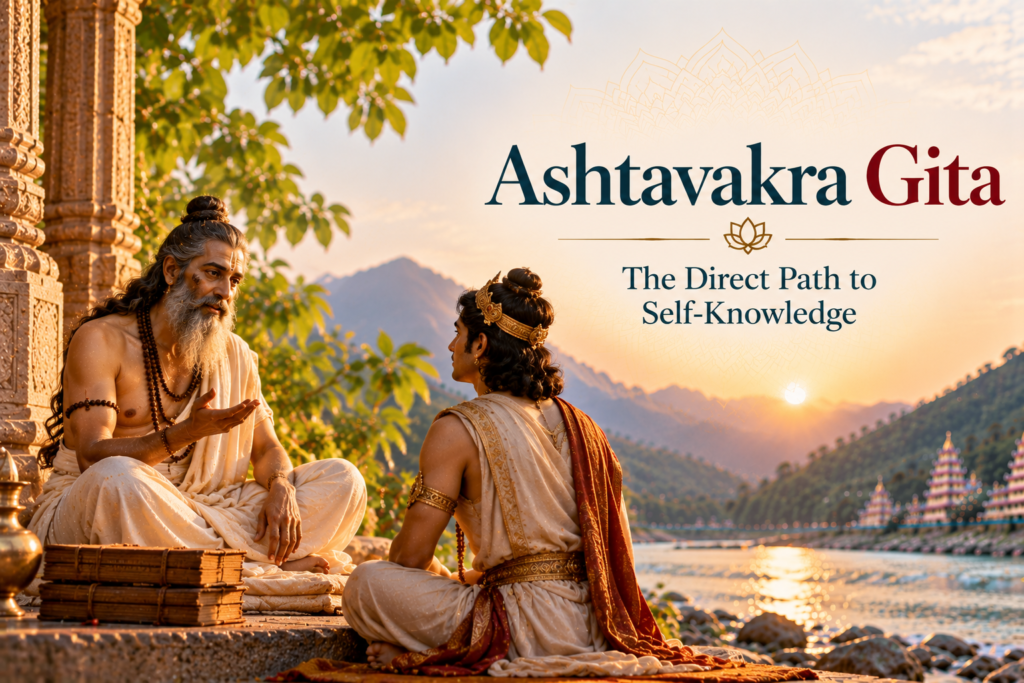
The Ashtavakra Gita invites readers to examine this assumption through the teachings of Advaita Vedanta. Presented as a dialogue between the sage Ashtavakra and King Janaka, this Sanskrit philosophical text explores consciousness, bondage, liberation and the nature of the Self. Throughout the dialogue, Ashtavakra directs Janaka’s attention toward pure awareness, which the text presents as the essential nature of the Self.
Also known as the Ashtavakra Samhita, or the Song of Ashtavakra, the work contains 20 chapters and 298 verses. Its central teaching places Self-knowledge at the heart of liberation and encourages readers to investigate the difference between changing experiences and the awareness that knows them.
What is the Ashtavakra Gita?
The Ashtavakra Gita is a Sanskrit philosophical text traditionally attributed to the sage Ashtavakra. Its dialogue with King Janaka focuses on the Self, non-duality, detachment and freedom from mistaken identification. The text belongs to the Advaita Vedanta tradition, which understands ultimate reality through the principle of non-duality.
Many spiritual texts explain a sequence of practices that guide seekers toward a particular goal. The Ashtavakra Gita takes a different approach by repeatedly directing attention toward the nature of awareness itself. Its teachings ask readers to investigate the identity they normally associate with the body, mind and personal history.
This direct style gives the text a distinctive place in Indian philosophy. Readers encounter questions about consciousness, freedom and identity throughout the dialogue, with each chapter examining these themes from a different perspective.
Who was Ashtavakra?
Traditional accounts explain the name Ashtavakra through two Sanskrit words: aṣṭa, meaning eight, and vakra, meaning bent or curved. According to these stories, the sage had eight bends in his body, a detail that became an important part of his traditional identity.
The Mahabharata recounts an episode involving Ashtavakra, his father Kahoda, his mother Sujata and his maternal grandfather Uddalaka. In the story, Ashtavakra travels to King Janaka’s court and engages in a debate with the scholar Vandin. The account emphasises the sage’s intellectual ability and challenges assumptions about the relationship between physical appearance and wisdom.
This traditional narrative connects with a central theme of the Ashtavakra Gita: external characteristics do not determine the depth of Self-knowledge. The text directs attention toward consciousness and understanding, placing these questions beyond social identity and bodily appearance.
The historical authorship of the Ashtavakra Gita remains uncertain. Although tradition attributes the work to Ashtavakra, scholars have proposed different dates for its composition. It is therefore useful to distinguish the traditional account of the sage from the historical questions surrounding the text itself.
Who was King Janaka?
King Janaka appears in Indian philosophical literature as the ruler of Mithila and a figure associated with spiritual inquiry. Several Upanishadic accounts also portray Janaka as a king who seeks knowledge from respected teachers.
In the Ashtavakra Gita, Janaka takes the role of a sincere seeker. He asks about knowledge, liberation and dispassion, giving Ashtavakra the opportunity to explain the nature of the Self. As the dialogue progresses, Janaka’s responses express an increasingly direct recognition of the non-dual perspective.
This relationship gives the text its conversational structure. Janaka represents the seeker who wants to understand reality, while Ashtavakra continually redirects his attention toward the awareness that already underlies experience.
What is the main teaching of the Ashtavakra Gita?
The central teaching of the Ashtavakra Gita concerns the Self as pure awareness. The text encourages readers to distinguish consciousness from the changing experiences that appear within it. The body changes, sensations fluctuate, thoughts arise and emotions move through different states, yet each of these experiences can become an object of observation.
Consider the simple act of listening to music. A melody enters awareness, memories may arise, and the mind may respond with pleasure or sadness. As the music changes, the listener can notice each response and recognise that the experience itself continues to evolve.
The Ashtavakra Gita uses this distinction to direct attention toward the nature of the knower. Its opening chapter introduces the relationship between the Self, the body, the senses and the mind, while the following chapter presents Janaka’s response as an expression of recognition. Together, these teachings establish the philosophical direction of the entire work.
Witness consciousness in the Ashtavakra Gita
The Sanskrit term sākṣin, commonly translated as witness, describes an important concept in the text. Witness consciousness refers to awareness as the principle that knows experience. Thoughts arise and pass, sensations change, and circumstances develop, while the text distinguishes the conscious witness from these changing objects.
The teaching invites a closer investigation of this relationship. When a thought appears, a person can recognise its content and observe how it changes. Similarly, an emotion may influence the mind for a period before another experience takes its place.
This inquiry does not require the creation of a new identity called the witness. Instead, the text encourages readers to examine the difference between what they experience and the awareness in which experience occurs. Within Advaita Vedanta, this investigation supports the recognition of the Self as pure consciousness.
The body and the Self
The Ashtavakra Gita repeatedly examines the tendency to identify the Self with the body. Physical form, age, movement and bodily sensations all change throughout life. From the perspective of the text, these characteristics belong to the changing field of experience.
The text describes the Self through a different set of qualities, including awareness, freedom, stillness and non-duality. These descriptions express its central philosophical distinction between consciousness and the body-mind complex.
This distinction becomes a starting point for Self-inquiry. A reader can observe the body’s changing conditions and consider how those conditions become known through awareness. The question then turns toward the nature of the Self that the text distinguishes from physical experience.
The mind and the Self
The same inquiry applies to the mind. Thoughts contain memories, plans, opinions, fears, desires and images, all of which change according to circumstances. The Ashtavakra Gita directs attention toward the awareness that knows these movements.
Meditation can provide a practical setting for exploring this idea. A practitioner may notice the mind becoming distracted, concentrated, restless or quiet, then observe how each state develops and passes. Through this process, mental activity becomes an object of observation.
The text encourages the seeker to investigate the knower itself. This approach shifts attention toward consciousness and forms an important part of its Advaita teaching.
Bondage and liberation
The Sanskrit terms bandha and moksha refer to bondage and liberation. The Ashtavakra Gita explains bondage primarily through mistaken identification with the body, mind, desires, actions and personal identity. When a person understands these changing aspects as the complete Self, the experience of limitation takes hold.
Liberation, in this framework, comes through recognising one’s true nature. The text places its emphasis on knowledge and direct understanding, presenting freedom as a recognition of the Self rather than the acquisition of an external condition.
Chapter 20 expresses this perspective in especially radical language. Janaka asks where the body, mind, bondage, liberation, teacher, student and spiritual practice exist from the standpoint of the non-dual Self. These questions challenge the ordinary distinctions through which people organise their experience.
The chapter therefore brings the text’s central inquiry to an intense philosophical conclusion. From the standpoint of non-duality, even familiar spiritual categories become subjects for examination.
What does Advaita mean in the Ashtavakra Gita?
The Sanskrit word Advaita means non-duality. Within Advaita Vedanta, Brahman represents ultimate reality, and the deepest Self, or Atman, is understood as identical with Brahman. The Ashtavakra Gita presents this perspective in a particularly direct form.
Throughout the dialogue, the text examines distinctions between subject and object, self and world, bondage and liberation. These distinctions shape ordinary experience, while the non-dual teaching directs attention toward the reality that the text understands as underlying them.
One verse from the opening chapter uses the image of space inside and outside a jar. The jar appears to divide space into separate portions, yet the space itself remains continuous. Through this comparison, the text illustrates how individual identity may appear separate even as the underlying reality remains undivided.
The metaphor offers an accessible introduction to non-duality. It encourages readers to investigate the difference between apparent separation and the deeper unity described by Advaita Vedanta.
Detachment and dispassion
Vairagya, commonly translated as detachment or dispassion, is another recurring theme in the Ashtavakra Gita. The text examines attachment to pleasure, possessions, achievements, identity and intellectual knowledge. Its teachings encourage the seeker to recognise the changing nature of these experiences.
Detachment in this context refers to freedom from compulsive identification. A person can participate in daily life while examining the tendency to define the entire Self through external circumstances. This perspective gives dispassion a philosophical meaning connected with Self-knowledge.
As the dialogue progresses, several chapters explore tranquillity, freedom from attachment and abiding in the Self. These themes reinforce the text’s central argument that understanding one’s true nature changes the relationship with experience.
Desire and freedom
The Ashtavakra Gita examines desire because the pursuit of external conditions can reinforce identification with the changing world. When someone believes that a particular achievement or possession will complete their identity, the sense of self becomes closely connected with obtaining that outcome.
The text directs attention toward the completeness it attributes to the Self. From its non-dual perspective, the deepest nature of consciousness does not depend on the arrival of a particular experience or possession.
Readers should interpret these teachings within their Advaita context. The text explores the standpoint of non-dual realisation, which gives its statements a different emphasis from traditions that focus primarily on cultivating virtues, performing rituals or following a sequence of spiritual practices.
Does the Ashtavakra Gita reject yoga?
The relationship between the Ashtavakra Gita and yogic practice requires careful interpretation. The text places strong emphasis on direct Self-knowledge and challenges attachment to spiritual methods themselves. In several passages, it describes the realised Self beyond conventional distinctions such as seeker and achievement, teacher and student, or meditation and concentration.
This emphasis reflects the text’s particular philosophical standpoint. According to its non-dual teaching, the Self already possesses its essential nature, so an external technique cannot create or manufacture that reality.
Yoga practices can still offer a valuable context for contemplation. Meditation, pranayama, mantra and Nada Yoga can help practitioners develop attention and investigate experience. The Ashtavakra Gita adds a deeper philosophical question by directing attention toward the awareness in which every practice occurs.
For yoga students, this distinction helps explain the relationship between disciplined practice and non-dual inquiry. The text focuses on recognising the Self, while other yoga traditions may give greater attention to methods that cultivate concentration, ethical discipline and meditative absorption.
The ocean and the waves
The Ashtavakra Gita uses imagery to express ideas that can otherwise seem abstract. The ocean and wave metaphor provides one useful way to contemplate non-duality. A wave has a recognisable shape and appears separate for a time, yet water remains the substance of both the wave and the surrounding ocean.
Similarly, individual experiences appear distinct because they have different forms and characteristics. The non-dual perspective directs attention toward the underlying reality in which those distinctions appear.
This metaphor helps explain why the text describes the Self as vast and untouched by the movement of experience. The image encourages readers to examine how the mind interprets apparent separation and how philosophical inquiry can challenge that interpretation.
The sky and the Self
Space provides another important image in the Ashtavakra Gita. A room, a vessel and the open sky may appear to contain separate portions of space, although their boundaries belong to the structures that surround them.
The text uses comparable imagery to describe consciousness. Body and mind shape the way an individual experiences the world, creating a sense of personal boundaries. Advaita directs attention toward awareness as a reality that the text distinguishes from those temporary forms.
These comparisons make the philosophy easier to contemplate. Rather than relying only on abstract definitions, the reader can reflect on familiar images to explore the relationship between apparent individuality and non-duality.
The 20 chapters of the Ashtavakra Gita
The Ashtavakra Gita contains 20 chapters and 298 verses, with substantial differences in length between chapters. Chapter 18 is particularly extensive, containing 100 verses. Chapter titles and English descriptions can vary across translations, so the following overview groups the chapters by their recurring themes.
| Chapters | Major themes |
|---|---|
| 1–4 | Self-knowledge, realisation and awareness |
| 5–8 | Tranquillity, the Self and liberation |
| 9–12 | Dispassion, detachment and abiding in the Self |
| 13–16 | Happiness, peace and direct instruction |
| 17–18 | The nature of the realised person and freedom |
| 19–20 | The majesty of the Self and non-dual realisation |
These groupings offer a general reading guide rather than a definitive division of the text. Individual translations may organise the material differently, and many chapters revisit themes that appear earlier in the dialogue.
Chapter 1: The foundation of Self-knowledge
The opening chapter establishes the philosophical direction of the Ashtavakra Gita. Janaka asks about knowledge, liberation and dispassion, and Ashtavakra responds by directing him toward the Self as pure awareness and the witness of experience.
The dialogue immediately examines the relationship between consciousness and the body-mind complex. This direct beginning establishes the text’s emphasis on recognition and sets the context for the teachings that follow.
Chapter 2: Janaka’s recognition
Chapter 2 presents Janaka’s response to Ashtavakra’s instruction. His words express wonder and recognition as he describes the Self through ideas of purity, freedom, vastness and consciousness.
The chapter marks an important movement in the dialogue. Ashtavakra has offered direct instruction, and Janaka now expresses the recognition that gives those teachings their philosophical significance.
Chapters 3 to 17: Examining the Self from different angles
The middle chapters explore the central inquiry through themes such as desire, attachment, action, renunciation, knowledge and tranquillity. Instead of presenting one linear method, the text returns repeatedly to the distinction between changing experience and the Self.
This repetition serves a clear philosophical purpose. Each discussion invites the reader to examine another aspect of identification and consider how it relates to awareness.
Chapter 18: Peace and freedom
Chapter 18 contains 100 verses and stands as the longest chapter in the text. It develops an extended reflection on freedom, tranquillity and non-dual realisation.
Throughout the chapter, the teaching examines the perspective of someone who understands the Self beyond ordinary attachment to distinctions. Its length allows the text to approach the central idea through many related expressions.
Chapters 19 and 20: The culmination
The final two chapters bring the dialogue toward an especially subtle expression of non-duality. Chapter 19 explores the majesty and repose of the Self, while Chapter 20 presents Janaka speaking from the standpoint of non-dual awareness.
Chapter 20 repeatedly uses the Sanskrit word kva, which can mean “where?” or “where is?” Janaka asks where the body, mind, bondage, liberation, practice, teacher and student exist from the standpoint of the pure Self. These questions examine the categories through which people ordinarily understand spiritual life.
The chapter concludes by moving beyond even the conceptual distinction between unity and duality. Its final teaching reflects the radical nature of the text’s approach: conceptual categories cannot fully capture the Self as Advaita understands it.
Ashtavakra Gita and meditation
The Ashtavakra Gita offers a distinctive perspective on meditation because it directs attention toward the one who knows experience. A practitioner can sit quietly and observe sensations, sounds, thoughts and emotions as they arise and pass away. This observation provides a practical starting point for the text’s inquiry into awareness.
The next step involves examining awareness itself. Rather than attempting to produce a special state, the practitioner can reflect on the consciousness in which changing experiences become known. This approach connects meditation with the text’s emphasis on recognising the Self.
For students of Advaita Vedanta, this inquiry can become a form of contemplative Self-investigation. The purpose lies in understanding the nature of awareness within the philosophical framework of the text.
Ashtavakra Gita and Nada Yoga
The relationship between the Ashtavakra Gita and Nada Yoga becomes especially interesting through attentive listening. Nada Yoga uses sound as an object of concentration, drawing on practices involving musical tones, mantra, the voice and other forms of listening.
A practitioner may begin with an external sound, such as a singing bowl, a tanpura drone or a repeated mantra. As attention settles, the listener can observe the sound’s beginning, resonance, changes and fading. This process also reveals how the mind interprets sounds and responds to them.
The Ashtavakra Gita adds a philosophical question: who is listening? The sound can be heard, the mind can interpret it, and attention can move between different experiences. Advaita inquiry then directs attention toward the awareness that knows these movements.
This connection offers a meeting point between sound-based contemplation and Self-inquiry. The two traditions retain distinct histories and teachings, while their shared interest in awareness provides an opportunity for thoughtful exploration.
Sound, silence and the Self
Sound gives meditation a clear object for attentive observation. A practitioner can listen to a single tone and notice its onset, resonance and gradual fading. As the sound disappears, attention may also become aware of the surrounding silence.
This simple exercise can develop a more careful relationship with listening. The sound changes from moment to moment, while the practitioner observes the entire experience. Silence then becomes part of the listening process, providing a context in which the changing qualities of sound become easier to notice.
For a Nada Yoga teacher training practitioner, this exercise can support sustained attention. The Ashtavakra Gita adds another dimension by inviting reflection on the awareness that knows both sound and silence.
Ashtavakra Gita and the Mahavakyas
The Ashtavakra Gita belongs to the wider Advaita Vedanta tradition, where the Mahavakyas, or great sayings, hold an important place. These statements express central teachings about the relationship between consciousness, Atman and Brahman.
The four commonly discussed Mahavakyas are:
- Prajnanam Brahma: Consciousness is Brahman.
- Aham Brahmasmi: I am Brahman.
- Tat Tvam Asi: That thou art.
- Ayam Atma Brahma: This Self is Brahman.
The Ashtavakra Gita explores closely related questions about identity, consciousness and non-duality. Its teachings can therefore provide another perspective for readers studying the Mahavakyas and investigating what the word “I” refers to in Advaita Vedanta.
Ashtavakra Gita and Jivanmukti
The Sanskrit term Jivanmukti refers to liberation while living. Advaita Vedanta uses this concept to describe a person who has realised the Self while continuing to live in a body and participate in the world.
The Ashtavakra Gita repeatedly describes freedom through qualities such as equanimity, tranquillity and freedom from compulsive identification. These qualities reflect the text’s emphasis on knowledge of the Self rather than external appearance or social position.
Within this framework, liberation concerns the recognition of one’s true nature. The teaching therefore returns to the distinction between awareness and the changing experiences that shape ordinary identity.
How to study the Ashtavakra Gita
The Ashtavakra Gita rewards slow, careful reading. Its concise verses often carry complex philosophical meanings, so studying a few verses at a time can provide more space for reflection. A reliable Sanskrit edition, a clear translation and a thoughtful commentary can help readers understand the language and context.
It also helps to study the text alongside the Upanishads and other works of Advaita Vedanta. These texts provide a broader context for concepts such as Atman, Brahman, witness consciousness, bondage and liberation. Comparing different explanations can deepen understanding of the philosophical questions that the Ashtavakra Gita raises.
Meditation can complement the reading process. After studying a verse about witness consciousness, for example, a practitioner can sit quietly, observe thoughts and sensations, and reflect on the nature of the awareness in which they arise.
What makes the Ashtavakra Gita distinctive?
The Ashtavakra Gita stands out for the directness of its Advaita teaching. Throughout the dialogue, the text directs the seeker toward the Self as already present and places strong emphasis on recognition rather than accumulation.
This approach gives the work a different character from texts centred on physical postures, ritual procedures or sequential techniques. Its recurring subject is awareness itself and the question of how the individual understands the relationship between consciousness and experience.
For students of Indian philosophy, the Ashtavakra Gita offers an important exploration of Jnana, or knowledge. Its teachings provide a concentrated introduction to non-duality and invite sustained contemplation of the nature of the Self.
Final thoughts
The Ashtavakra Gita is an important text associated with Advaita Vedanta. Through its dialogue between Ashtavakra and Janaka, it examines consciousness, the Self, attachment, bondage, liberation and the nature of non-duality. Its central inquiry asks readers to look closely at the awareness that knows every changing experience.
For students of Vedanta, the text provides a direct exploration of Self-knowledge. Yoga students can use its philosophical ideas to deepen their understanding of meditation and self-inquiry, while Nada Yoga practitioners can reflect on awareness through the experience of listening. These connections create opportunities to study sound, consciousness and contemplative practice while respecting the distinct teachings of each tradition.
Ultimately, the Ashtavakra Gita invites readers to investigate identity at its deepest level. The body changes, the mind moves and experiences arise and disappear, while the text directs attention toward the awareness in which those experiences become known.
Frequently asked questions
What is the Ashtavakra Gita?
The Ashtavakra Gita is a Sanskrit philosophical text traditionally attributed to the sage Ashtavakra. Presented as a dialogue between Ashtavakra and King Janaka, it explores Self-knowledge, liberation and non-duality within the Advaita Vedanta tradition.
How many chapters are in the Ashtavakra Gita?
The text contains 20 chapters and 298 verses. Chapter lengths vary considerably, with Chapter 18 containing 100 verses.
Who wrote the Ashtavakra Gita?
Tradition attributes the Ashtavakra Gita to the sage Ashtavakra. However, the historical authorship and date of composition remain uncertain, so the traditional attribution should be distinguished from established historical evidence.
Is the Ashtavakra Gita part of the Bhagavad Gita?
No. The Ashtavakra Gita and the Bhagavad Gita are separate Sanskrit texts. The Bhagavad Gita presents a dialogue between Krishna and Arjuna, while the Ashtavakra Gita presents a dialogue between Ashtavakra and King Janaka.
What does the Ashtavakra Gita teach?
The text teaches that the Self is pure consciousness and explores the recognition of non-duality. Its central themes include witness consciousness, attachment, desire, liberation, tranquillity and Self-knowledge.
Is the Ashtavakra Gita related to Advaita Vedanta?
Yes. The Ashtavakra Gita belongs to the Advaita Vedanta tradition and presents a strongly non-dual understanding of the Self and reality.
What is the connection between the Ashtavakra Gita and meditation?
The text encourages contemplation of awareness and the nature of the Self. Meditation can provide a setting for observing thoughts, sensations and perceptions while investigating the awareness in which these experiences arise.
How is the Ashtavakra Gita connected to Nada Yoga?
Nada Yoga uses sound and attentive listening as contemplative tools, while the Ashtavakra Gita focuses on the awareness that knows experience. Studying these perspectives together can inspire a deeper inquiry into the relationship between sound, listening and consciousness.