Indian philosophy developed over centuries through questioning, debate, contemplation and systematic inquiry. Philosophers explored fundamental questions about reality, consciousness, knowledge, action, suffering, liberation and the nature of the Self. Their investigations gave rise to several influential traditions, each offering a distinct way to understand human experience and the world.
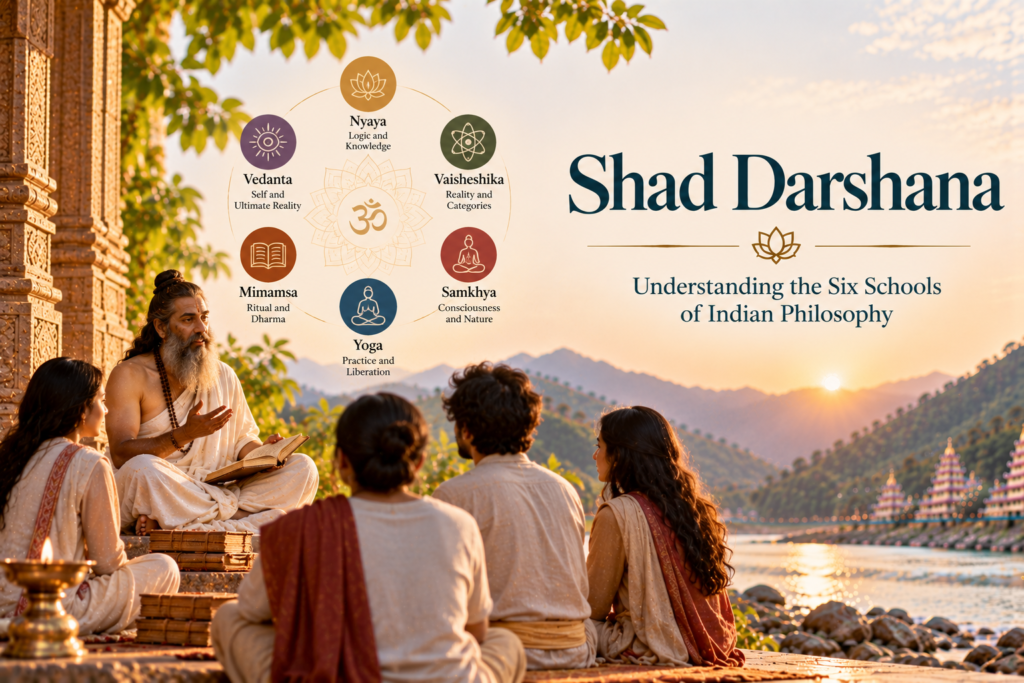
Among these traditions, six schools became collectively known as the Ṣaḍ Darśana, or the six darshanas. These schools are Nyaya, Vaisheshika, Samkhya, Yoga, Purva Mimamsa and Vedanta. The Sanskrit word darshana comes from the root dṛś, meaning “to see.” Consequently, the term refers to a philosophical vision or a systematic perspective on reality.
Traditionally, scholars classify these six schools as āstika because they recognize the authority of the Vedas. This classification refers primarily to their relationship with Vedic authority. It does not automatically indicate belief in a creator God. For example, classical Samkhya developed a philosophical system that does not require a creator God, yet it remains one of the six āstika darshanas.
Together, these traditions provide an essential foundation for understanding Indian philosophy. They also help explain the intellectual background of classical yoga, including its ideas about consciousness, meditation, knowledge and liberation.
What does Shad Darshana mean?
The term Shad Darshana combines two Sanskrit words:
- Ṣaḍ: Six
- Darśana: Vision, viewpoint or philosophical perspective
Together, they refer to the six traditional schools of Indian philosophy that recognize Vedic authority.
| Darshana | Main area of inquiry | Traditional founder or principal figure | Important text |
|---|---|---|---|
| Nyaya | Logic, reasoning and valid knowledge | Gautama or Akṣapāda Gautama | Nyaya Sutra |
| Vaisheshika | Reality, categories and the nature of existence | Kanada | Vaisheshika Sutra |
| Samkhya | Purusha, Prakriti and liberation | Traditionally Kapila | Samkhya Karika |
| Yoga | Meditation, mind and liberation | Patanjali as systematizer | Yoga Sutras |
| Purva Mimamsa | Dharma, Vedic ritual and interpretation | Jaimini | Mimamsa Sutra |
| Vedanta | Brahman, Atman and liberation | Traditionally Badarayana | Brahma Sutras |
These systems developed across different historical periods and generated extensive traditions of commentary and debate. Although they share certain concepts, each school approaches philosophical questions through its own methods and assumptions.
What makes these six schools orthodox?
The Sanskrit term āstika is often translated as “orthodox.” In Indian philosophy, however, the term primarily describes recognition of Vedic authority.
By contrast, the category nāstika traditionally includes philosophical traditions such as Buddhism, Jainism and Carvaka, which developed outside the authority of the Vedas.
This distinction helps explain why the six darshanas can hold different positions on God, consciousness and reality while belonging to the same broad classification. Their shared recognition of Vedic authority provides the traditional basis for grouping them together.
For example, Samkhya explains the world through Purusha and Prakriti, while Vedanta investigates Brahman and Atman. Nyaya emphasizes valid knowledge and reasoning, whereas Purva Mimamsa concentrates on dharma and Vedic interpretation. Their approaches differ considerably, even though all six belong to the āstika tradition.
1. Nyaya: The path of reasoning
Nyaya is the philosophical school most closely associated with logic, reasoning, debate and the investigation of valid knowledge. The Sanskrit word nyaya can refer to a method, rule or principle of reasoning. Accordingly, this tradition developed detailed methods for evaluating arguments and identifying reliable knowledge.
The foundational Nyaya Sutra is traditionally attributed to Gautama, also known as Akṣapāda Gautama. Over time, scholars expanded the system through commentaries, debates and further philosophical analysis. Nyaya also developed a close relationship with Vaisheshika.
What does Nyaya study?
Nyaya investigates several fundamental questions:
- How can a person establish reliable knowledge?
- What makes an inference valid?
- How does perception provide information about the world?
- When can testimony serve as a source of knowledge?
- How can philosophers identify faulty arguments?
- What role does reasoning play in understanding reality?
These questions place pramana, meaning a valid means of knowledge, at the center of Nyaya philosophy.
Classical Nyaya recognizes perception, inference, comparison and verbal testimony as four important means of knowledge. Through these methods, the school examines how people acquire knowledge and distinguish sound conclusions from errors.
In addition, Nyaya develops philosophical arguments concerning the Self, causation, the external world and God. Its position is broadly realist, meaning that it recognizes the real existence of objects and other features of the world.
Why is Nyaya important for spiritual inquiry?
Logic may appear separate from meditation at first. However, Nyaya demonstrates why reasoning became an important part of Indian philosophical traditions.
Before accepting a claim about reality or liberation, a philosopher needs to examine the evidence and determine whether the claim rests on reliable knowledge. Nyaya provides methods for conducting this examination.
Its emphasis on careful reasoning also influenced philosophical debates across India. As a result, Nyaya remains an important starting point for understanding the intellectual traditions that shaped classical Indian thought.
2. Vaisheshika: The analysis of reality
Vaisheshika approaches philosophy through the classification of existence. Traditionally associated with the philosopher Kaṇāda and the Vaisheshika Sutra, this school investigates the fundamental categories through which people can understand reality.
The name Vaisheshika relates to the Sanskrit term viśeṣa, meaning particularity or distinction. This connection reflects the school’s interest in identifying the characteristics that distinguish one thing from another.
The categories of Vaisheshika
Early Vaisheshika philosophy identified several categories of existence:
- Dravya: Substance
- Guna: Quality
- Karma: Action or motion
Later philosophers expanded the list to include additional categories:
- Samanya: Universality
- Vishesha: Particularity
- Samavaya: Inherence, or the relationship through which things are inseparably connected
Later developments also included abhava, meaning absence.
Through these categories, Vaisheshika developed a systematic account of substances, qualities, actions and relationships. The school also proposed an atomic theory in which physical objects arise through combinations of fundamental atomic entities. Consequently, Vaisheshika became an important tradition in Indian metaphysics and natural philosophy.
How does Vaisheshika relate to Nyaya?
Nyaya and Vaisheshika began as distinct philosophical systems. Over time, however, their approaches increasingly complemented each other.
Nyaya contributed sophisticated theories of knowledge and reasoning, while Vaisheshika developed a detailed account of the categories of reality. By the medieval period, scholars had brought the two traditions into close association.
For students, their central concerns offer a useful starting point: Nyaya examines how people know, while Vaisheshika investigates what exists and how reality can be classified.
3. Samkhya: The distinction between Purusha and Prakriti
Samkhya presents one of the most influential metaphysical frameworks in Indian philosophy. Its classical teachings appear especially clearly in Īśvarakṛṣṇa’s Samkhya Karika, generally dated to around the fourth century CE.
The system explains experience through two fundamental principles: Purusha and Prakriti. Purusha represents consciousness, while Prakriti represents nature and the changing processes through which experience unfolds.
This distinction forms the basis of Samkhya’s explanation of the relationship between consciousness, the mind and the material world.
Understanding Purusha
Samkhya describes Purusha as conscious, eternal and unchanging. It also recognizes multiple Purushas, with each embodied being associated with a distinct Purusha.
The body, senses, mind and intellect belong to Prakriti. Purusha, by contrast, represents the principle of consciousness through which experience becomes known.
This distinction helps Samkhya explain why the changing activities of the mind differ from consciousness itself.
Understanding Prakriti and the three gunas
Prakriti is the dynamic principle of nature. It includes the physical universe as well as the subtle structures involved in perception, thought and personal experience.
According to Samkhya, Prakriti consists of three gunas, or qualities:
- Sattva: Clarity, harmony and lightness
- Rajas: Activity, movement and desire
- Tamas: Inertia, heaviness and obscurity
These qualities interact continuously and influence the changing conditions of nature and the mind. Their different combinations help Samkhya explain the variety of experiences and processes found in the world.
How does Samkhya explain liberation?
Samkhya identifies mistaken identification between Purusha and Prakriti as a central source of bondage. People experience the changing activities of the mind and body as though these activities define their deepest identity.
Liberation arises through discriminative knowledge, which allows a person to recognize the distinction between consciousness and nature. The liberated state is traditionally called kaivalya.
Samkhya therefore provides an important philosophical foundation for classical Yoga. Its concepts of Purusha, Prakriti and the gunas help explain how yogic traditions understand the mind, consciousness and the possibility of liberation.
4. Yoga: The path of meditation and disciplined practice
Yoga Darshana is closely related to Samkhya and gives particular emphasis to meditation, concentration and practical discipline. The classical system is associated with Patanjali’s Yoga Sutras, which organized and presented an established body of yogic teachings.
Patanjali is therefore understood as a major systematizer of Yoga. Yogic practices existed before the composition of the Yoga Sutras, and the text brought many of these ideas into a systematic philosophical framework.
Samkhya provides much of the metaphysical background, while classical Yoga explains how disciplined practice can help a person progress toward liberation. Both traditions discuss Purusha, Prakriti, the gunas and kaivalya.
What is the goal of Yoga?
Patanjali introduces Yoga through the well-known Sanskrit expression:
Yogaś citta-vṛtti-nirodhaḥ
This expression is commonly translated as the restraint or cessation of the fluctuations of the mind.
The Yoga Sutras then describe a path of ethical discipline, personal observance, posture, breath regulation, sensory withdrawal, concentration, meditation and samadhi. Together, these practices form the eight limbs of Yoga, traditionally known as Ashtanga Yoga.
The eight limbs of Yoga
| Limb | Meaning |
|---|---|
| Yama | Ethical restraints |
| Niyama | Personal observances |
| Asana | Posture |
| Pranayama | Regulation of breath |
| Pratyahara | Withdrawal of the senses |
| Dharana | Concentration |
| Dhyana | Meditation |
| Samadhi | Deep meditative absorption |
Each limb contributes to the wider discipline of Yoga. Ethical principles guide conduct, while posture and breath practices support the development of steadiness. The later limbs focus increasingly on attention and meditation.
This structure shows that classical Yoga encompasses a complete philosophical and contemplative path. Physical postures form one part of that path, while concentration, meditation and samadhi occupy central positions in its account of inner development.
Yoga and Ishvara
Patanjali’s system also includes Ishvara, described as a special Purusha. The practice of Ishvara-pranidhana, or devotion to Ishvara, appears among the personal observances and as a means that can support samadhi.
The Yoga Sutras also connect Ishvara with the sacred syllable Om. Patanjali recommends its repetition and contemplation of its meaning.
This connection offers an important point of study for students of Nada Yoga. Mantra, Om and contemplative listening can all be explored within the broader history of yogic meditation and its philosophical foundations.
5. Purva Mimamsa: The inquiry into dharma
Purva Mimamsa is often called the Mimamsa school or the “earlier inquiry.” The name reflects its focus on the earlier portions of the Vedic corpus, particularly the sections concerned with ritual and sacrifice.
The school is traditionally associated with Jaimini and the Mimamsa Sutra. Its central concern is dharma, especially the duties and actions established through Vedic injunctions.
Why does the Veda matter to Mimamsa?
Purva Mimamsa assigns the Vedas a foundational role in understanding dharma. Its philosophers developed detailed theories about language, interpretation and the authority of Vedic revelation.
They examined how words communicate meaning and how Vedic instructions establish duties. In addition, the school explored the relationship between ritual action and the results that such actions are understood to produce.
These investigations made Mimamsa an important tradition for understanding the role of language, ritual and interpretation in classical Indian thought.
How does Mimamsa approach liberation?
Early Mimamsa philosophy concentrates primarily on dharma and Vedic action. Later thinkers gave greater attention to liberation and its relationship with ethical and ritual duties.
This development provides a useful point of comparison with Vedanta. Both schools engage deeply with Vedic literature, yet they emphasize different questions and textual traditions.
Purva Mimamsa focuses primarily on the earlier, action-oriented portions of the Vedas. Vedanta, also called Uttara Mimamsa, gives particular attention to the Upanishadic teachings concerning Brahman, Atman and ultimate reality.
6. Vedanta: The inquiry into Brahman
Vedanta means “end of the Veda.” The expression has both textual and philosophical significance. The Upanishads traditionally appear toward the end of the Vedic corpus, and Vedanta developed as a systematic inquiry into the teachings associated with these texts.
Vedanta investigates fundamental questions about Brahman, Atman, consciousness, the world and liberation. Its principal sources are traditionally grouped under the name Prasthanatrayi.
These three sources are:
- The Upanishads: Teachings concerning the Self, Brahman and ultimate reality
- The Bhagavad Gita: A dialogue exploring dharma, action, devotion and knowledge
- The Brahma Sutras: A systematic examination of the philosophical teachings associated with Vedanta
Over the centuries, Vedantic thinkers interpreted these texts in different ways. Their interpretations produced several influential philosophical traditions.
Advaita Vedanta
Advaita Vedanta is associated especially with Adi Shankaracharya. The term Advaita means “non-duality” or “non-secondness.”
Advaita teaches that the deepest Self, Atman, is ultimately identical with Brahman, the fundamental reality. According to this tradition, liberating knowledge reveals the true nature of this identity.
Vishishtadvaita Vedanta
Vishishtadvaita is associated especially with Ramanuja. Its name is commonly translated as “qualified non-dualism.”
This tradition understands Brahman as the supreme reality while affirming the real existence of individual selves and the world in their relationship with Brahman. Devotion also occupies a central place in its spiritual teachings.
Dvaita Vedanta
Dvaita Vedanta is associated with Madhva. It teaches a dualistic understanding in which God and individual selves remain distinct.
Dvaita emphasizes devotion to God and maintains a clear distinction between the supreme reality and individual souls.
These three traditions demonstrate the breadth of Vedanta philosophy. Each interprets the Upanishads, Bhagavad Gita and Brahma Sutras through a distinct philosophical framework, leading to different understandings of the Self, God and liberation.
How do the six darshanas relate to one another?
Each darshana developed its own philosophical identity. At the same time, their thinkers engaged with shared questions and responded to one another through debate, commentary and interpretation.
The following overview summarizes the central concern of each school.
| Darshana | Central question |
|---|---|
| Nyaya | How can valid knowledge be established? |
| Vaisheshika | What exists, and what are the fundamental categories of reality? |
| Samkhya | What is consciousness, and how does it differ from nature? |
| Yoga | How can disciplined practice support liberation? |
| Purva Mimamsa | What is dharma, and how do Vedic teachings establish it? |
| Vedanta | What are Brahman, Atman and ultimate reality? |
These questions offer an introduction to each system. In practice, the schools developed much broader accounts of knowledge, metaphysics, language, ethics, consciousness and liberation.
Nyaya and Vaisheshika
Nyaya and Vaisheshika eventually became closely connected philosophical traditions. Nyaya developed theories of valid knowledge and reasoning, while Vaisheshika offered a systematic classification of reality.
Their later synthesis combined these approaches into an influential intellectual tradition. Studying them together helps students understand how Indian philosophers investigated both the nature of knowledge and the nature of the world.
Samkhya and Yoga
Samkhya and Yoga share a particularly close philosophical relationship. Samkhya explains Purusha, Prakriti and the components of nature, while classical Yoga emphasizes the practices of meditation and disciplined living.
This relationship is especially relevant for students studying yoga philosophy. The concepts of consciousness, mind and liberation become easier to understand when students explore the philosophical framework that informs classical yogic practice.
For example, the eight limbs of Yoga place asana within a wider system that also includes ethical discipline, breath regulation, concentration and meditation. This broader context helps explain the philosophical purpose of yogic practice.
Mimamsa and Vedanta
Purva Mimamsa and Vedanta are also known as the earlier and later inquiries, respectively. Purva Mimamsa focuses primarily on Vedic ritual, injunctions and dharma, while Vedanta concentrates on the Upanishadic teachings concerning Brahman and Atman.
Their relationship illustrates the importance of textual interpretation in Indian philosophy. Philosophers often developed their systems through detailed examination of inherited teachings, exploring their meaning and implications for human life.
The six darshanas and the idea of liberation
Liberation, or moksha, is an important concern across many classical Indian philosophical traditions. Each school approaches the question through its own understanding of knowledge, reality and human experience.
Nyaya connects reliable knowledge with freedom from suffering. Vaisheshika examines how understanding reality contributes to the highest good. Samkhya explains liberation through discriminative knowledge of Purusha and Prakriti, while Yoga emphasizes disciplined practice and the development of meditative insight.
Purva Mimamsa places its primary emphasis on dharma and Vedic action, although later thinkers explored liberation in greater detail. Vedanta, meanwhile, presents several accounts of moksha involving knowledge, devotion and the relationship between the individual self and ultimate reality.
These approaches reflect the philosophical diversity of India. The schools share an interest in human life and its highest possibilities, yet they explain the path toward freedom through different principles and practices.
Shad Darshana and the study of Yoga
For yoga students, the six darshanas provide a valuable map of the philosophical ideas surrounding classical practice.
Samkhya explains Purusha, Prakriti and the three gunas. Yoga develops a systematic approach to meditation and disciplined practice. Nyaya teaches careful reasoning, while Vaisheshika offers a framework for examining existence and its categories.
Purva Mimamsa explores dharma and Vedic interpretation. Vedanta investigates Brahman, Atman and ultimate reality.
Studying these systems together reveals the wider intellectual culture in which yoga developed. Philosophers examined meditation alongside ethics, metaphysics, logic, ritual and Self-inquiry. Their work continues to provide important context for students who want to understand the ideas behind traditional yogic teachings.
For students of Nada Yoga, this philosophical background can also deepen the study of mantra, listening and meditation. The practice of sound can become an entry point into broader questions about perception, attention and consciousness.
Why are the six darshanas important today?
The six darshanas remain valuable because they present a rich and diverse account of Indian philosophical inquiry. Each school approaches fundamental questions from a different direction, giving students several frameworks for examining knowledge, existence, consciousness and spiritual development.
For modern yoga students, this knowledge can clarify the origins and meaning of familiar concepts. The relationship between Samkhya and Yoga, for instance, helps explain the philosophical ideas behind classical meditation. Similarly, Vedanta provides a framework for studying teachings about the Self and ultimate reality.
The study of darshana also encourages careful observation and reflection. The Sanskrit word points toward vision, suggesting a disciplined way of examining experience and questioning familiar assumptions.
By studying the six systems, readers gain a clearer understanding of the philosophical traditions that have shaped Indian spiritual thought for centuries.
Final thoughts
The Ṣaḍ Darśana, or six traditional schools of Indian philosophy, represent six major approaches to understanding reality within the Vedic philosophical tradition. Nyaya investigates reasoning and valid knowledge, while Vaisheshika examines the categories of existence. Samkhya distinguishes Purusha from Prakriti, and Yoga develops a disciplined path of meditation. Purva Mimamsa explores dharma and Vedic interpretation, while Vedanta investigates Brahman, Atman and ultimate reality.
Together, these schools form a broad map of Indian philosophical thought. Their teachings show how philosophers examined questions about consciousness, knowledge, action and liberation through different methods and perspectives.
For students of yoga, this knowledge provides essential context for understanding classical teachings and practices. Students of Nada Yoga can draw on this wider philosophical background when exploring mantra, contemplative listening, meditation and self-inquiry. The study of sound can open a path toward deeper questions about perception and the consciousness that experiences it.
FAQs
What are the six darshanas?
The six traditional āstika darshanas are Nyaya, Vaisheshika, Samkhya, Yoga, Purva Mimamsa and Vedanta. They share recognition of Vedic authority while developing distinct philosophical systems.
What does darshana mean?
Darshana comes from a Sanskrit root associated with seeing. It is commonly translated as “vision,” “viewpoint” or “philosophical perspective.”
What does astika mean in Indian philosophy?
In the traditional classification of Indian philosophical schools, āstika primarily refers to recognition of Vedic authority. The term describes a school’s relationship with the Vedas and does not automatically indicate belief in God.
Which darshana is associated with Yoga?
Yoga Darshana is one of the six traditional schools. It is closely associated with Patanjali’s Yoga Sutras, which present a systematic framework for meditation, ethical discipline and liberation.
Are Samkhya and Yoga the same philosophy?
Samkhya and Yoga are distinct darshanas with closely related philosophical frameworks. Samkhya emphasizes the analysis of Purusha and Prakriti, while classical Yoga gives particular importance to meditation and practical discipline.
What is the difference between Mimamsa and Vedanta?
Purva Mimamsa focuses primarily on Vedic injunctions, ritual and dharma. Vedanta concentrates on the Upanishadic teachings concerning Brahman, Atman and ultimate reality.
Which darshana deals with logic?
Nyaya is especially associated with logic, reasoning, epistemology and valid means of knowledge. Its philosophers developed detailed methods for examining arguments and determining how knowledge can be established.
Which darshana explains atoms and categories of reality?
Vaisheshika developed an influential classification of existence and an atomic theory of physical reality. Its categories include substance, quality, action, universality, particularity and inherence.
What are the major traditions of Vedanta?
Advaita Vedanta, Vishishtadvaita Vedanta and Dvaita Vedanta are three major traditions. They offer different interpretations of the relationship between Brahman, the individual self and the world.
How are the six darshanas connected with yoga?
The six darshanas provide the broader philosophical context for understanding classical Yoga. Samkhya is especially closely related to Yoga, while Nyaya, Vaisheshika, Purva Mimamsa and Vedanta contribute distinct perspectives on knowledge, reality, dharma and liberation.