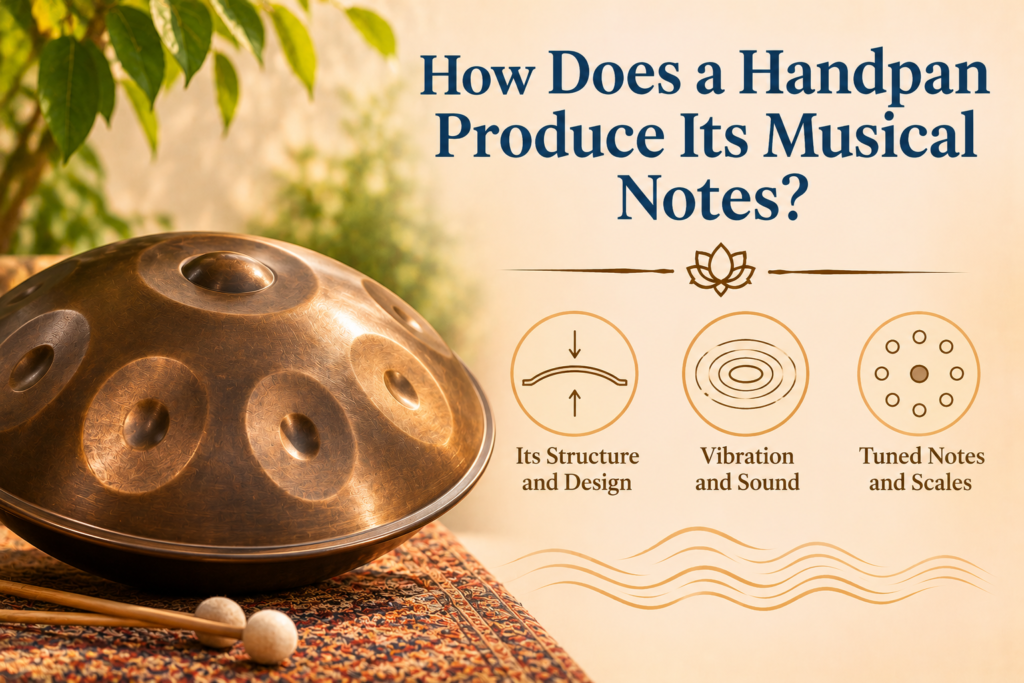
The handpan has a distinctive sound that combines clear musical tones with a soft, resonant quality. Its rounded steel body produces notes that can feel gentle, rhythmic and spacious. When a player strikes its surface with the fingers or hands, each note creates a layered sound that gradually fades into silence.
Although the instrument has a simple appearance, its acoustic design involves careful metal shaping, tuning and resonance. Every note is formed through the vibration of a specially prepared area of the steel shell. Understanding this process reveals how the handpan produces its characteristic musical voice.
What is a handpan?
A handpan is a steel percussion instrument consisting of two metal shells joined together to form a hollow, rounded body. Its upper surface contains several carefully shaped note areas arranged around a central note called the ding. The lower shell usually has an opening known as the Gu, which allows air to move in and out of the instrument’s internal cavity.
The player produces sound by gently striking the note areas with the fingers or hands. Each area is tuned to a particular pitch, allowing the instrument to produce a musical scale.
Handpans are commonly made from steel that has been shaped and treated to achieve the required acoustic properties. Depending on the maker, the instrument may use nitrided steel, stainless steel or other specially prepared metal.
How does a handpan produce sound?
A handpan produces sound through the vibration of its steel surface. When a player strikes one of the shaped note areas, the metal begins to vibrate. These vibrations create changes in air pressure, which travel outward as sound waves.
Each note area has a carefully formed shape that allows it to vibrate at particular frequencies. Its dimensions, curvature, metal thickness and tension influence the resulting pitch and tonal character.
The note areas are often surrounded by carefully shaped boundaries that help define their vibrating regions. These boundaries also influence how energy moves through the steel surface.
The hollow interior of the handpan contributes to its overall resonance. As the steel vibrates, it interacts acoustically with the air inside the instrument. This interaction influences the sound’s character, sustain and volume.
Understanding the different parts of a handpan
The ding
The ding is the central note on the upper surface of the handpan. It usually produces a relatively low pitch and provides the tonal foundation for the instrument.
Its shape and tuning determine its characteristic sound. When struck gently, the ding produces a rounded tone with a noticeable resonance.
The tone fields
The smaller shaped areas surrounding the ding are called tone fields. Each field is tuned to a specific musical note, and their arrangement determines the scale available to the player.
These areas are carefully formed and tuned by the instrument maker. Their size, curvature and metal properties influence the pitch and response of each note.
The Gu
The Gu is the opening found on the lower shell of many handpans. It allows air to move between the internal cavity and the surrounding environment.
This opening also contributes to the instrument’s acoustic behaviour. Its dimensions and shape influence the interaction between the enclosed air and the vibrating steel.
Why does each note produce a particular pitch?
A handpan note is created through a combination of physical shaping and precise tuning. The maker adjusts the metal until the note area produces the intended frequencies.
Each note area has several natural vibration modes. These are patterns in which the metal surface moves when it is struck. Different modes produce different frequencies, and together they contribute to the note’s tonal character.
Many handpan makers tune each note around three important frequency components:
- Fundamental: The main frequency that establishes the perceived pitch.
- Octave: A frequency approximately twice the fundamental frequency.
- Fifth: A frequency approximately one and a half times the fundamental frequency.
These frequency relationships help create the rich, layered sound associated with handpans. Their exact tuning and balance vary according to the instrument and the maker’s approach.
The tuning process requires considerable skill. Makers use specialised tools and repeated hammering to adjust the steel’s shape and tension. Small changes can influence the frequencies and the way a note responds when played.
The role of resonance inside the handpan
Resonance is an important part of the handpan’s sound. It occurs when a system responds strongly to particular frequencies associated with its natural modes of vibration.
The hollow body of the instrument contains a volume of air that can also resonate. The opening in the lower shell allows this air to interact with the surrounding environment.
This acoustic interaction contributes to the overall sound produced by the instrument. The vibrating note fields and the internal air cavity work together to shape its tonal quality.
The result is a sound with a combination of distinct pitches and softer resonant components. Depending on the instrument’s design, some notes may have a longer sustain, while others produce a shorter and more focused tone.
Why does striking technique change the sound?
The way a player touches the handpan has a direct influence on the sound. A light fingertip strike usually creates a clear and controlled note, while a different contact point or striking force can change its volume and tonal response.
Several playing factors influence the result:
Striking position: Different areas of a tone field can produce variations in the sound because the metal responds according to its vibration patterns.
Striking force: A stronger strike generally transfers more energy into the instrument, increasing the sound level. Excessive force can create an uncontrolled tone and may damage the instrument.
Hand contact: The duration and manner of contact influence how freely the steel can vibrate. Clean, brief strikes allow the note to develop naturally.
Muting: A player can use the fingers or hands to stop a note from continuing to ring. This creates rhythmic variation and allows greater control over overlapping sounds.
Developing a sensitive touch helps players explore the instrument’s range and produce a balanced musical performance.
How handpan makers tune the instrument
Handpan tuning is a detailed process that requires experience with metalworking and acoustics. Makers begin by shaping and preparing the steel shells. They then form individual note fields and adjust their dimensions and tension through controlled hammering.
Each note is checked using electronic tuning equipment and careful listening. The maker evaluates its fundamental frequency and related partials, making small adjustments until the desired tonal relationships are achieved.
The process also involves checking how the notes interact with one another. A handpan should produce a coherent musical scale, with individual notes that respond consistently across the instrument.
Temperature, metal properties and structural changes can influence tuning. Skilled makers therefore pay close attention to the instrument throughout its construction.
The handpan in sound meditation
The handpan is frequently used in sound meditation because its musical tones offer a distinctive listening experience. Its sustained notes can create a spacious sound environment, while simple melodic patterns provide a focus for attention.
During a meditation session, listeners may notice the attack of each note, its changing resonance and the gradual fading of sound. These qualities can encourage attentive listening and awareness of the relationship between sound and silence.
The instrument can also be combined with singing bowls, gongs, chimes and other sound-producing instruments. Each instrument has its own acoustic character, allowing practitioners to explore different textures and musical arrangements.
For those interested in understanding the acoustic principles and practical applications of sound instruments, the Sound Healing Teacher Training Course in Rishikesh at Nada Yoga School introduces participants to sound, vibration, listening practices and traditional instruments.
Conclusion
The handpan produces its musical notes through the controlled vibration of carefully shaped steel surfaces. Each tone field has specific acoustic properties, while the hollow body and internal air cavity contribute to the instrument’s overall resonance.
Its sound emerges through the relationship between metal vibration, frequency, resonance and playing technique. Understanding these elements helps musicians and sound practitioners appreciate the craftsmanship behind the instrument and develop a more attentive approach to listening.
The handpan offers a fascinating example of how physical materials and acoustic principles come together to create music.